
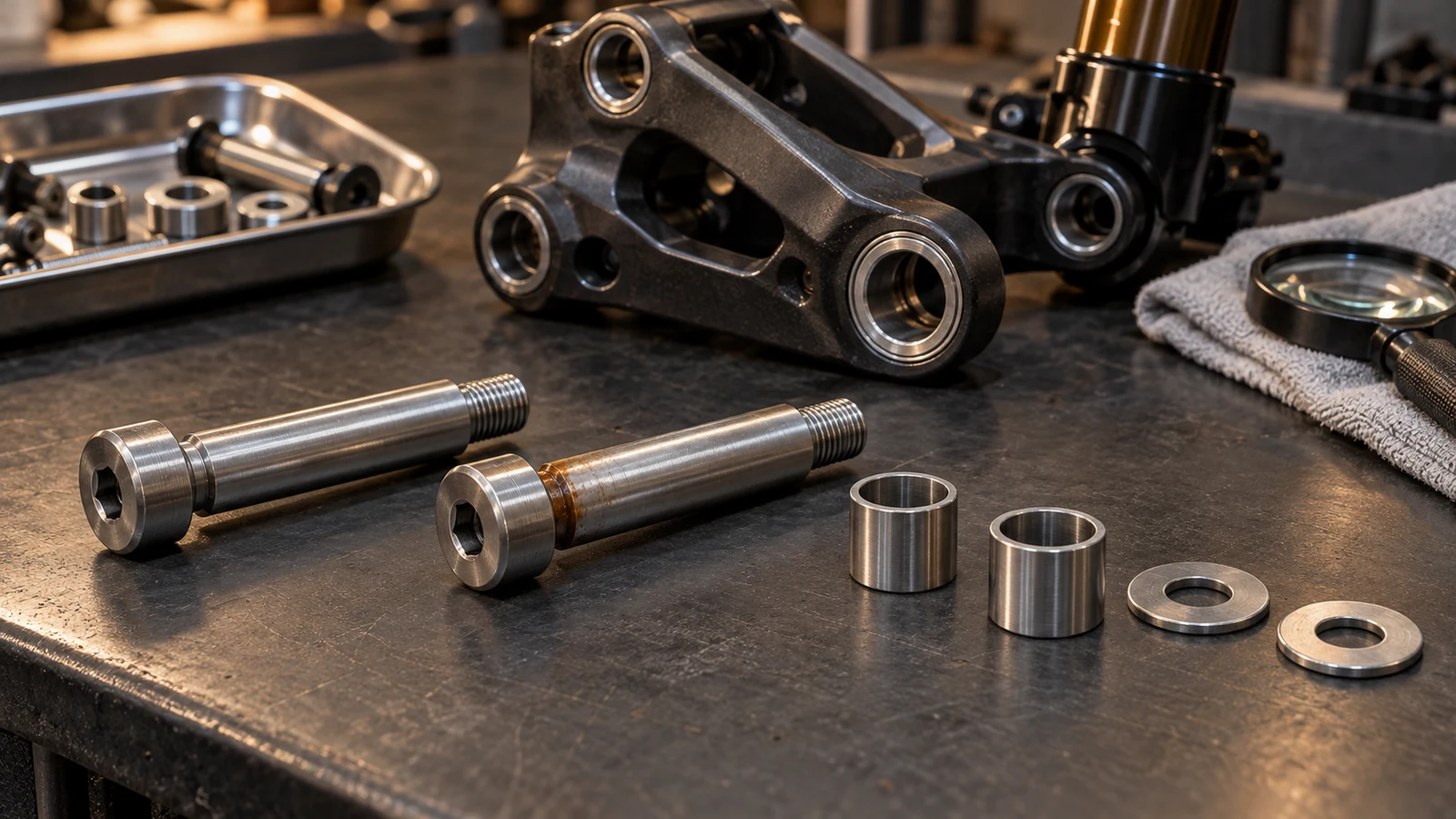
A brown mark on a 316L suspension pivot bolt can come from deposited iron, accumulated dirt or corrosion of the underlying stainless surface. The material name alone cannot identify which has occurred. Record the stain before cleaning, locate it relative to washers and sleeves, and assess the exposed surface using the design owner's inspection criteria. The low-carbon L designation does not make a part immune to chlorides or shielded wet contacts. Keep contamination, localized attack and relevant heat history as separate hypotheses, then choose evidence that can distinguish them before prescribing a new alloy or treatment.
Hero: concept illustration of example hardware and its application. It is not a factory photograph, tested component or approved production geometry.
Preserve the evidence before making the surface look clean
Photograph the part in the joint and again after controlled disassembly. Show the exact contact, the adjacent washer or sleeve, and the corresponding receiving surface. Include the part number, known material document and exposure history in the review. A close-up with no indication of location cannot show whether the mark came from a washer, a sheltered contact or the free surface of the bolt.
Do not use abrasive polishing as the first diagnostic action. It can remove deposits and round small surface defects at the same time. If a qualified examination is needed, retain an uncleaned suspect part and a representative unaffected part. Record whatever cleaning or chemical treatment has already occurred so an examiner does not treat an altered surface as its original condition.
Section loss, cracking, damaged threads or a disturbed bearing seat require the design owner's component assessment. A stain that wipes off is useful evidence about the deposit, but it is not a complete structural inspection. For the reuse-versus-replacement decision, consult corrosion damage and replacement, which addresses a different question from root-cause diagnosis.
Keep contamination and stainless attack as different hypotheses
Transferred iron can leave rust-colored deposits on an otherwise corrosion-resistant substrate. Possible investigation points include mixed-material brushing, grinding debris, shared handling equipment and contact with a corroding adjacent part. These are hypotheses to check against the manufacturing and handling records, not conclusions that can be drawn from every orange mark.
Localized attack of the stainless needs a different response from removing a deposit. Examine whether cavities remain after appropriate cleaning and whether they follow a sheltered wet contact. Outokumpu's corrosion guidance distinguishes extraneous rust and chloride-driven local attack. Examine the substrate instead of using color as a diagnosis.
The position of the mark can narrow the investigation. A ring beneath a washer suggests a contact-specific condition that deserves comparison with an open face. Staining scattered across exposed parts from one handling tray suggests a different question. Neither pattern proves a cause, but each helps select which process records and surfaces should be examined first.
| Working hypothesis | Observation to investigate | Potential response | What the observation cannot prove |
|---|---|---|---|
| Deposited iron or handling contamination | Deposit location, handling records and cleaned substrate condition | Correct contamination route and surface-cleanliness requirement | Complete structural fitness from color removal |
| Localized substrate corrosion | Cavities and their relationship to a wet contact | Review exposure, crevice and supplied material/surface | Universal inadequacy of every 316L part |
| Surface deposit with uncertain origin | Residue identification and adjacent contact condition | Preserve samples and narrow the investigation | A diagnosis from an image alone |
| Thermal-history-related susceptibility | Documented processing of the affected stainless component | Qualified materials/process review | Sensitization merely because the surrounding frame was welded |
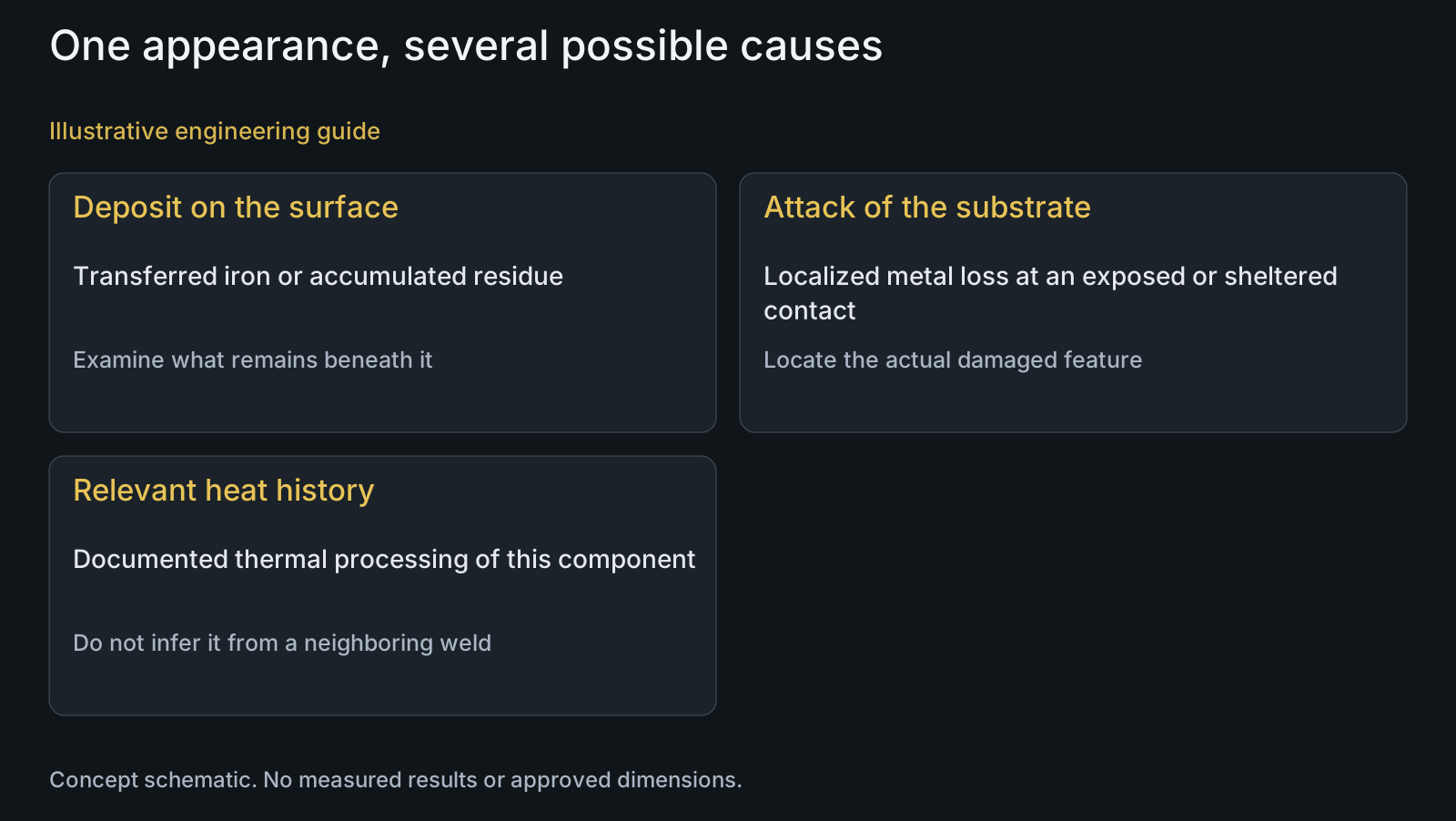
Use low carbon only where the thermal history makes it relevant
Outokumpu's Supra 316L guidance identifies a low-carbon grade and relates that condition to improved resistance to intergranular corrosion after welding. This is a particular metallurgical subject, not immunity to deposits, pitting or a poorly drained pivot contact. Its flat-product data do not establish the properties of a finished machined bolt.
Ask whether the bolt itself experienced a relevant thermal operation. A machined bolt fitted next to a welded frame is not automatically a welded stainless component. Identify the operation, material state and component that received heat before making sensitization the main explanation. If the bolt was not welded or otherwise subjected to a relevant heat history, first examine the more directly supported contamination and exposure possibilities.
Where thermal processing is genuinely relevant, refer the material condition and suspected mechanism to a qualified materials review. Do not assign an intergranular-corrosion diagnosis from a photograph or create a temperature threshold without the applicable material and process data. Keep welded-frame qualification separate from the supplied pivot-bolt requirement.
Choose a correction that can address the supported cause
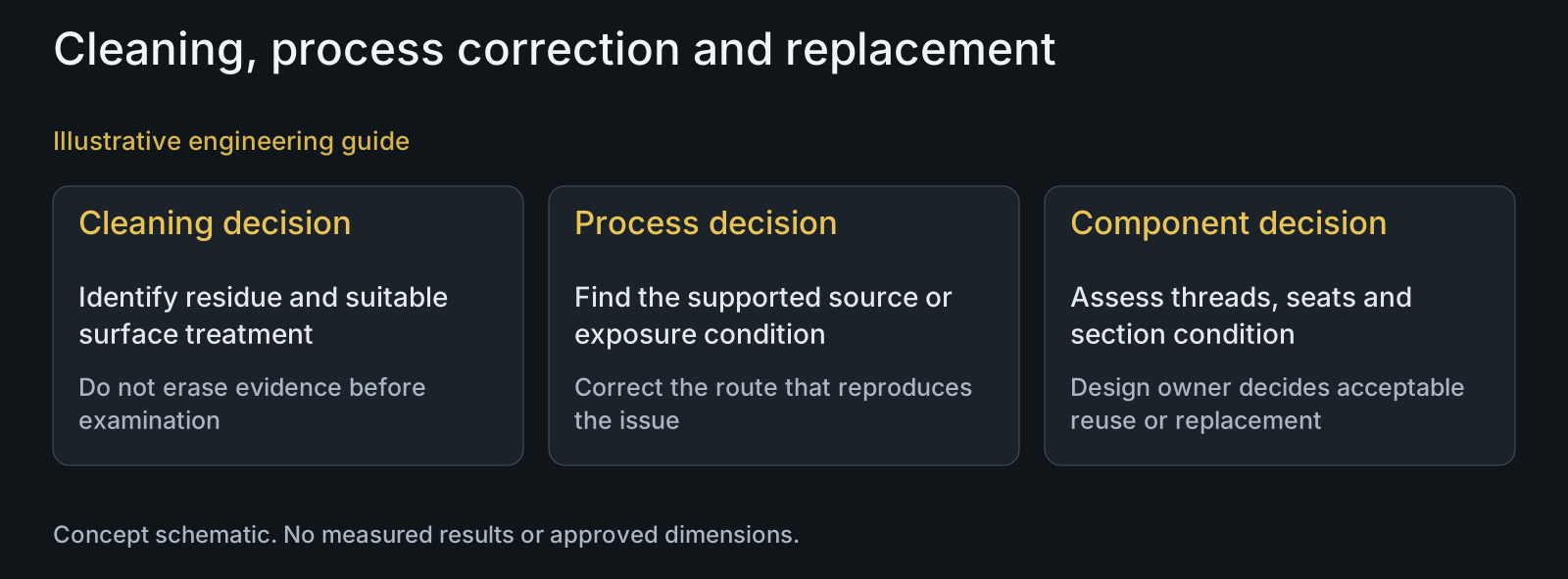
If the evidence identifies contamination from handling or finishing, correct that route and define appropriate cleaning or passivation acceptance for subsequent parts. If the substrate is attacked at a wet contact, review the grade, delivered surface, joint geometry and exposure together. A different alloy cannot by itself remove a source of deposited iron or establish drainage.
Passivation is a defined surface-treatment route, not a repair method for restoring material removed by corrosion. The treatment requirement should identify the applicable specification and verification for the selected part. Do not use a successful cleaning demonstration as permission to disregard a damaged thread or locating feature.
A drawing-led supplier discussion should identify which part and process are under review. PremFixer can review the manufacturing and specified partner finishing route from the customer's material requirement, drawings and samples. See manufacturing and the coastal 304/316 comparison when the evidence supports a wider material-change question.
Illustrative diagnosis of staining under a washer
Illustrative engineering example: assume brown staining is found beneath a stainless washer on a 316L pivot bolt after wet storage. The alloy document is available, but no detailed examination has been performed. The team preserves one affected bolt, records the matching washer face and compares the location with an unaffected assembly.
If suitable examination finds a removable deposit without substrate cavities, the next investigation follows contamination and handling, while the design owner still assesses the component. If cavities remain in the underlying contact surface, the inquiry shifts toward exposure and local corrosion. If a supplier then mentions heat treatment, the review asks which operation affected the bolt and whether that history is documented.
The branches require different corrective actions. The example supplies no microscope result, measured pit depth or customer outcome; it shows what evidence would change the next decision. The useful inquiry is therefore 'what remains under the stain and where did it occur?' before 'which material should replace 316L?'
Questions buyers need to confirm
Does 316L mean that a bolt cannot rust?
No. It can carry rust from external iron and it can suffer corrosion under unsuitable conditions. Identify the deposit, substrate condition and exposure instead of treating the grade name as proof of what produced the mark.
Does a welded aluminum frame make the stainless bolt sensitized?
Not by itself. Establish whether the bolt experienced the relevant thermal operation and what its material condition was. Welding history of a neighboring part is not evidence of the bolt's metallurgical history.
Can I diagnose pitting from an orange ring under a washer?
No. Preserve the contact evidence and examine the underlying surface using an appropriate method. The ring identifies a location worth checking; it does not distinguish transferred contamination from metal loss on its own.
Will passivation restore a corroded shoulder diameter?
No. It is a surface-treatment process, not a method for replacing lost metal or repairing fit. The design owner must assess a damaged shoulder or thread before any cleaning result is taken as approval to return it to use.
What evidence should be sent with a staining complaint?
Provide pre-cleaning photographs showing the joint location, the affected and mating parts, material/finish records, wetting and storage conditions, and any cleaning already performed. Retain samples when examination is needed; state whether the concern is appearance, fit, seizure or visible damage.
Technical references and scope
Outokumpu: corrosion mechanisms and extraneous rust. Mechanism background, not a diagnosis of the photographed concept.
Outokumpu: stainless welding and material-property changes. Relevant thermal-processing context; not evidence that a pivot bolt was welded.
ASTM A967/A967M-25: chemical passivation scope. Surface-treatment and verification scope, not repair or service-life approval.
Explore related component, material and sourcing decisions in the customer decision knowledge center. For a drawing review, use the Drawing/BOM RFQ path.
Review the stain without losing the evidence
Send the pivot drawing, material and finishing records, pre-cleaning contact photographs and available affected samples. Include storage, cleaning and known thermal history so PremFixer can help define the manufacturing review and the evidence needed to distinguish contamination from component damage.
Discuss the drawing and BOM