
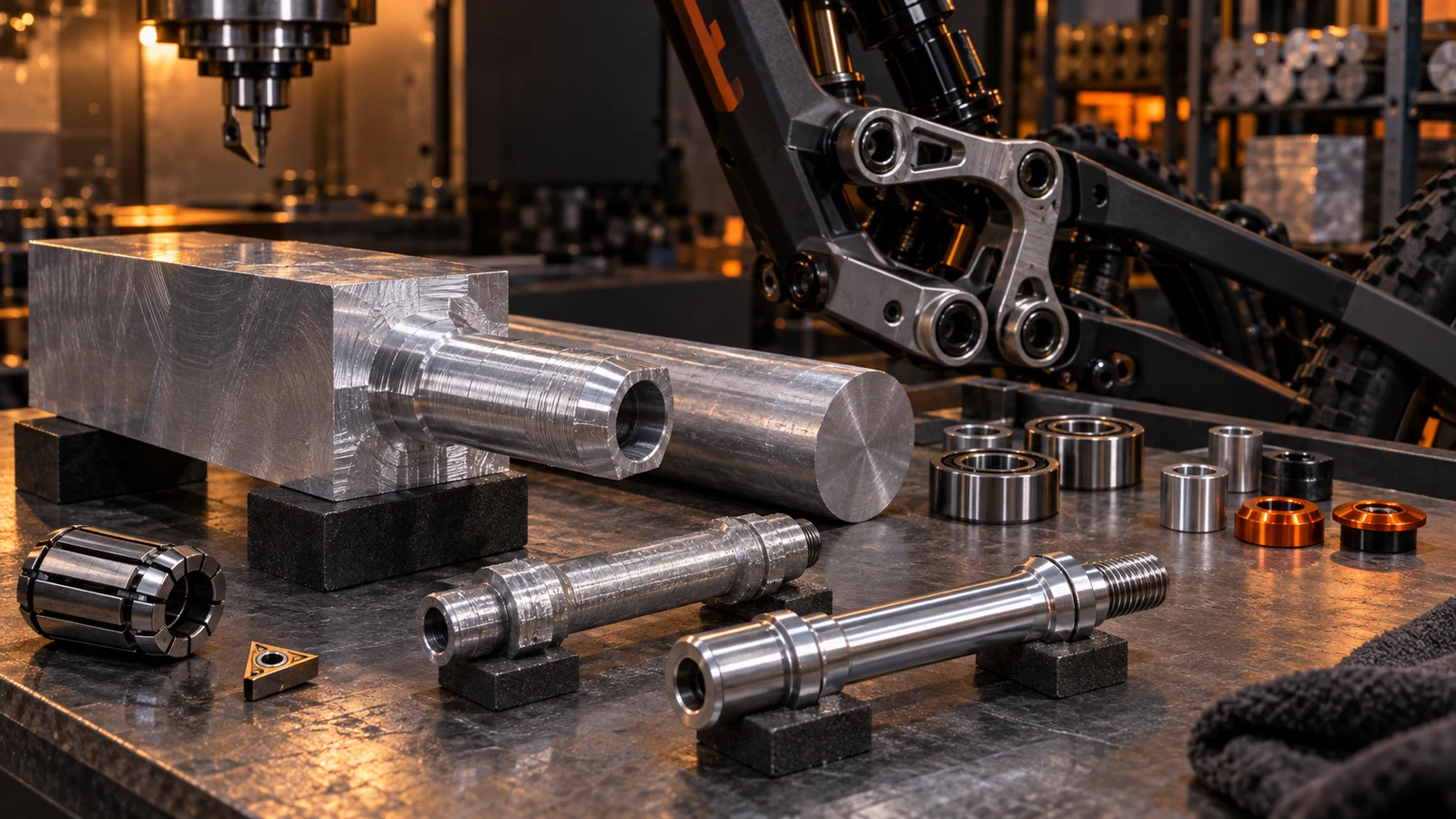
For a machined 7075 pivot axle or shoulder bolt, T651 is not a universal replacement for a T6 drawing callout. Select the supplied temper with the product form, governing material specification and design requirements visible. Stress relief by stretching can be relevant to machining stability, but the suffix does not promise zero movement after material removal. The blank shape, hollow sections, cutting sequence, workholding and acceptance state still matter. A dimension measured while a slender axle is restrained may not represent the released part. Define both the stock being purchased and the final condition being accepted before quoting the route.
Hero: concept illustration of example hardware and its application. It is not a factory photograph, tested component or approved production geometry.
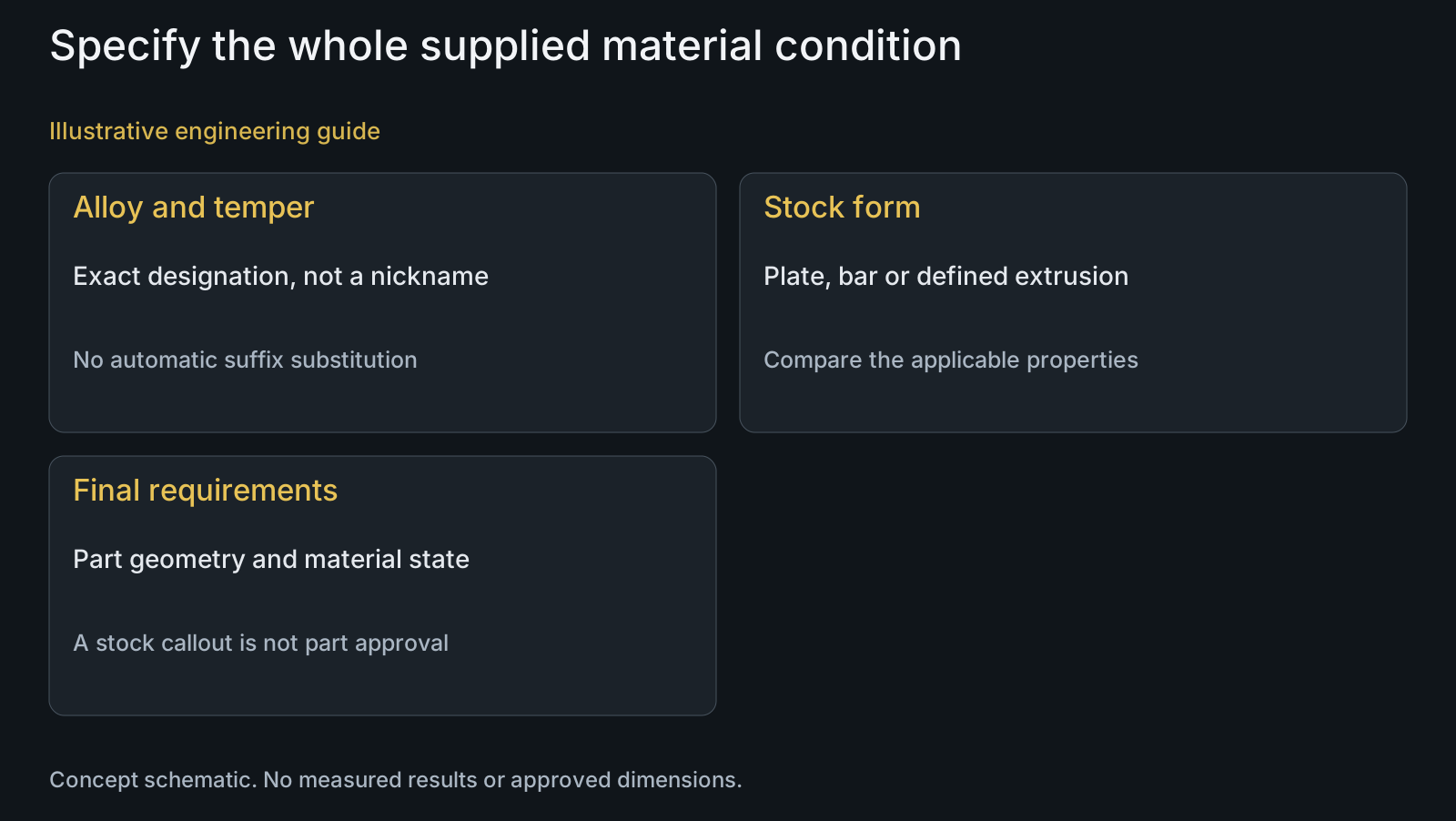
Read the temper together with the product form
T6 denotes solution heat treatment and artificial aging. T651 includes a specified stretching stress-relief operation; it is not simply a shorthand for any shop stress-relief treatment. BIKAR's 7075 reference lists the delivery-condition definitions alongside product-specific property tables.
The Aluminum Association's interpretation distinguishes processing designations, including T651 and T6511, and warns against assuming that a different supplied temper satisfies the requested condition. The latter designation is associated with extruded and relevant drawn products rather than being an extra digit that purchasing can ignore.
Write the alloy, temper, form and applicable purchase specification as one coherent requirement. Confirm whether the proposed blank is plate-derived, rolled/cold-finished bar, extrusion or another defined product. A supplier should identify a proposed alternative, not quietly revise the material description because a different form is readily available.
Separate stock stress relief from movement during machining
Machining removes part of a previously balanced material volume. If the remaining geometry contains an unbalanced residual-stress distribution, the component can move when it is no longer restrained. This mechanism is different from elastic movement caused by cutting force or chuck pressure, although both can affect the observed geometry.
For a hollow axle, compare the starting section with the material left after the bore and shoulders are cut. For an asymmetric flange or pocketed part, identify where removal is concentrated. The useful manufacturing question is how the proposed blank and operation sequence interact with that geometry, not whether a suffix guarantees a universal result.
Hydro's explanation of stress-relieved extruded material describes reducing the possibility of machining distortion, not eliminating it. Apply that distinction carefully: its page is about 6061 and provides designation background, not a 7075 project result. A successful trial on one blank does not establish behavior of another form or heavily revised section.
| Proposed condition | What it establishes | What it does not establish | Useful review |
|---|---|---|---|
| T6 callout | A specified heat-treated/aged material condition | A specified stretching operation or final geometry | Applicable material specification and actual stock form |
| T651 callout | A defined condition including stretching stress relief | Zero machining movement or blanket substitution approval | Form, specification and required final features |
| Different extruded condition | A distinct proposed material supply route | Equivalence merely because the name starts with T6 | Design-owner comparison of the exact proposed condition |
| Thin or hollow machined section | A removal pattern needing route consideration | Predictable distortion from the temper name alone | Blank/part relationship and released-feature evaluation |
| Clamped inspection | Geometry in that restrained state | Free-state straightness or roundness | Drawing-intended support and measurement condition |
| Post-machining heat or straightening | An additional process proposal | Automatic retention of the approved material state | Effect on material, surfaces and final acceptance |
Measure the geometry that the drawing intends
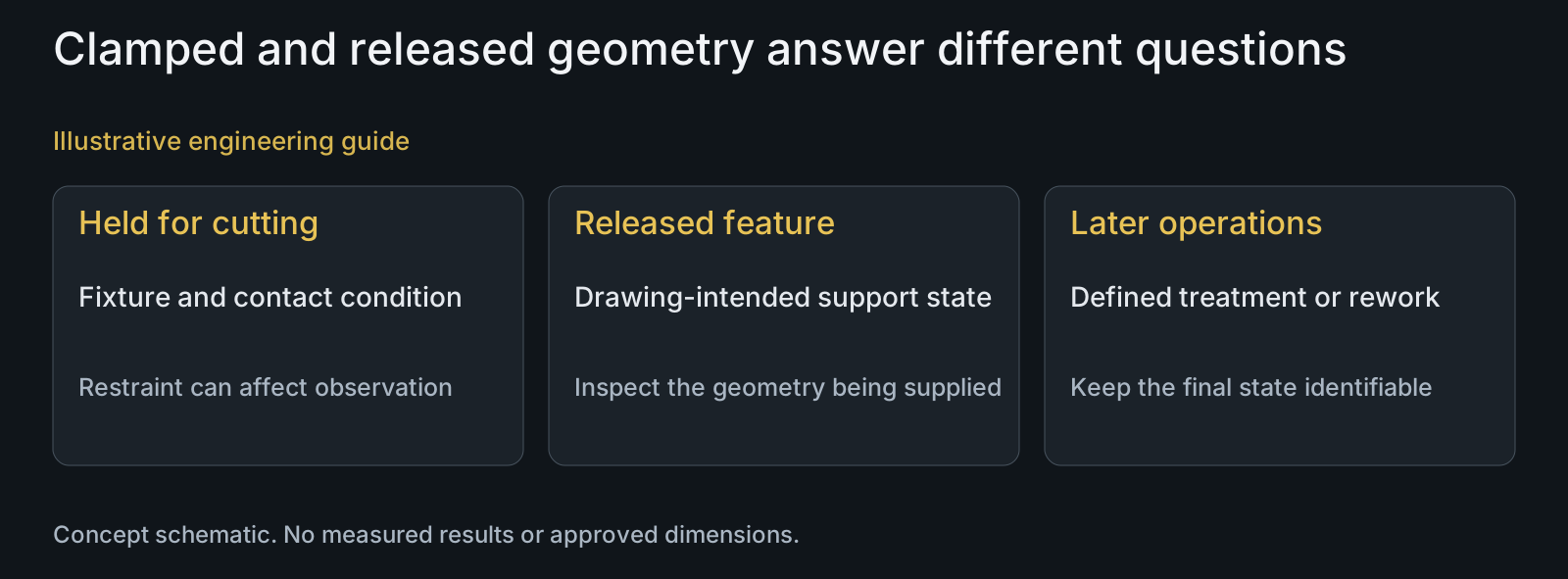
A slender shoulder axle can appear straight or round in a fixture that changes its shape. The CNC turning discussion should therefore include the datum strategy and workholding surfaces as well as the cutting features. Identify whether the required inspection is free-state or under a specifically defined restraint.
When movement is observed, separate the observations: geometry while clamped, geometry after release and geometry after the specified subsequent operations. Comparing these states can help distinguish workholding effects from a route that leaves an unsuitable delivered part. It does not by itself identify the residual-stress distribution or prove a root cause.
Do not invent a universal intermediate dwell time, chuck pressure or finishing allowance. Propose a part-specific roughing/finishing trial where needed and evaluate the relevant features after release. The existing 7075 machining and final-state guide covers the broader machining review; this article focuses on how the purchased state enters that decision.
Do not change the final material condition to recover a dimension
A proposal to heat, mechanically straighten or otherwise rework the part is a separate manufacturing change. Its effect on the required material properties, surface and geometry must be assessed. Calling a step stress relief does not show that the delivered component still meets the approved material definition.
Likewise, distinguish an already aged blank from a route that intentionally heat-treats a machined component. These routes involve different represented states and acceptance questions. Keep the final material condition connected to the item supplied rather than describing only what the stock was called before processing.
The material-certificate scope discussion helps distinguish stock identity from finished-part evidence. A stock certificate does not measure a finished axle's straightness, and a good dimensional report does not establish an unverified post-machining material condition.
Illustrative review: a hollow axle and an available extrusion
Illustrative engineering example: assume a pivot drawing requests a particular 7075 bar condition. Purchasing receives a proposal for an available stress-relieved extrusion, while machining plans a deep axial bore and slender shoulder. No actual distortion, material property result or lead-time benefit is assumed.
The reviewer first resolves whether the alternative form and temper meet the governing design and purchase requirements. That is distinct from whether the proposed machining route maintains the shoulder and bore relationship after release. A stretching suffix alone cannot answer either question for the unspecified alternative.
If the design owner accepts the material proposal, a defined machining trial can examine the final features in their required state. If it is not accepted, the quotation retains the original stock definition. The example shows why material substitution and dimensional-route evaluation should not be combined into a single promise of reduced distortion.
Make the stock proposal visible in the RFQ
Send the available component and assembly drawings, requested alloy/temper/form, governing specification and quantities. Mark hollow or thin sections and features whose free-state relationship matters. State any planned heat or straightening operation instead of leaving it outside the quoted material scope.
PremFixer can discuss the available manufacturing inputs and quote an identified stock and processing route. The 7075 versus 6061 material comparison addresses alloy choice; a temper proposal should remain tied to this item's actual requirements rather than reopen an unrelated alloy decision without explanation.
Questions buyers need to confirm
What is the practical T6 versus T651 difference?
T651 identifies stretching stress relief in addition to the heat-treated and aged condition. Match the exact designation to the specified product form. It is a material processing definition, not permission for an arbitrary finished-part rework.
Can T6511 be supplied against a T651 drawing?
Do not assume equivalence. The Aluminum Association identifies distinct processing/product-form associations and possible property differences. Compare the applicable specifications and obtain the responsible design team's decision on the proposed substitution.
Will stress-relieved stock prevent all machining distortion?
No guarantee follows from the designation. Starting geometry, removal pattern and workholding still affect the route. Examine final features after release in the drawing-intended condition rather than claiming a universal reduction.
Is an in-chuck diameter enough for a slender axle?
Only if it represents the specified acceptance condition. A restraint can affect the observed geometry. Define datum support and check the required delivered state; do not substitute a convenient held measurement for a free-state requirement.
Can the shop heat a finished part to straighten it?
Treat that as a separate proposed process, not an automatic correction. Evaluate its effects on the required material condition, surface and geometry and define the accepted resulting state before including it in the route.
What should be provided for a stock-condition review?
Send the alloy/temper/form and material specification, component drawing, hollow or thin features, datum requirements and quantities. Include planned later thermal or straightening work so stock identity and final-part acceptance are not confused.
Technical references and scope
The Aluminum Association: temper-designation interpretation. Official interpretation of distinct temper processing and why substitutions cannot be assumed equivalent.
BIKAR: EN AW-7075 reference and delivery conditions. Technical supplier reference for T651 delivery-condition meaning and form-specific tables, not a project distortion guarantee.
Hydro: temper-designation background. General explanation of T6 and stretching stress relief using 6061; no alloy-specific 7075 results are transferred.
Explore related component, material and sourcing decisions in the customer decision knowledge center. For a drawing review, use the Drawing/BOM RFQ path.
Review the 7075 stock and final-condition requirements
Share the drawing, STEP model or sample, exact material requirement, proposed blank, critical released features and quantities. PremFixer can compare manufacturing scopes and identify where a stock substitution or final-state decision needs the design owner's approval.
Discuss the drawing and BOM