
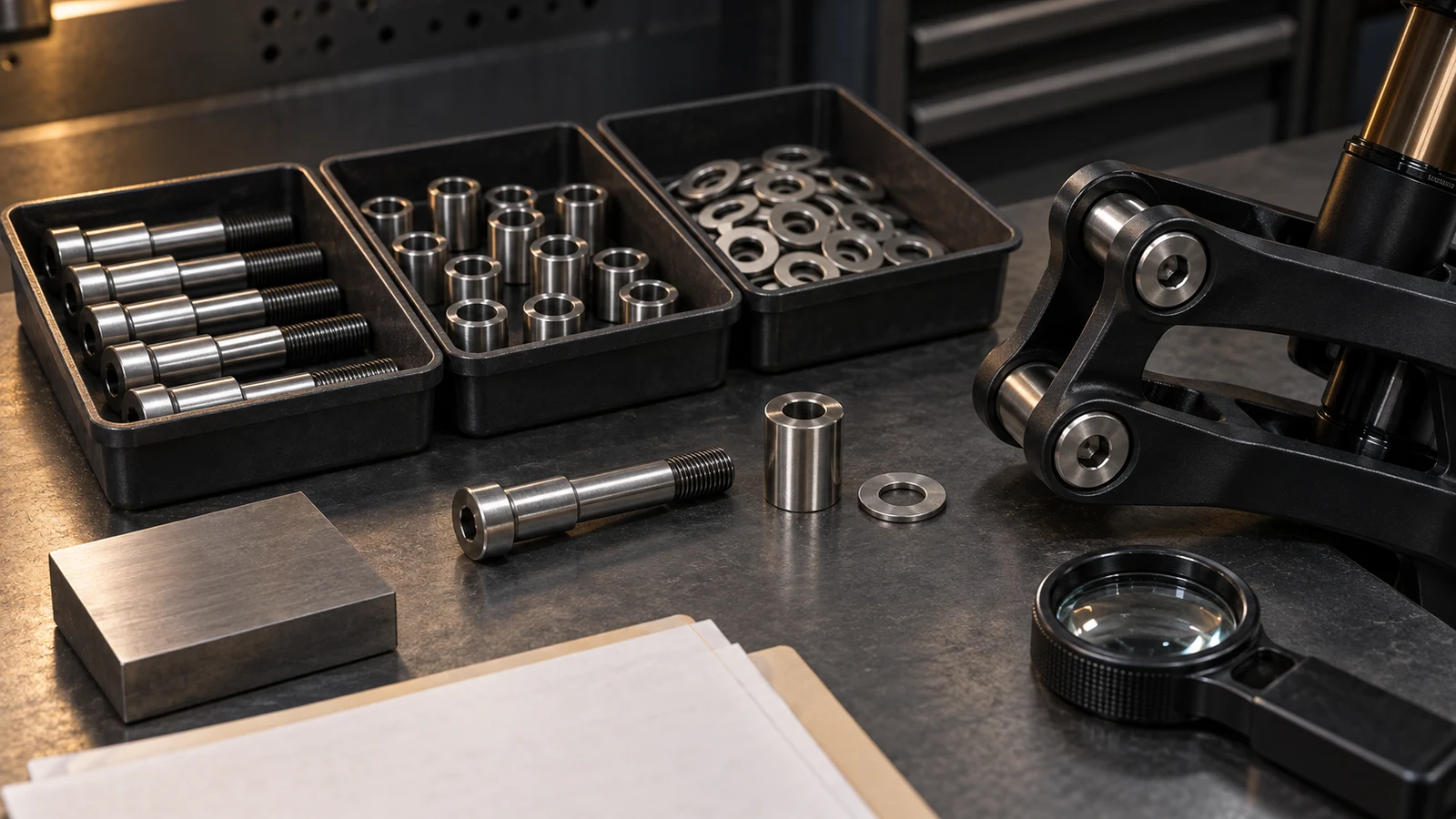
An A2-70 head marking does not by itself prove that a custom suspension pivot bolt satisfies a drawing calling for a particular 304 material specification. A2 identifies a fastener grade and 70 a property class within the applicable fastener system; those are not a complete raw-material and component description. At receiving, compare the order requirement with the actual marking, material documents, connection to the supplied lot and finished-part inspection. A chemically appropriate bar record cannot establish every finished-bolt property, while a property-class marking cannot establish custom shoulder fit. Resolve a missing evidence link before accepting the part as fully conforming.
Hero: concept illustration of example hardware and its application. It is not a factory photograph, tested component or approved production geometry.
Read A2-70 without turning it into a material certificate
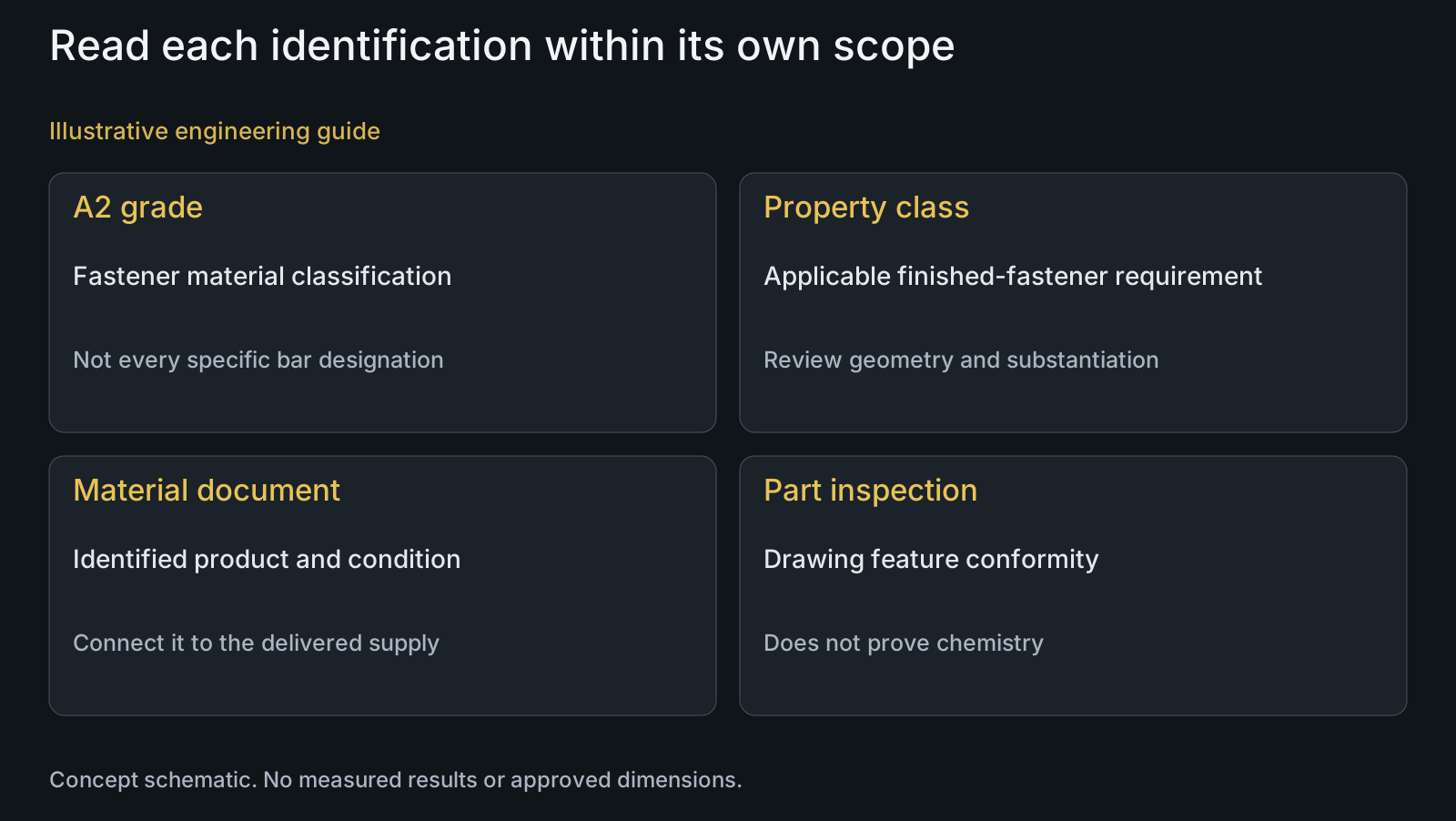
Separate the two parts of the designation. The A2 grade belongs to the stainless fastener classification, and the property-class suffix belongs to its mechanical-property requirements. BSSA's fastener guidance explains that the composition ranges for fastener grades are wider than those for feedstock specifications. Approximate equivalence to a familiar alloy therefore does not prove compliance with a specifically ordered bar-material designation.
This is not a claim that A2 and 304 can never describe the same conforming supply. They can be relevant to different requirements for one part. The question is whether the supplied material and finished component meet the requirements actually ordered. A marking should be interpreted against the applicable specification and the geometry to which it applies, not used as a shortcut for every drawing note.
Read the part identification and manufacturer identification requirements in the applicable full standard when they matter to the order. Do not assume that absence or presence of a head mark resolves a custom component's acceptance without reviewing its specification and geometry. Writing a 304 pivot specification concerns the earlier purchasing decision; this article follows the evidence for delivered parts.
Connect the material document to the bolts in the tray
A valid material document can still be irrelevant to a particular tray if the connection is missing. Identify the supplied part number and revision, delivery lot, manufacturing record and material source record. The identifier used for a raw-material heat may differ from the finished-part lot; the supplier should explain that relationship rather than the buyer assuming both numbers must be identical.
Ask which statements in the record concern chemical composition, supplied condition or test evidence. A raw-stock result describes its stated product and sampling scope. It should not be relabeled as a completed bolt test merely because the bolts were machined from that stock. Later forming or processing can change the questions that matter for finished-component properties.
If an inspection-document type is required, put that requirement in the purchase description and confirm its availability and scope before ordering. A request for EN 10204 type 3.1 documentation is not proof that every supplier automatically provides it for every custom part. PremFixer can review the requested documentation route; no certificate should be inferred from an editorial image of paperwork.
| Evidence item | What to compare | Useful conclusion | Remaining question |
|---|---|---|---|
| Head designation | Applicable fastener specification and part geometry | Declared grade/property-class information | Specific stock requirement and substantiation |
| Material record | Ordered designation, condition and documented supply link | Identified material within its record scope | Finished component properties |
| Manufacturing lot link | Material source to delivered part number/revision | Which record belongs to which supply | Whether each result meets its criterion |
| Thread inspection | Delivered-state thread requirement | Specified thread geometry evidence | Shoulder and seating geometry |
| Feature inspection | Pivot drawing and acceptance method | Actual custom-interface conformity | Separate material and mechanical requirements |
Keep finished mechanical evidence and fit evidence distinct
The finished fastener requirement must be applicable to the component. ISO 3506-1's public scope distinguishes specified grades and property classes and notes geometry-related loadability considerations. A custom head, reduced section or shoulder feature can make an unrestricted use of a familiar class claim inappropriate. Review the actual shape and applicable provisions rather than reading the suffix as a universal load rating.
A passed thread gauge answers its specified geometry question. It does not measure the shoulder diameter, usable engagement, seating contact or bottom clearance. For a pivot assembly, those features can determine whether clamp load reaches the intended stack or whether the bolt bottoms before the joint is seated. Inspect them using the drawing's actual delivered-state requirements.
Conversely, a dimensional inspection report does not identify chemistry or establish a mechanical class by implication. Arrange the receiving checklist by requirement and evidence scope, not by how many documents have arrived. If one requirement lacks support, keep that gap visible even when the other documents are complete.
Investigate a mismatch without inventing a substitute requirement
When a label, document or inspection result conflicts with the order, identify the exact difference. It may be an unexplained lot connection, a proposed alternative material or an unsupported property claim. Ask for clarification of that difference; do not silently rewrite the purchase requirement to fit the available document.
A proposed equivalent grade needs the original and proposed specifications, condition and affected component requirements. Have the responsible design team assess the change. A supplier's statement that both materials are stainless or commonly called 304 does not establish equivalence to the ordered specification. Record an accepted substitution explicitly rather than mixing it with ordinary receiving acceptance.
PremFixer's manufacturing discussion can connect drawing-led component supply with the requested material and inspection records. Provide the questioned delivery information and the requirement it is supposed to support. This is more actionable than sending only a close-up of a head mark with no purchase or part context.
Illustrative receiving review of an A2-70-marked batch
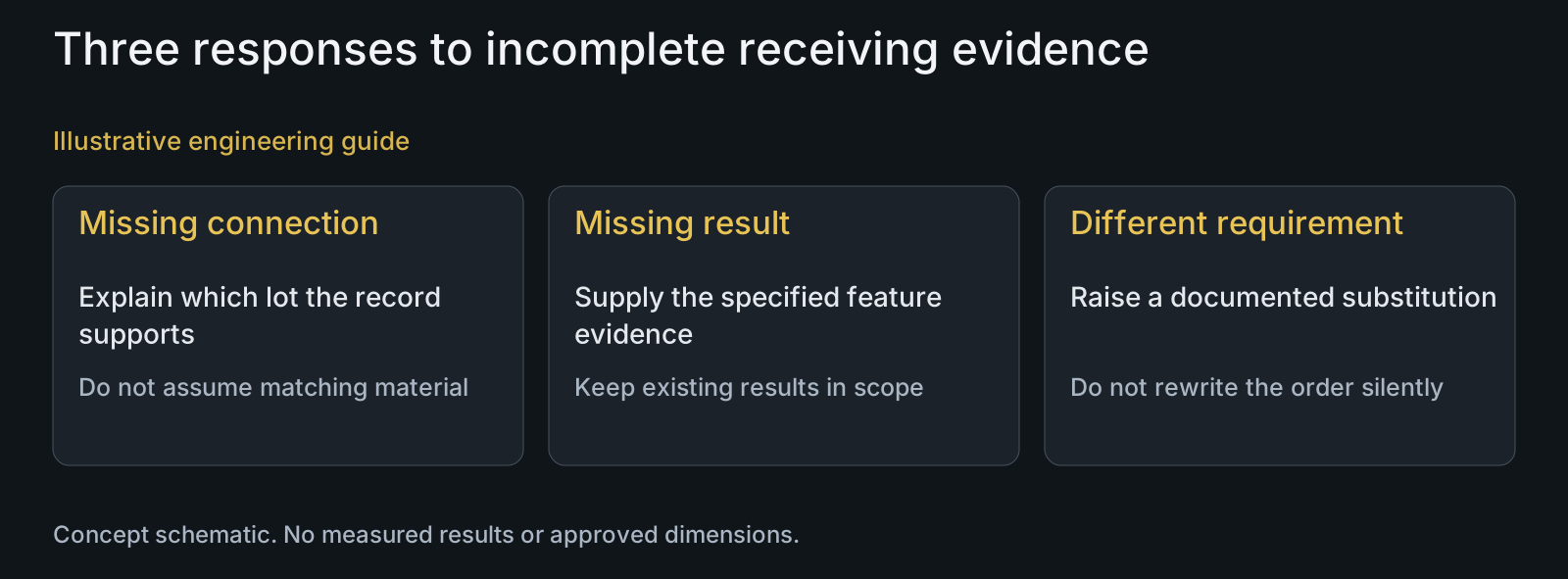
Illustrative engineering example: assume a drawing specifies a defined 304 stock requirement and separate finished-component requirements. The arriving shoulder bolts carry an A2-70 mark. A supplier sends a bar-material record and a thread-gauge report, but the record does not show its connection to the delivered lot and the shoulder inspection is missing.
Receiving does not reject the entire concept of A2-70 or assume counterfeit material. It asks the supplier to connect the stock record to the delivered lot, substantiate the applicable finished-fastener requirement and provide the specified shoulder evidence. The thread result remains useful within its scope while those other questions are resolved.
If a different stock designation was actually used, the issue becomes a documented substitution review, not a better label on the same tray. No certificate, chemical analysis or final acceptance result is invented here. The example shows why mapping each ordered requirement to its evidence prevents a familiar marking from concealing an incomplete acceptance file.
Questions buyers need to confirm
Is A2-70 another exact name for 304?
No. A2 is a fastener grade classification and 70 a property-class designation under the applicable system. Compare any specifically ordered material designation and condition separately, because approximate grade correspondence is not an exact material certificate.
Does a 304 bar certificate establish the finished bolt's property class?
Not by itself. It supports the identified stock within its stated scope. Confirm its connection to the delivered parts and obtain the applicable finished-component evidence, accounting for geometry and processing.
Must the stock heat number and finished lot number be identical?
Not necessarily. Different identifiers can be connected through manufacturing records. Ask for a clear relationship from the identified material source to the supplied part and revision rather than requiring an unexplained identical numbering convention.
Does a thread-gauge report prove a custom pivot fits?
No. Review the shoulder, seating contact, engagement and clearance requirements separately. The gauge result does not demonstrate those features or establish alloy identity and mechanical properties.
Can PremFixer supply a particular inspection-document type automatically?
Confirm the requested type, content and supply scope in the RFQ. Provide the material specification, component requirement and documentation purpose. Do not treat a general capability discussion as a promise of a specific certificate for every order.
Technical references and scope
BSSA: stainless fastener grades and feedstock distinctions. Classification and wider fastener composition ranges; approximate correspondences are not treated as exact equivalence.
ISO 3506-1:2020: specified grades, property classes and geometry scope. Public scope; no unavailable marking clause or component test result is asserted.
Explore related component, material and sourcing decisions in the customer decision knowledge center. For a drawing review, use the Drawing/BOM RFQ path.
Connect the requirement to the supplied evidence
Share the drawing and purchase description, marking photographs, material records and questioned delivery-lot information. PremFixer will review which manufacturing or inspection record addresses each requirement and identify any documentation gap or proposed substitution.
Discuss the drawing and BOM