
Aluminum pivot hardware cost should be compared with titanium at the level of the approved delivered kit. A raw-metal price ratio does not answer how much an OEM will pay for usable shoulder bolts, sleeves and washers. The stock purchased, material removed, machining features, finish, inspection scope and item quantities all enter the comparison. If a material change needs different geometry, first establish that the revised design fits and performs its intended role. No universal discount or shorter aluminum service life is assumed here. Request comparable quotations for defined configurations, then identify which cost difference comes from material, processing or a changed deliverable.
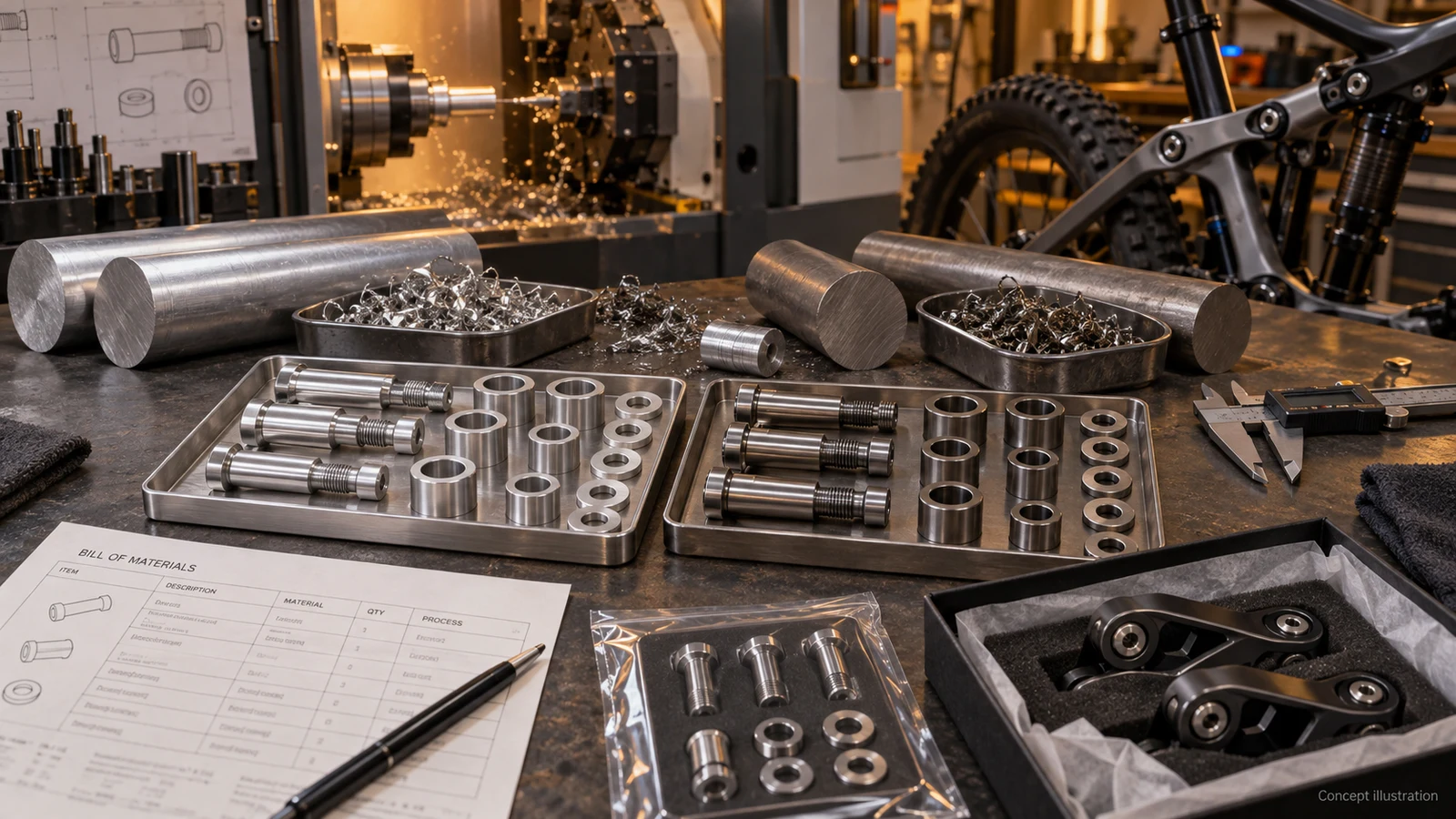
Hero: concept illustration of example hardware and its application. It is not a factory photograph, tested component or approved production geometry.
Choose a comparison the assembly can actually use
A same-drawing comparison and an equivalent-function comparison answer different questions. Quoting two materials against unchanged geometry isolates part of the commercial proposal, but does not prove both configurations are approved. Comparing redesigned parts can be more useful for an application decision, provided the changed interfaces and validation responsibilities are visible.
If the aluminum option requires a different shoulder, head or thread arrangement, list those changes beside the material proposal. Do not call the lower quote a like-for-like saving while leaving the receiver or spacer redesign outside its scope. The material and weight comparison explains why equal geometry and equal function are not the same basis.
Set the purchased unit explicitly: an individual bolt, a complete pivot position or a bike-level kit. Include the required finish, reports and packaging condition. A price for unfinished bolts and a price for finished matched kits cannot be ranked until the missing work and components are reconciled.
Use purchased stock, not finished mass, for the material line
The material contribution depends on the blank needed to make the component. A small finished part can require a larger bar to accommodate its head or flange, plus cutoff and holding allowance. Ask how the proposed stock size and supplied condition relate to the drawing rather than multiplying final component mass by a generic metal price.
Separate stock utilization from acceptance yield. The first concerns how purchased material becomes the part; the second concerns how many processed parts meet the agreed requirements. Neither can be inferred from the alloy name. Treat any quoted allowance or expected rejection assumption as a stated basis, not a proven PremFixer production result.
Do not subtract a notional scrap value twice or assume all chips recover the original stock purchase value. If a quotation includes a recovery credit, identify its scope and basis. The buyer needs a comparable finished supply price, not an invented universal aluminum-to-titanium price ratio.
| Cost item | Normalize these inputs | Risk in a raw-price comparison | Useful confirmation |
|---|---|---|---|
| Approved configuration | Geometry and mating changes for each option | Lower price for a part the assembly cannot use | Identify retained and revised components |
| Material consumption | Stock form, condition, blank size and allowance | Finished mass treated as purchased stock | Supplier's stated blank and utilization basis |
| Machining work | Bores, drive, shoulder, threads and secondary work | Universal time discount substituted for a route | Feature-level explanation of the proposed operations |
| Finish and inspection | Defined surface, final fit and included evidence | Bare parts compared with accepted finished supply | Included operations and report scope |
| Complete kit | All item counts and excluded shared charges | Representative bolt price hides missing components | BOM-based total with no double counting |
| Service cost | Applicable evidence and agreed calculation boundary | Invented replacement interval creates a false winner | Separate unknown service effects from purchase totals |
Compare feature-level work instead of one machining percentage
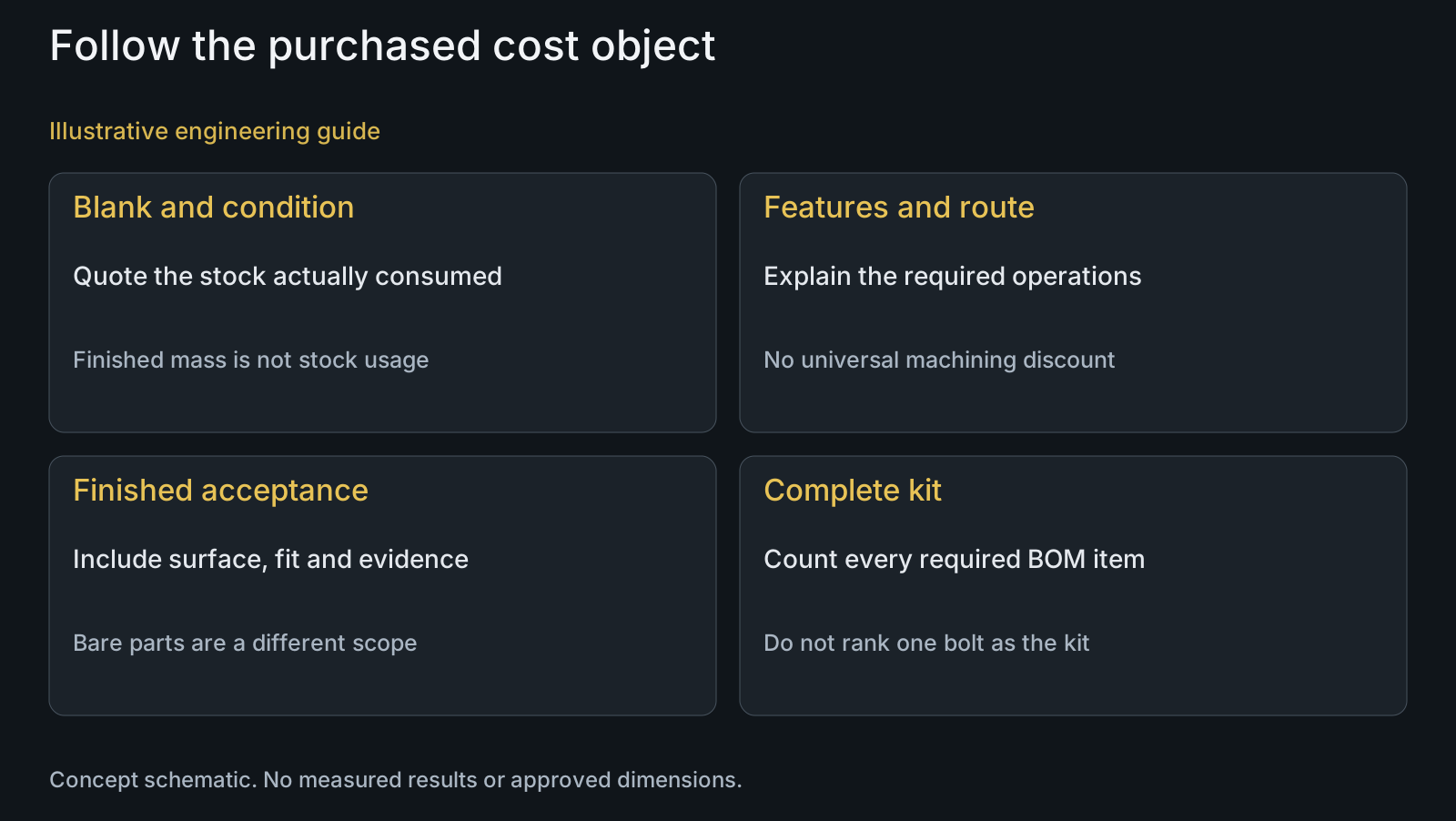
A short external shoulder, a deep bore, a recessed drive and an interrupted head profile impose different operations. Identify the actual features in the CNC turning scope. A material label does not determine the complete cycle or the number of tool changes, setups and secondary operations required.
Sandvik Coromant's titanium machining session explains heat at the cutting area, adhesion and stability-related tool-wear concerns. Its aluminum session also discusses burrs and edge smearing. Those general mechanisms support asking about the actual route. They do not establish that every aluminum pivot takes a fixed percentage less machining time or tool cost.
Compare the delivered feature requirements after the chosen route. A quoted machining advantage may be irrelevant if the option adds a difficult finished fit or another controlled operation. Ask the supplier to explain which features drive the difference, without requiring disclosure of a proprietary program or pretending that faster cutting alone defines total cost.
Keep finishing and evidence in the normalized price
An aluminum option may include a specified anodized finish while the titanium option has a different approved surface requirement. Compare each valid configuration as delivered; do not force identical process names onto different substrates. At the same time, do not omit the aluminum finish and call the resulting bare-part price the complete alternative.
Mark finished-fit features, masked zones and appearance requirements in the surface-treatment discussion. A tightly controlled seat or a restricted cosmetic defect may need a different inspection scope from a nonfunctional external face. Retain the function that requires the control; removing it to lower a quote changes the purchase rather than demonstrating a manufacturing saving.
Specify the evidence included with each option. Lot identification, material documents and dimensional results answer different acceptance questions. Avoid comparing a documented finished supply with an option whose reports are excluded. Also keep quotation quantity and delivery scope aligned so unrelated commercial differences do not masquerade as a material effect.
Calculate the complete-kit total without double counting
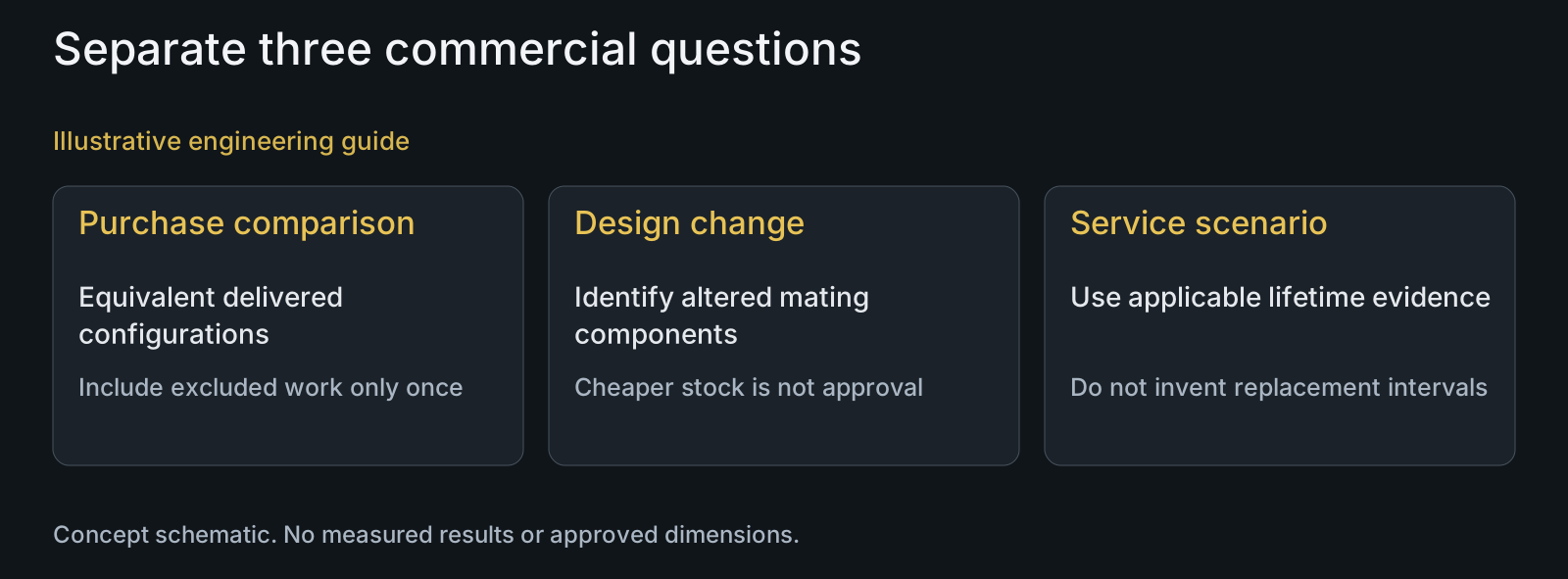
Multiply each accepted item price by its BOM quantity, then add only charges excluded from those prices. If finishing or inspection is already included in an item price, do not add it again at kit level. Show separately any one-time development charge and its chosen allocation across the compared order quantity.
Use kit quantity consistently. A quotation for a larger quantity of identical bolts may not cover the sleeves or small-volume washer variants needed to complete the kit. Compare the full item mix, not the lowest-volume tier for one representative fastener. The lead-time and order-scope guide addresses the separate delivery milestone question.
Keep service assumptions outside the manufacturing total unless there is applicable evidence and an agreed calculation scope. Do not automatically assign aluminum a shorter replacement interval or titanium a lifetime benefit. Without that evidence, report the purchase comparison and the unresolved service question separately rather than manufacturing a total-cost winner.
Illustrative review: a cheaper bolt is not yet a cheaper kit
Illustrative engineering example: assume a buyer compares two approved candidate drawings for a linkage kit containing a shoulder bolt, sleeve and washer set. The aluminum bolt quote excludes its specified finish, while the titanium quote includes the defined finished condition. No actual prices, savings, lifetime or supplier yield are assumed.
The reviewer adds the missing aluminum finishing scope and includes the sleeve and washer quantities on both sides. It checks whether evidence and packaging are already in each line before adding kit-level charges. If geometry differs, it also identifies the revised mating work separately instead of hiding it in the material comparison.
Only after reconciliation can the buyer describe the delivered purchase difference. The lower bare-bolt line may remain lower, but it is not the original claim of a cheaper complete kit. PremFixer can quote the drawing-defined alternatives and coordinated finishing scope; this example is a comparison method, not a real customer saving.
Questions buyers need to confirm
Is 7075 always one third of the titanium material cost?
No universal ratio is used here. Compare actual stock proposals with their form, condition, size, quantity and validity identified. A raw-material figure also does not establish the delivered component or complete-kit price.
Should final bolt weight determine the material cost line?
Not alone. The required blank, head envelope, holding and cutoff allowances affect purchased consumption. Ask for the stated stock basis rather than treating all material removed during machining as if it were never purchased.
Can aluminum machining always be priced forty percent lower?
No fixed discount follows from the material name. The bore, drive, shoulder, threads, stability and secondary work determine the proposed route. Use a feature-level comparison, not a percentage detached from the drawing.
Must both material options use the same surface process?
No. Compare the approved finished requirements for each substrate. Include the required treatment and final-fit evidence on both sides; identical color or omission of one finish does not create an equivalent delivered scope.
How can a kit comparison avoid double-counting finishing?
Identify whether each item price already includes the finish and inspection. Multiply item prices by BOM counts and add only excluded shared charges. Keep one-time development work separate with a stated allocation basis.
Should shorter aluminum life be assumed in the calculation?
No. Use applicable service evidence if a lifecycle comparison is required. Without it, compare defined purchase totals and identify the service question as unresolved rather than assigning a replacement interval from the alloy label.
Technical references and scope
Sandvik Coromant: Solid Round Tools session 11. Titanium machining heat, adhesion and stability mechanisms only; no cutting recipe, tool-life result, cycle time or PremFixer productivity claim adopted.
Sandvik Coromant: Navigating the Artistry of Aluminum Machining. General burr and smearing considerations only. Demonstration outcomes, cast-alloy details, recycling claims and cutting numbers not transferred to 7075 pivots.
Explore related component, material and sourcing decisions in the customer decision knowledge center. For a drawing review, use the Drawing/BOM RFQ path.
Request an equivalent delivered-kit comparison
Send the approved or clearly identified candidate drawings, material conditions, BOM item counts and finished requirements for both alternatives. State quantity, included evidence and delivery scope. PremFixer will quote the defined manufacturing routes and identify scope differences so the team can compare complete kits rather than raw-metal ratios.
Discuss the drawing and BOM