
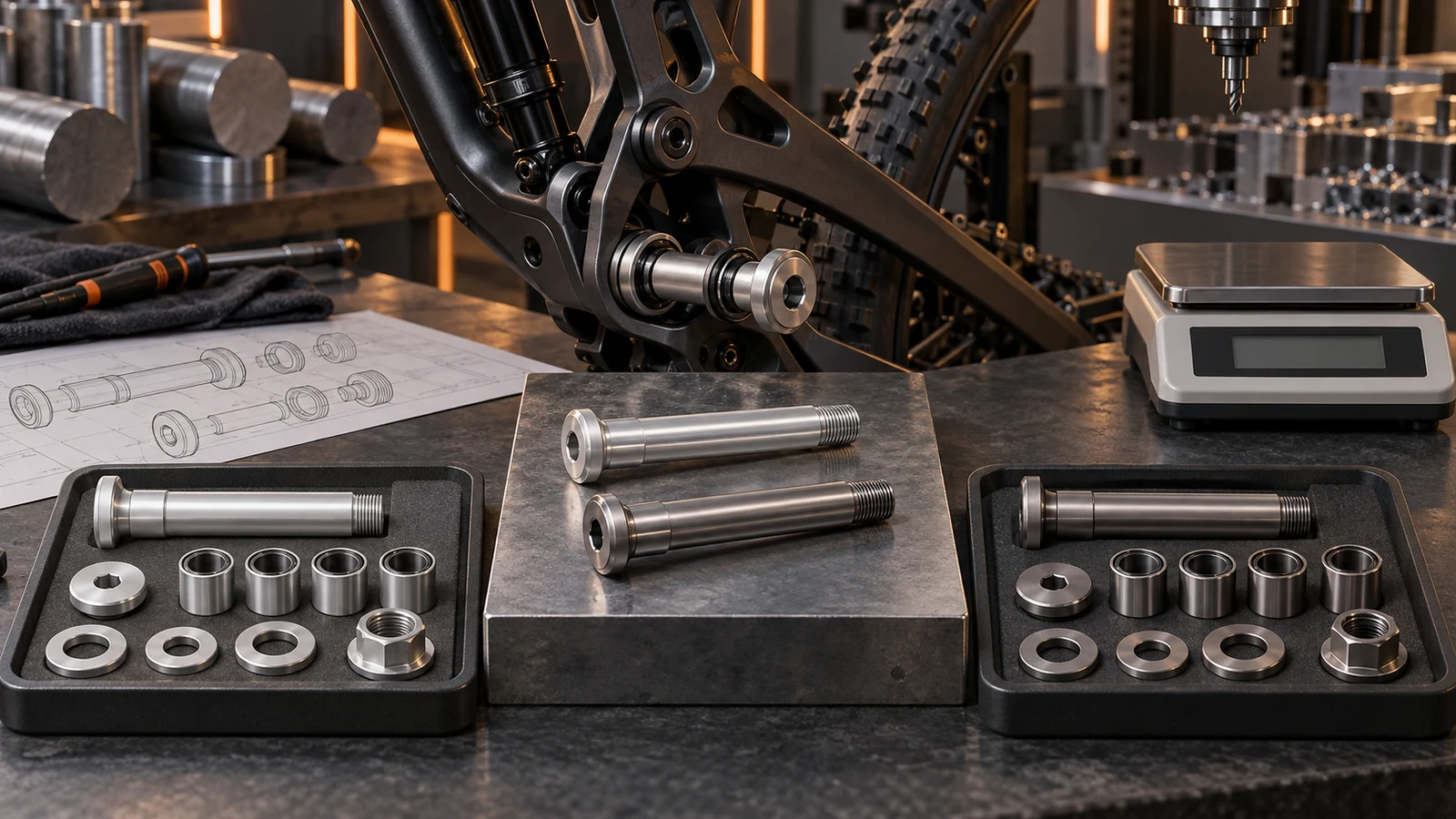
At the same solid volume, 7075 aluminum has lower estimated mass than Grade 5 titanium, but that result does not establish the saving for a redesigned pivot or complete hardware kit. Define the exact alloys, finished geometry, supplied items and comparison baseline first. Calculate each changed part from its own volume, then include the unchanged washers, sleeves, caps and receivers in the total. Report a modeled estimate separately from a measured kit result. Lower density is useful for screening; it does not authorize substitution where the proposed section, contacts or assembly function have not been evaluated.
Hero: concept illustration of example hardware and its application. It is not a factory photograph, tested component or approved production geometry.
Use equal volume only when geometry is actually equal
For a homogeneous part, estimated mass is density multiplied by solid material volume. Use the net finished model rather than a stock cylinder containing material later removed as a bore or recess. Keep units consistent, and check that a hollow component's model is not mistakenly treated as a solid envelope.
Kaiser's 7075 sheet lists a density of 2.80 g/cm³. TIMET's TIMETAL 6-4 sheet lists 4.42 g/cm³ at 22°C. Using those reference entries at equal volume gives 2.80 ÷ 4.42 = approximately 0.633: the aluminum estimate is about 36.7% lower relative to the titanium estimate. This calculation is not a measured pivot result.
Keep the basis visible when presenting that screening number. It assumes identical net volume and the cited densities. It does not include a redesigned section or another BOM item. The material-by-joint-role guide covers why equal external appearance does not establish an approved material substitution.
Name the denominator before reporting a percentage
A reduction is the reference mass minus the proposed mass, divided by the reference mass. If titanium is the reference in the equal-volume calculation above, the reduction is about 36.7%. If aluminum is the reference, titanium is about 57.9% heavier. These are different questions with different denominators, not contradictory measurements.
A statement such as lighter by a percentage should identify the reference material, part or kit and its revision. Do not switch from a titanium reference bolt to an aluminum reference kit within the same comparison. The absolute modeled difference may be unchanged while the percentage changes because the denominator changed.
For a quotation comparison, label columns by configuration rather than simply light and heavy. Record whether the listed mass is a drawing-model estimate, one measured sample or a defined representative set. A useful customer-facing claim carries its scope beside the number instead of hiding the basis in a footnote.
| Comparison basis | What stays consistent | Useful output | Risk and verification |
|---|---|---|---|
| Equal net volume | One part's finished geometry | Density-based screening estimate | Not substitution approval; identify densities and units |
| Redesigned part | Required function and stated boundary | Candidate-specific modeled mass | Use each drawing's net volume and evaluate the design |
| Complete kit | Items, quantities and supplied condition | Sum of all included item masses | Common items dilute the percentage; reconcile BOMs |
| Measured finished set | Defined actual items and finish | Mass for the represented set | Identify sample/set scope; do not call a model measured |
| Shipment | Hardware plus explicitly included packaging | Shipping-mass comparison | Keep packaging separate from a hardware claim |
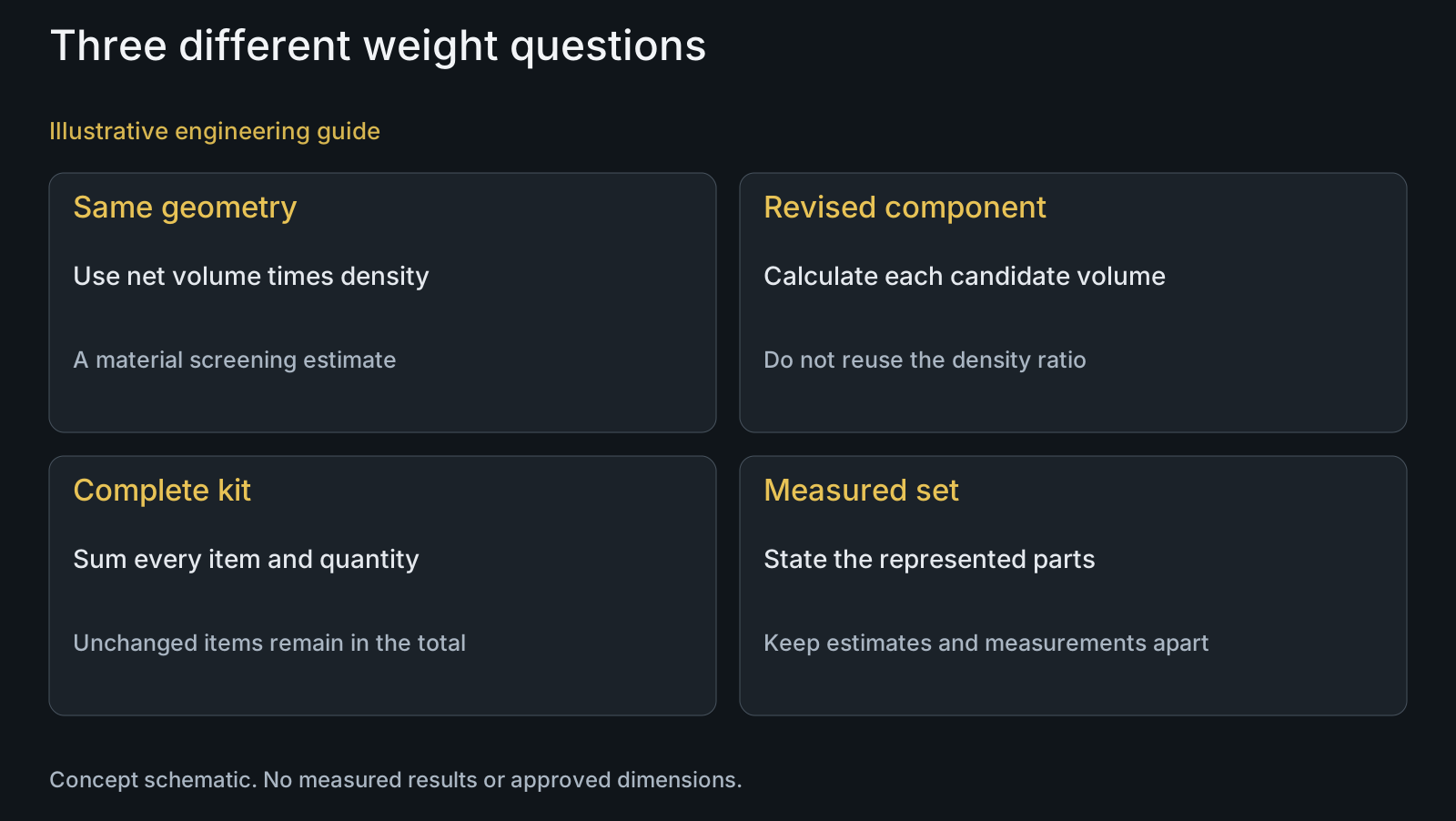
Recalculate a redesign instead of reusing the density ratio
When the proposed axle changes wall, shoulder, head or sleeve arrangement, multiply each new net volume by its assigned density. Do not apply the equal-volume ratio to the previous part mass if the volumes differ. The estimate must follow the actual candidate drawings.
Do not size the new section from density alone. The designer must evaluate what the part clamps, locates or supports, its contacts and the relevant loading. A design that needs a different section or additional support can have a different mass benefit from the first same-geometry screening estimate.
A separate sleeve or receiver is not mass-free because it sits outside the named bolt. If the proposal adds one to preserve a function, include it in the affected assembly comparison. The 7075 pivot geometry discussion and fatigue evidence guide address engineering questions that a mass model cannot settle.
Sum the full BOM and keep unchanged items visible
Define what one kit contains for one bicycle or one pivot location. List every part number, revision, material and quantity, including common washers, caps, spacers, nuts and locking items. Separate alternate configurations so that an optional part is not counted in one offer and omitted from the other.
The kit estimate is the sum of item quantity multiplied by each item's estimated mass. An unchanged item contributes to both totals and cancels from the absolute difference, but it still contributes to the baseline kit mass. Consequently, a changed bolt's reduction is diluted when expressed as a percentage of the complete kit.
Keep packaging separate unless the comparison explicitly concerns shipped mass. A finished hardware mass claim should not include a box in one total and omit it in the other. Equally, a single pivot location is not the complete bicycle's hardware set unless the stated BOM actually includes that scope.
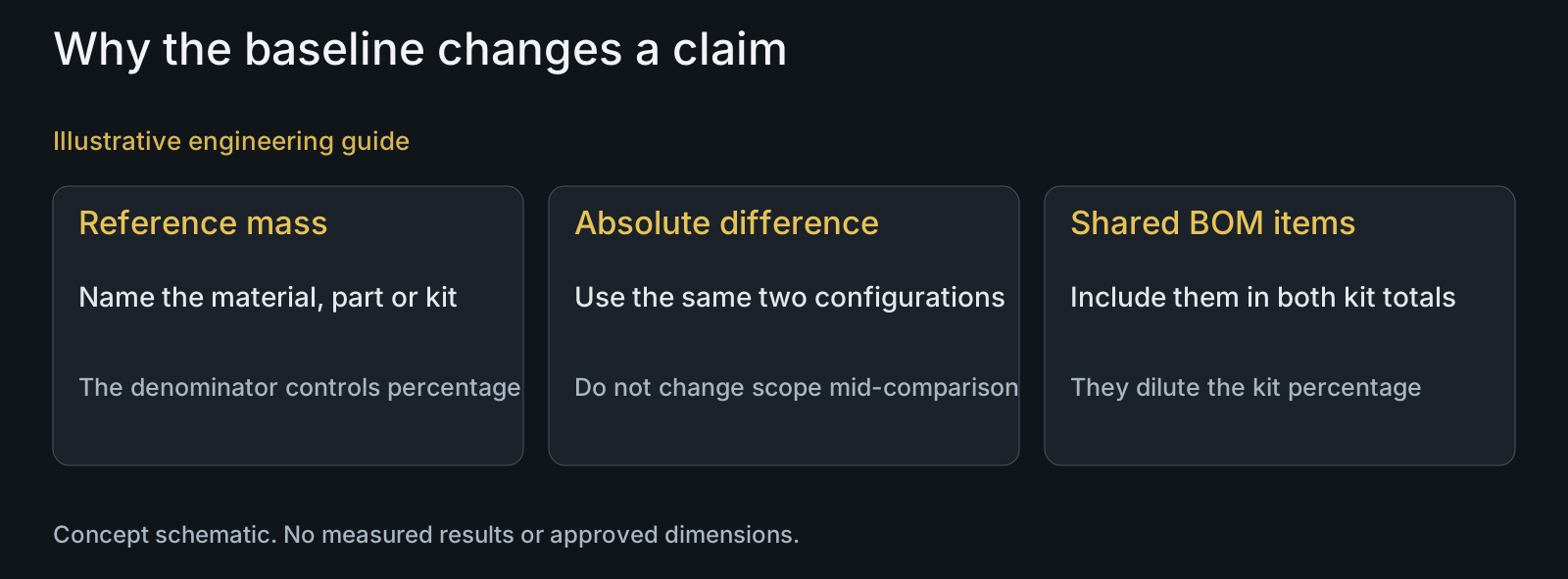
Illustrative review: one axle changes, the common items do not
Illustrative engineering example: assume a candidate kit changes only an axle from Grade 5 titanium to 7075 while retaining the same net axle volume. The kit also includes unchanged sleeves, washers and a cap. No real part weight, quantity, approved substitution or measurement is assumed.
Let T represent the modeled titanium axle mass and U the total mass of the unchanged items. The density-based aluminum axle estimate is about 0.633T. The kit reduction is therefore about 0.367T divided by T + U, rather than 36.7% of the whole kit. Any positive unchanged mass makes the kit percentage smaller than the isolated axle percentage.
If the new axle geometry changes, replace 0.633T with the new model's own mass estimate and recalculate the kit. Then evaluate the candidate configuration and measure the agreed finished set when a measured claim is needed. This scenario demonstrates mass accounting, not a lightweight project outcome.
Ask for a comparable finished-set quotation
Provide both candidate drawings or STEP models and the BOM boundary, quantities and required finishes. Ask the supplier to distinguish calculated mass from measured sample mass and to identify any added or excluded item. Do not request a guaranteed reduction without supplying the configurations being compared.
PremFixer can review the CNC turning scope, item definitions and delivered-set requirements. Its role is to manufacture and quote the agreed configuration; the OEM retains application approval. A comparison should not convert lower hardware mass into an unmeasured improvement in handling, range, durability or total project cost.
Questions buyers need to confirm
Is aluminum always lighter than titanium pivot hardware?
At equal net volume, the cited 7075 density gives a lower estimate than Grade 5 titanium. Finished designs may have different volumes or additional parts, so recalculate the actual candidate and kit instead of assuming equal geometry.
Why can one comparison say 36.7% lighter and another 57.9% heavier?
They use different reference masses. The cited equal-volume aluminum-to-titanium ratio is about 0.633; reversing the comparison changes the denominator. State the baseline beside the percentage.
Can a bolt's weight reduction be applied to the full kit?
No. Include all parts and quantities in the kit. Unchanged items cancel from the absolute difference but remain in the baseline total, making the kit percentage different from the isolated bolt percentage.
Should I use the raw bar weight in the estimate?
Not for finished-part mass. Use the net material volume after bores, recesses and other removed features are represented. Stock consumption is a manufacturing-cost input, not the delivered component mass.
Does a modeled mass count as a measured weight?
No. Label the model estimate and its density assumptions. A measured claim needs a defined finished sample or set, with the included items and condition identified.
What does PremFixer need for a like-for-like lightweight quotation?
Send the baseline and candidate drawings or STEP models, item quantities, material/finish requirements and kit contents. Identify whether the requested mass deliverable is a model estimate or a measurement of a defined supplied set.
Technical references and scope
Kaiser Aluminum: 7075 rod and bar technical sheet. Reference density2.80 used only in a transparent equal-volume mass estimate, not a component approval.
TIMET: TIMETAL 6-4 alloy data. Grade5-identifying manufacturer sheet, density4.42g/cm3 at22C. Historical technical reference, not current procurement-standard certification.
Explore related component, material and sourcing decisions in the customer decision knowledge center. For a drawing review, use the Drawing/BOM RFQ path.
Compare two clearly defined hardware configurations
Send the baseline and candidate STEP models, drawings and complete BOM with quantities and finishes. PremFixer can review manufacturable parts and a consistent delivered-set quotation, with calculated and measured mass kept separate.
Discuss the drawing and BOM