
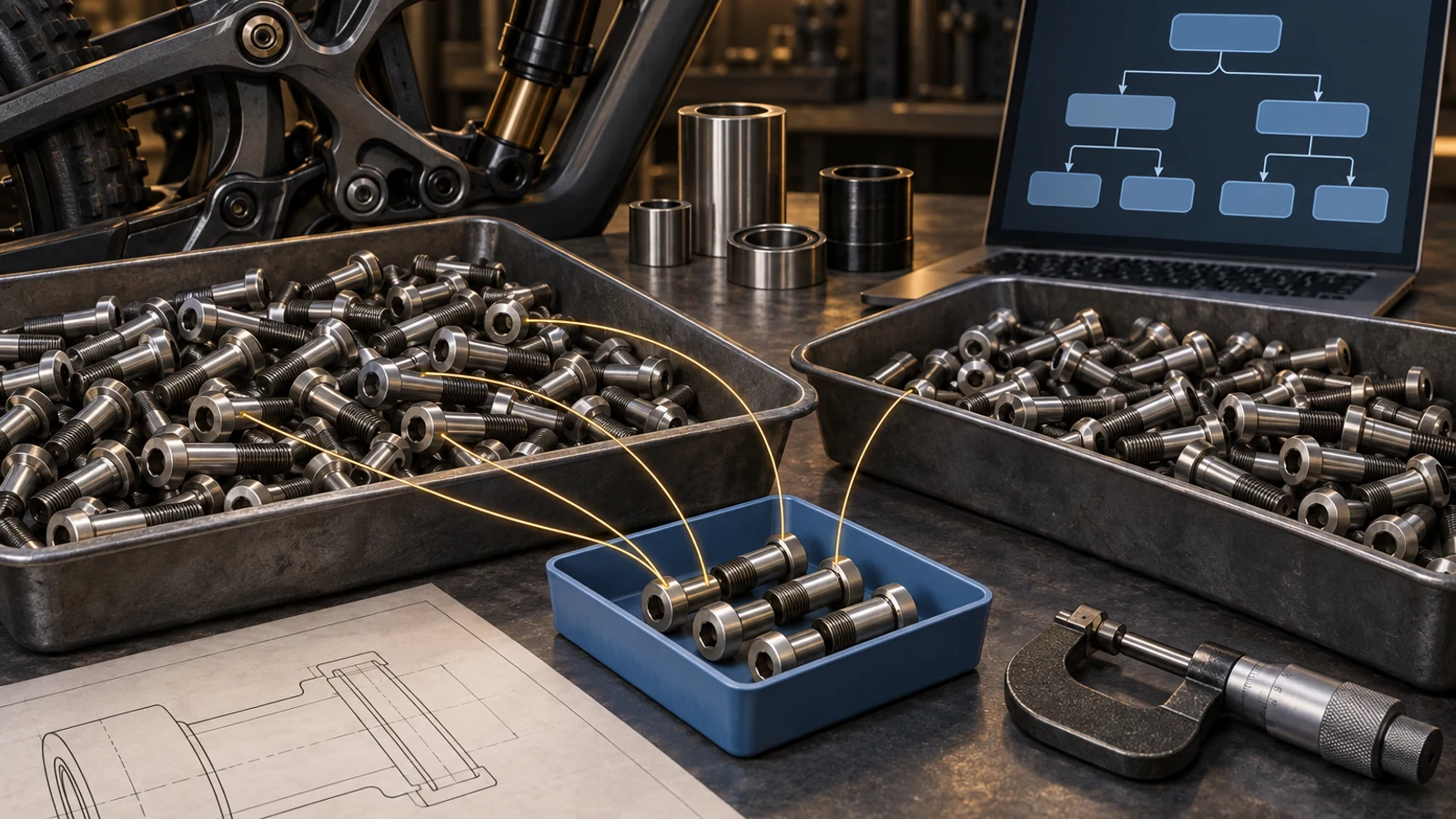
There is no single AQL that is appropriate for every bicycle pivot bolt or every characteristic on it. Before choosing a number, define the inspected lot, unit, relevant nonconformities and the consequence each classification represents in the actual design. Then agree a complete sampling scheme, its selection method and disposition rules with the responsible quality team. Do not copy a safety, functional or appearance value from a generic checklist. Acceptance sampling supports a defined lot decision; it does not prove every piece is defect-free or establish the complete suspension's safety. Critical questions may require controls beyond the chosen sampling plan.
Hero: concept illustration of example hardware and its application. It is not a factory photograph, tested component or approved production geometry.
Define what one lot and one inspected unit mean
Identify the part revision, delivered condition and manufacturing population represented by the submitted lot. A shipment can contain several component groups, and a pivot kit can contain several different parts. Decide whether the inspected unit is a bolt, a particular component or a complete kit; the result's meaning changes with that choice.
Do not merge different revisions or finish conditions merely to simplify the count. Conversely, do not split a population after seeing unfavorable findings just to obtain a different decision. Explain the lot boundary before sampling and preserve it with the reported results.
Classify the actual nonconformity before assigning AQL
A bearing-seat discrepancy, incomplete usable thread, damaged contact surface and cosmetic mark have different potential consequences. Classification should reflect the actual feature, requirement and application, not a universal label attached to all bolts. A visible mark may matter if it occurs on a functional contact rather than an appearance-only area.
The responsible design and quality teams should identify which risks need preventive process controls, additional verification or another acceptance approach. This article does not prescribe a critical-feature AQL, acceptance number or rule that sampling alone is adequate for every safety-related requirement.
| Choice | Why it changes meaning | Misleading shortcut | Verification question |
|---|---|---|---|
| Lot boundary | Defines the represented population | One shipment total hides separate groups | Which revision and final condition are included? |
| Inspected unit | Defines what is counted | Bolt and complete kit treated alike | What constitutes one nonconforming unit? |
| Classification | Connects finding to its consequence | Appearance label ignores contact function | Which requirement and application are affected? |
| Plan and edition | Defines sample and decision rules | AQL alone treated as the plan | Which complete scheme is agreed? |
| Selection method | Determines represented access | Only attractive or accessible pieces chosen | Can the defined population be selected? |
| Continuation | Defines a legitimate next sample | Repeat until a favorable sample appears | Is continuation part of the original plan? |
| Disposition | Controls rejected or corrected populations | Delete failures and relabel the lot | What action and resubmission are authorized? |
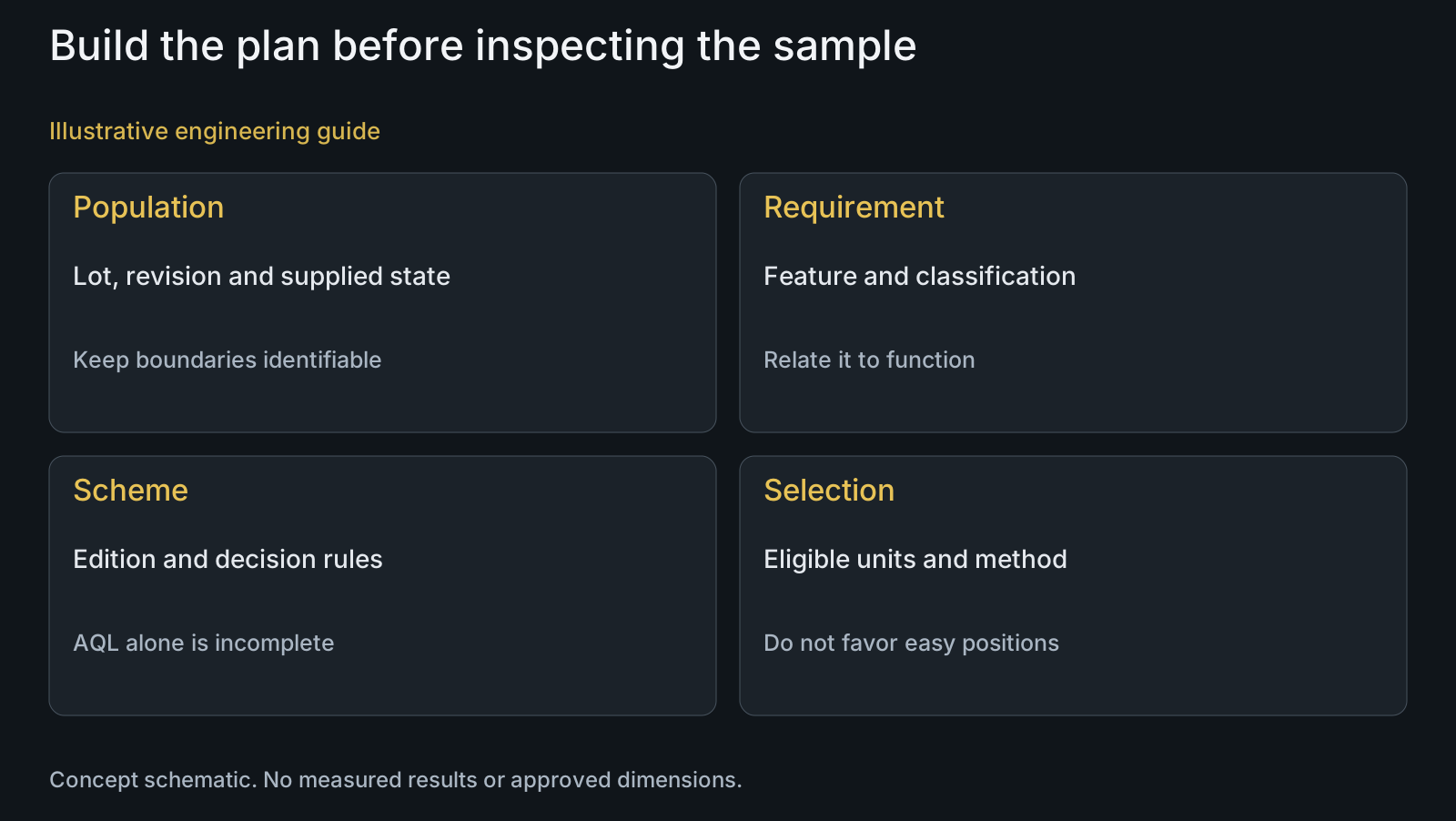
Specify the scheme, not just its headline number
ISO's public catalog identifies ISO 2859-1:2026 as the current published edition for AQL-indexed attribute sampling schemes. Identify the edition selected by the actual agreement and use its authorized full text for plan selection. A current publication does not silently amend an existing contract's named edition.
Document the applicable inspection level, lot-size basis, single or other agreed plan, sample size, acceptance and rejection criteria, and the required handling of continuing lots. Exact tables and switching conditions are not reproduced here. A number labeled AQL cannot supply the missing rules by itself.
Select the sample without making it the best-looking subset
NIST describes lot acceptance using random selection and explains different plan types. Under a single plan, the specified sample supports the lot decision; a double plan has a defined continuation when the first stage does not decide it. Taking another convenient sample after a rejection is not equivalent to following that predetermined scheme.
Make relevant positions in the defined population eligible for selection. Picking only easily reached or visibly attractive parts may omit the distribution the lot decision is meant to represent. The supplier and buyer should agree access and identification so results remain tied to the selected units and lot.
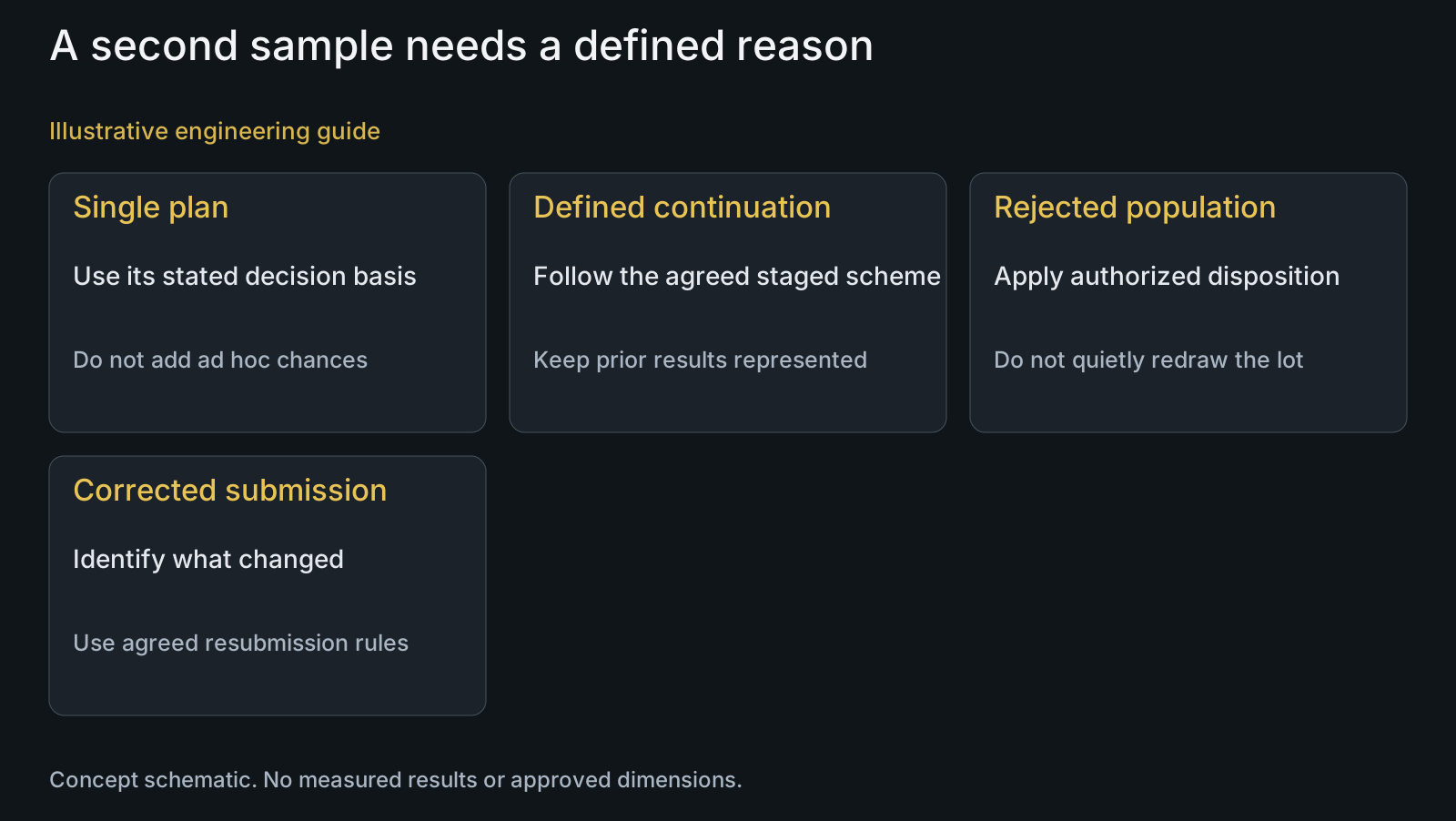
Define rejection, resubmission and continuing inspection treatment
Identify what happens to a rejected lot: segregation, investigation and the authorized disposition or resubmission basis. Keep a corrected population distinguishable from the original submission. Removing observed failures and repeating an unspecified sample until it passes does not demonstrate that the original lot met the agreed plan.
For continuing supply, apply the chosen scheme's relevant history and switching rules from the authorized edition. Do not improvise reduced inspection from a few favorable observations or promise exact triggers from an unread table. The quality-agreement guide places this lot decision alongside separate process and sample evidence.
Example: two finish groups need a clear population decision
Illustrative engineering example: assume a delivery contains the same nominal pivot bolt from two distinct finishing groups. The buyer plans a final-seat attribute check, but the paperwork gives only one shipment total. No lot sizes, inspection level, AQL, observed defects or outcome are assumed.
The reviewer first determines whether one justified lot definition represents both groups or whether distinct populations must be retained. Only then is the agreed scheme applied with traceable selection. If findings occur, the team follows its predetermined disposition; it does not redraw the boundary afterward to hide an unfavorable subgroup.
Discuss the represented final condition through surface-treatment, the part scope through manufacturing and materials, and related decisions through full-suspension solutions and the customer decision knowledge center.
Questions buyers need to confirm
Is AQL 0.65 a default for every critical pivot feature?
No universal default is established here. Identify the specific requirement and consequence with the design and quality teams, then choose the applicable controls and sampling scheme. A generic number does not show that sampling alone addresses the actual risk.
Does an accepted lot mean every piece is defect-free?
No. The decision follows the agreed plan for its represented population. Sampling does not inspect every item or independently validate the complete bicycle assembly; retain the other controls required by the actual design.
Can the entire shipment be treated as one lot?
Only under a justified defined population. Check component identity, revision, manufacturing and finished condition. A mixed shipment total should not erase meaningful groups whose acceptance questions differ.
Can we take another sample after a rejection?
Follow the predetermined scheme and authorized disposition. A defined double-sampling continuation is not the same as repeating an arbitrary sample until it passes. Preserve earlier findings and any corrected submission's identity.
Which ISO 2859-1 edition should be used?
Identify the edition expressly selected for the project and review its authorized full text. ISO currently lists the 2026 edition, but publication alone does not change an existing agreement or justify mixing tables from different editions.
What should a supplier receive to discuss the plan?
Provide the drawing and characteristics, classification rationale, lot and unit definition, intended scheme and edition, inspection state and required report. Include proposed rejection and resubmission handling so the numerical selection has an actionable context.
Technical references and scope
ISO: ISO 2859-1 public catalog. Public identity and publication scope of the 2026 edition; full copyrighted plan tables and exact switching criteria are not reproduced or asserted from the catalog.
NIST: Kinds of Lot Acceptance Sampling Plans. Original random single-sample and predetermined double-sample continuation concepts; no example numerical risks, sample sizes or acceptance criteria transferred.
Explore related component, material and sourcing decisions in the customer decision knowledge center. For a drawing review, use the Drawing/BOM RFQ path.
Define the represented pivot lot before selecting sampling inputs
Send the controlled drawing and BOM, characteristic and classification list, proposed lot boundary, inspected unit, scheme and edition, and report requirements through the Drawing/BOM RFQ path. Ask PremFixer to discuss practical inspection access and document scope; have your quality team select the authorized plan.
Discuss the drawing and BOM