
A quality agreement for custom bicycle pivot hardware should define what is supplied, which characteristics matter, how they are evaluated and who decides what happens when evidence or parts do not meet the agreed requirement. Include the kit configuration, final material and surface condition, inspection coverage, reporting and change responsibilities. Treat any AQL-based plan or Cpk target as a defined control with its own purpose, not a universal factory rating. A sample's conformity does not automatically release a later lot, and a favorable process study does not verify every assembly interface. The agreement should close those gaps without pretending one number describes the whole product.
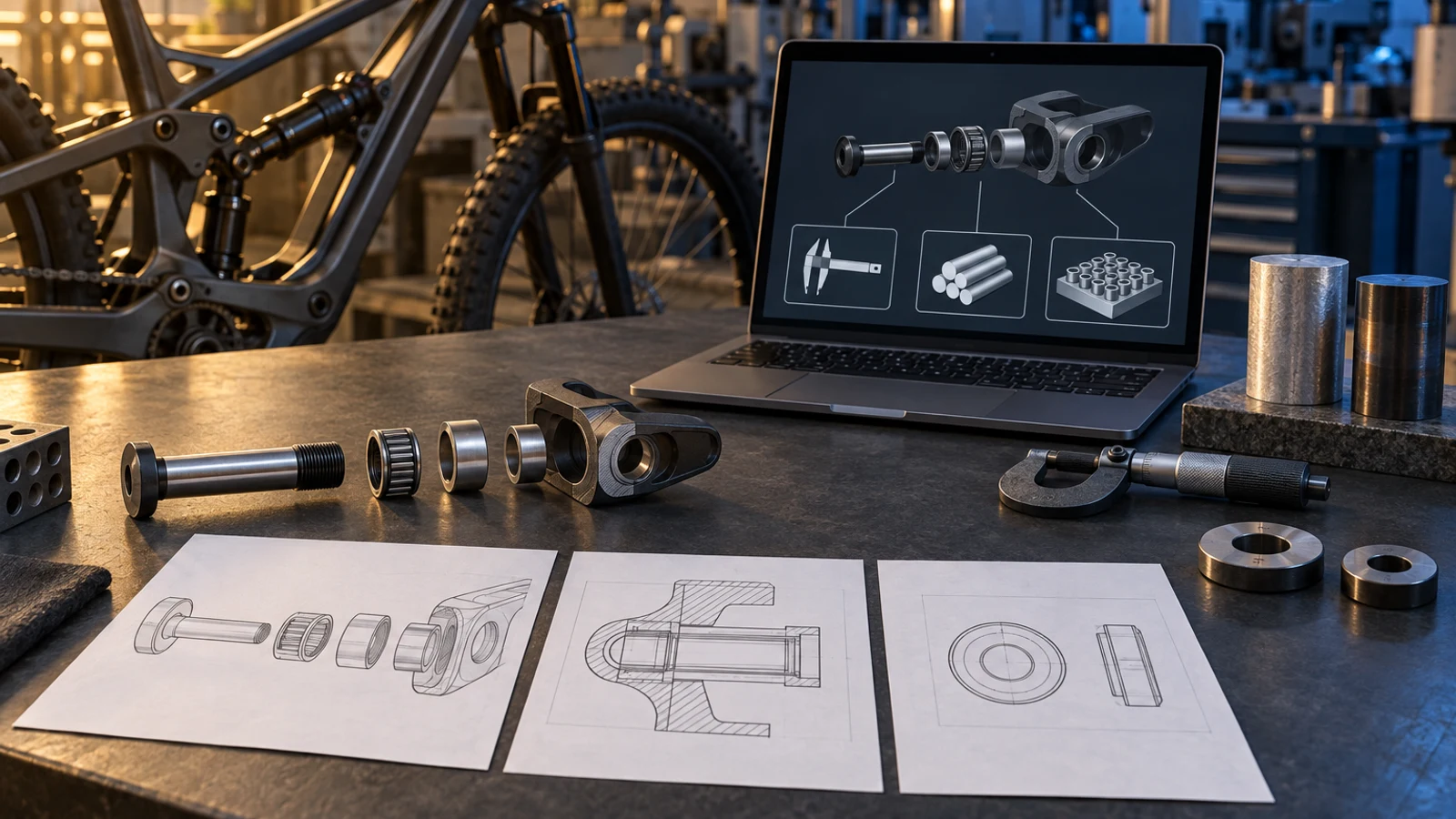
Hero: concept illustration of example hardware and its application. It is not a factory photograph, tested component or approved production geometry.
Start with the supplied kit and final condition
Identify drawings, revisions, BOM positions and quantities, material specification and condition, and surface-treatment scope. A quality attachment for an axle cannot automatically cover its separate screw and spacer. Clarify accepted alternatives and whether evidence concerns unfinished or delivered parts.
Define relevant characteristics by function and drawing reference. A bearing-seat size, shoulder-face relationship, usable thread requirement and appearance criterion answer different questions. Avoid transferring one acceptance rule to every feature because it is convenient to put them in the same report.
Give each requirement a measurement and evidence subject
Specify the characteristic, datum or setup where relevant, method, units, represented component condition and applicable requirement. A diameter reading does not independently establish coaxiality; a material document does not report finished interface geometry. The measurement definition should actually address the controlled relationship.
Connect the result to the represented part population and document version. If different organizations measure the same feature, discuss support, contact and interpretation before assuming their results are equivalent. This is not a requirement to prescribe every supplier's machine; it is a way to make the acceptance question reproducible and meaningful.
| Control | Defined subject | What it cannot replace | Agreement needs |
|---|---|---|---|
| Drawing requirement | Named feature and delivered state | An unrelated reported size | Method, datum and applicable limits |
| Lot sampling | Identified lot under a complete plan | Proof that every unit conforms | Plan basis, classification and disposition |
| Capability study | Named process and characteristic data | All-feature lot or system acceptance | Model, stability and represented data |
| Sample evaluation | Specified sample and purpose | Later production release automatically | Configuration and evaluated scope |
| Material document | Represented stock and condition | Final dimensional or kit evidence | Component link and document subject |
| Rework disposition | Defined affected parts and action | Permanent design revision | Authority and relevant reevaluation |
| Service or warranty term | Agreed commercial responsibility | Universal remedy or lifetime claim | Scope and qualified legal review |
Separate lot sampling from process capability
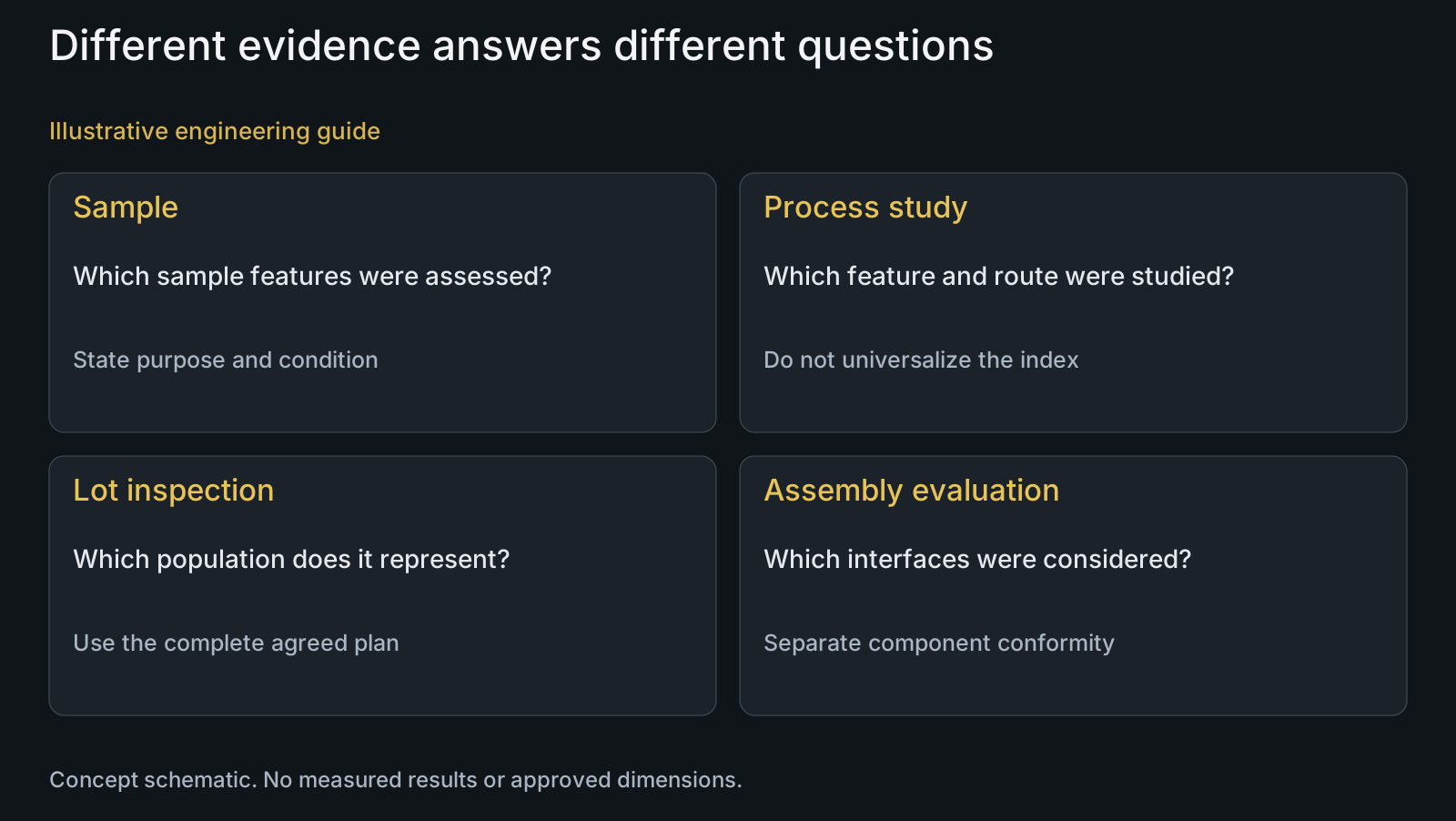
NIST's acceptance-sampling introduction distinguishes a lot-disposition decision from estimating the lot's quality. Its capability discussion considers process behavior relative to specifications under stated statistical assumptions. Those are different evidence tasks, not interchangeable approval labels.
For a sampling requirement, identify the lot, characteristics, classification and complete agreed plan, including acceptance and rejection treatment. An AQL value alone does not identify sample size or the whole plan. For capability, identify the named feature, process and data basis, suitable measurement and required analysis; a target is not evidence that it was achieved.
The Cpk and Ppk guide explains statistical interpretation. This agreement should say how capability evidence relates to required acceptance coverage rather than assume a favorable index removes checks on every other feature.
Define nonconforming-part decisions without assuming the remedy
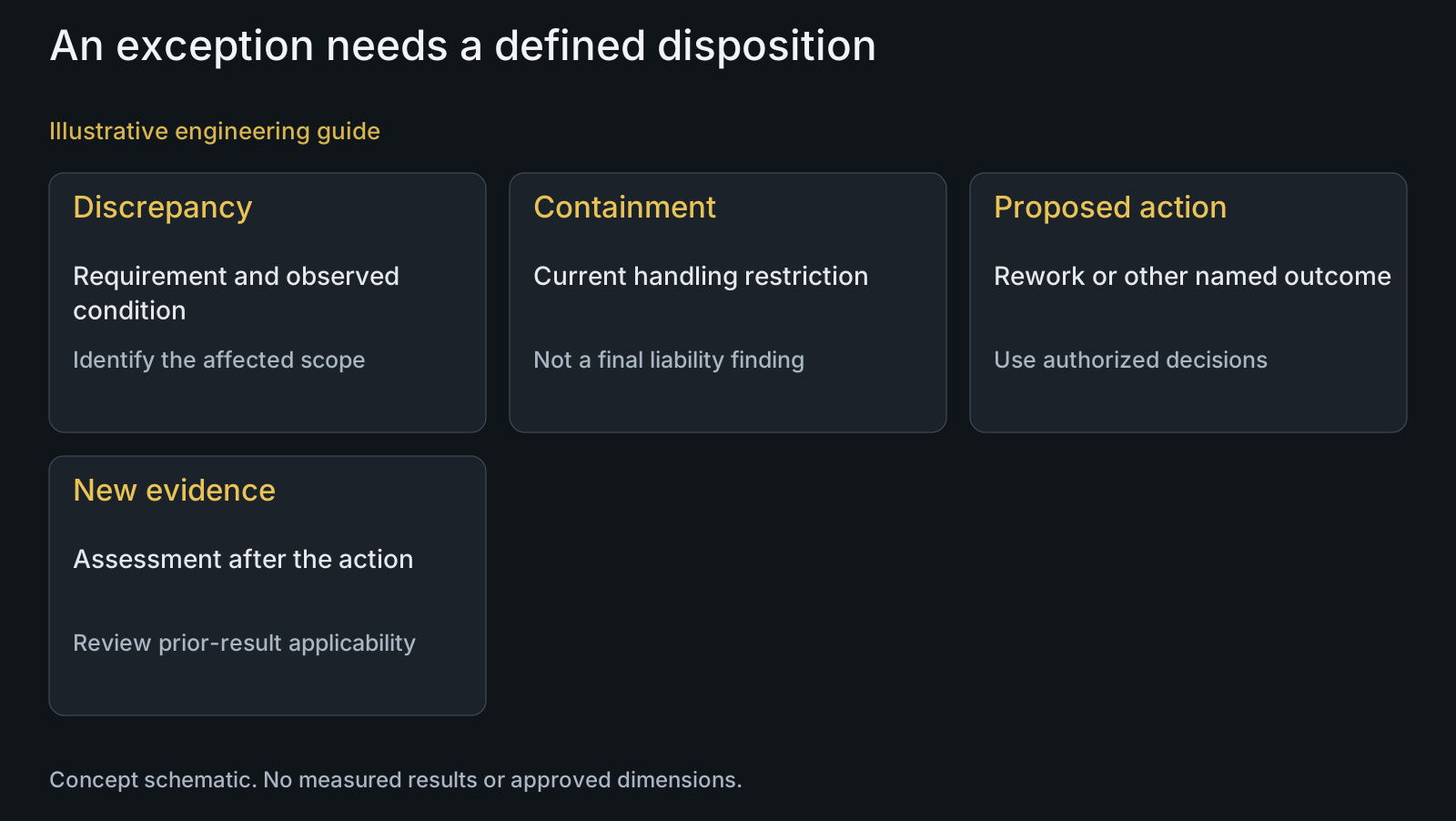
Distinguish immediate segregation or containment from investigation, authorized rework, replacement and any proposed acceptance under concession. A discrepancy report should identify the component, requirement, observed condition and represented population. It should not silently declare every shipment defective or establish legal responsibility from an unresolved measurement disagreement.
Identify who can authorize the technical disposition and which evidence would be needed afterward. Rework may change geometry or final condition, so earlier results must be reviewed for applicability. A concession for a named lot does not automatically revise the drawing for all future production.
Connect changes and service terms to their real subjects
Specify which drawing, material, finish or route changes require notification or review for the actual project. Keep the affected characteristics and existing evidence visible. A new report format may be administrative; a changed finished seat can affect the acceptance definition itself.
Discuss warranty, response, document access and any audit arrangements as explicit commercial subjects. Do not invent a standard duration, automatic compensation or unlimited audit right. The supply-contract guide helps identify those connections; qualified advisers should review enforceability and actual legal terms.
Use manufacturing, materials and surface-treatment to align the required delivered state with the offered manufacturing scope. A generic agreement should be adapted rather than signed with unexplained placeholders.
Example: a sample report leaves a final-condition question open
Illustrative engineering example: assume a sample axle has a dimensional report before the specified finish. The quality attachment also asks for a process-capability study on one turned seat, while the production kit includes a separate spacer. No measurement, Cpk value, sampling level or actual acceptance outcome is assumed.
The reviewer identifies three distinct questions: whether the sample represents the final interface, what the seat study actually covers, and which evidence is required for the spacer and later production lot. A favorable-looking sample report cannot answer all three. The agreement is revised to identify each evidence subject and the decisions it supports.
The result is a clearer discussion boundary, not a completed product approval. Keep adjacent engineering and sourcing questions accessible through solutions and the customer decision knowledge center.
Questions buyers need to confirm
What should a pivot quality agreement include?
Define the configuration, characteristics, methods, evidence scope, acceptance rules and exception responsibilities. Connect changes and service terms to the actual supplied components rather than collecting certificate names and unexplained thresholds.
Is an AQL number enough to define inspection?
No. Identify the relevant population, characteristic classification and complete sampling plan, including acceptance and rejection treatment. A single value does not specify how the lot decision will be made or verify every unit.
Can a Cpk target replace final inspection?
Not automatically. Capability concerns a defined characteristic and data basis, while acceptance coverage addresses the agreed supplied population. Specify how the two controls relate instead of letting one favorable index remove unrelated checks.
Does sample conformity release a later production lot?
No automatic release follows. Establish the sample's configuration, condition and evaluated scope, then apply the production acceptance and change requirements. Later parts sharing a name are not necessarily represented by that sample.
Does rework approval permanently change the drawing?
Not inherently. Identify the affected parts, authorized action and required reevaluation. A lot-specific disposition or concession does not automatically become the definition for future orders.
Can we sign a generic quality template unchanged?
Adapt it to the actual product and supply arrangement. Resolve technical placeholders and conflicting evidence subjects, and obtain qualified review of commercial or legal terms. This guide is a discussion structure, not a ready-to-sign agreement.
Technical references and scope
NIST: What is Acceptance Sampling?. Official distinction between lot acceptance and estimating lot quality; no standard plan tables, AQL values or mandatory sample counts adopted.
NIST: What is Process Capability?. Stable-process and statistical-model context for capability relative to specifications; no generic target, predicted defect rate or PremFixer result asserted.
Explore related component, material and sourcing decisions in the customer decision knowledge center. For a drawing review, use the Drawing/BOM RFQ path.
Define evidence for the actual pivot configuration
Share the controlled drawings and kit BOM, characteristic list, final material and finishing state, proposed sampling or capability requirements and report format through the Drawing/BOM RFQ path. Ask PremFixer to discuss what each inspection deliverable will represent and which acceptance or disposition decisions remain with your team.
Discuss the drawing and BOM