
An AS9102-style first-article request for custom pivot hardware needs an agreed deliverable, not just three familiar report forms. Decide whether the OEM wants a useful reporting structure or compliance with a named standard edition and its customer requirements. Then define the part revision, represented manufacturing configuration, characteristics and supporting evidence before production. A prototype made by a different route cannot silently stand for the later production condition. For purchasing and SQE teams, the direct answer is to specify what each report will demonstrate and who reviews it. FAI does not automatically authorize shipment, validate the bicycle joint or establish company aerospace certification.
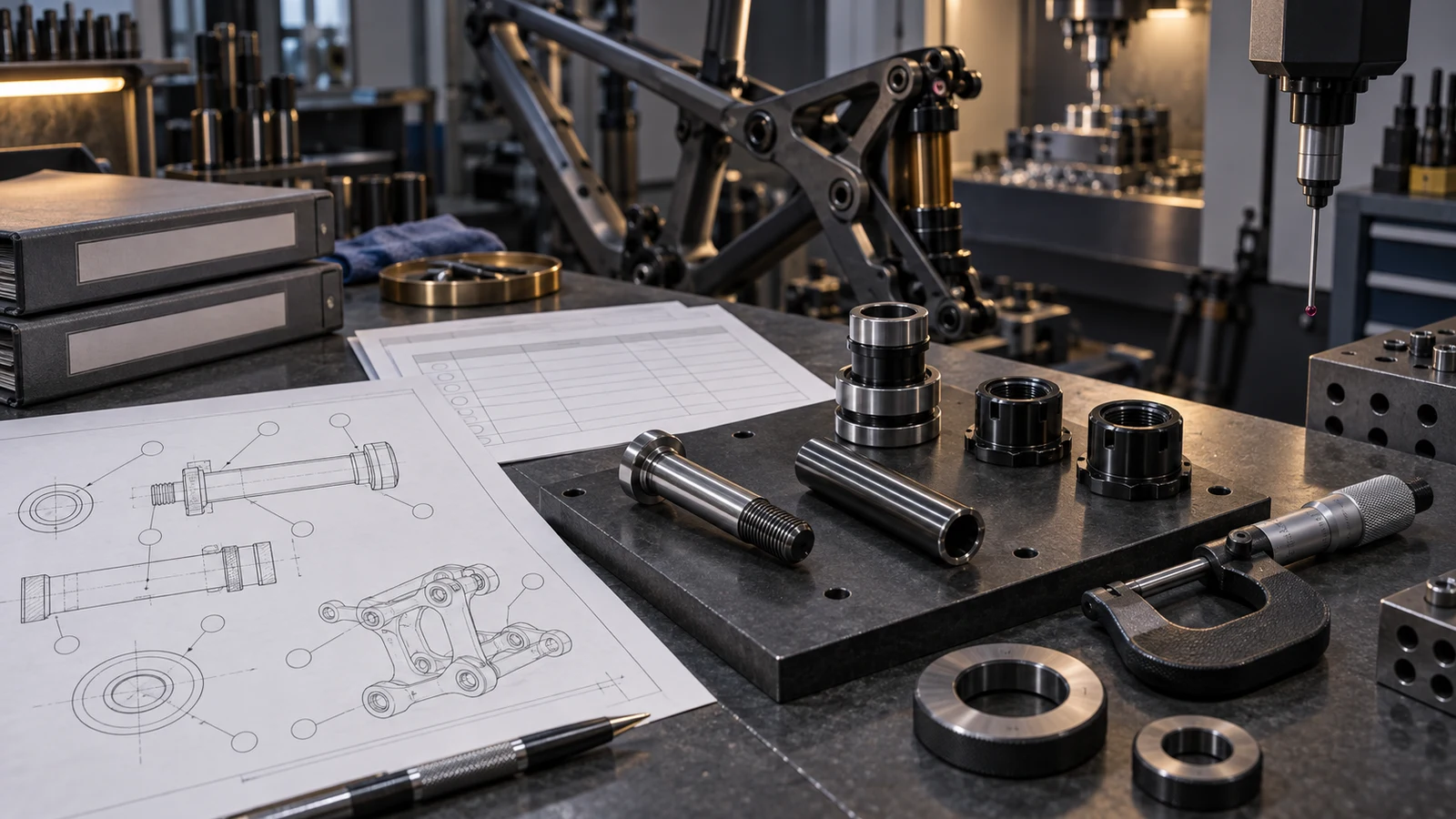
Hero: concept illustration of example hardware and its application. It is not a factory photograph, tested component or approved production geometry.
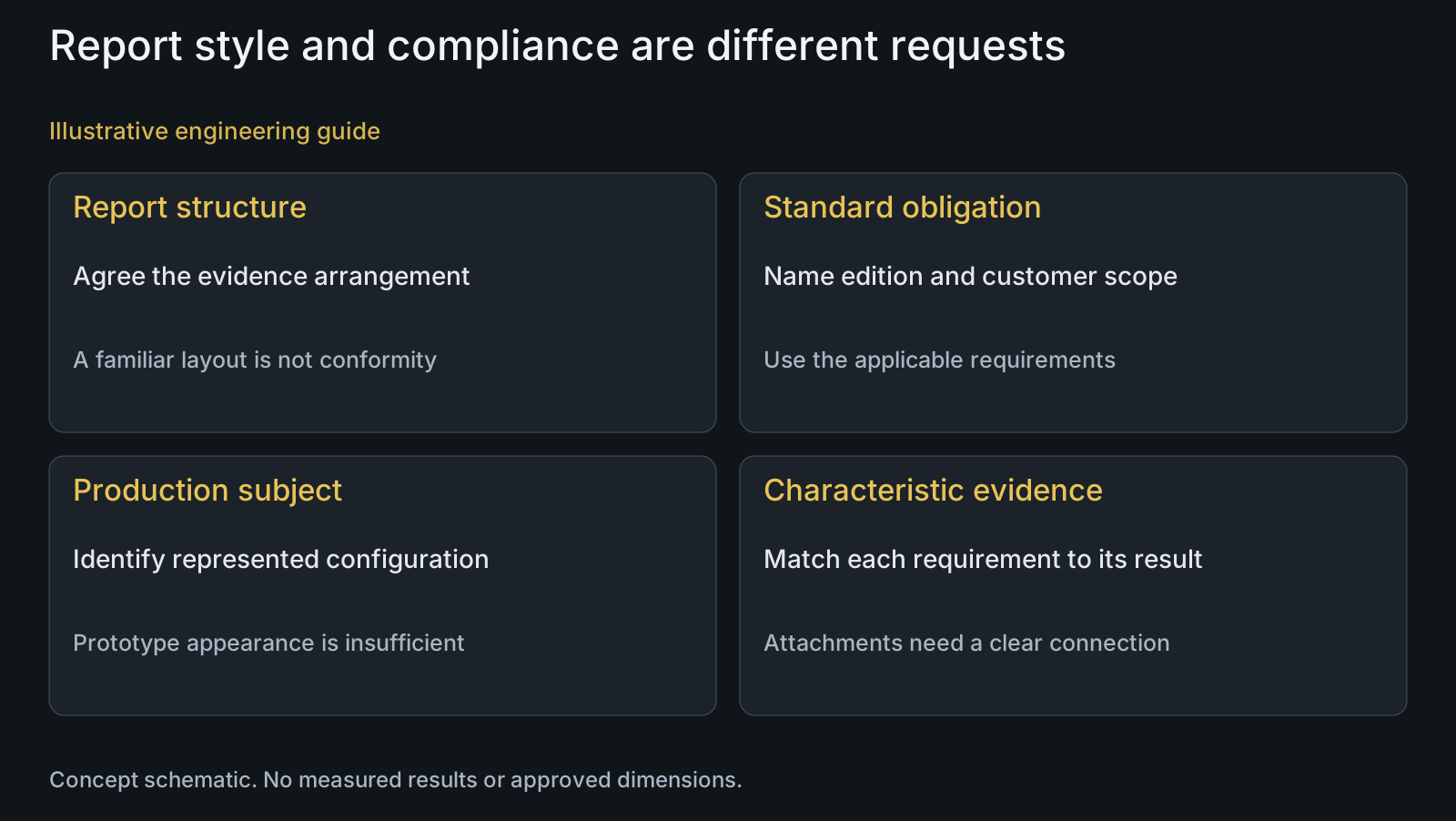
Choose reporting style or a defined standard obligation
IAQG's 9102 overview identifies its aerospace origin and use in other industries needing a standardized FAI process. That makes it a possible framework for an OEM bicycle project, not a mandatory certification for every pivot bolt.
SAE's AS9102C public scope states that the FAI requirements complement customer and applicable statutory or regulatory requirements. A standard reference does not erase the order's separate obligations. Agree the edition and any customer-specific format, submission and review instructions.
If only the structure is desired, describe it as an agreed first-article package without claiming full standard conformity. If conformity is required, the responsible team needs the applicable document and a conforming process. An online summary or this article is not a complete field-by-field implementation procedure.
Represent the production configuration, not just the sample appearance
Identify the drawing and digital definition revision, material condition, finish and manufacturing configuration represented by the submitted article. A visually identical sample made from different stock or by a different thread route may not demonstrate the intended production characteristics. State those differences instead of allowing the term first article to conceal them.
The question is not whether a prototype is useful. It can answer fit or design questions while still being a different evidence subject. If later production changes the relevant process or supplied condition, review what the earlier report actually represents. An earlier matching diameter does not prove that a different finished process has produced the same required relationship.
Use the manufacturing process discussion to identify the intended route. Keep prototype evaluation, production first article and shipment checks distinct so each deliverable has a clear purpose and cost. No universal sample quantity or automatic schedule follows from the FAI label.
| Buyer request | Defined deliverable | Main risk | Review before quotation |
|---|---|---|---|
| AS9102-style report | Agreed structure and evidence scope | Layout mistaken for standard compliance | State whether full conformity is required |
| AS9102C obligation | Applicable edition and customer instructions | Summary used as the complete procedure | Confirm process, forms and submission scope |
| Production first article | Represented route and supplied condition | Different prototype copied as production evidence | Identify configuration and changed features |
| Finished bearing-seat conformity | Result for the required final state | Pre-finish value treated as final fit | Connect datum, method and surface state |
| Earlier-stage characteristic | Evidence collected while inspectable | Final inspection cannot recover missing data | Plan stage and supporting process record |
| Change or deviation | Documented evidence and disposition review | Old approval expanded to a new requirement | Identify unrepresented characteristics and authority |
Connect design characteristics to usable evidence
Build the agreed characteristic map from the actual released definition, not only the obvious dimensions. A pivot can include bearing-seat geometry, thread requirements, surface roughness, material and finish notes, marking and supplied condition. Decide how each is verified and where the evidence can be found.
A coordinate list may not directly evaluate the geometric relationship required by the drawing. Similarly, a material document can support its identified material requirement without measuring the finished shoulder. Connect reports through their represented part and revision, but keep the measurements and claims specific.
The CMM feature-and-datum guide explains why measurement must address the controlled relationship. The thread limit-check guide explains what thread evidence can and cannot establish. A thicker report is not necessarily more complete if the critical characteristic still has no relevant result.
Plan evidence for characteristics hidden by later operations
Some characteristics cannot be verified in the same way after a subsequent operation. A covered interface, an altered surface or a process-dependent requirement may need evidence at the stage where it can be assessed. Identify that need before manufacturing rather than expecting final inspection to reconstruct missing observations.
For example, distinguish a pre-finish dimension from a required final bearing fit. A useful pre-finish result does not independently establish the final condition; conversely, a final measurement may not answer a specified earlier-stage process requirement. State which result supports which characteristic and what supporting process record is required.
This planning is part-specific. It does not mean applying every test or collecting every certificate to every order. Agree the required evidence and sources with the OEM, including any partner work, so the quoted package addresses the actual definition rather than a generic all-tests promise.
Illustrative review: an old sample and a new finished requirement
Illustrative engineering example: assume an OEM has a dimensional report for an uncoated prototype pivot and now requests an AS9102C first article for a production drawing specifying a finished bearing seat and a different surface system. No actual measurements or accepted report are supplied.
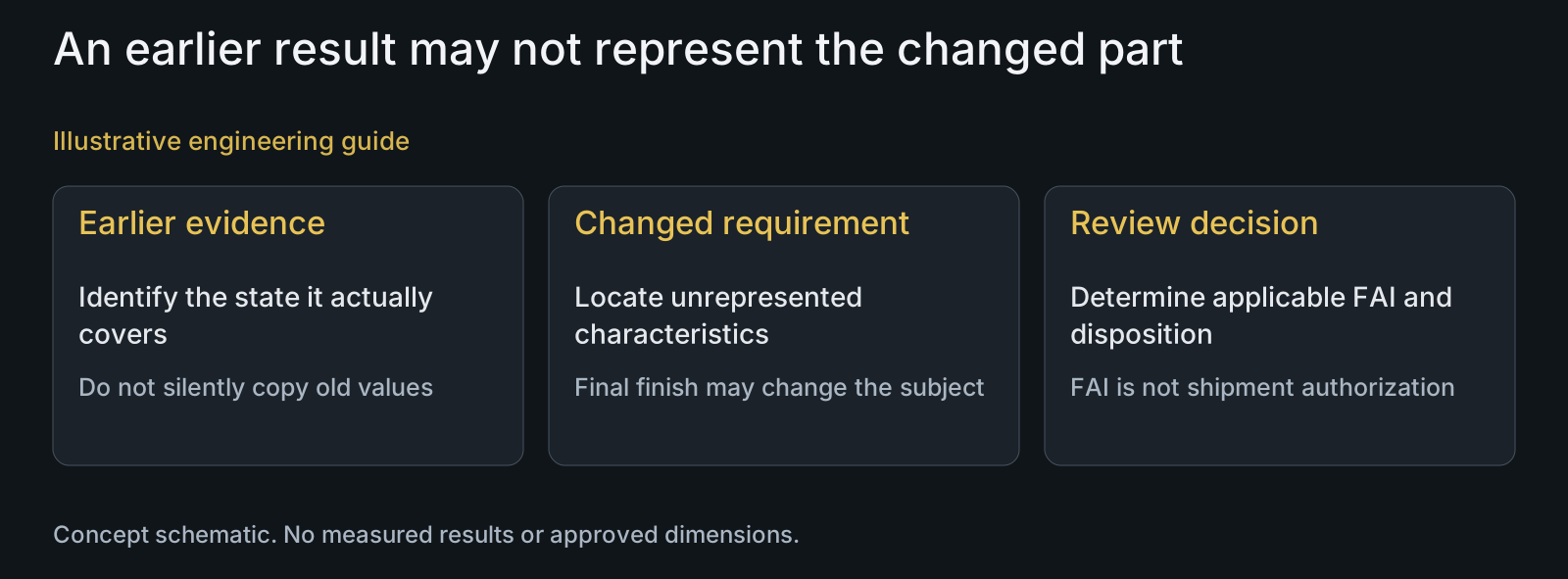
Copying the prototype's values into a standard-looking form would not show the new finished condition. The review identifies the revision and production route, maps the final seat requirement to relevant evidence, and defines the finish and material documentation needed for the new article. Unchanged information can remain useful only where its represented scope is valid and the applicable process permits it.
IAQG's Revision B-to-C change summary highlights evaluating changes through characteristics invalidated or not represented. For this hypothetical pivot, the actionable decision is which earlier evidence still represents the requirement, not whether the old spreadsheet can be reformatted. A partial or new FAI must be determined through the applicable requirements and documented review.
Separate FAI review, deviations and product acceptance
IAQG's Revision C summary explicitly clarifies that FAI is not a product acceptance document. Identify report verification, any customer review, disposition of nonconformities and shipment authorization separately. A signature or a completed-looking package should not silently authorize a deviation or approve an untested bicycle application.
State unresolved characteristics and their responsible disposition rather than hiding them behind an overall pass statement. If the project uses an adapted format, describe the agreed fields and evidence honestly. Do not attach an aerospace-standard label to imply a certification, customer approval or test capability that has not been established.
PremFixer's manufacturing team can review the requested sample and evidence package, including coordinated inspection. Availability of a fully compliant AS9102 deliverable needs explicit project confirmation; the original topic description is not independent proof of that capability. Drawing conformity and application validation remain separate responsibilities.
Questions buyers need to confirm
Is AS9102 mandatory for every bicycle pivot bolt?
No. It is an aerospace FAI framework that can also be used in other sectors. Identify whether the customer requires it contractually and which edition and instructions apply. Do not describe it as a universal bicycle product certification.
Is an AS9102-style spreadsheet the same as a compliant FAIR?
No. An adapted reporting structure can be useful without demonstrating all applicable requirements. Agree whether the project needs full conformity or a defined format, then confirm process and evidence scope. A three-form appearance alone does not establish compliance.
Can our prototype dimensional report stand for the production first article?
Only where its represented scope is valid under the agreed requirements. Compare revision, material, thread route, finish and relevant production characteristics. Identify what changed or was never represented before relying on earlier evidence.
Why might inspection need to happen before final completion?
Some required characteristics may become covered or altered by later operations. Identify them from the drawing and process and plan relevant evidence while they remain inspectable. Separately verify characteristics required in the final supplied state; an earlier reading cannot establish an unmeasured final fit.
Does an FAI report approve shipment or bicycle durability?
Not by itself. Keep FAI verification, customer review, deviation disposition, shipment authorization and application validation distinct. A completed report does not authorize an unresolved nonconformity or validate a load case that was not examined.
Can PremFixer promise a full AS9102C package from the article alone?
No blanket capability or completed compliance is established here. Send the applicable requirements, definition revision, characteristic scope, forms, source restrictions and reporting needs for project review. Confirm deliverable availability and responsibilities before treating it as an order commitment.
Technical references and scope
IAQG, 9102 First Article Inspection Requirement. Official aerospace origin and possible use in other sectors; no automatic bicycle obligation or company certification.
SAE, AS9102C public scope. Original publisher's June 2023 revision and complementary customer/regulatory requirements boundary, not full paid procedure.
IAQG, 9102 Revision B-to-C summary of changes. Official 2023 public changes concerning non-product-acceptance purpose and invalidated or unrepresented characteristics; not full implementation instructions.
Explore related component, material and sourcing decisions in the customer decision knowledge center. For a drawing review, use the Drawing/BOM RFQ path.
Agree the first-article evidence before manufacturing
Send the released pivot drawing and digital definition, BOM, material and finish requirements, intended production route and quantities. Include the required AS9102 edition or adapted format, customer instructions, characteristic list, supporting records and review authority. PremFixer can assess the sample and coordinated evidence scope while keeping compliance, deviation disposition and bicycle validation separate.
Discuss the drawing and BOM