
For an Australian bicycle order, define the supplied product and its applicable market requirements before specifying custom pivot hardware. The published mandatory bicycle rule references AS/NZS 1927:1998 with stated variations; a newer voluntary edition is not automatically the legal purchase basis. Component drawings should then translate relevant assembly requirements into defined interfaces, finished conditions and agreed verification work. A material report for a loose bolt does not evaluate the complete bicycle. Keep Australian and New Zealand scope decisions separate, particularly when the bicycle type or supplied assembly changes, and avoid promising approval from an unexplained AS/NZS label.
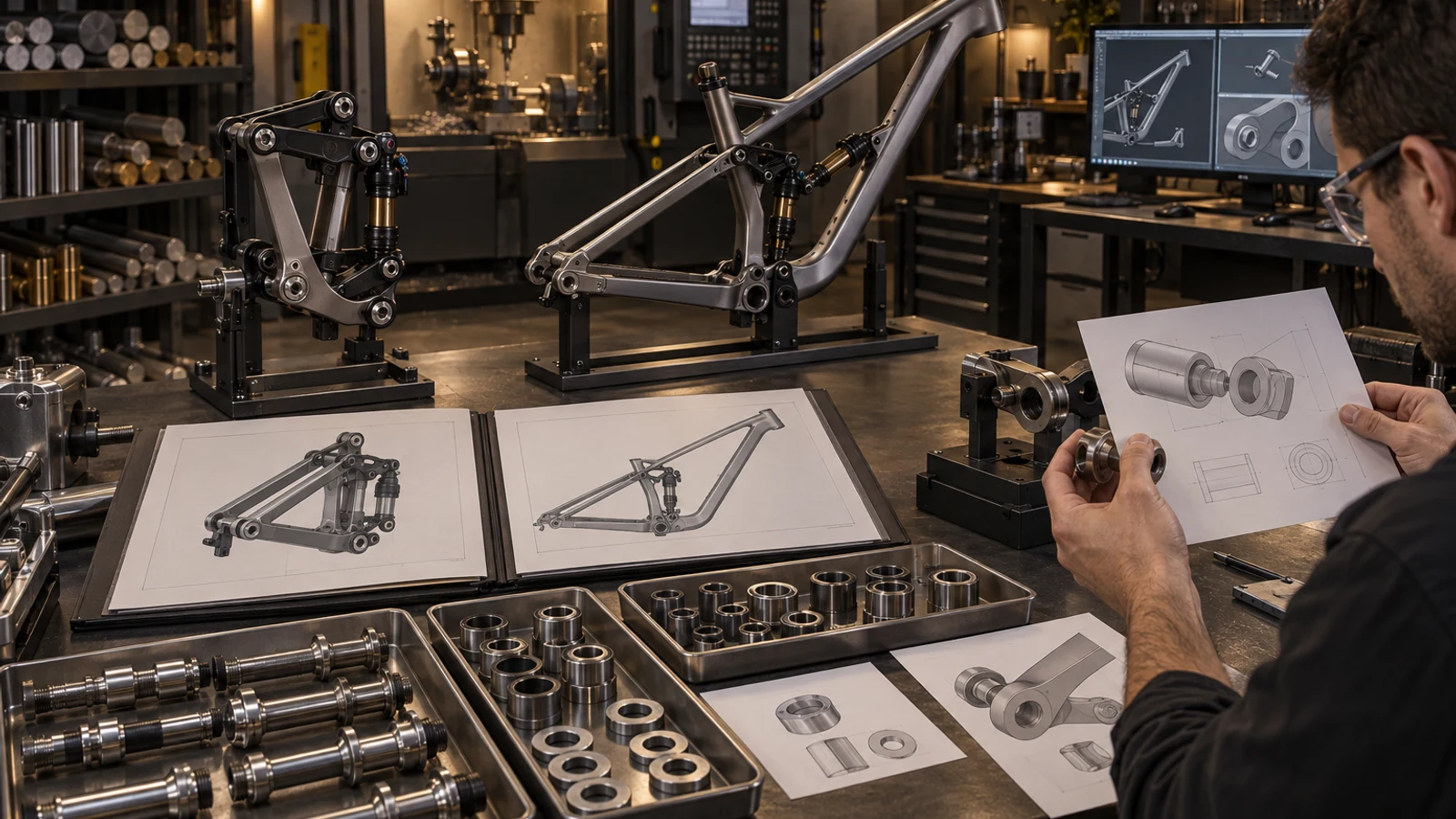
Hero: concept illustration of example hardware and its application. It is not a factory photograph, tested component or approved production geometry.
Use the mandatory reference, not just the newest catalogue year
ACCC's current bicycle page points to Consumer Protection Notice No. 6 of 2004 and certain sections of AS/NZS 1927:1998. The Federal Register lists that notice in force, and its schedule identifies the 1998 standard with specified variations. This is the published legal reference checked for this guide, not a claim to reproduce the full standard.
Record the applicable legal instrument separately from any additional engineering or customer specification. A buyer may require another standard for a defined purpose, but that request should not be described as an automatic replacement for the mandatory reference.
ACCC also lists pedal bicycles among standards under review. A review is not itself an enacted change or an approved transition date. At the project's release decision, have the responsible team reconfirm the current rule rather than infer adoption from a consultation or newer standard title.
Describe the product before claiming the bicycle rule applies
ACCC describes coverage of fully or partially assembled pedal bicycles and exclusions including power-assisted and folding bicycles. These boundaries matter to scope selection; they do not mean excluded products are free from every safety obligation. The responsible reviewer must determine the rules for the actual product.
Identify whether the order contains loose custom fasteners, a linkage assembly, a replacement kit or a bicycle supplied for final assembly. Do not silently describe a carton of shoulder bolts as a bicycle, or assume that taking an assembled product apart avoids the applicable assessment.
The export-document guide separates general destination paperwork. Here the decision is which Australian product assessment the component inputs support and where that component evidence stops.
| Review condition | What cannot be assumed | Component input needed | Responsible verification |
|---|---|---|---|
| Covered pedal bicycle supplied partly assembled | A carton configuration completes testing | Actual assembly and installation assumptions | Product team checks applicable assembled evaluation |
| Loose custom pivot order | Material evidence approves the complete bicycle | Drawing, mating stack and represented supplied condition | Buyer separates component acceptance from product assessment |
| Folding or power-assisted bicycle | Exclusion from this rule means no safety duties | Actual product description and joint function | Responsible reviewer selects the applicable route |
| Newer voluntary standard requested | Its edition automatically replaces the mandatory reference | Separate legal and contractual specifications | Confirm each requirement's purpose and current status |
| Same hardware destined for New Zealand | Shared AS/NZS title gives identical scope | Destination-specific product and supply description | Review the New Zealand rules independently |
| Finish or mating stack changes | The old component evidence represents the new joint | Changed finished features and assembly conditions | Assess affected component and assembly evidence |
Translate an assembly concern into controlled component inputs
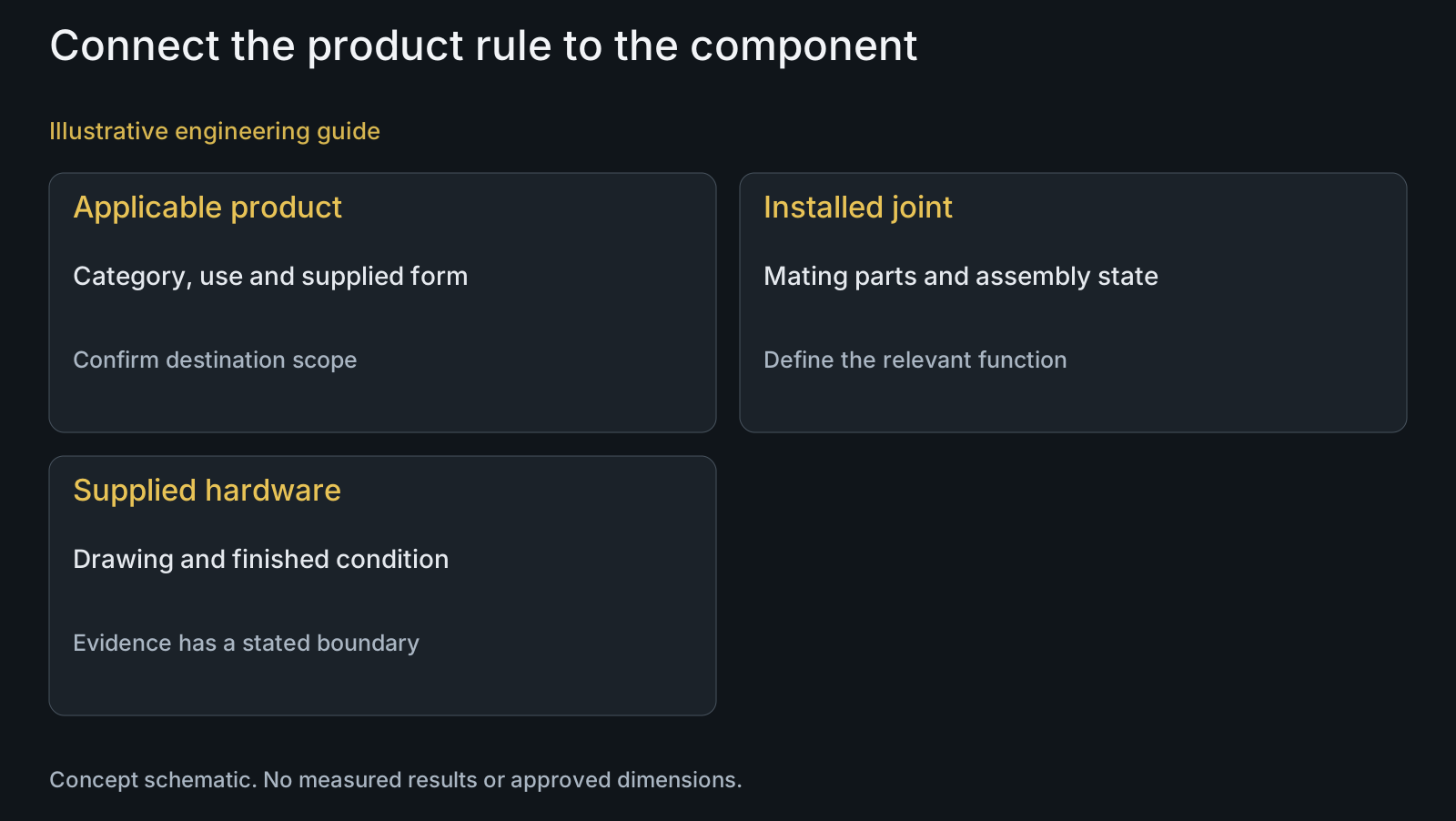
Ask the bicycle engineering team to identify the affected joint function and required assembled condition. For a pivot, this can mean which faces clamp, which surfaces locate the bearing arrangement and which interfaces permit movement. Those engineering inputs are not all supplied by the name of a bicycle safety standard.
Link each relevant requirement to the drawing feature or assembly instruction that controls it. A shoulder length can influence the clamped stack; a finish can change the finished interface; the mating receiver affects thread engagement. The product team needs the actual geometry and assembly assumptions to decide how the joint will be evaluated.
Separate component acceptance from assembled-product testing. The pivot fit drawing guide covers feature definition. Do not invent one mandatory torque, property class or AS 1110/1111 requirement for every bicycle pivot without the applicable clause and project specification.
Do not transfer Australian scope to New Zealand automatically
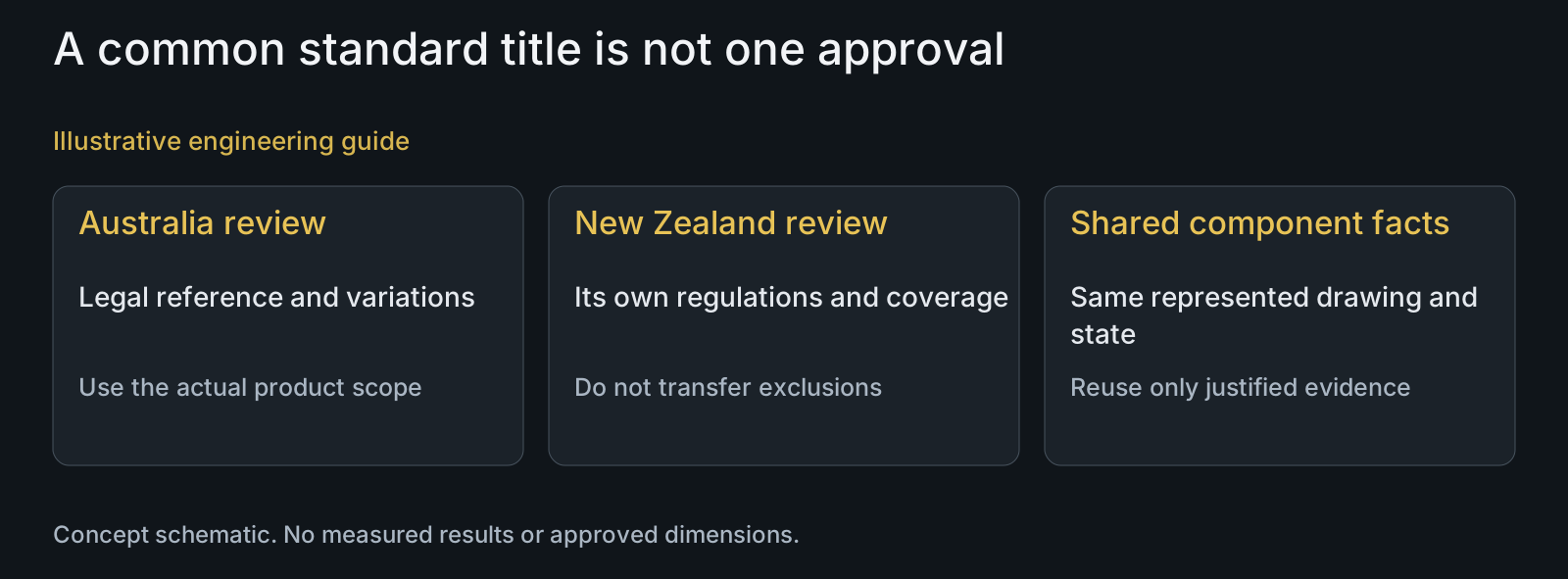
New Zealand's Commerce Commission describes its own regulations adopting AS/NZS 1927:1998 with amendments and covering partially assembled or sub-assembled bicycles. Its published competition exclusion has conditions different from the broad Australian competition description. A common standard title therefore does not establish identical legal coverage.
Use separate applicability entries for the two destinations even where the hardware drawing is unchanged. Identify the represented bicycle, supply form and intended use for each. Then determine which component information can be shared and which product assessment or instructions need destination-specific review.
Do not label an Australian assessment New Zealand approval by changing a cover page. Keep the assessment's represented configuration and rule scope visible so the product team can make an informed decision rather than assume the same prefix resolves it.
Illustrative engineering example: unchanged pivot, changed supply form
Illustrative engineering example: assume an OEM uses one custom pivot configuration in a conventional pedal bicycle and a separate folding-bicycle project. Purchasing proposes one AS/NZS compliant hardware line for both. No actual bicycle, accepted test report or market clearance is represented.
The review separates the product-scope decisions instead of starting with two identical certificate requests. It also verifies whether the supposedly shared pivot operates against the same mating stack, receiver and assembly instructions. A common part drawing does not prove that the installed joints or product obligations are identical.
The manufacturing request then identifies the controlled component features and available evidence for each represented assembly. Product-level evaluation remains with the responsible team. The scenario demonstrates a better handoff, not a successful test or an exemption determination for a real folding bicycle.
Request evidence that answers the joint question
State what each requested record is intended to establish: material identity, finished feature measurements, a defined sample configuration or an assembled-product result. If a report covers only the supplied component, retain that boundary. Do not rename incoming inspection a complete-bicycle test.
PremFixer manufactures to the agreed drawings, samples, interfaces and BOM scope. Discuss relevant manufacturing and surface-treatment inputs, including finished dimensions and partner-supported work where agreed. No universal Australian approval or included market-access service is implied.
Provide the actual destination, bicycle category, supplied configuration and assigned assessment responsibilities with the RFQ. Use the customer decision knowledge center to connect the interface questions that need resolution before the component offer can support the product team's work.
Questions buyers need to confirm
Is the newest AS/NZS edition automatically the Australian mandatory requirement?
No. Check the legal instrument and its adopted reference. The published bicycle notice checked here names AS/NZS 1927:1998 with variations; a newer voluntary edition or ongoing review is not itself an enacted replacement.
Does this bicycle rule apply directly to every loose pivot bolt?
Do not treat a loose bolt as a complete bicycle. Identify the supplied object and applicable product scope, then identify the component requirements supporting the assembly assessment. Other relevant duties and contract requirements still need consideration.
Does a folding-bicycle exclusion prove that any hardware is acceptable?
No. Exclusion from the identified mandatory bicycle rule is not freedom from all safety obligations. Determine the actual product route and define the installed joint requirements rather than drop engineering verification.
Must every custom pivot use AS 1110 or AS 1111?
No universal requirement is asserted here. Identify the applicable clause and customer specification, and check whether the referenced fastener family represents the custom part. A borrowed standard feature does not define the whole pivot.
Can the same approval be used for Australia and New Zealand?
Not automatically. Their published scope descriptions differ despite the shared AS/NZS reference. Review the actual bicycle category and supplied configuration for each destination, then reuse only evidence whose represented scope remains justified.
What should an Australian-market hardware RFQ include?
Provide the destination, bicycle type and supply form, drawing or STEP and BOM, mating stack, material and finish, assembly assumptions and requested evidence purpose. Identify the product-assessment owner so component records are not mistaken for complete-bicycle approval.
Technical references and scope
ACCC: bicycles mandatory standard. Public covered bicycle and exclusion overview and signpost to the mandatory reference. Not a complete guide or individual product determination.
Australian Federal Register: Consumer Protection Notice No. 6 of 2004. In-force public record and linked notice schedule naming AS/NZS 1927:1998 with specified variations. Full incorporated standard requirements not reproduced.
ACCC: improving mandatory product safety standards. Public review process and pedal-bicycle review listing. A review is not an enacted amendment or a bicycle-specific transition announcement.
New Zealand Commerce Commission: pedal bicycles. Government guidance on its own adopted reference, supply forms and exclusions, including conditional competition coverage. Not identical Australian scope or a real approval.
Explore related component, material and sourcing decisions in the customer decision knowledge center. For a drawing review, use the Drawing/BOM RFQ path.
Define the Australian project's component handoff
Send the drawing or STEP and BOM, mating interfaces, finished condition, bicycle category and supply form, plus the responsible team's applicable requirements. PremFixer can discuss the manufacturing inputs and component evidence needed for a defined joint review.
Discuss the drawing and BOM