

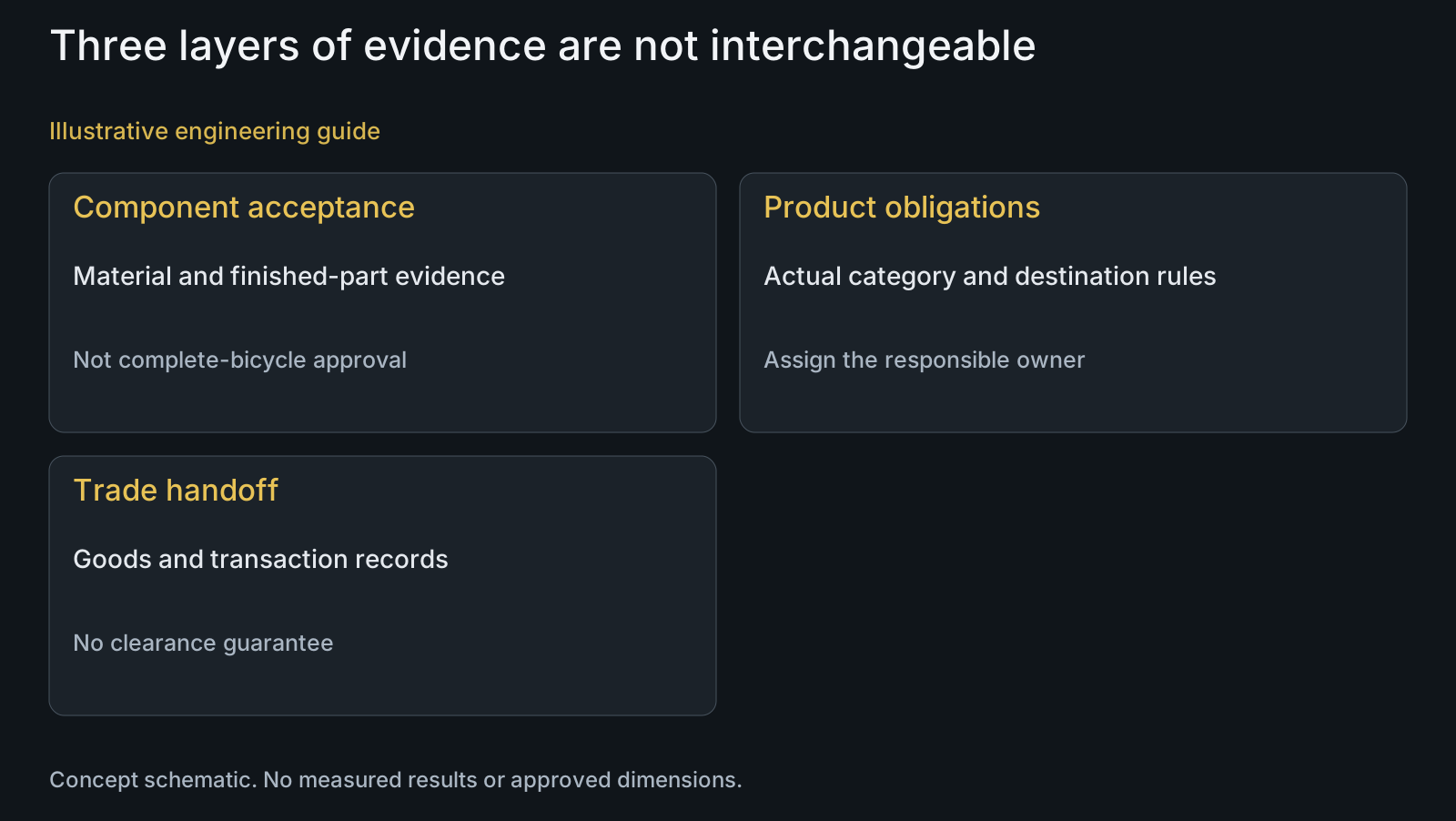
Prepare export documents for bicycle pivot hardware by identifying what is actually entering the destination market: loose components, an assembly or a complete bicycle. Then separate component-quality evidence, applicable product obligations and trade records. The EU, US and Japan do not create one interchangeable certificate pack for every bolt. The intended application, product category, buyer specification and responsible importer can change the required work. Ask which decision each document supports and who must issue or accept it. A full folder can still be inadequate if it covers the wrong product, while a missing applicability decision cannot be repaired by ordering an unrelated certificate.
Hero: concept illustration of example hardware and its application. It is not a factory photograph, tested component or approved production geometry.
Describe the imported object before naming certificates
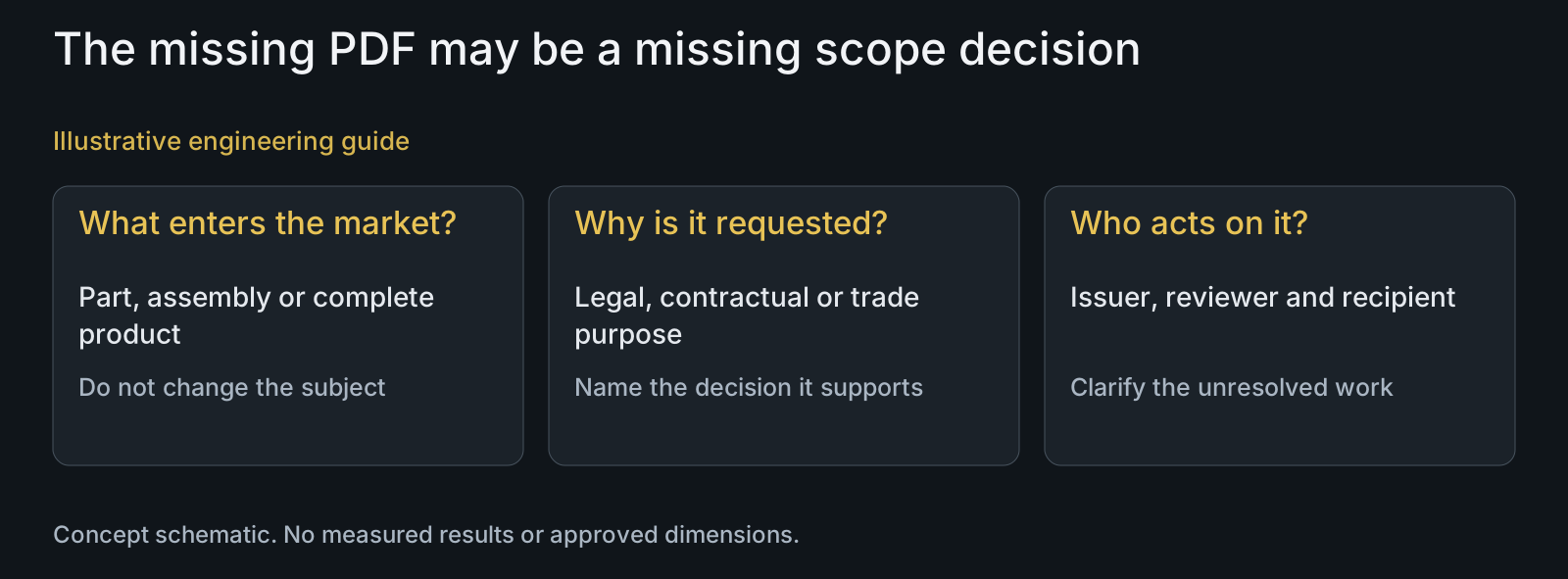
State the item numbers, delivered configuration, intended use and destination. Distinguish a pivot kit supplied to an OEM from a complete bicycle offered for sale. Also identify whether the import is a production component, a replacement assembly or another defined product; do not silently apply one category's rules to another.
Separate a legal requirement from a contractual request. A buyer can require a particular report even where that report is not a universal border document. Record both its purpose and the party evaluating it so purchasing does not describe every requested file as government certification.
The custom-order document guide explains material and inspection coverage. This article instead organizes the destination handoff and product-level responsibility, rather than repeating the differences between every inspection-document type.
EU: do not convert component records into automatic CE approval
Your Europe states that CE marking applies only where specific harmonised EU rules require it and must not be used where no such requirement exists. Determine the applicable product category and rules before asking for a CE certificate for an unidentified pivot item.
The responsible manufacturer assesses the product within the applicable scope. Component material, dimensional or substance evidence can contribute to that work without becoming approval of the complete bicycle. The CE scope guide addresses that boundary in detail.
Give substance requests their own scope, including the supplied finish and compounds where relevant. Use the SVHC document guide and e-bike substance-evidence guide for their respective questions. Do not present REACH, RoHS and CE as three identical certificates that every loose fastener must carry.
| Destination or purpose | Identify first | Relevant evidence question | Risk and responsible review |
|---|---|---|---|
| EU product-rule assessment | Actual product and applicable rule scope | What component evidence supports the responsible product assessment? | CE must not be assumed for every part; product-compliance owner decides scope |
| EU substance request | Supplied configuration and represented substance requirements | Does the evidence cover substrate, finish and relevant compounds? | A bare-metal record may miss added materials; responsible chemical reviewer assesses scope |
| US product certification | Imported object, intended user and applicable rules | Which certification and current submission obligations apply? | A supplier PDF is not automatically the importer's certification work |
| Japan standard or certification request | Named JIS, edition and represented product | Is evidence against the specification or JIS Mark certification requested? | A drawing statement is not a JIS Mark approval; importer and certification route clarify |
| Component acceptance in any destination | Drawing, condition and represented lot or sample | Which material and inspection results are contractually needed? | A material certificate does not test the complete bicycle; buyer acceptance scope governs |
| Trade records for the actual shipment | Goods identities, transaction and document purpose | Which records and accepted delivery arrangements apply? | Clearance is not guaranteed by folder size; importer and relevant trade specialists review |
US: distinguish bicycle requirements from the certification subject
CPSC identifies 16 CFR part 1512 as the bicycle requirements and describes evaluation of assembled bicycles, including assembly according to instructions for products offered partly assembled. That context does not turn a stock-material report into a test of the finished bicycle.
CPSC's public certification guidance distinguishes applicable general-use product certification from children's-product certification. Establish the actual product and intended user category with the responsible manufacturer or importer; do not treat CPSIA as the name of one universal supplier-issued bolt certificate.
For a children's product within the relevant rules, CPSC describes the responsible domestic manufacturer or importer and the required certification basis. Its current guidance also directs importers to electronic-filing requirements. Confirm the applicable current submission work for the real entry instead of assuming that placing a PDF in the carton completes it.
Japan: separate a named JIS requirement from JIS Mark certification
A drawing reference to a Japanese Industrial Standard needs the standard number, edition, represented product and acceptance purpose. The word JIS alone does not tell the supplier which geometry, material, test or certification arrangement the buyer wants.
METI describes JIS Mark use through certification by a registered third-party certification body. JQA's public scheme explanation distinguishes product conformity and appropriate quality control. A supplier statement against a drawing is not automatically that certification, and this guide does not claim that every imported pivot needs the mark.
Ask the Japanese importer which actual product obligations apply and which additional customer requirements must be met. If JIS Mark certification is requested, identify the covered standard, product scope and accepted certification route. Do not add a mark or infer eligibility from a generic material document.
Illustrative engineering example: one component order, two destination uses
Illustrative engineering example: assume an OEM orders one pivot-kit configuration for assembly programs in the EU and Japan. A purchasing spreadsheet initially labels both shipments all compliance certificates, without identifying the imported object or final-product responsibilities. No actual clearance or compliance finding is assumed.
The team replaces that line with separate entries for component evidence, destination product questions and shipment records. The EU reviewer determines the relevant product-rule scope; the Japanese reviewer clarifies whether a named JIS requirement is contractual, part of an applicable obligation or a request for JIS Mark certification.
An existing material report may support the same represented material scope, but it does not close either destination's product assessment. The lesson is not to generate two larger folders. It is to identify the unresolved decision, its owner and the evidence actually needed before making a shipment commitment.
Agree the destination handoff without promising clearance
For each selected record, name the represented item, requirement purpose, issuer or responsible role, intended recipient and relationship to the order or shipment. Identify what remains unavailable and which action it prevents. An applicability question, a missing test and a packing-reference mismatch require different responses.
Keep trade-document work separate from component acceptance. The origin-document handoff guide and customs-classification guide address adjacent import questions. Neither a genuine origin document nor a dimensional pass guarantees market access.
PremFixer can discuss evidence within the agreed manufacturing scope, with destination requirements supplied by the responsible parties. Confirm extra testing, certification or submission work before assuming it is included. Use the customer decision knowledge center to connect these decisions while keeping their responsibilities distinct.
Questions buyers need to confirm
Is there one certificate pack for EU, US and Japan pivot shipments?
No universally sufficient package is asserted. Establish the imported object, intended use, applicable requirements and responsible parties. Select evidence for defined purposes instead of copying one country's certificate names into every order.
Must every loose pivot bolt have a CE mark?
Do not assume that. CE marking depends on specific applicable EU product rules and must not be used without that basis. Ask the responsible product reviewer to establish the actual item's scope before requesting a marking or certificate.
Does a material certificate establish 16 CFR part 1512 compliance?
No. It represents its stated material evidence, not evaluation of the complete bicycle. Determine the actual product assessment and certification responsibilities separately from incoming component acceptance.
Is CPSIA one report that PremFixer can attach to every US order?
No universal report with that role is claimed. Product category and applicable rules determine the relevant certification work. The responsible manufacturer or importer must address its scope and current submission requirements; component evidence has a different role.
Does a JIS reference on a drawing permit JIS Mark use?
Not by itself. Identify the named standard and specification requirements, then distinguish them from JIS Mark certification through an appropriate registered body. No certification or marking eligibility is inferred from the drawing reference.
What should I submit for a destination-specific document review?
Provide drawings and BOM, the imported configuration and intended use, destination, importer instructions and requested document purposes. Include the represented order or lot and required issuers or submission roles so gaps can be assigned without promising customs clearance.
Technical references and scope
Your Europe: CE marking. Public marking applicability and responsible manufacturer boundary, not an individual pivot classification or product approval.
CPSC: Bicycles. Public 16 CFR part 1512 bicycle and assembly assessment context. No exact test recipe or individual component exemption asserted.
CPSC: Testing and Certification. Public distinction between applicable general-use and children's-product certification responsibilities, not a real import determination.
CPSC: Children's Product Certificate. Public certification basis and responsible party, with current electronic-filing guidance signpost. No individual entry filing or blanket application to all loose hardware.
METI: JIS Mark system. Public indexed explanation of registered third-party certification for JIS Mark use. No blanket Japanese import requirement or PremFixer certification asserted.
JQA: JIS Mark Certification. Certification body's own public scheme explanation of product conformity and quality control. No actual certification application or approval.
Explore related component, material and sourcing decisions in the customer decision knowledge center. For a drawing review, use the Drawing/BOM RFQ path.
Define the export evidence for your actual hardware order
Send the drawings, STEP or item-level BOM, delivered configuration, destination and importer requirements. Identify the intended use and each requested document's purpose. PremFixer can discuss the component evidence and agreed handoff while the responsible parties resolve product and import obligations.
Discuss the drawing and BOM