
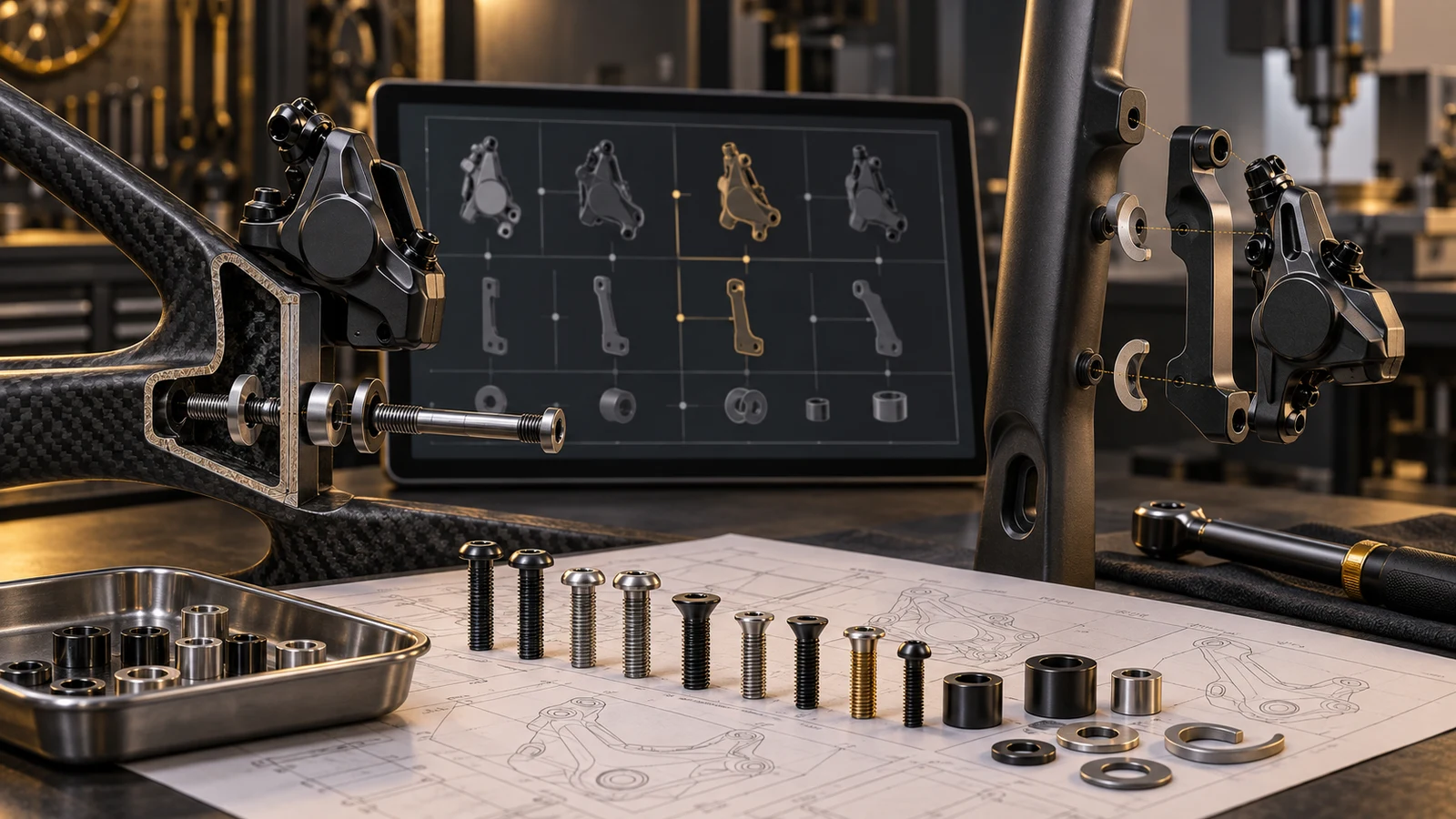
Specify bicycle brake-mount fasteners from the complete mounting configuration, not a preferred bolt material alone. The OEM or buyer is deciding which screws, brackets, spacers and retaining items belong to each represented frame or fork and caliper arrangement. Identify the mount, caliper version, rotor configuration and relevant installation requirements before quoting a common hardware family. A drawing-conforming screw can still be the wrong item for one variant. Keep caliper mounting distinct from body, pad-retaining and hose connections. For existing systems, use the manufacturer's applicable hardware and instructions; for custom development, make the configuration-to-BOM rules and approval responsibilities explicit before considering material or finish changes.
Hero: concept illustration of example hardware and its application. It is not a factory photograph, tested component or approved production geometry.
Create a configuration map before the hardware list
Name the front or rear position, frame or fork interface, caliper reference and version, bracket where present, and represented rotor size. Attach the applicable manufacturer or OEM requirement to that combination. Do not use disc brake as the complete application field.
Two builds can use a similarly named caliper but require different mounting components. Conversely, an unchanged screw may remain valid in several explicitly reviewed combinations. The configuration map should express those relationships rather than assume either universal interchangeability or a separate screw for every bicycle.
The caliper material-substitution guide examines whether a proposed titanium part can replace defined hardware. This guide establishes which hardware definition applies to each build before that part-level comparison begins.
Distinguish the connection and its mating-item requirements
Separate a screw passing through the frame into a caliper from one joining a bracket to a mount or the caliper to a bracket. Identify the receiver and head contact for each connection. One drawing can omit an entire second attachment if the bracket is treated only as background geometry.
SRAM's mounting specification distinguishes flat, post and IS arrangements and separates offset-tab from inline-tab caliper hardware. Its charts include configuration-specific brackets, spacers and washer relationships. This supports identifying the actual combination, not copying a chart entry into an unrelated custom brake.
Where curved alignment washers or another specified mate are required, include their order and identities in the controlled assembly definition. Do not add or omit washers based on appearance. A component that alters the contact stack also affects the question the bolt-length review must answer.
| Specification approach | Useful condition | Risk if used alone | Verification needed |
|---|---|---|---|
| Material or strength label | Early candidate discussion | No mount or mating-item definition | Actual part and assembly requirements |
| One screw drawing | Manufacturing a defined component | Wrong item supplied to another variant | Connection-specific applicability |
| Mount-type description | Identifying the interface family | Caliper and bracket differences hidden | Exact represented component combination |
| Configuration-to-BOM map | Several reviewed build variants | Rule becomes stale after a component change | Current variant and constituent definitions |
| Configuration sample set | Assessing represented prototype builds | One sample treated as every variant | Explicit coverage and unresolved variants |
| Complete delivery-kit definition | Preventing picking or packing omissions | Kit completeness called brake approval | Identity checks separate from application evidence |
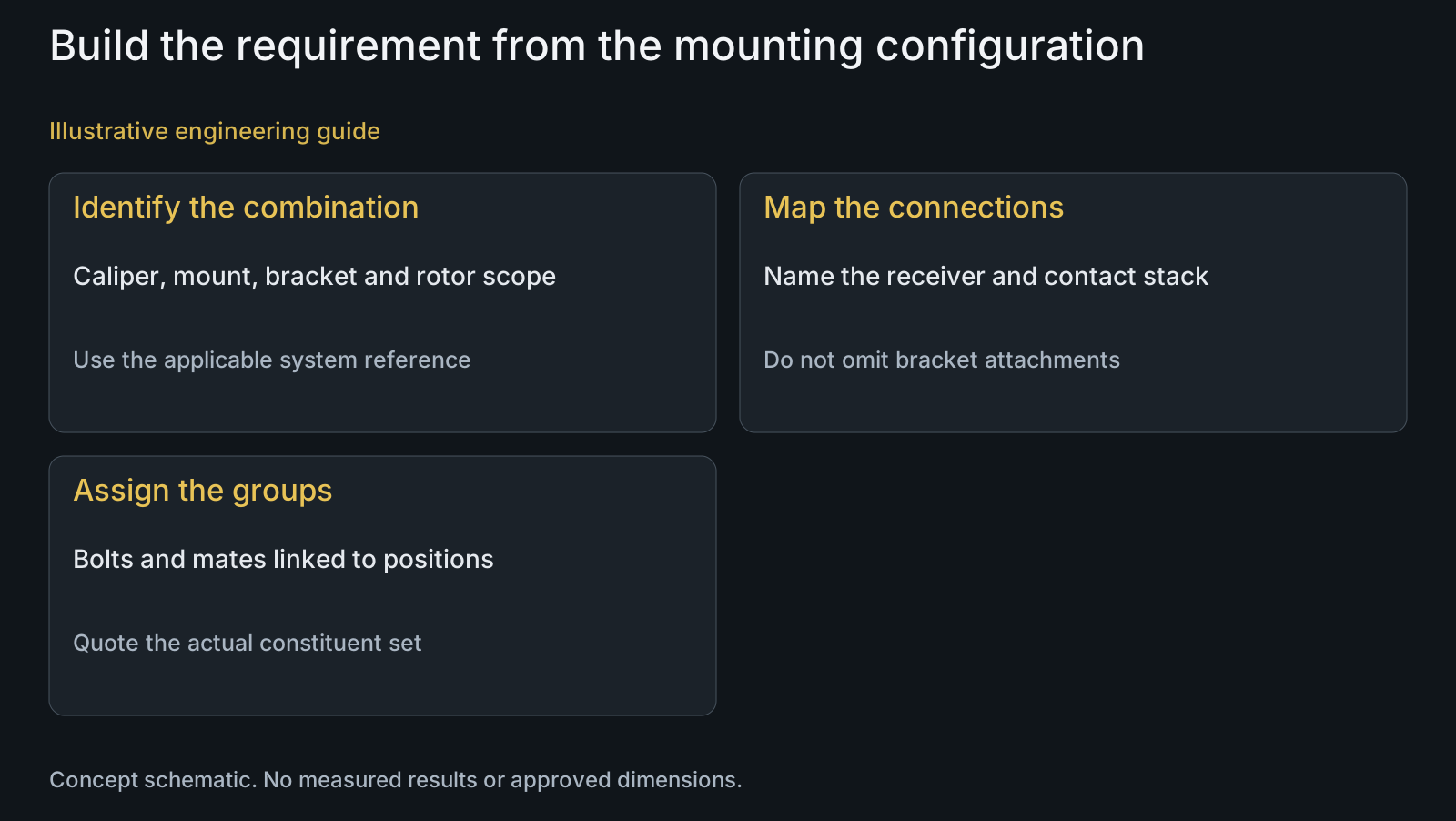
Assign bolt groups from the complete stack and receiver
For each connection, show the parts between the head reference and receiving thread. Identify the useful thread region, engagement requirement and allowed projection from the controlling system definition. Overall screw length is an input, not the assembled result.
SRAM's flat-mount tables relate boss thickness to selected hardware, while its post-mount illustrations distinguish upper and lower groups for some arrangements. These are named-system relationships; neither a published length nor an engagement interval is treated here as a universal custom-component limit.
Keep both excessive reach and inadequate overlap visible in the review. The effective-engagement discussion explains why nominal length is insufficient. It does not authorize a brake installation or justify trimming a service screw to an assumed fit.
Write variant rules so a quote describes the right set
Give each bolt and mating item a controlled part identity, quantity and position. Record which assembly variants use it. If two variants share a part, state the shared definition; if their length or head requirements differ, do not hide that distinction under one purchasing description.
A supplier quotation needs the quantities for each actual set as well as the total project volume. A blended total can conceal a missing low-volume configuration. Define whether the requested delivery is loose parts, separated groups or configuration-specific kits without assuming a factory inventory service.
Use drawings, STEP and annotated BOMs for manufacturing review. State the represented sample configurations so prototype quantities cover the intended questions. A sample from only one mount does not demonstrate the completeness of every kit variant.
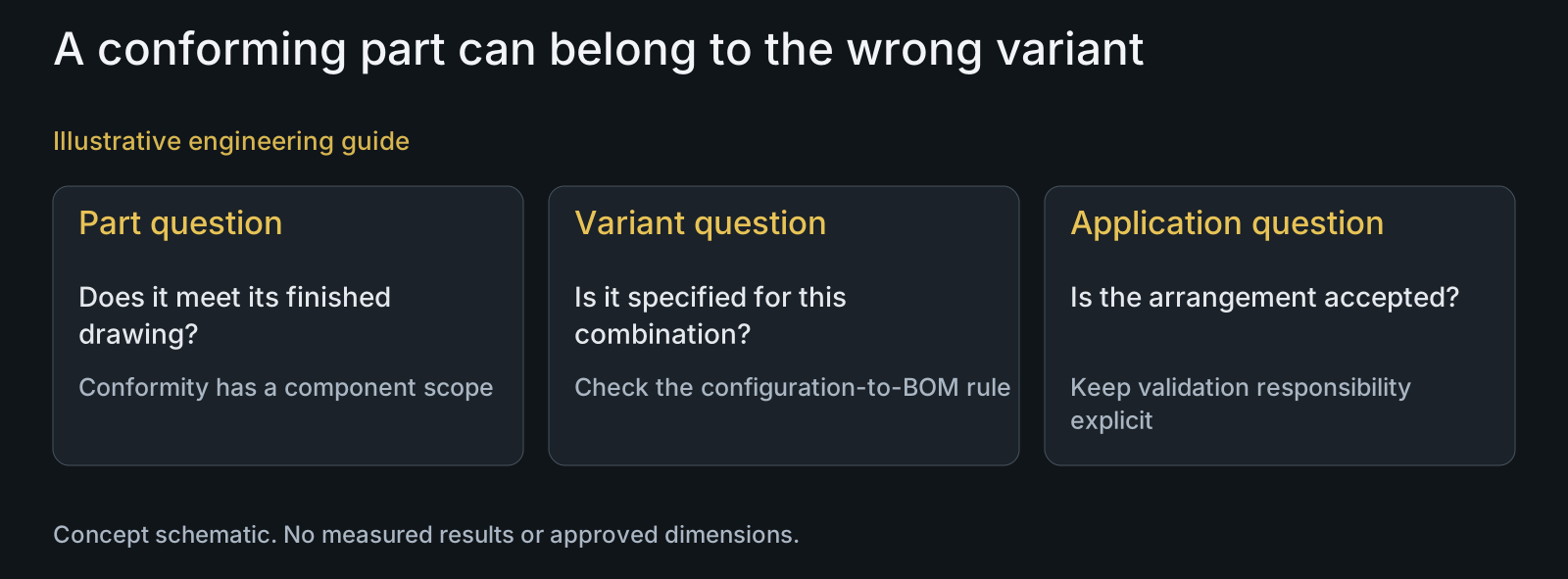
Keep manufacturing acceptance and mounting applicability separate
Specify material grade and condition, finished geometry, surface requirements and the appropriate inspection basis for each part. A preference for titanium or a high steel property class does not define the complete mounting hardware. No universal material recommendation or blanket material ban is made here.
Keep locking or preparation requirements with the applicable assembly and supplied surface. Review changes through the surface-treatment scope rather than infer unchanged assembly behavior from a matching decorative color.
Treat changes to the caliper, bracket, mount or relevant frame feature as configuration changes even when the individual bolt drawings remain unchanged. Determine whether the existing BOM rule and instruction still apply. Part conformity cannot by itself establish a revised mounting arrangement's compatibility or brake performance.
Review example: a caliper change leaves the bolt order untouched
Illustrative engineering example: assume an OEM has a reviewed hardware list for one post-mount assembly and proposes a different caliper configuration. Purchasing retains the earlier bolt and washer set because the nominal mounting thread appears unchanged. No engagement, torque or brake-test result is assumed.
The reviewer first identifies the proposed caliper's applicable bracket and mating-item requirements. They then map each resulting connection and compare its stack with the earlier definition. The original screw's dimensional conformity does not settle whether it belongs in the revised set.
The purchasing list is updated only from the resolved configuration relationship, with changed and retained groups explicit. This example exposes a variant-control gap rather than declaring the old set defective or the new arrangement acceptable from a visual comparison.
Questions buyers need to confirm
Can brake fasteners be chosen only by strength?
No. Identify the mounting connection, receiving part, head contact, usable thread and assembly state. Then specify the material condition and evidence for that configuration. A strength label alone does not define a compatible brake-mount part.
Can one master bolt serve every mount variant?
Only when applicability is established for those exact variants. Compare their stacks, receivers and head requirements. Shared nominal thread is insufficient, and a family-level description should not conceal different length or mating-item groups.
Should brackets and washers be included in the RFQ?
Include their controlled definitions when they form part of the represented mount, even if another party supplies them. Identify what PremFixer's quotation includes and what remains a mating input. Otherwise the screw may be reviewed against an incomplete stack.
What changes if a different caliper is introduced?
Review the applicable mounting hardware, bracket and required mating items for the new configuration. Compare each connection before retaining the earlier BOM rule. Unchanged thread size does not prove the old set remains applicable.
Does inspecting every screw prove the delivery kit is correct?
Not by itself. Inspecting component features and checking variant identity, quantities and constituent selection answer different questions. A conforming screw can still be picked for the wrong build, and kit completeness does not establish application performance.
What should a multi-variant brake hardware RFQ contain?
Provide the front/rear configuration list, caliper and mount references, brackets, rotor scope, assembly drawings and position-linked BOMs. Include receiver and finished-part requirements, applicable instructions and prototype coverage so the quote represents the actual variants.
Technical references and scope
SRAM MTB and road disc-brake caliper mounting specifications. Rev V, 2025: named mounting configurations connect caliper types, brackets, washers, boss thickness and bolt groups. Numeric dimensions and engagement intervals are not generalized to custom systems.
Explore related component, material and sourcing decisions in the customer decision knowledge center. For a drawing review, use the Drawing/BOM RFQ path.
Quote the correct brake hardware for each build
Send configuration drawings or STEP, caliper and frame/fork references, bracket and mating-item definitions, variant BOM quantities and finished-part requirements through the Drawing/BOM RFQ path. PremFixer can review component manufacture and kit scope while your team controls mounting applicability and validation.
Discuss the drawing and BOM