
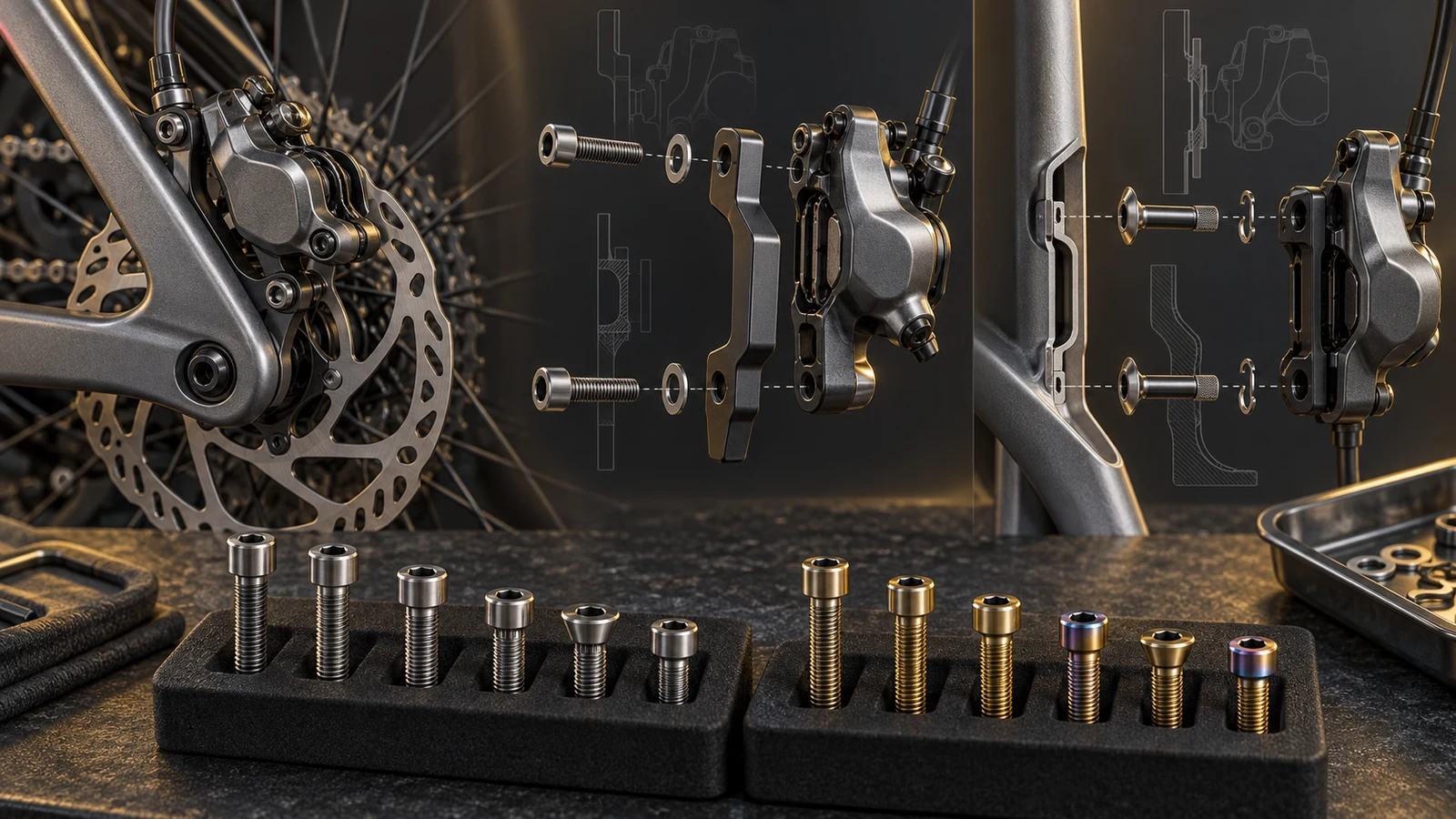
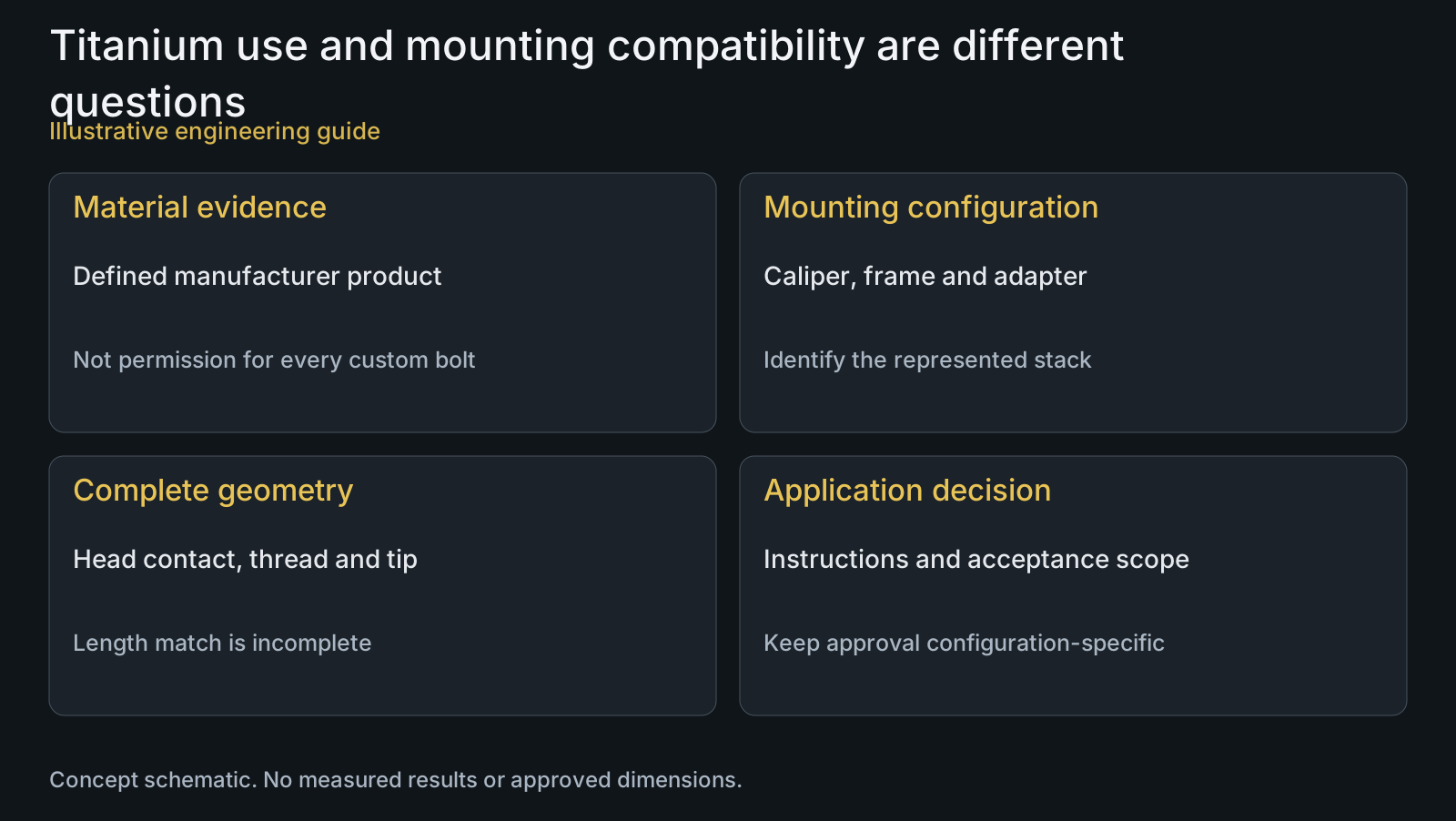
Titanium can be used in manufacturer-defined disc-brake caliper mounting hardware, but that does not make any matching titanium screw an approved substitute. SRAM lists titanium among its caliper mounting-hardware materials; the applicable product and installation scope still matter. Identify the brake, mounting type, adapter, frame or fork and required retaining parts, then compare the complete bolt definition. Length and thread alone leave head contact, engagement and retention unresolved. PremFixer can review drawing-defined custom manufacture, while compatibility and application approval must remain explicit. This is a caliper mounting connection, not automatically a suspension pivot or permission to alter the brake body.
Hero: concept illustration of example hardware and its application. It is not a factory photograph, tested component or approved production geometry.
Separate caliper mounting from other brake fasteners
Locate the proposed component on an assembly view. A bolt securing the caliper to the bicycle is different from a caliper-body fastener, pad-retaining item or hose connection. The same brake contains different functions, and an instruction for one location does not govern them all.
Identify the brake model, front or rear location, frame or fork and rotor configuration. Include the mount and any adapter rather than naming only the caliper. A change to an associated component can change which hardware definition applies.
Keep this distinction visible in the RFQ and service reference. The V-brake hardware guide concerns a different rim-brake mechanism; its mounting relationships are not a disc-caliper instruction. A shared material preference does not make the two interfaces equivalent.
Recognize a titanium option without generalizing its approval
SRAM's DB-ACC-MTHW-A2 product information includes titanium caliper mounting hardware. That is direct evidence that titanium is not categorically excluded from all such products. It is not evidence that an unrelated custom part, material condition or mounting configuration has the same approval.
Separate a specified manufacturer replacement from an OEM development candidate. For the replacement, identify the applicable product, size and instructions. For the candidate, state the component requirements and who will assess its use in the represented brake assembly.
Specify the alloy and condition instead of treating titanium as a complete manufacturing instruction. Review the finished geometry and surface route through materials and CNC turning. No universal TC4 recommendation, material ban or accepted brake-performance claim is established here.
| Candidate or condition | What it establishes | Risk | Review basis |
|---|---|---|---|
| Manufacturer titanium option | A defined product uses titanium | Assuming any custom titanium screw inherits approval | Applicable product and installation scope |
| Matching total length | One observed geometric field | Different effective engagement or head contact | Actual stack and receiver definition |
| Changed frame thickness | A different mounting relationship | Reusing a length from another frame | Applicable length-selection procedure |
| Changed adapter | A different component stack | Omitted required mounting or mating part | Correct mount and adapter specification |
| Different tip or retaining feature | A potentially changed retention relationship | Treating it as cosmetic geometry | Specified part and retaining-item BOM |
| Changed finish or locking treatment | A changed assembly condition | Borrowed torque correction | Approved instruction applicability |
Review the mount, adapter and frame stack together
Flat-mount and post-mount arrangements have different mounting geometry. SRAM's support explanation distinguishes them and directs users to the fork/frame specifications and caliper mounting specification sheet. Identify the represented arrangement before selecting a bolt or adapter.
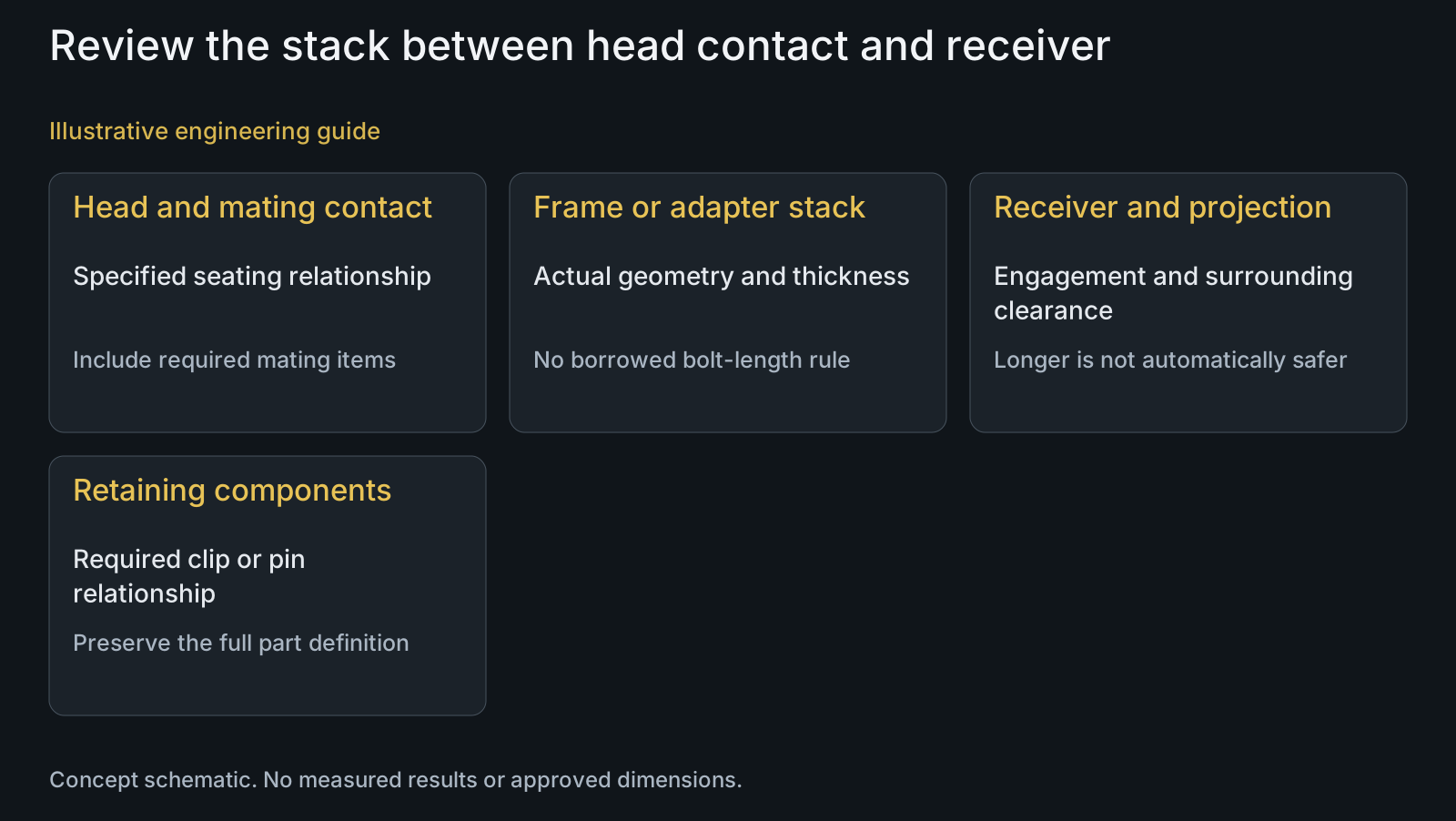
Engineering analysis: show the components between the head contact and receiver, including the adapter and any required mating items. Describe which part receives the thread and what constrains the selected bolt length. Nominal total length is not the same as effective engagement in the assembled stack.
If the stack changes, check the entire relationship. The thread-engagement guide explains that distinction without assigning a universal caliper ratio. Do not compensate for an unverified stack by adding arbitrary washers or altering a bolt.
Preserve length selection and retaining geometry
Shimano's DM-BR0004 dealer manual includes model-specific bolt-length checks related to frame thickness and separate mounting/retaining items. It illustrates why a nominally similar screw is an incomplete replacement definition. Use the applicable model procedure for an actual installation, not a dimension borrowed from another brake.
Compare head contact, thread and shank regions, tip form and any retention-related feature shown in the specified part. If a clip or pin is required, include its identity and relationship in the BOM. A decorative or lightweight screw can match overall length without matching those functions.
The risk is not solved by choosing more thread length. Excess projection and inadequate engagement are different concerns and must be assessed against the actual receiver and surrounding geometry. Establish the required final definition instead of assuming longer means safer.
Carry the approved assembly condition into manufacture
Include the specified surface, locking treatment and installation reference with the replacement definition. A change to material or coating can require a review of the instruction's applicability; a generic torque adjustment percentage is not a substitute for that decision.
Discuss functional finish requirements through surface treatment. Identify which features are inspected in the final state and what supplied kit the quotation covers. Dimensional conformity and kit completeness do not establish the whole brake's application performance.
Use the revision-compatibility guide to maintain the represented part and assembly boundaries. If a custom material change is approved for one mounting configuration, do not silently extend it to another frame, adapter or brake revision.
Review example: correct material, wrong mounting stack
Illustrative engineering example: assume an OEM team identifies a manufacturer titanium option but proposes a custom screw for a different represented frame-and-adapter stack. Its nominal thread and total length resemble a listed item. No installation, measured engagement or brake test is supplied.
The reviewer separates evidence of titanium use from the custom part's compatibility. It identifies the receiving thread, head contact, stack thickness and required retaining geometry, then compares them with the proposed drawing. The alloy remains a candidate while unresolved interface fields are made visible.
The resulting RFQ asks for manufacture of the defined component, not a declaration that all titanium caliper bolts are safe. The team can seek the applicable compatibility and validation decision before releasing the proposed substitution. No real customer approval or performance outcome is represented.
Questions buyers need to confirm
Are titanium caliper mounting bolts always prohibited?
No. Manufacturer-defined titanium mounting hardware exists, including SRAM's listed caliper hardware. That does not approve an arbitrary custom substitution. Match the applicable product and mounting scope or obtain the required OEM development decision.
Is equal bolt length enough to establish compatibility?
No. Compare thread and shank regions, head contact, receiver engagement, tip form and required retaining features in the represented stack. Overall length is only one field of the component definition.
Why does frame thickness matter in a flat-mount review?
It can affect the length-selection relationship specified for the actual mount. Use the applicable brake and frame instructions, not a dimension copied from another configuration. Include the represented frame, caliper and adapter where present.
Can a longer screw solve uncertain engagement?
Not by assumption. Review effective engagement and allowable projection in the actual receiver and adjacent geometry. More length can introduce a different concern; establish the required component rather than adding washers or modifying an unverified screw.
Can caliper-body screws be treated like mounting screws?
No. Identify the exact location and function. Body, hose, pad-retaining and frame-mounting components have different tasks and applicable service instructions. A mounting-material option does not authorize changes elsewhere in the brake.
What should a custom titanium caliper-bolt RFQ include?
Send the caliper model, frame/fork mount and adapter, component and assembly drawing or represented sample, BOM and quantities. Include receiver and contact geometry, retaining parts, specified alloy condition and finish, and applicable instructions. Identify the authority and evidence for any proposed substitution.
Technical references and scope
SRAM disc-brake mounting hardware DB-ACC-MTHW-A2. Manufacturer-defined titanium caliper hardware exists. No custom substitution, alloy condition or universal fit approved by that listing.
SRAM flat-mount and post-mount explanation. Mounting-geometry distinction and direction to actual frame/fork and mounting specifications. Numeric spacing not used as complete compatibility proof.
Shimano DM-BR0004 dealer manual. Model-specific frame-thickness/bolt-length checks and required retaining components. No installation dimension or torque transferred to another model.
Explore related component, material and sourcing decisions in the customer decision knowledge center. For a drawing review, use the Drawing/BOM RFQ path.
Review a custom caliper bolt within its complete mounting stack
Send the brake and frame configuration, mount and adapter details, component and assembly drawings or represented samples, BOM and quantities. Include receiver geometry, retaining parts, specified material condition and finish and the installation reference. PremFixer can review component manufacture while the custom substitution's compatibility and application decision remain explicit.
Discuss the drawing and BOM