
A low tightening torque does not by itself approve an aluminum bicycle pulley axle bolt. First establish what the bolt locates and retains, where the pulley rotates and which surface actually experiences relative movement. A bushing-and-sleeve arrangement differs from a bearing arrangement, and a chain-guide mounting fastener may serve neither role. For an OEM comparing lightweight hardware, review shoulder span, contact stack, receiver, final surface and component instructions together. Do not assume every bolt is the wear journal or that stainless or titanium automatically solves the interface. A material candidate needs a defined component and acceptance basis, not only a small wrench setting.
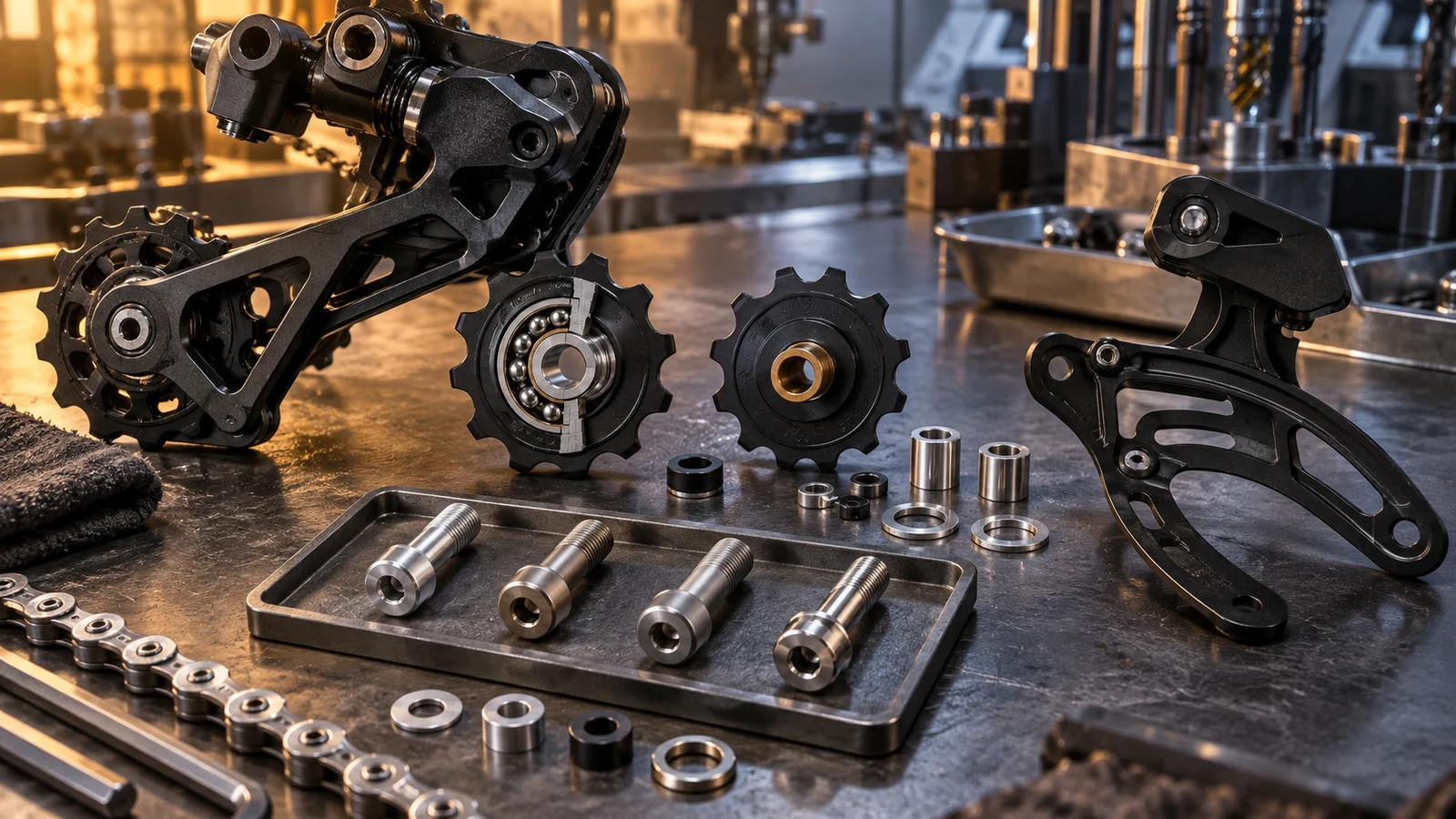
Hero: concept illustration of example hardware and its application. It is not a factory photograph, tested component or approved production geometry.
Identify the pulley or guide mechanism being ordered
Locate the ordered item on the assembly: a rear-derailleur guide pulley, tension pulley, separate chain-guide roller, upper guide or backplate connection. These names describe different mechanisms. Mark the component and part revision rather than asking the manufacturer to infer its function from a short bolt photograph.
Shimano's DM-GARD001 pulley-maintenance section distinguishes guide and tension pulleys and their model-specific orientation requirements. Use the applicable component document to identify the represented assembly. The instructions are not a universal pulley bolt drawing or permission to replace either item with an unapproved custom design.
A chain guide also contains hardware that mounts or adjusts non-pulley parts. OneUp's Bashguide parts list identifies separate mounting, guide and retaining items. Do not merge that assembly with a derailleur pulley merely because both manage the chain. The derailleur precision guide covers mounting versus internal hardware as a separate decision.
Find the moving interface before making a wear claim
Use a section or exploded view to show the pulley body, bearing or bushing, sleeve, shoulder and cage or bracket. Mark relative movement at each contact. Identify whether the proposed bolt directly serves a sliding interface, retains a separate sleeve or participates in a bearing-ring contact stack.
Engineering analysis: if motion occurs within a bearing, the bolt's alloy is not automatically the pulley body's sliding-wear material. If a sleeve or bushing slides on a defined journal, that pairing and final surface are relevant to the wear question. These are conditional distinctions, not a claim that all pulleys use one architecture.
Locate the observed wear if service parts are available. A worn tooth, damaged sleeve contact and marked bolt shoulder are different observations. Do not infer a material wear ranking without identifying the feature and conditions. The surface roughness guide relates a specified texture to its actual function rather than appearance alone.
| Arrangement or proposed change | Relevant decision | Shortcut risk | Useful verification |
|---|---|---|---|
| Pulley rotates on a separate sleeve | Sleeve contact and bolt retention | Bolt alloy assumed to be the wear journal | Relative-motion and contact map |
| Specified bearing arrangement | Ring support and retained stack | Sliding-wear rule copied to bearing hardware | Actual bearing and shoulder definition |
| Direct sliding contact on a journal | Material pairing and final surface | Alloy name treated as a wear result | Defined pairing and evaluation conditions |
| Shorter shoulder, same total length | Contact closure and span | Thread match mistaken for complete fit | Section and axial-stack comparison |
| Lighter head or alloy | Complete baseline and proposed part | Low torque treated as design approval | Geometry, final state and acceptance scope |
| Chain-guide adjustment hardware | Mounting, adjustment and retention role | Every guide bolt called a pulley axle | Applicable component definition and BOM |
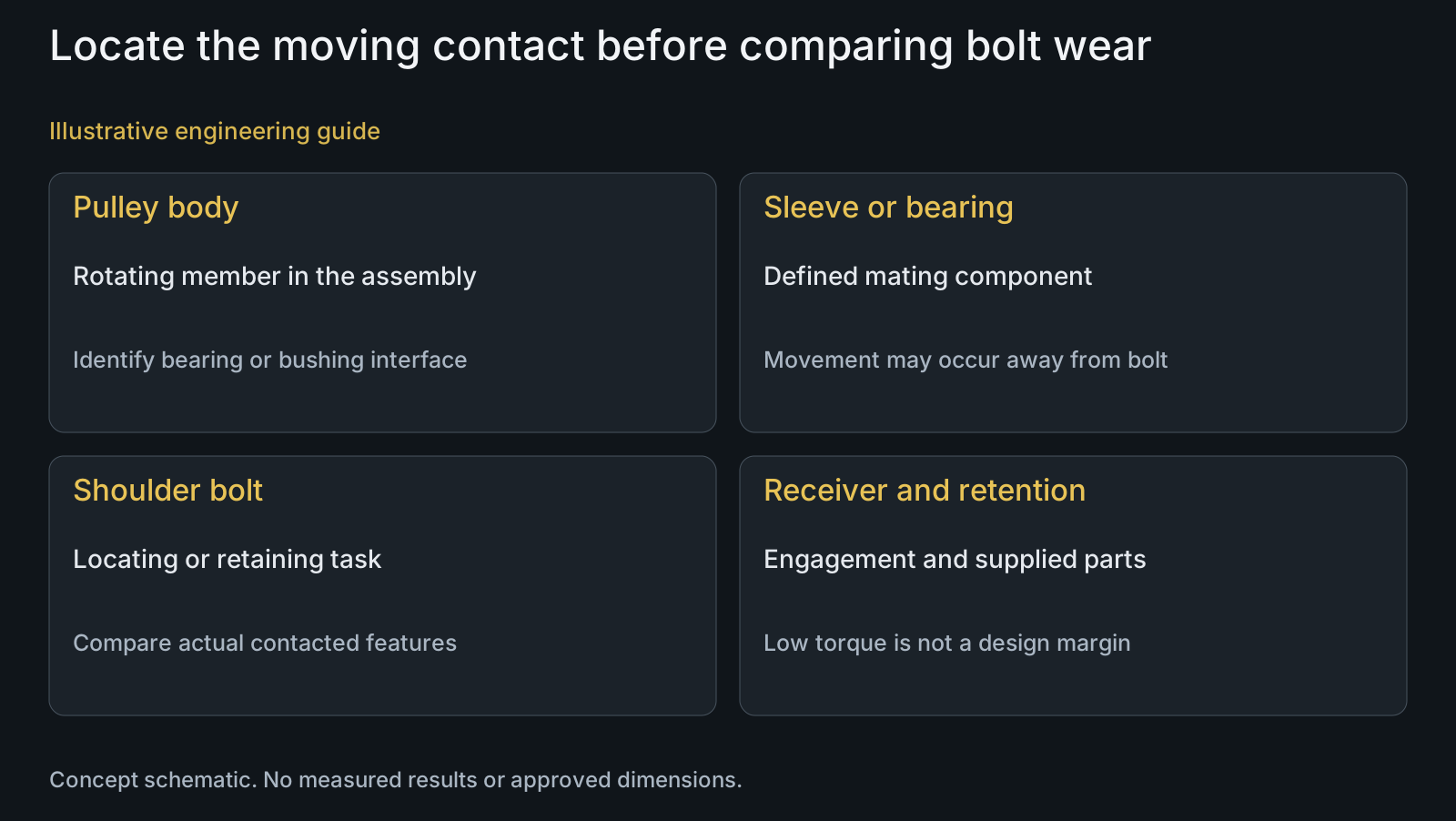
Check shoulder span and axial contacts with retention
Show which members the shoulder spans and which contact faces close when assembled. A matching overall bolt length can conceal a different shoulder length or threaded region. The proposal must establish the intended support and contact relationship, not simply pass through the pulley opening.
Identify the receiving thread, effective engagement, bottom clearance and required retaining features. A screw reaching a tightening setting does not prove that the intended stack has closed. Do not compensate for uncertain geometry with arbitrary washers or a longer screw.
Keep pulley movement and retained-stack acceptance distinct. Use effective engagement and the stack-up guide for those component relationships. An OEM should define any required represented-assembly check instead of treating hand rotation alone as full approval.
Compare material, geometry and surface as a complete candidate
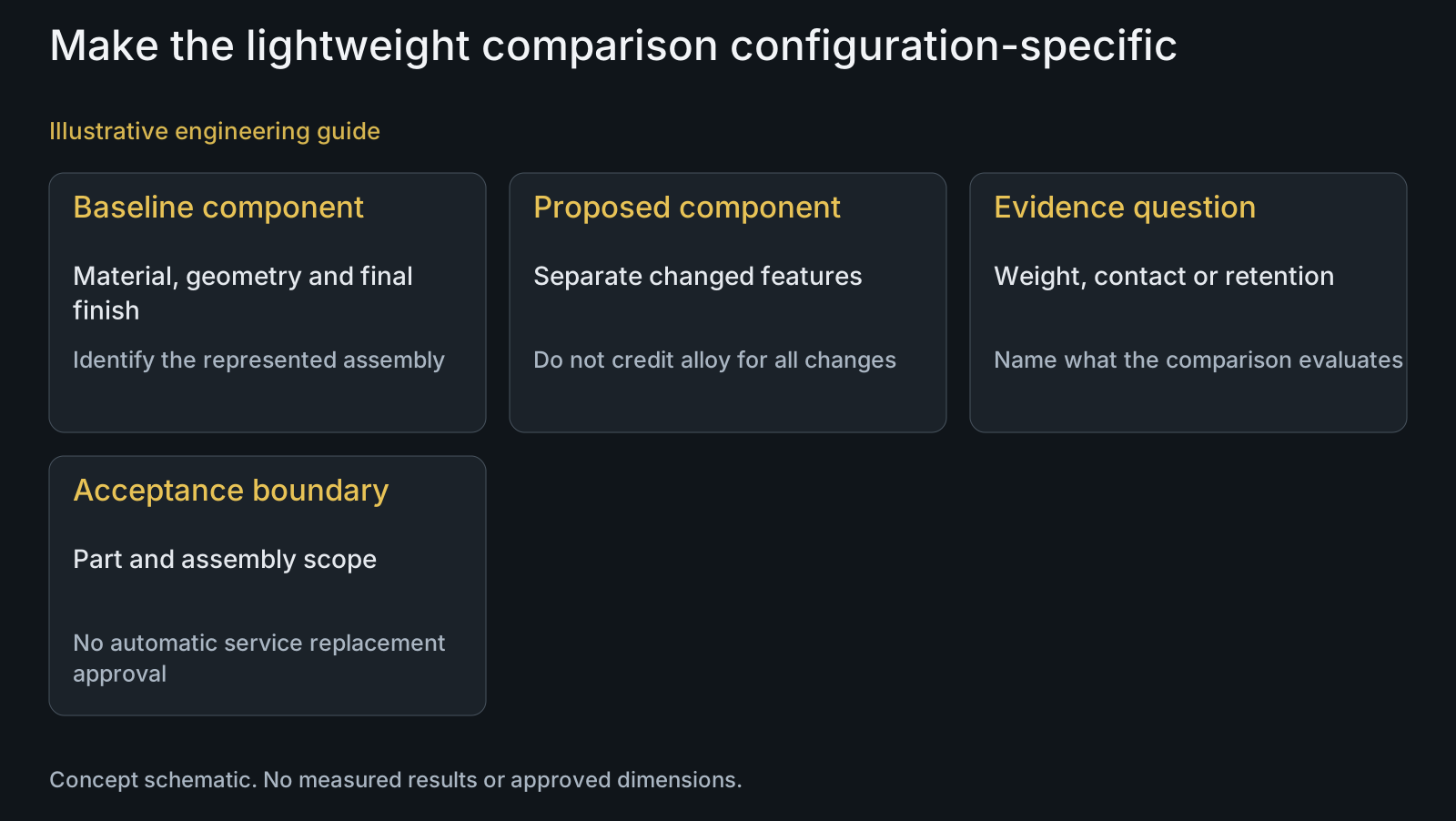
Record the baseline and proposed part definitions, including material condition, geometry and final treatment. If weight is the objective, identify which parts and quantities belong to the comparison. Do not attribute a change to material alone when a different head or shoulder has also changed the compared part.
Review candidate materials against the actual loading, receiver and moving-contact requirements. Aluminum, stainless and titanium labels do not specify the final properties or interface acceptance. A low installation setting is not a calculation of operating stress, retention margin or resistance to repeated service damage.
Discuss drawing-defined manufacture through CNC turning and functional finish through surface treatment. Identify the surfaces to inspect after processing. No universal alloy approval, wear-life ranking, mass saving or fatigue result is established by the conceptual comparison.
Preserve adjustment and service functions in a chain-guide option
If the ordered item belongs to a chain guide, identify whether it retains the guide, fixes its adjustment or mounts the backplate. The actual assembly may include specified shims, washers or retaining components. List their roles in the BOM rather than treating every short fastener as a pulley axle.
OneUp's V2 guide instructions distinguish guide-height and chainline adjustment from other mounting operations. This illustrates why hardware and associated parts need a location-specific definition. Follow the applicable manufacturer document for service; no adjustment recipe or universal shim package is prescribed here.
For a custom lightweight replacement, retain tool access, required contacts and the agreed compatibility scope. The revision-compatibility guide helps document which assembly the item represents. A smaller head or deleted retaining feature must not be described as an approved weight reduction without that review.
Review example: the retaining bolt is not the wear journal
Illustrative engineering example: assume a pulley turns on a specified sleeve while a bolt retains the sleeve within a cage. An OEM proposes a lighter bolt with the same thread but a changed shoulder length. No dimensional data, measured mass or wear result is assumed.
The reviewer separates the pulley-to-sleeve sliding interface from the bolt's retention task. It compares the shoulder and contact stack, receiver engagement and supplied finish. A statement that the lighter bolt will wear faster would need evidence at the actual bolt contact; a statement that low torque proves suitability would leave the geometry unresolved.
The RFQ therefore defines the complete candidate and the relevant component and assembly checks. It can evaluate manufacture and specify a fair comparison without asserting that either alloy is superior or that the proposed replacement is already authorized for the pulley assembly.
Questions buyers need to confirm
Can aluminum be approved because a pulley bolt uses low torque?
No. The installation setting alone does not establish operating loads, geometry or retention margin. Define the candidate's material condition, shoulder stack, receiver and actual contact functions, then obtain the appropriate component and application acceptance basis.
Is the pulley bolt always the surface that wears?
No. Map the actual movement. The pulley may move relative to a separate sleeve or within a bearing arrangement. A wear claim must identify the affected feature, material pairing, final surface and conditions rather than assume the retaining bolt is the journal.
Is equal overall bolt length enough for a replacement?
No. Compare shoulder span, threaded region, head contact, receiver engagement and required retaining features. The same total length can create a different axial-contact relationship in the pulley or cage stack.
Can a chain-guide mounting screw be specified like a pulley axle?
Not without identifying its function. A guide may use separate backplate, height-adjustment and guide-retention hardware. Include the actual location, associated parts and instructions instead of assigning a rotating-journal role to every screw.
How should a lightweight hardware comparison be reported?
Define the baseline and proposed components and included quantities. Separate material, geometry and finish changes. Report measured mass only when available for that defined set, and keep wear, retention and compatibility evidence separate from the weight comparison.
What should a custom pulley or guide hardware RFQ include?
Send the exact mechanism and part location, assembly section, drawing, STEP or represented sample and BOM quantities. Include bearing or bushing/sleeve contacts, shoulder stack, receiver, retention, final material and finish and applicable instructions. Identify the comparison and approval scope.
Technical references and scope
Shimano DM-GARD001 dealer manual. Model-specific guide/tension pulley maintenance and orientation distinctions only. No numeric torque or approved custom bolt geometry transferred.
OneUp Bashguide exploded view and parts. Separate mounting, guide and retaining items illustrate different fastener roles. Not a universal pulley assembly or replacement definition.
OneUp V2 Bashguard and Chainguide instructions. Location-specific guide adjustment, chainline and mounting distinctions. No numeric setting, shim recipe or permission for unapproved substitutions.
Explore related component, material and sourcing decisions in the customer decision knowledge center. For a drawing review, use the Drawing/BOM RFQ path.
Compare lightweight pulley hardware against its real contacts
Share the pulley or guide identity, component drawing, assembly section, STEP or represented sample and BOM. Include the bearing, bushing or sleeve arrangement, shoulder span, receiver, retaining parts, material condition, finish and quantities. PremFixer can review the custom candidate's manufacture without assuming that low torque or a material label establishes suitability.
Discuss the drawing and BOM