
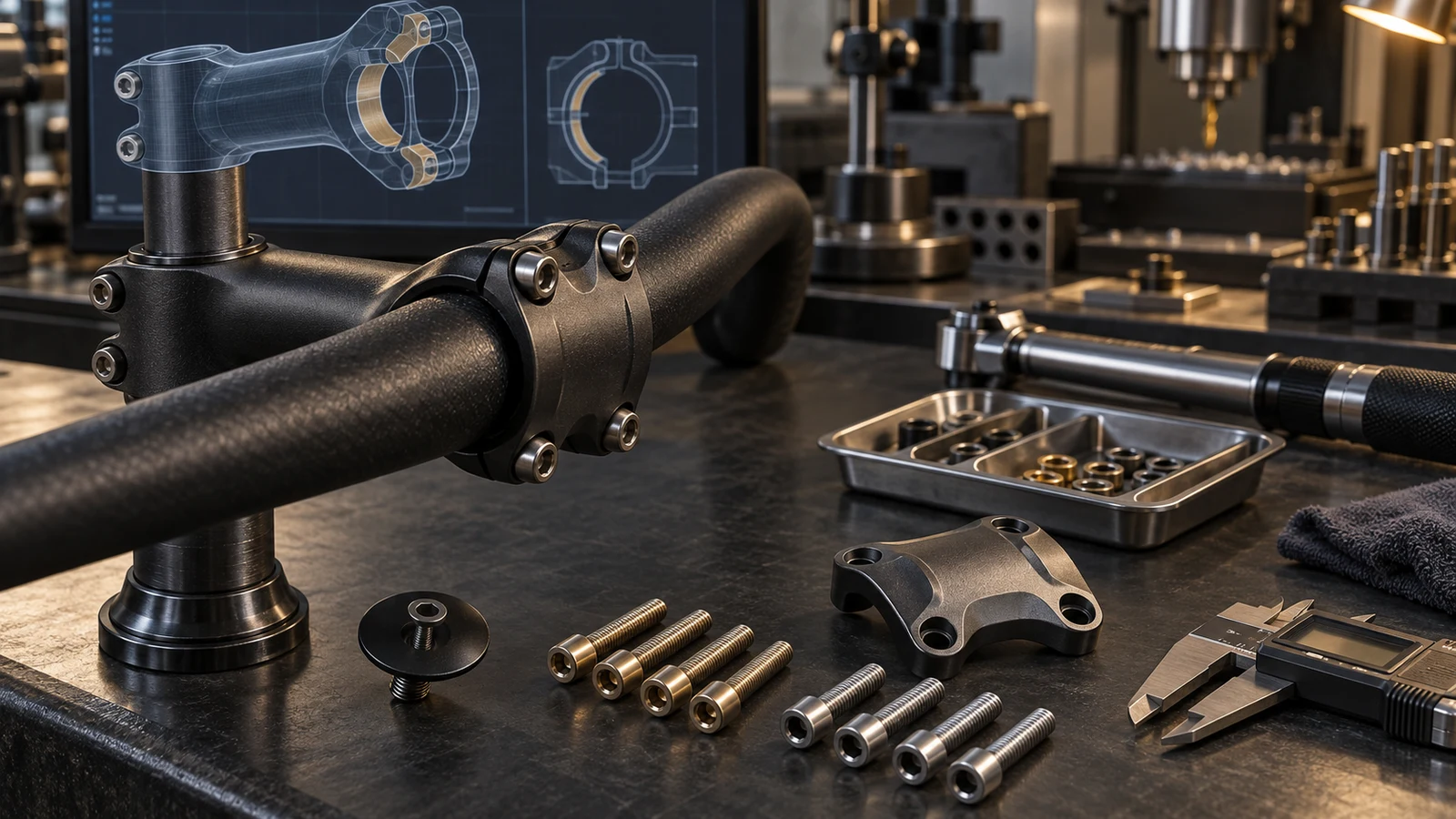
Titanium bicycle stem bolts can be a manufacturer-defined option, but matching the original thread size does not make an arbitrary replacement suitable. Identify the exact stem model and revision, bolt position, head contact, receiving thread and assembly instructions before changing hardware. Faceplate bolts clamp the handlebar; steerer-clamp bolts secure the stem; the headset top cap has a different adjustment role. For custom OEM hardware, define the complete candidate and its joint-level evaluation rather than selecting TC4 by name. The decision must preserve the intended clamp behavior and mating component limits, not merely achieve a lighter bolt or the same wrench setting.
Hero: concept illustration of example hardware and its application. It is not a factory photograph, tested component or approved production geometry.
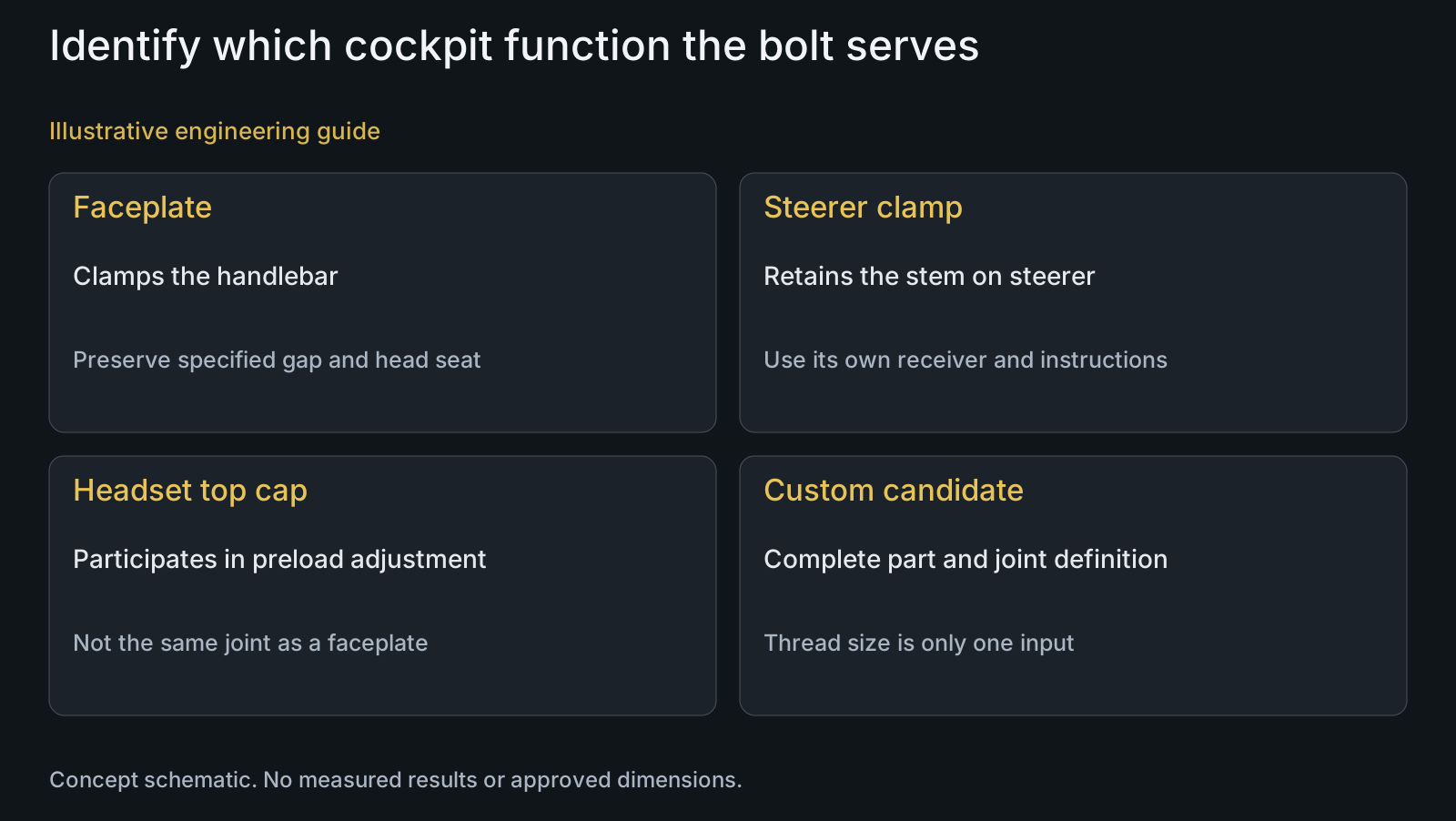
Separate three cockpit fastener functions
Mark the requested bolts on an assembly view. Faceplate, steerer-clamp and top-cap hardware can sit close together but do different jobs. Do not quote all of them as stem pivot bolts: a conventional stem is a clamping assembly, not necessarily a rotating pivot.
The top cap participates in headset adjustment, while the steerer clamp retains the stem in its installed position. Follow the actual component instructions for their relationship. OneUp's installation guide treats these operations separately; this article does not transfer its numeric settings to another cockpit.
Give each location its own part definition and BOM quantity. A mixed titanium kit should identify exactly which original parts it replaces. The broader stem and seatpost hardware guide addresses other lightweight connections; the decision here is specific to stem-clamp substitution.
Distinguish a named option from generic titanium hardware
Burgtec lists an Enduro Stem Titanium Bolt Kit for its Enduro MK2 and MK3 stems. That is evidence of a defined titanium option for named components, not proof that all stems should use titanium or that a third-party copy has the same approval.
An aftermarket service replacement and an OEM development part are different purchasing tasks. For service, use the component maker's applicable approved parts and instructions. For development, the responsible OEM must establish the candidate drawing, final material state and acceptance criteria for the represented assembly.
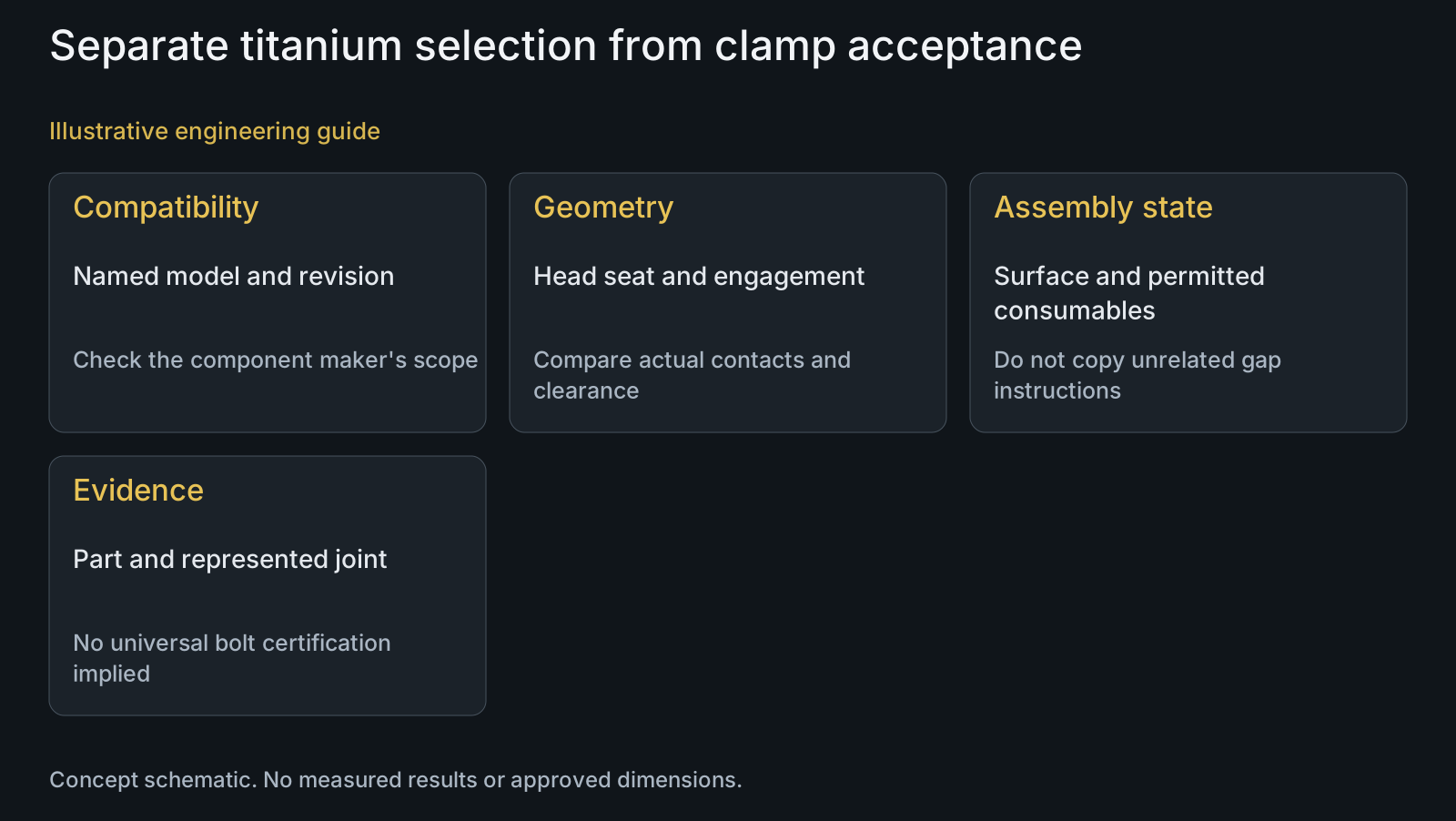
A material certificate describes the supplied material within its scope. It does not establish that head geometry, clamp behavior or installation conditions suit a particular stem. Use the materials information to discuss candidate stock, then assess the part and assembly separately.
| Candidate or position | Decision input | Misleading shortcut | Verification basis |
|---|---|---|---|
| Manufacturer-defined titanium kit | Exact named model and included parts | Approval extended to every stem | Maker's compatibility and instructions |
| Faceplate bolt | Head seat, bar and prescribed gap | Thread match treated as clamp equivalence | Contact drawing and assembly conditions |
| Steerer-clamp bolt | Receiver and steerer clamp definition | Faceplate instructions copied to rear clamp | Location-specific component requirements |
| Headset top-cap screw | Adjustment role and supplied stack | All cockpit bolts assigned one torque | Applicable headset and stem instructions |
| Changed surface or lubricant | Final state and permitted consumables | Old torque assumed to give equal tension | Defined assembly and evaluation scope |
| Custom OEM titanium candidate | Material, dimensions and complete joint | Grade or standard name called approval | Part records plus represented-assembly evidence |
Compare the head contact and receiver, not just the thread
Show the under-head bearing surface, seat in the stem or faceplate, drive geometry and available tool access. An apparently equivalent head can bear on a different area or contact an unintended edge. The comparison should identify the actual contact, including any drawing-defined washer.
Compare thread length, usable receiver depth, effective engagement and clearance before bottoming. A replacement reaching a tightening setting is not proof that the clamp has closed correctly. The engagement guide explains why nominal screw length and useful receiver contact are separate inputs.
Treat an altered head, shank or threaded region as a changed feature, even when the alloy is the headline. For custom CNC turning, dimension those features and state the inspection condition. Do not reduce the purchase specification to diameter, length and a titanium grade.
Preserve the manufacturer's clamp and assembly conditions
Faceplate gap is design-specific. OneUp warns that not all stems use its no-gap upper-clamp arrangement; Burgtec's Enduro MK3 page calls for equal faceplate spaces. These examples demonstrate differing instructions, not interchangeable installation methods. Use the correct document for the exact product.
Engineering analysis: changing the bolt material, final surface or permitted lubrication can change the relationship between applied torque and resulting tension. A copied torque number alone therefore does not establish equivalent clamp load. The OEM should define the intended assembly condition and any required evaluation of the candidate joint.
Include the handlebar and steerer definitions and applicable component limits. Do not resolve conflicting instructions by choosing a higher setting or adding an unspecified lubricant. Torque specification development discusses the separate evidence needed for a controlled custom joint, not a replacement instruction for a branded stem.
Keep material records and steering-system evidence distinct
The public scope of ISO 4210-5:2023 identifies steering test methods for ISO 4210-2. It does not establish from the catalog description that every titanium stem bolt is certified, or prescribe a universal titanium grade. Any compliance claim needs the applicable requirements, configuration and evidence.
For an OEM change, state which part and assembled cockpit the review represents. Separate dimensions and material identification from joint performance, compatibility and applicable bicycle test evidence. PremFixer's custom manufacturing review is not a substitute for the component owner's design acceptance.
Define final treatment and permitted assembly consumables on the drawing or associated specification. Review surface treatment by functional contact and specified final state; a decorative color is neither a clamp-load result nor proof of fatigue suitability.
Review example: an identical thread conceals a changed seat
Illustrative engineering example: assume an OEM proposes titanium faceplate bolts with the same nominal thread and overall length as its steel baseline. The proposed head has a different under-head contact diameter, and the stem uses a drawing-defined faceplate gap. No measured load, mass saving or test outcome is assumed.
The reviewer first compares the bolt seat and contact footprint, receiver engagement and bottom clearance. It keeps the prescribed gap and assembly condition in the review instead of applying another maker's installation pattern. Any potential weight benefit remains separate from acceptance of the clamp joint.
The resulting RFQ names the baseline, changed features and represented handlebar/stem assembly. It supports a manufacture and evaluation decision without declaring the titanium part compatible simply because it screws into the receiver.
Questions buyers need to confirm
Can titanium replace steel when the stem bolt thread matches?
Not on that basis alone. Identify the exact stem and bolt position, head seat, engagement and assembly conditions. Use a manufacturer-defined replacement option or the OEM's evaluated candidate definition; a matching thread does not establish clamp compatibility.
Are titanium stem bolts always unsuitable?
No. Named manufacturer options exist, such as Burgtec's kit for its Enduro MK2 and MK3 stems. That scope does not approve arbitrary titanium hardware, another stem model or a custom copy without its own acceptance basis.
Should every stem faceplate have equal gaps?
No universal pattern applies. Real manufacturers specify different arrangements. Consult the exact stem's instructions and identify the required gap condition; do not copy a no-gap or equal-gap method from a different design.
Can the original torque be used after a material or finish change?
Do not assume it gives equivalent tension. The approved assembly condition includes the fastener surface and permitted consumables as well as the joint. A custom change requires the responsible OEM's defined torque and evaluation basis, not a generic titanium conversion rule.
Does ISO 4210-5 mean a titanium bolt is individually certified?
Not from its public catalog scope. The document covers steering test methods associated with ISO 4210-2. A claim must identify the applicable requirements, tested configuration and evidence; naming the standard does not establish approval of a replacement bolt.
What does PremFixer need for custom stem hardware review?
Send the stem model or OEM assembly definition, marked bolt locations, drawings, STEP or samples, BOM and baseline. Include head contacts, receiver depth, material condition, final finish and assembly requirements. State the part and joint acceptance scope and who controls compatibility approval.
Technical references and scope
Burgtec Enduro Stem Titanium Bolt Kit. Named Enduro MK2/MK3 titanium option only; no generic stem compatibility, copied part geometry or universal substitution approval.
OneUp Basic Stem and Handlebar Install Instructions. Separate headset/steerer/faceplate operations and model-specific no-gap warning. No numeric settings or installation recipe transferred.
Burgtec Enduro MK3 Stem. Model-specific equal faceplate gap requirement as a contrasting example, not universal guidance or permission for arbitrary titanium replacements.
ISO 4210-5:2023 public scope. Steering test-method scope for ISO 4210-2 only. No paid clauses, prescribed titanium grade or individual bolt certification claimed.
Explore related component, material and sourcing decisions in the customer decision knowledge center. For a drawing review, use the Drawing/BOM RFQ path.
Review a titanium stem candidate against the complete clamp
Share the stem and mating component definitions, marked bolt locations, baseline and candidate drawings, STEP or represented samples and BOM. Include head seats, receiver engagement, final material and surface, permitted assembly conditions and the intended evaluation scope. PremFixer can assess drawing-based manufacture; the component owner retains design and substitution acceptance.
Discuss the drawing and BOM