

Blockchain can support tamper-evident recordkeeping for pivot materials and processing events, but it does not independently prove that an entered material identity or measurement is true. First establish how the physical bolt group connects to the source evidence, who enters the event and what the record represents. Keep material, treatment and packing relationships distinct, and define correction and access arrangements. A wrong lot link does not become correct because its entry is difficult to change. This article evaluates an optional record architecture; it does not establish a deployed PremFixer blockchain, absolute immutability or automatic certification of a finished pivot kit.
Hero: concept illustration of example hardware and its application. It is not a factory photograph, tested component or approved production geometry.
Identify the claim before selecting a ledger
A buyer may need to retrieve material origin, identify a treated subgroup or determine which kits contain an affected component. These are different traceability questions. Name the required evidence and granularity before deciding whether distributed recordkeeping addresses the actual gap.
NIST's Blockchain Technology Overview abstract describes tamper-evident and tamper-resistant distributed ledgers and persistence under normal network operation. It does not establish that every external event entered is correct or that a particular supplier implementation is certified.
A shared-ledger proposal should explain which participating parties need a common event history. If the missing information is an unrecorded material split, a different storage architecture alone cannot restore it. Compare the record need rather than choose the technology because the product is described as premium.
Keep the physical identity relationship intact
Identify the received stock, manufacturing group, treated subgroup and packed kit separately. One material origin can feed several processing groups, and one kit can contain components with different origins. A ledger entry needs the actual relationship, not one repeated order number.
Ask how the association survives splitting, rework, mixing and unpacking. A lot-level relationship identifies a population; it does not automatically identify every loose part individually. If unit-level distinction is needed, the physical identification and handling scope must support it.
The digital lot-traceability guide explains these manufacturing and packing relationships. Blockchain concerns the recording architecture, not an exemption from that physical evidence chain.
| Claim | Evidence relationship needed | Ledger-only limitation | Useful review |
|---|---|---|---|
| Material origin | Bolt group linked to represented stock evidence | Wrong input link can persist | Check source document and physical group |
| Treatment history | Input group, operation and resulting subgroup | Record entry is not process acceptance | Match operation scope and relevant evidence |
| Kit composition | Packing parent and constituent identities | Shared carton is not common origin | Reconcile each required component link |
| Record correction | Earlier event linked to corrected interpretation | Persistent error remains misleading | Identify affected record and current meaning |
| Loose-part identity | Agreed unit identification continuity | Lot record cannot create serialization | Check granularity after unpacking |
| Confidential design | Controlled access and permitted recipients | Public persistence can expose data | Review minimal shared scope and access |
Separate protected history from trustworthy input
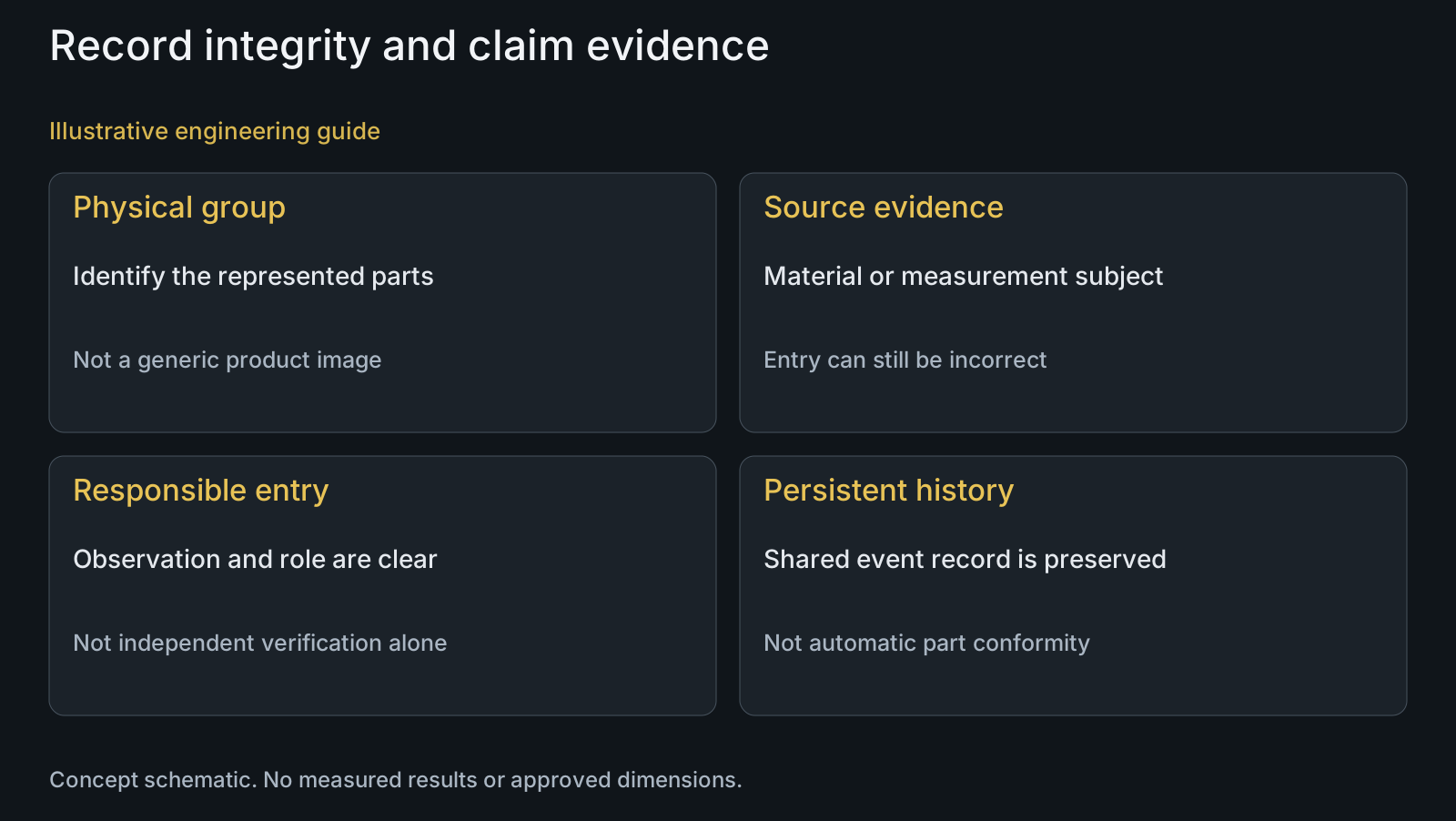
For each event, identify the observation or source document, represented item or group and responsible entrant. A material document linked to the wrong group can be preserved consistently while remaining irrelevant to the supplied bolt. Likewise, a measurement from an untreated sample cannot automatically describe the final treated state.
An authorized entrant is not necessarily an independent verifier. State who observes, enters and reviews the claim, and what their roles establish. Do not call a shared record independent material certification merely because several parties can read it.
Use materials definitions and the document-scope guide to identify the claim being supported. Record integrity, material identity and finished-part acceptance need their own evidence rather than one technology label.
Make corrections visible without pretending errors cannot happen
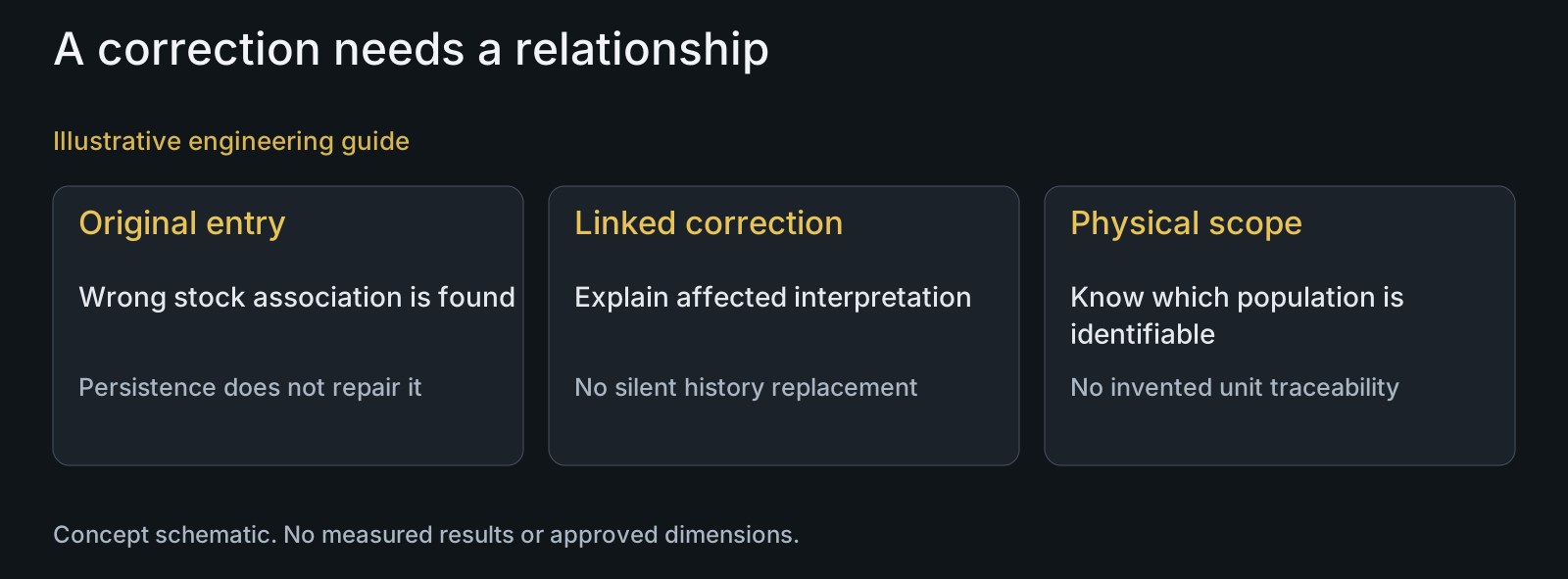
Plan how an incorrect association or result is corrected while preserving its relation to the earlier entry. The correction should identify what changed, why it matters and which interpretation now applies. A later event with no link can leave the buyer relying on the original mistake.
Distinguish correcting a record from authorizing a physical change. Revising a lot association does not approve a changed sleeve geometry; adding a treatment event does not establish its acceptance. Preserve the relevant disposition and configuration authority separately.
Assess retention, participant access and retrieval of supporting evidence with the responsible system owners. A public ledger is not an appropriate default destination for confidential drawings or customer information. A record can refer to controlled evidence without publishing every design detail to every participant.
Review an incorrect material-to-group association
Illustrative engineering example: assume two stock groups feed similar pivot bolts. An event is entered with the wrong source-group relationship, and the mistake is discovered during a document review. No actual ledger, customer order, material result or security incident is assumed.
The buyer asks whether the record system can show a linked correction and clearly identify the affected interpretation. It also asks how the physical bolt population was identified, because an electronic correction cannot create unit-level distinction that was never maintained.
The review therefore needs both source evidence and corrected event context. A persistent original entry alone would preserve the error, while silently replacing it could conceal the history. The example claims no validated implementation; it shows why a correction path is part of traceability rather than proof that input errors are impossible.
Compare the architecture against the retrieval need
Evaluate an existing controlled database, shared record exchange and a proposed ledger against the same evidence questions: represented objects, responsible entries, corrections, confidentiality and retrieval. Do not claim one architecture automatically has better material truth or lower cost.
A pilot discussion should use non-sensitive sample relationships and defined responsibilities, not public customer drawings or production writes. Confirm feasible access and actual information availability before promising any deployment.
PremFixer's manufacturing overview supports the physical process discussion, and the knowledge center covers related buyer decisions. Agree traceability deliverables and document scope for the project. No universal blockchain service, record retention period or perfect defect prevention is asserted.
Questions buyers need to confirm
Does blockchain prove the stated alloy is correct?
No. Evaluate the represented material evidence and physical-part relationship. A protected record can preserve an incorrect entry; the technology does not replace source identification or relevant review.
Is tamper-evident the same as impossible to change under every condition?
Do not make that absolute claim. The cited NIST overview describes behavior under normal network operation. Evaluate the actual architecture and governance with qualified system reviewers rather than promise universal immutability.
Does an authorized signer independently certify the part?
Not automatically. Identify who observed, entered and reviewed the claim and what their roles establish. Permission to enter a record is distinct from independent verification or final acceptance.
Can a wrong material link be corrected?
A proposed design needs a clear linked correction and current interpretation. Preserve the earlier relation and affected scope instead of silently erasing history. The actual mechanism and authority require system-specific agreement.
Should customer drawings be published to a shared ledger?
Not by default. Decide the minimum information and authorized recipients with responsible security owners. Keep confidential design evidence controlled; shared event context does not require unrestricted design disclosure.
Does PremFixer provide blockchain traceability on every order?
That universal deployed service is not established here. Agree the physical links, evidence, granularity and retrieval needs for the project, then discuss feasible record arrangements without assuming a blockchain endpoint.
Technical references and scope
NIST Blockchain Technology Overview public abstract. Historical overview abstract on tamper-evident/resistant distributed ledgers and normal operation only; no complete implementation or security assurance reviewed.
Explore related component, material and sourcing decisions in the customer decision knowledge center. For a drawing review, use the Drawing/BOM RFQ path.
Define the traceability claim before selecting record technology
Send the drawing, STEP, BOM and supplied-condition requirements through the Drawing/BOM RFQ path. Identify the material, process and packing relationships you need to retrieve, plus granularity and access needs, so PremFixer can discuss evidence scope without an unverified blockchain-service promise.
Discuss the drawing and BOM