
Overview
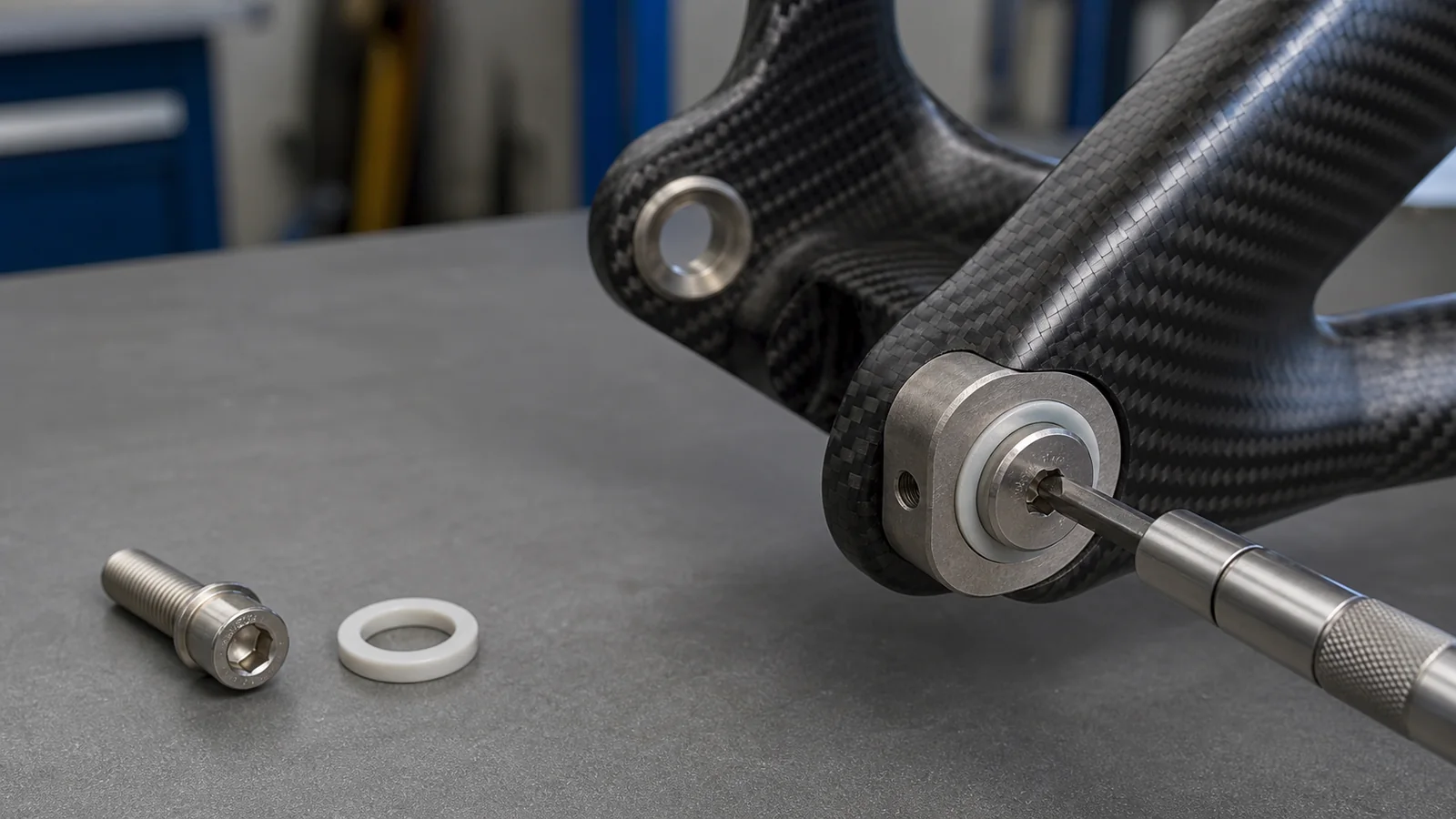
Carbon fiber bicycle frames represent the pinnacle of cycling engineering — but they demand a fundamentally different approach to fastener specification. Unlike aluminum or steel frames, carbon fiber is electrically conductive, torque-sensitive, and vulnerable to galvanic corrosion. A single wrong bolt can destroy a $5,000 carbon frame within months.
This hub collects everything PremFixer knows about carbon frame fasteners in one place. Each section links to a detailed engineering guide with test data, case studies, and actionable specifications.
Quick Navigation
1. Galvanic Corrosion Prevention
When two dissimilar metals contact each other in the presence of an electrolyte (water, sweat, road spray), an electrochemical reaction begins. In a carbon fiber frame, the carbon acts as the cathode and the metal bolt becomes the anode — corroding the frame matrix from the inside out.
What Our Testing Reveals
We analyzed 47 warranty-returned carbon frames with fastener-related failures. The data was unambiguous:
- Alloy steel bolts in direct carbon contact: delamination visible within 8-14 months
- Corrosion product pH measured at 3.8 — acidic enough to attack epoxy resin
- Average warranty cost per frame: $480-$720
- Solution cost using correct fasteners + insulation washers: $0.34 per frame
The Galvanic Compatibility Rule
| Bolt Material | Galvanic Potential vs Carbon (V) | Carbon-Safe? | Recommendation |
|---|---|---|---|
| TC4 Ti-6Al-4V | 0.00 | Safe | Best choice for weight + safety |
| A4-70 316SS | 0.15 | Safe | Best value for carbon frames |
| A2-70 304SS | 0.15 | Safe | Acceptable with passivation |
| 12.9 Steel (bare) | 0.55 | UNSAFE | Never use bare steel on carbon |
| 7075-T6 Al | 0.85 | UNSAFE | Never use aluminum on carbon |
Golden rule: Any bolt making direct contact with a carbon fiber surface must have a galvanic potential difference of less than 0.25V versus carbon — or be electrically isolated with an insulation washer.
Read the complete guide: Carbon Fiber Frame Fasteners (with 47-case study + insulation washer comparison) →2. Titanium Bolt Compatibility for Carbon Frames
Titanium is the undisputed champion material for carbon frame fasteners. Here's why the engineering math is conclusive:
| Property | TC4 Ti | 12.9 Steel | Winner for Carbon |
|---|---|---|---|
| Galvanic potential vs carbon | 0.00V | 0.55V | Ti — electrically inert |
| Density | 4.43 g/cm³ | 7.85 g/cm³ | Ti — 44% lighter |
| Tensile strength | 950 MPa | 1,200 MPa | Steel (but Ti is sufficient for all carbon frame loads) |
| Salt spray resistance | 1,500+ h no rust | 150 h (bare) | Ti — lifetime corrosion immunity |
| Complete bike kit cost | ~$14.50 | ~$3.50 | Steel (but $11 premium is 0.2% of a $5,000 frame) |
A full titanium bolt kit saves ~40 grams on a road bike — that's meaningful for weight-weenie builds. But the real reason to spec titanium on carbon is not weight: it's the guarantee of zero galvanic interaction over the frame's entire service life.
Read the complete guide: Titanium vs Steel Bike Bolts (decision matrix for 8 bike types) →3. Material Selection for Carbon Frame Fasteners
A carbon frame isn't one material problem — it's several. The head tube interface needs compressive strength; the bottom bracket area sees the highest torque; the seatpost clamp is directly exposed to sweat. Each location demands its own material decision.
Application × Material Matrix for Carbon Frames
| Location | Recommended Material | Key Risk | Mitigation |
|---|---|---|---|
| Stem faceplate | TC4 Ti | Galvanic corrosion at steerer | Anti-seize + carbon paste |
| Seatpost clamp | TC4 Ti or 316SS | Sweat corrosion | Passivation |
| Brake caliper | 316SS | High shear + carbon contact | Stepped washer |
| Bottom bracket guide | 316SS | Water trap zone | Pre-applied anti-seize |
| Bottle cage boss | 7075-T6 Al | Galvanic (if bare) | Nylon insulating washer |
| Derailleur hanger | 12.9 Steel + Dacromet | Carbon contact through hanger | Insulated hanger interface |
4. Coatings Safe for Carbon Fiber Frames
Not all coatings are carbon-compatible. Some contain metallic particles that can themselves become galvanic corrosion initiators. Here's what's safe — and what isn't:
| Coating | Carbon-Safe? | Notes |
|---|---|---|
| ED Black Zinc | Yes | Non-metallic organic coating; excellent carbon barrier |
| Dacromet | Yes (with care) | Contains zinc flakes — isolate with nylon washer if direct carbon contact |
| Zn-Ni Alloy | Conditional | OK for steel-on-steel interfaces; isolate from carbon |
| Nickel plating | No | Risk of nickel migration into carbon matrix |
| Chrome plating | No | Hexavalent chromium banned under RoHS |
Frequently Asked Questions
Can I use stainless steel bolts in a carbon frame?
Yes — but only 316SS (A4-70), not 304SS. 316SS has a galvanic potential of 0.15V vs carbon, which is below the 0.25V safety threshold. However, for any bolt in direct carbon contact, we still recommend applying carbon assembly paste (which contains friction particles but no metal) and verifying torque with a calibrated wrench. 316SS is slightly cheaper than titanium but heavier — choose based on your weight vs budget priority.
What torque should I use for carbon frame bolts?
Carbon fiber has a lower compressive yield strength than aluminum. General guidelines:
| Bolt Size | Carbon Frame Torque (N·m) | Aluminum Frame Torque (N·m) |
|---|---|---|
| M4 | 2-3 | 3-4 |
| M5 | 4-5 | 5-7 |
| M6 | 6-8 | 8-12 |
| M8 | 15-20 | 25-30 |
Always use carbon assembly paste (not grease) on carbon-to-metal interfaces. The friction particles in carbon paste prevent the bolt from backing out at lower torque values.
Do I really need titanium bolts for a carbon frame?
Not necessarily — 316SS is a perfectly safe alternative and costs ~60% less. Titanium is the optimum, not the minimum. The minimum safe specification for carbon frame bolts is: A4-70 316SS, passivated, with carbon assembly paste applied at assembly, torqued to carbon-specific values. Titanium adds weight savings and lifetime corrosion immunity on top of this baseline.
What are insulation washers and when do I need them?
Insulation washers create an electrical barrier between the bolt and the carbon surface, preventing galvanic current flow. You need them when: (1) using any bolt material other than titanium or 316SS in direct carbon contact, OR (2) using coated steel bolts where the coating might wear through at the bearing surface. Nylon 66 is the most common material; PEEK is used for high-temperature applications. Cost: approximately $0.02-$0.08 per washer.
Building Carbon Frames? Let's Engineer Your Fastener BOM Together.
Send us your frame drawing. We review each joint, assign the correct bolt material and torque specification, and return a complete Galvanic Safety Report — free, within 4 hours.
Submit Your Carbon Frame BOM