

Plan international shipping for custom pivot bolts around the receiving milestone your bicycle program needs, not a universal number of transit days. Separate manufacturing completion, packed shipment readiness, carrier handover and arrival at the destination plant. Obtain a current estimate for the actual origin, destination, package and service, then identify clearance, inland transport and receiving responsibilities. Air, courier and ocean offers may cover different endpoints, making their quoted dates incomparable until scope is aligned. A paid freight charge also does not by itself establish who bears transport risk. PremFixer manufactures to the agreed drawing and BOM; the order must separately define its delivery arrangement.
Hero: concept illustration of example hardware and its application. It is not a factory photograph, tested component or approved production geometry.
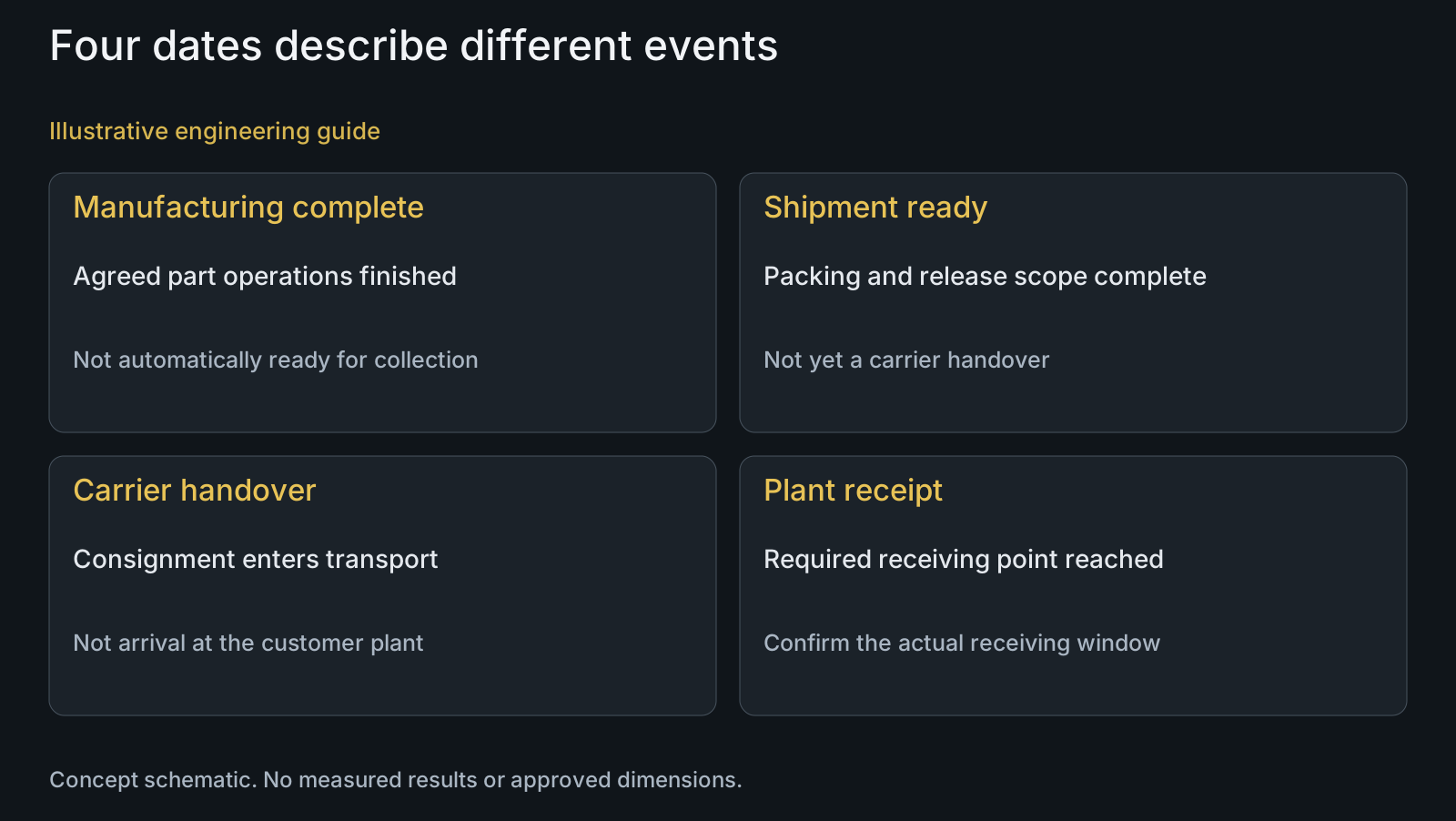
Name the milestone behind the requested delivery date
Write the required event next to the date: parts finished, released for packing, collected by the carrier, available at a destination terminal or received at the plant. These events are not interchangeable. An assembly team normally needs usable hardware at its receiving point, while a manufacturing quotation may state an earlier milestone.
Connect the shipping plan to the custom-fastener lead-time milestones. If inspection or agreed documentation must accompany dispatch, that work belongs before shipment readiness. Do not place a transport booking against an assumed completion date while a relevant manufacturing requirement remains unresolved.
Specify the delivery address, receiving contact, opening window and whether goods must be booked into an appointment system. A shipment can physically reach the destination area without being accepted into the customer's store. That difference matters when the requested date supports a scheduled bicycle assembly operation.
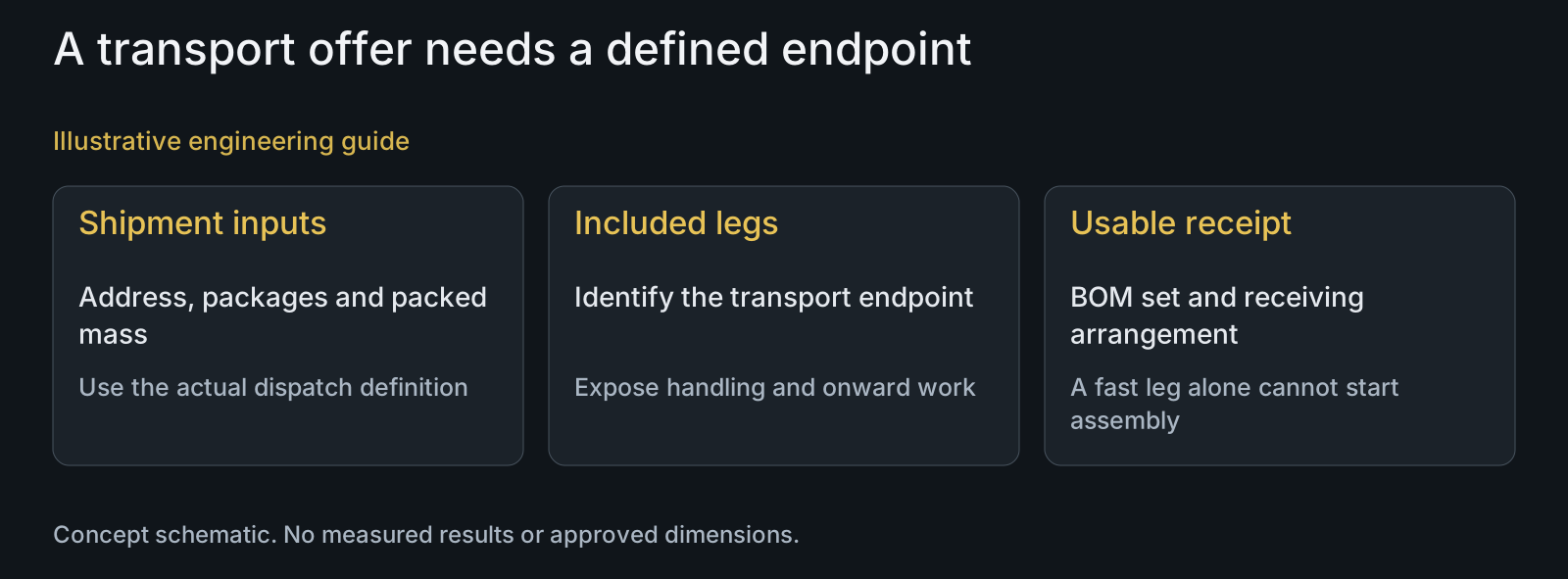
Quote transport from the packed shipment and actual route
Use origin and destination addresses, shipment date, carton count, packed weights and dimensions rather than the bolt's individual mass. The protective pack can change the shipment definition. Obtain a transport offer for the actual service and ask what its estimated date represents.
DHL's published quote guide uses destination details and package quantity, weight and dimensions to display services, dates and prices. It supports obtaining a shipment-specific estimate, not assuming that all international pivot orders share one transit range. The guide is carrier documentation, not evidence of an order booked by PremFixer.
Keep the manufacturing price and the freight estimate identifiable. If the shipment changes from loose parts to separated kits, or the destination changes from a city terminal to a remote plant, request the corresponding transport update. A previous quote for a different package or destination cannot settle the revised delivery decision.
| Option or milestone | Suitable decision | Hidden risk | Confirm before selection |
|---|---|---|---|
| Factory completion | Plan when manufacturing work ends | Packing or release work still outstanding | Exact completion and dispatch-ready definitions |
| Courier service | Assess a small or urgent receiving requirement | Quoted service differs by destination and package | Actual service, packed details and delivery address |
| Air-freight offer | Assess a time-sensitive packed consignment | Terminal handling or inland leg excluded | Door or terminal endpoints and responsible parties |
| Ocean-freight offer | Assess planned replenishment | Port arrival mistaken for plant receipt | Handling, onward transport and receiving scope |
| Split consignment | Supply an independently usable early requirement | First cartons lack a required mating component | BOM-complete quantity and additional shipment work |
| Plant receiving | Support the assembly availability date | Arrival outside the receiving window | Contact, appointment and acceptance procedure |
Choose transport against urgency and receiving scope
Compare courier, air freight and ocean freight against the same receiving point and packed quantity. Do not infer a universal speed or cost ranking from the mode name alone. Ask about available service, consolidation or handling arrangements and any legs excluded from the quotation.
For an urgent sample or small assembly requirement, evaluate whether the selected service reaches the intended recipient with the needed hardware set. For a larger replenishment, compare shipment cost and receiving timing against the stock plan. Neither decision is established by the component being small or made from titanium.
A split shipment is useful only if the first consignment supplies an independently usable quantity or kit. Sending bolts ahead of their required spacers may not start assembly. Compare the additional shipment and receiving work with the actual scheduling benefit before dividing the order. This is an option to assess, not a promise of a standard expedited service.
Keep transport payment separate from delivery risk
ICC explains that an Incoterms delivery point can differ from the transport destination. Under CIF, for example, risk transfers onboard at the shipment port although the seller pays freight to the named destination port. Write the selected rule, version and named place explicitly; 'freight included' is not a complete allocation.
ICC's checklist distinguishes maritime-only FOB from multimodal FCA and warns that DDP can create practical import-clearance problems. Its flowcharts are starting points, not substitutes for the rulebook. Have the responsible commercial and logistics parties confirm the arrangement for this shipment; do not assume PremFixer offers every rule in every destination.
For project planning, list which party arranges each physical leg and who the receiving team contacts if that leg stalls. Keep this operational list consistent with the agreed sale and transport terms. It helps purchasing understand what remains to be arranged without treating an article as country-specific customs or legal advice.
Protect the receiving configuration during transit
Specify part separation, finish protection and kit identification for the proposed handling route. A carton count is not enough to show that threaded ends, bearing-contact surfaces and small spacers will remain identifiable. The pivot packaging guide addresses the protection and identification decisions.
Match the shipment's part numbers, revisions, quantities and package units to the agreed BOM. Identify accompanying documents and their intended recipients. Keep material and inspection evidence separate from commercial transport information: a material-document package does not replace the shipment's required paperwork.
Define the receiving response to missing packages, visible damage or identity discrepancies. Preserve the package and its identification where an investigation is needed, and contact the responsible parties. Do not assume a damaged carton proves the hardware is unusable, or that an intact carton proves its contents conform.
Review example: port arrival is not plant availability
Illustrative engineering example: assume a bicycle assembly team requests hardware available at its plant, but a freight offer states arrival at a destination port. The packed order is otherwise the same. No actual route, transit duration or carrier performance is assumed.
The buyer identifies the missing clearance, inland transport and receiving steps and asks for their scope and timing. It compares a port-ending option with a plant-ending option only after the additional work is visible. If urgency justifies a partial shipment, that consignment must contain a usable BOM-defined set rather than an arbitrary carton.
The resulting decision is a comparable delivery plan, not a claimed improvement in shipping speed. A route-specific estimate and agreed receiving endpoint expose where the schedule still needs confirmation. Choosing a faster main transport leg alone would not close the original gap.
Questions buyers need to confirm
How many days does overseas pivot delivery take?
There is no universal duration. Obtain a current service estimate for the actual addresses, shipment date, packed weights and dimensions. State whether the estimate ends at a terminal or the plant, and identify manufacturing readiness and any other work outside it.
Is express courier always better than ocean freight?
No. Compare the actual service and receiving scope against urgency, quantity and the stock plan. A small urgent requirement and a planned replenishment can justify different arrangements. Do not select from mode names without a current quotation and an identified endpoint.
Does freight paid to the destination mean risk stays with the seller?
Not necessarily. ICC identifies a separation between transport destination and risk transfer under C-family rules. Confirm the exact agreed rule and named place rather than infer risk allocation from the freight price.
Can the first shipment contain only the bolts?
Only if that consignment supports the intended use without absent components. Check the assembly BOM, including required spacers and other mates. Otherwise separate bolts can arrive early while the usable hardware set remains incomplete.
Can we request DDP to any destination?
Request the proposed arrangement, but do not assume availability. ICC warns of practical import-clearance difficulties with DDP. Confirm the responsible parties and destination-specific feasibility before treating the delivery scope as agreed.
What information is needed for a shipping assessment?
Provide the delivery address and contact, receiving milestone and window, BOM-defined quantities, packed details when known, planned dispatch date and proposed transport responsibilities. Identify whether the order includes an urgent usable subset and which documents must accompany it.
Technical references and scope
ICC Academy: place of delivery and risk transfer. Distinguishes contractual delivery, transport destination and C-family risk transfer. Does not establish a carrier booking or PremFixer contractual capability.
ICC Incoterms 2020 checklist and flowcharts. Transport-mode suitability and practical import-clearance caveats. Checklist requires the rulebook and transaction-specific consideration.
DHL: obtaining a rate and time quote. Origin/destination and package information for a service-specific estimate. UK guide is not proof of any Chinese-origin transit duration.
Explore related component, material and sourcing decisions in the customer decision knowledge center. For a drawing review, use the Drawing/BOM RFQ path.
Plan a usable receiving date for your pivot hardware
Send the current drawings and BOM, order and early-use quantities, delivery address, required receiving event and date, receiving contact and proposed transport arrangement. Include packed details or packaging requirements where available. PremFixer can review manufacturing and packing scope while the responsible logistics parties confirm the route and shipment-specific timing.
Discuss the drawing and BOM