
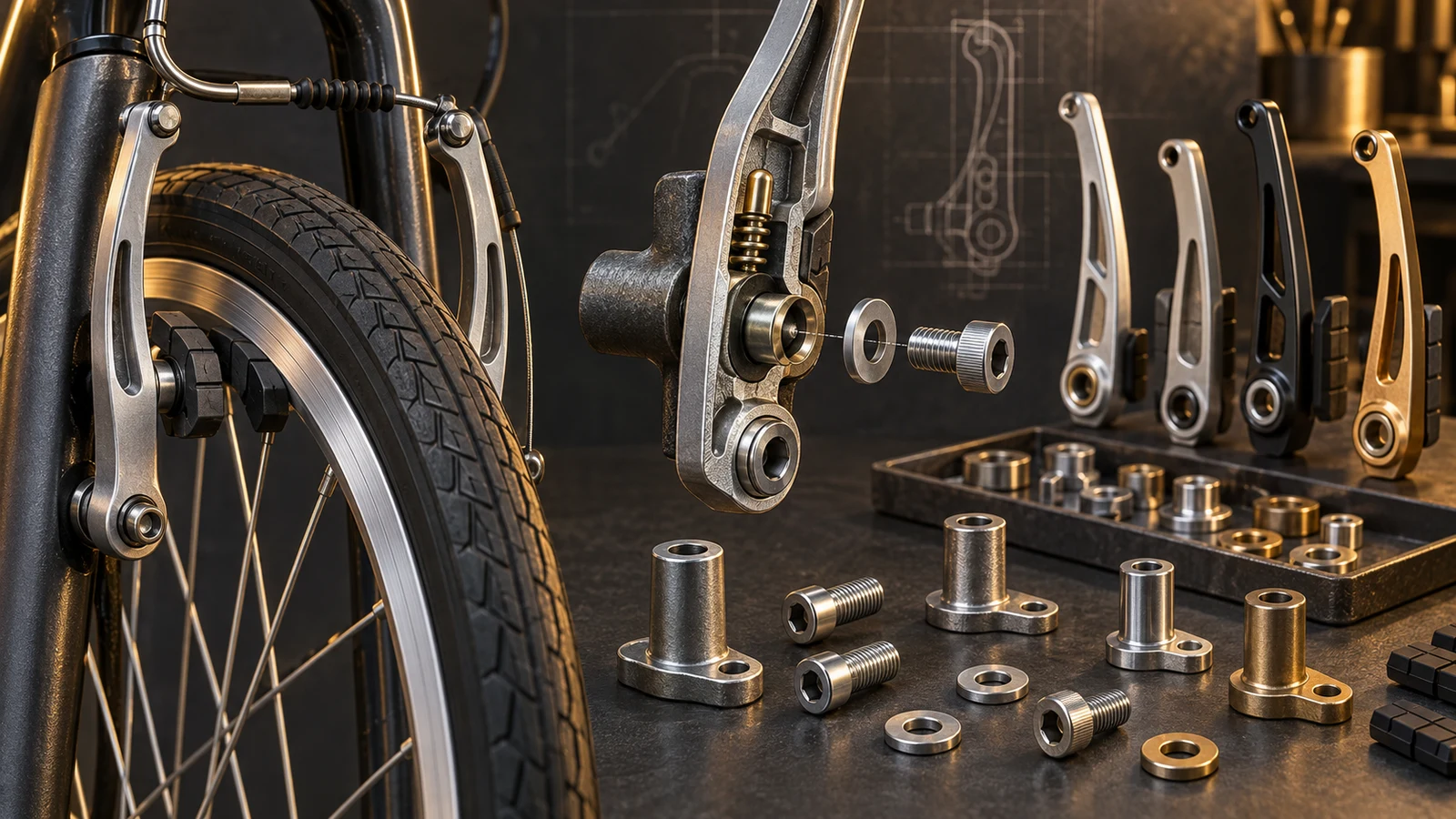
A V-brake mounting part cannot be approved for aluminum substitution merely because its installation torque appears modest. First identify the component: the frame or fork boss, the brake-arm fixing bolt, or a different adjustment or cable fastener. Then review its working surfaces, retaining contact, receiver, specified material condition and manufacturer requirements. Equal thread size does not establish those relationships, and installation torque is not the component's braking-load rating. PremFixer can review manufacture from an authorized drawing or represented sample, but a custom component must not be described as an approved service replacement without the corresponding compatibility and application decision.
Hero: concept illustration of example hardware and its application. It is not a factory photograph, tested component or approved production geometry.
Name the component before comparing materials
Use the brake's model and exploded view to identify the part under discussion. A V-brake assembly contains fasteners serving different functions. Ordering a pivot bolt without showing its location can confuse arm mounting with cable retention or spring adjustment.
Shimano's BR-T610 exploded view names a link fixing bolt, shoe fixing nut unit, spring tension adjustment screw and cable fixing bolt with plate as separate items. That model-specific vocabulary is useful for identifying an enquiry; it does not make those parts interchangeable across every rim brake.
Show the component in its installed position and identify the frame or fork mounting interface. The supplied drawing should make clear whether the enquiry covers the stationary mounting feature, its retaining fastener or an assembly. Keep the matching brake body and relevant revision visible.
Separate the pivot contact from the retaining thread
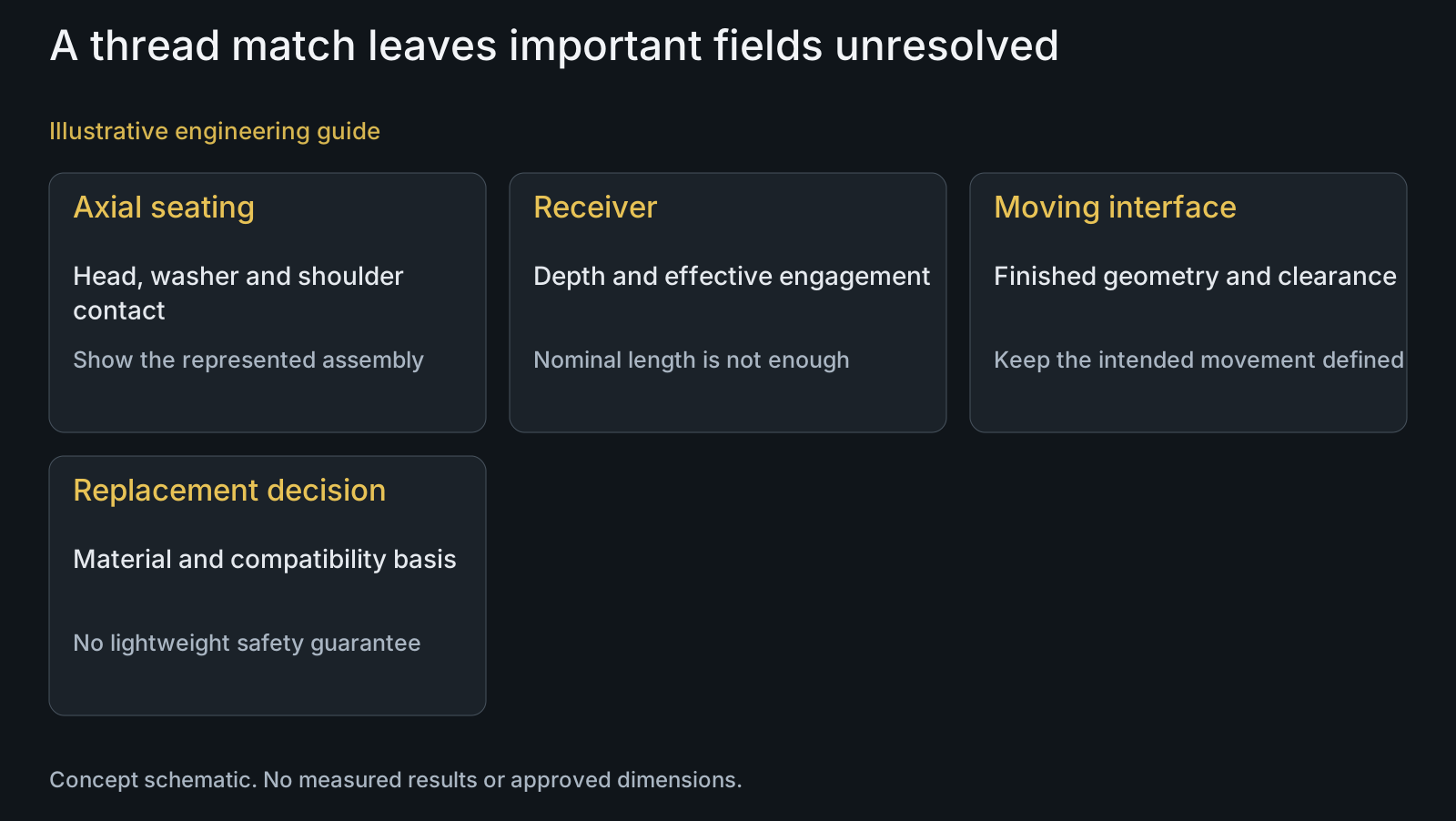
Engineering analysis: trace the represented arm's moving support and the contact that retains it. Specify which cylindrical region supports the movement and where the axial fixing contact closes. Thread geometry describes only part of that relationship.
Include working diameter and length, shoulders, mating-edge clearance, washer or head contact and receiver depth as applicable to the design. A fastener can engage its thread without establishing the intended seating relationship. Verify the represented assembly rather than using the ability to screw it in as the acceptance test.
The fit-drawing guide helps distinguish final size limits and mating geometry. The effective thread-engagement guide separates engaged thread from nominal length. Neither supplies universal V-brake dimensions.
| Part or proposal | Decision to make | Risk | Verification basis |
|---|---|---|---|
| Frame or fork mounting boss | Working surface and brake-body relationship | Calling a stationary mount a generic fixing bolt | Represented mount and mating geometry |
| Arm fixing fastener | Retaining contact and effective engagement | Thread match mistaken for full compatibility | Head/washer contact and receiver definition |
| Spring adjustment component | Its own adjustment function | Using it as arm-mounting hardware | Applicable exploded view and instruction |
| Cable fixing component | Cable-retaining scope | Substituting an arm fastener by appearance | Correct part and required mating item |
| Aluminum candidate | Defined alloy, condition and application | Low installation torque used as approval | Component requirements and authorized evaluation |
| Used sample reproduction | Current observation versus intended geometry | Copying wear or undocumented modifications | Reconstruction basis and approved scope |
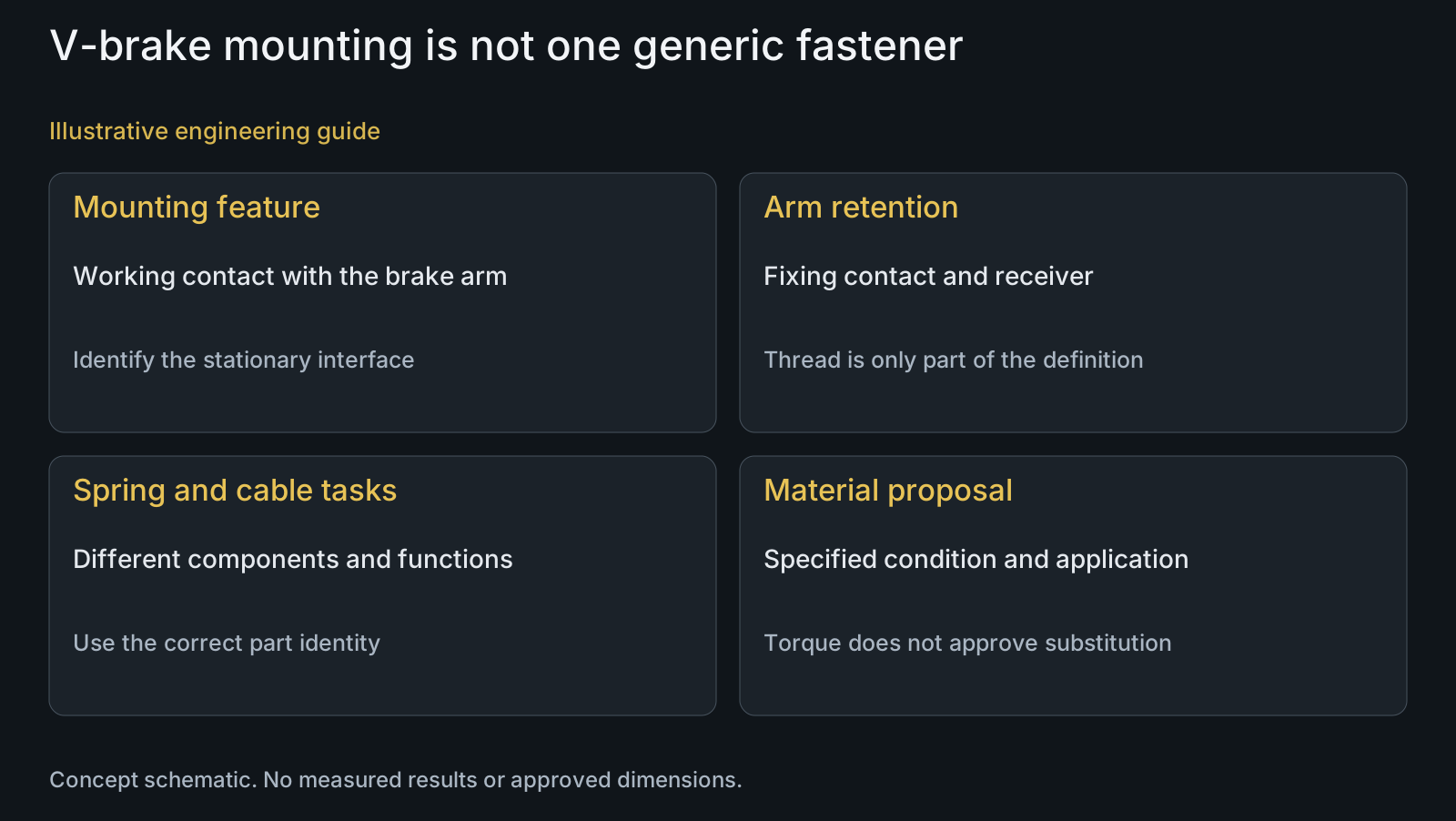
Preserve the brake's spring and adjustment relationships
A material or shape review must preserve more than retention. Locate any spring anchor or locating feature shown by the manufacturer and distinguish it from the arm fixing fastener. Shimano's general V-brake installation description identifies a stopper pin, frame mounting-boss spring hole and link fixing bolt as separate parts of that mounting task.
Describe the specified contact and clearances rather than modifying a component until hand movement feels acceptable. If the brake does not return or move as required, the responsible service team should assess the represented assembly and applicable instructions. More tightening or a different material is not a diagnosis.
Keep component conformity separate from complete brake adjustment and function. Pad position, cable attachment and lever compatibility belong to their own applicable instructions. This manufacturing article does not replace a mechanic's model-specific brake setup or prescribe a repair for an unknown installation.
Evaluate aluminum as a controlled candidate, not a torque inference
An installation setting describes a specified assembly operation. It is not a standalone allowable braking load, material selection calculation or statement that every part at that location can use a lower-density alloy. Do not turn an apparently low wrench setting into permission to change the component.
If an OEM proposes aluminum, state the alloy and condition, finished geometry, surface route and intended mating materials. Compare the candidate with the actual component requirements and application evaluation. The relevant question is what evidence supports this component, not whether aluminum appears elsewhere on the bicycle.
Discuss the manufacturing candidate through materials, CNC turning and surface treatment. No blanket claim that 7075 is suitable, unsuitable or equivalent to an original V-brake part is made without its defined requirements.
Define a replacement scope the buyer and supplier can share
State whether the order reproduces an authorized definition or proposes a changed material or geometry. Those are different decisions even when both can be machined. Identify the compatible brake and mounting configuration and who approves the proposed application.
Show which components are supplied together and which remain in the bicycle. Include installation-document references where applicable, final material and finish requirements, and the features to inspect. A catalog photograph or a nominal thread does not complete the replacement definition.
The sample reverse-engineering guide explains why a used sample's present condition is not automatically its intended drawing. For an obsolete or worn brake mount, keep sample observation and any reconstruction assumptions explicit. A custom manufacturing response is not permission to alter a safety-relevant assembly.
Review example: a lightweight screw selected by thread alone
Illustrative engineering example: assume a buyer proposes a lightweight screw for a V-brake arm because its nominal thread matches the existing fixing bolt. The buyer provides no head-contact definition, receiver depth or authorized material-substitution basis. No real installation or failure result is represented.
The reviewer identifies the arm-mounting location and asks for the applicable part definition and assembly view. It compares axial seating, effective engagement and relevant clearance before considering the proposed alloy. The spring adjustment screw and cable fixing parts remain separate from the enquiry.
The resulting candidate has a defined component scope and unresolved application questions, rather than a claim of compatibility based on thread match. It may proceed to an authorized manufacturing review, but no braking performance or accepted replacement follows from that administrative progress alone.
Questions buyers need to confirm
Can aluminum replace a V-brake fixing bolt because the torque is low?
That is not an approval basis. Identify the exact part and compare its geometry, material condition, receiver and retaining contacts with the authorized definition. Installation torque is not a braking-load rating or permission for an alloy substitution.
Are the mounting boss and arm fixing bolt the same component?
Not in every represented design. Identify each from the model documentation and assembly view. Distinguish the working support surface from the retaining fastener and specify which component or kit the supplier is to manufacture.
Is matching the thread enough for a replacement?
No. Review effective engagement, receiver depth, head or washer contact, shoulders and mating clearance as applicable. A screw that engages can still leave its seating or compatibility unresolved.
Can the spring adjustment screw serve as an arm mounting screw?
Do not substitute by appearance. Use the correct component identity and applicable instruction for the mounting or adjustment task. The BR-T610 exploded view, for example, lists these as different items.
Does hand-smooth arm movement establish complete brake approval?
No. It is an observation of one represented state. The complete brake's setup, retention and function require the applicable manufacturer's instructions and responsible service or product assessment. Do not treat hand feel as an alloy-validation result.
What should a custom V-brake hardware RFQ contain?
Send the brake model and part location, assembly and component drawings or represented samples, mating mount and receiver information, quantities and kit scope. Specify material condition, finish, installation reference and whether the request reproduces an authorized definition or proposes a change.
Technical references and scope
Shimano BR-T610 exploded parts view. Model-specific distinction between link fixing, spring adjustment, shoe fixing and cable-retaining parts. No universal size, compatibility or aluminum suitability inferred.
Shimano general dealer manual: V-brake installation description. Public installation description distinguishes stopper pin, mounting-boss spring hole and fixing bolt. No inaccessible procedure or installation value republished.
Explore related component, material and sourcing decisions in the customer decision knowledge center. For a drawing review, use the Drawing/BOM RFQ path.
Identify the V-brake component and proposed replacement scope
Send the brake model, installed location, drawing or represented sample and mating-mount information. Include receiver and contact geometry, BOM, quantities, specified material and finish and applicable installation references. PremFixer can review component manufacture; identify any material change and the authority responsible for replacement compatibility and brake validation.
Discuss the drawing and BOM