
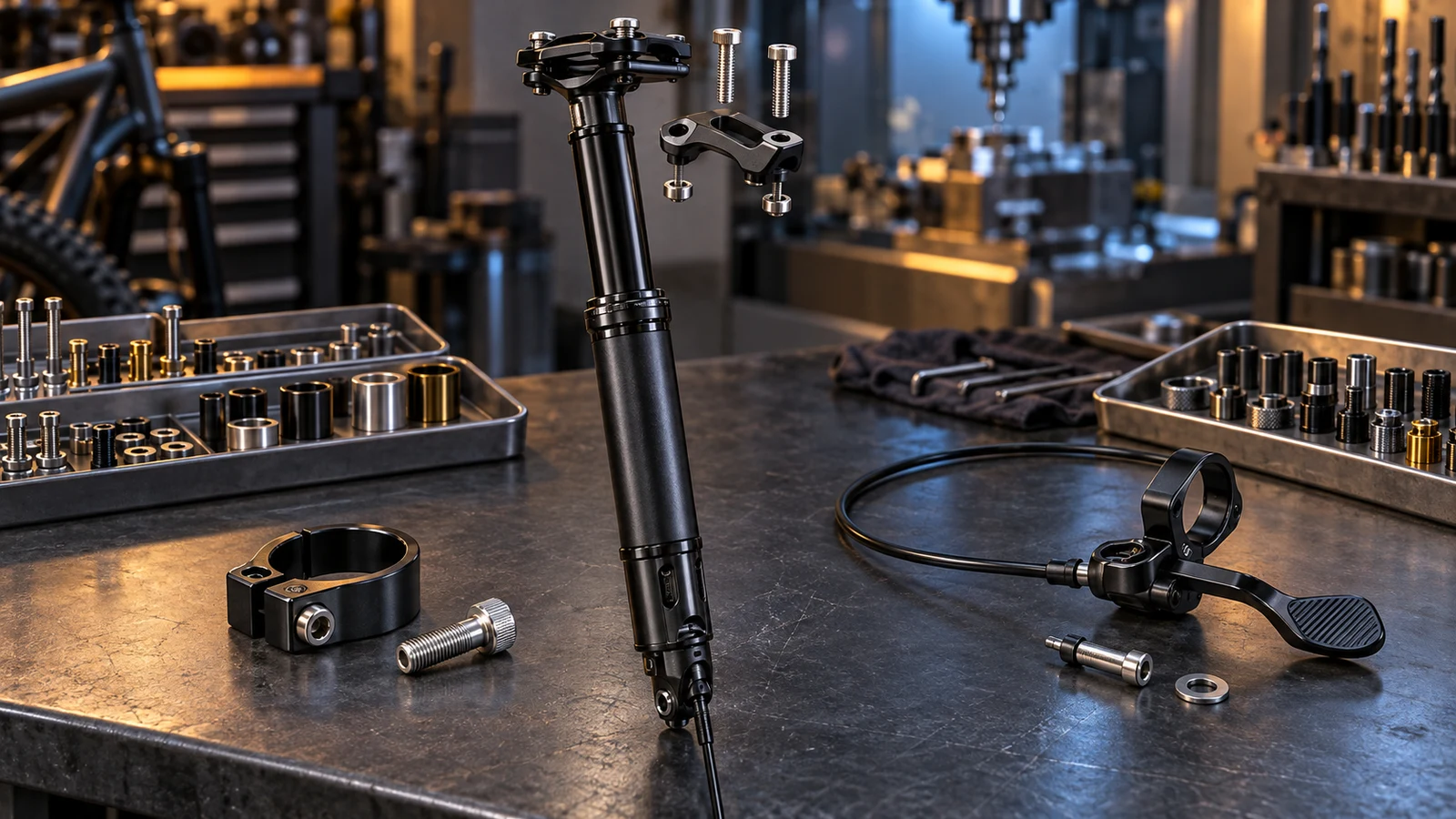
Dropper seatpost fastening hardware should not be specified as one generic pivot bolt. Identify whether the part belongs to the saddle clamp, frame collar, remote cable connection, actuator or internal mechanism. Frequent height actuation does not mean every fastener is loosened during each movement, and poor post operation does not establish a loose-bolt diagnosis. An OEM planning replacements or service hardware should match the actual model, location and revision, with its contact geometry and applicable instructions. Do not transfer torque, threadlocker or material rules between locations. PremFixer can review custom component manufacture without treating that review as approval of the whole dropper mechanism.
Hero: concept illustration of example hardware and its application. It is not a factory photograph, tested component or approved production geometry.
Name the hardware location and the event it controls
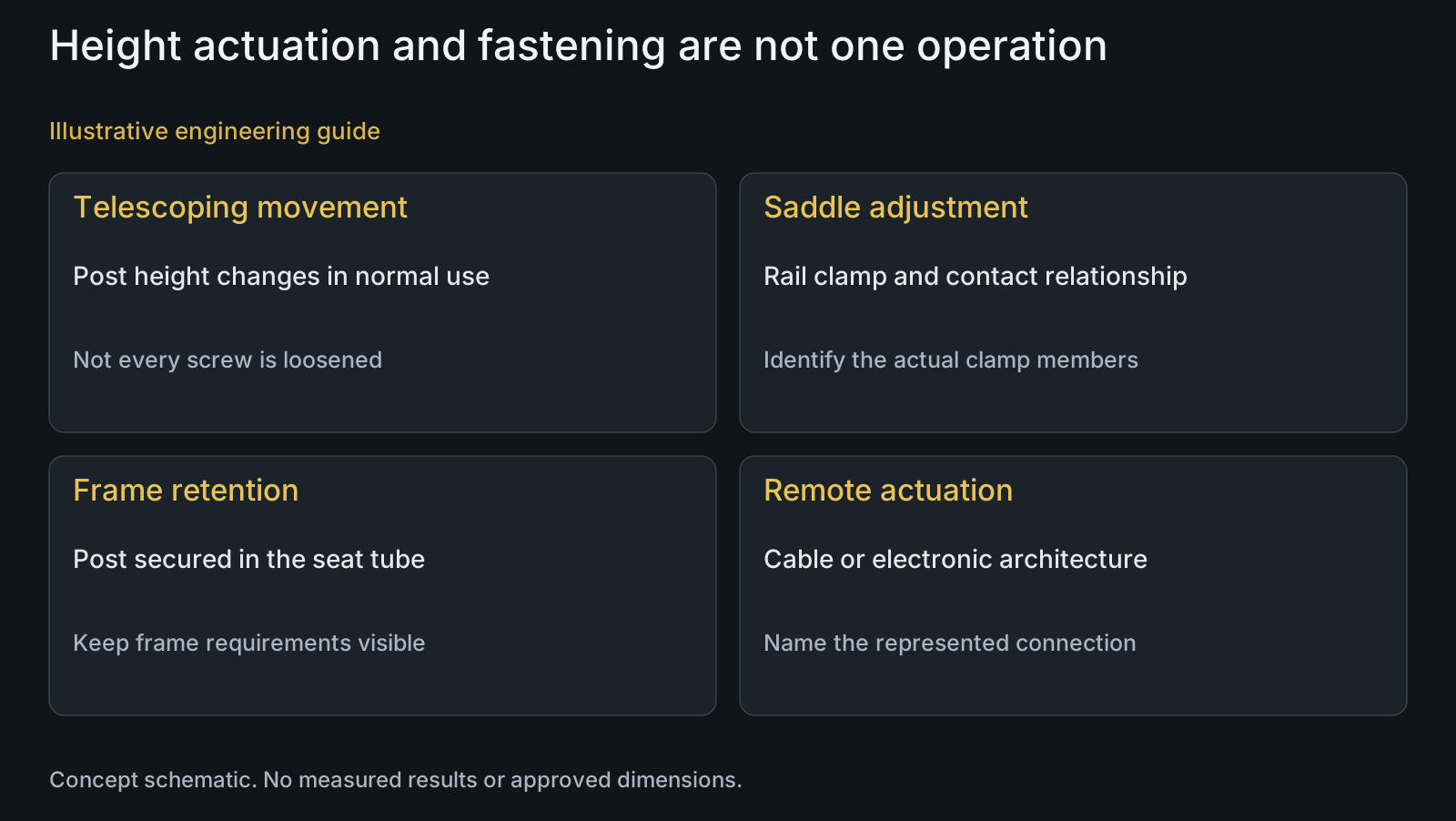
Distinguish the saddle-rail clamp from the collar that secures the post in the frame. A remote cable clamp, remote mounting fastener and lower actuator connection serve other functions. An internal threaded part may belong to a service operation rather than a user adjustment.
OneUp's dropper installation instructions list the seat collar, cable clamping screw, remote mounting items and seat-rail clamp separately. That manufacturer example illustrates location-specific requirements; it does not supply universal hardware sizes or instructions for another post.
Engineering analysis: normal height actuation, changing saddle angle and repositioning the post in the frame are different events. State which event the ordered hardware participates in and whether it moves, retains, locates or clamps. Do not infer identical cycling or loosening duty from the words dropper post.
Describe movement before choosing a remedy
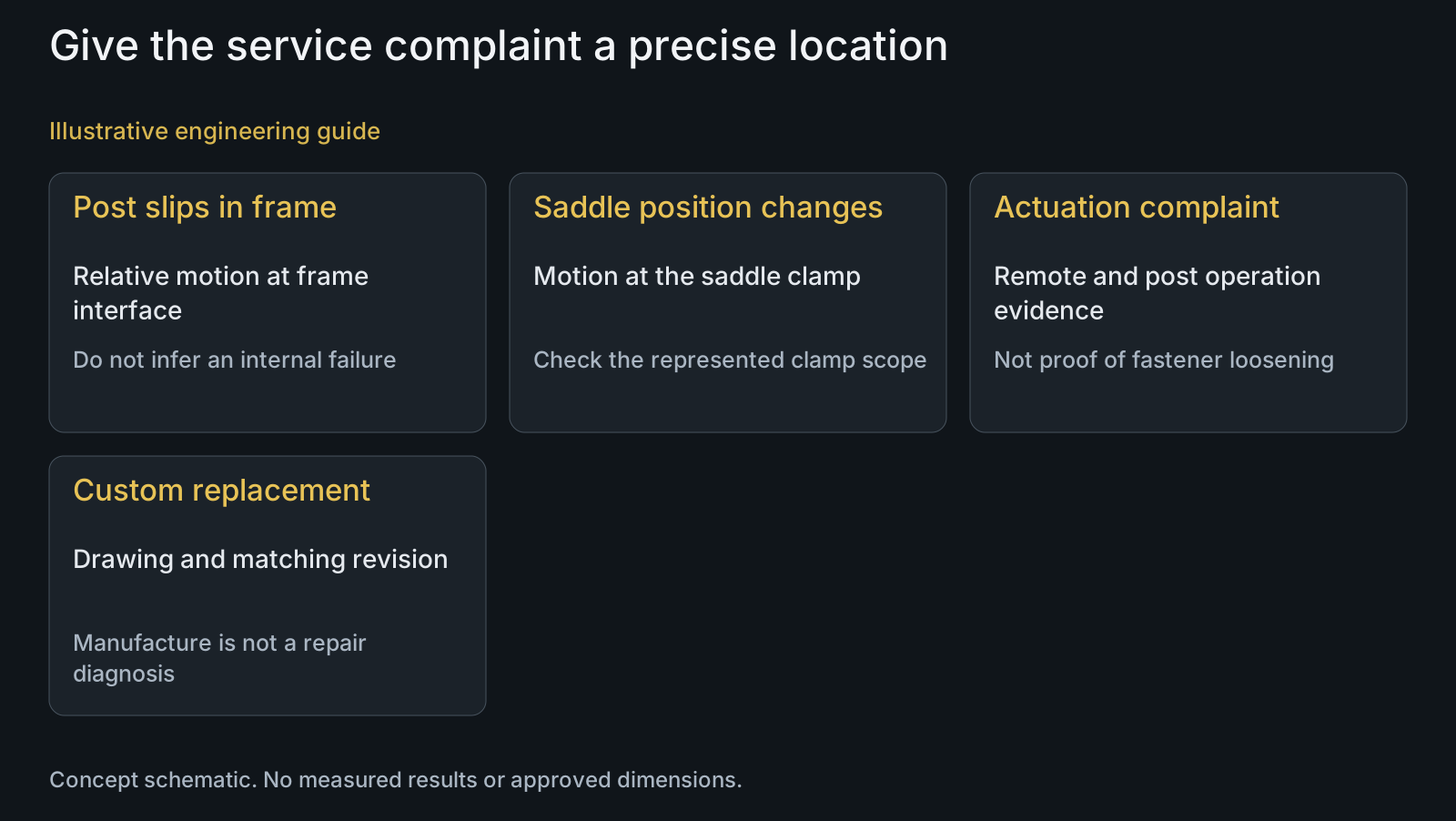
A report that the post moves can mean intended telescoping, undesired post movement within the frame, a change in saddle position or another observation. Record where relative motion occurs and when it appears. Include the model, installed configuration and any recent part or service change.
Similarly, slow return, a remote problem and visible clamp movement are different symptoms. Do not increase a fastening setting simply to see whether an operation complaint disappears. Use the applicable manufacturer's troubleshooting or technical support to determine the relevant operation and evidence.
Preserve the observed condition without declaring that frequent adjustment has caused fastener loosening. For an OEM quality review, the corrective-action guide separates reported symptoms from confirmed causes. A replacement RFQ can state an observed symptom while leaving diagnosis explicitly unresolved.
| Location or observation | Decision input | Risk of a common remedy | Useful verification |
|---|---|---|---|
| Saddle-rail clamp | Clamp pieces, rails and mating nut | Collar instruction copied to saddle hardware | Model-specific saddle interface and instruction |
| Frame seat collar | Frame/post contact and applicable requirements | More torque treated as a general fix | Applicable frame and component instruction |
| Remote cable clamp | Cable contact, washer and receiver | Saddle bolt ordered for an actuation complaint | Remote identity and contact geometry |
| Remote mounting fastener | Handlebar or adapter connection | Cable-clamp setting transferred | Actual mounting arrangement and instruction |
| Internal mechanism item | Post generation and authorized service operation | Generic threadlocker or repeat tightening | Applicable service document and component |
| Unclear post movement | Location and timing of relative motion | All movement diagnosed as bolt loosening | Symptom record before cause or replacement decision |
Keep frame and component instructions attached to the location
The frame collar joins a post and frame; saddle hardware joins a different contact arrangement. Identify the applicable requirements of the represented components rather than copying whichever number appears on a nearby bolt. Retain required surface preparation, tools and operation with the instruction.
RockShox's Reverb AXS welcome guide distinguishes the seatpost clamp from saddle clamp bolts and directs the reader to check the frame manufacturer's collar requirement. This is a named manufacturer example of overlapping component boundaries, not a general rule for every dropper or frame.
Do not add threadlocker to every item or routinely re-tighten internal parts without an applicable instruction. State the approved locking and preparation condition in the custom part definition. The torque-specification guide explains why a new hardware condition needs a defined basis rather than a setting inferred from material alone.
Review tool access and associated parts as geometry requirements
Show the screw head, tool approach and mating components in the represented assembly. Saddle-clamp access may differ from a remote or lower actuator location. A replacement can share a thread yet change whether the specified tool can reach the head without interference.
Include any shaped nut, washer, clamp piece or cable contact that belongs to the part's function. An apparently ordinary screw can participate in a defined contact system. Do not specify its head or length from a product photograph while omitting the receiving member or required orientation.
Use an assembly section, STEP or a represented sample alongside the part drawing. Review machining through CNC turning and supplied finish through surface treatment. A machinable head profile is not automatically an acceptable service substitute.
Control replacement identity without a universal stainless rule
Record the post generation, ordered component and applicable part or drawing revision. If the remote or saddle clamp has been changed, identify it separately. A kit described only by the post brand can leave the actual hardware interface uncertain.
Specify the material condition and final requirements through materials, not a blanket stainless preference. The receiver, head contact, service environment and approved assembly condition determine the necessary comparison. No universal alloy, threadlocker product or maintenance interval is established here.
List supplied and retained components in the BOM. The revision-compatibility guide supports keeping compatible-looking parts from being silently mixed. A component's conformity must be assessed against its own definition; it does not approve internal mechanism changes outside the agreed supply scope.
Review example: a remote complaint is not a saddle-clamp order
Illustrative engineering example: assume an OEM receives a report that the dropper does not respond as expected and initially requests a generic seatpost bolt replacement. The represented system is cable-operated, but no failure cause, measurement or repair result is available.
The reviewer asks where the reported symptom occurs and identifies the remote cable clamp separately from saddle and frame hardware. It obtains the relevant component identity, cable contact and receiving geometry. A saddle-clamp drawing would not define the requested remote item, and replacing it would not constitute a supported diagnosis.
The resulting RFQ names the intended custom component and preserves the unresolved service question for the responsible technical team. It can compare manufacture against a clear definition without claiming that threadlocker, another alloy or the proposed replacement has corrected the complaint.
Questions buyers need to confirm
Does frequent dropper use mean the bolts repeatedly loosen?
Not by itself. Distinguish height actuation from loosening a clamp for adjustment. Identify the part, relative motion and service history. A loosening claim needs evidence at the actual connection rather than the frequency of post operation alone.
Can the seat collar and saddle clamp use the same instruction?
Do not assume so. They join different components and contacts. Locate the applicable frame/post collar requirement and the saddle-clamp instruction separately, including preparation and operation. A nearby setting does not govern an unidentified connection.
Should threadlocker be added to every dropper fastener?
No universal instruction is supported. Use the manufacturer-defined locking and preparation condition for the exact location and operation. For custom manufacture, include that supplied condition explicitly; do not extend an external fastener rule to internal service parts.
Is slow post return evidence of a loose fixing bolt?
Not on its own. Describe when the symptom occurs and identify the post, remote and recent changes. Follow applicable troubleshooting or seek manufacturer support. An operation complaint does not establish a hardware cause or justify arbitrary tightening.
Can a replacement share the thread but have a different head?
Only within an approved definition. Compare tool access, head contact, associated nut or washer and surrounding clearance in the actual assembly. Equal thread size does not establish service access or contact compatibility.
What should a custom dropper-hardware inquiry include?
Send post and remote generation, exact hardware location, part and assembly drawings, STEP or represented samples and BOM quantities. Include receiver, associated clamp or cable contacts, material condition, finish and applicable instructions. Describe symptoms separately from any unconfirmed cause.
Technical references and scope
OneUp dropper installation instructions. Named collar, cable clamp, remote mounting and saddle-clamp requirements demonstrate different locations. No numeric setting or universal replacement rule transferred.
RockShox Reverb AXS welcome guide. Distinguishes post collar and saddle clamp and references the frame requirement. Applies to represented Reverb documentation, not all droppers or unapproved substitutes.
Explore related component, material and sourcing decisions in the customer decision knowledge center. For a drawing review, use the Drawing/BOM RFQ path.
Identify the dropper component before specifying replacement hardware
Share the post and remote identity, exact part location, drawings, STEP or represented samples and associated clamp, nut or cable contacts. Include BOM, quantities, final material and finish and the applicable service or installation reference. PremFixer can review component manufacture while keeping symptom diagnosis and approved service scope separate.
Discuss the drawing and BOM