
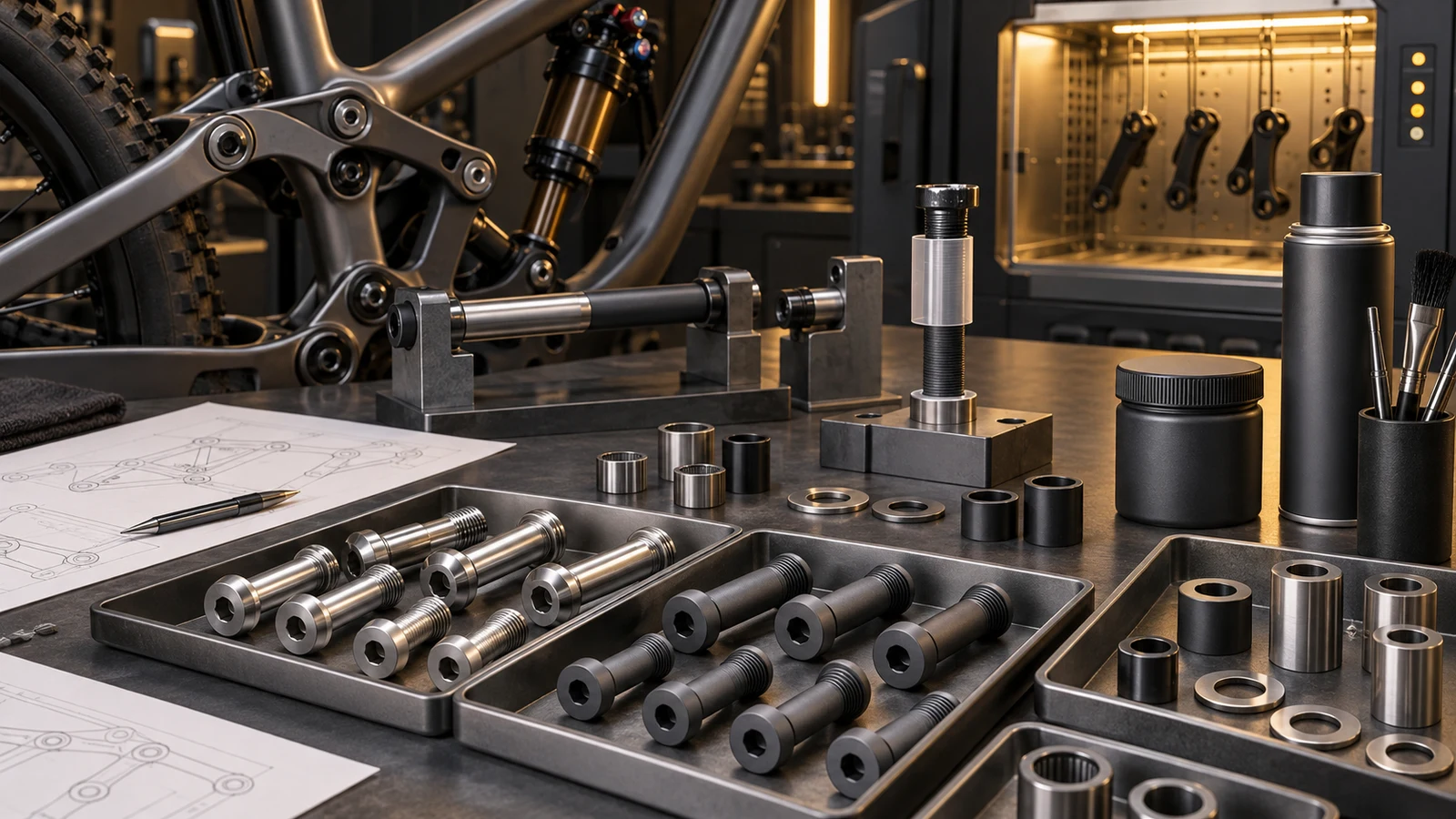
A MoS2 dry-film coating cannot simply replace an existing anti-seize product while leaving the manufacturing and assembly definition unchanged. For a pre-coated pivot bolt, identify the complete formulation, substrate preparation, coated contacts and ready-for-use condition. A gray-black film or shared solid-lubricant ingredient does not establish equivalent behavior. Air-curing and heat-curing products can introduce different manufacturing requirements, while thread and under-head coverage affect the assembled condition. Review final fit and the approved tightening method against the actual supplied film. Use the proposed product's evidence and relevant application assessment, not a generic friction range, to decide whether the substitution is acceptable.
Hero: concept illustration of example hardware and its application. It is not a factory photograph, tested component or approved production geometry.
MoS2 names a lubricant ingredient, not the complete film
DuPont's anti-friction coating guide describes solid lubricants dispersed in resin and solvent systems. Its explanation connects the bonded film with boundary or mixed-friction applications. The binder is not an incidental color carrier that purchasing can ignore.
Request the complete product identity and current technical document, not just 'MoS2 coated.' Identify the substrate and application objective. A thread assembly-lubrication requirement and a working sleeve's sliding-contact requirement are different functions even if a lubricant ingredient is shared.
The titanium dry-film versus anti-seize comparison covers supply and service choices. This article focuses on the coating application definition: which formulation and ready-for-use state are actually being supplied.
Preparation and application belong to the product proposal
The MOLYKOTE D-321 R sheet identifies cleaning, preparation and application requirements, with separate handling directions for bulk liquid and aerosol. These are examples of product-specific instructions, not an approved PremFixer process for every titanium surface.
For the manufacturing review, ask the provider how preparation is compatible with the actual substrate and final functional features. Do not copy a pretreatment listed for a general product into a titanium or aluminum order without resolving its suitability and dimensional consequences.
Define application and excluded zones on the drawing. Confirm how recesses, thread roots and local boundaries are represented. A uniform-looking exposed head does not inspect an internal or sheltered surface, and more material on every feature is not automatically better lubrication.
| Proposed change | Why it matters | Shortcut to avoid | Relevant confirmation |
|---|---|---|---|
| Same MoS2 label, different formulation | Binder and complete product differ | Ingredient name treated as equivalence | Named product and applicable technical instruction |
| Air cure replaced by heat cure | Readiness and substrate exposure differ | Gray-black appearance used as approval | Cure route and material compatibility |
| Bulk application replaced by aerosol | Handling and application instructions may differ | Container swap treated as identical execution | Product identity and represented coating state |
| Preparation method changed | Bonded film and local geometry need review | General pretreatment copied across substrates | Provider proposal and final feature requirements |
| Thread-only coverage extended under head | Assembly contact state changes | Earlier tightening basis carried over silently | Actual contacts and approved assembly method |
| Generic friction range used for acceptance | Test pair and stage omitted | One number treated as all-service behavior | Relevant motion, conditions and endpoint |
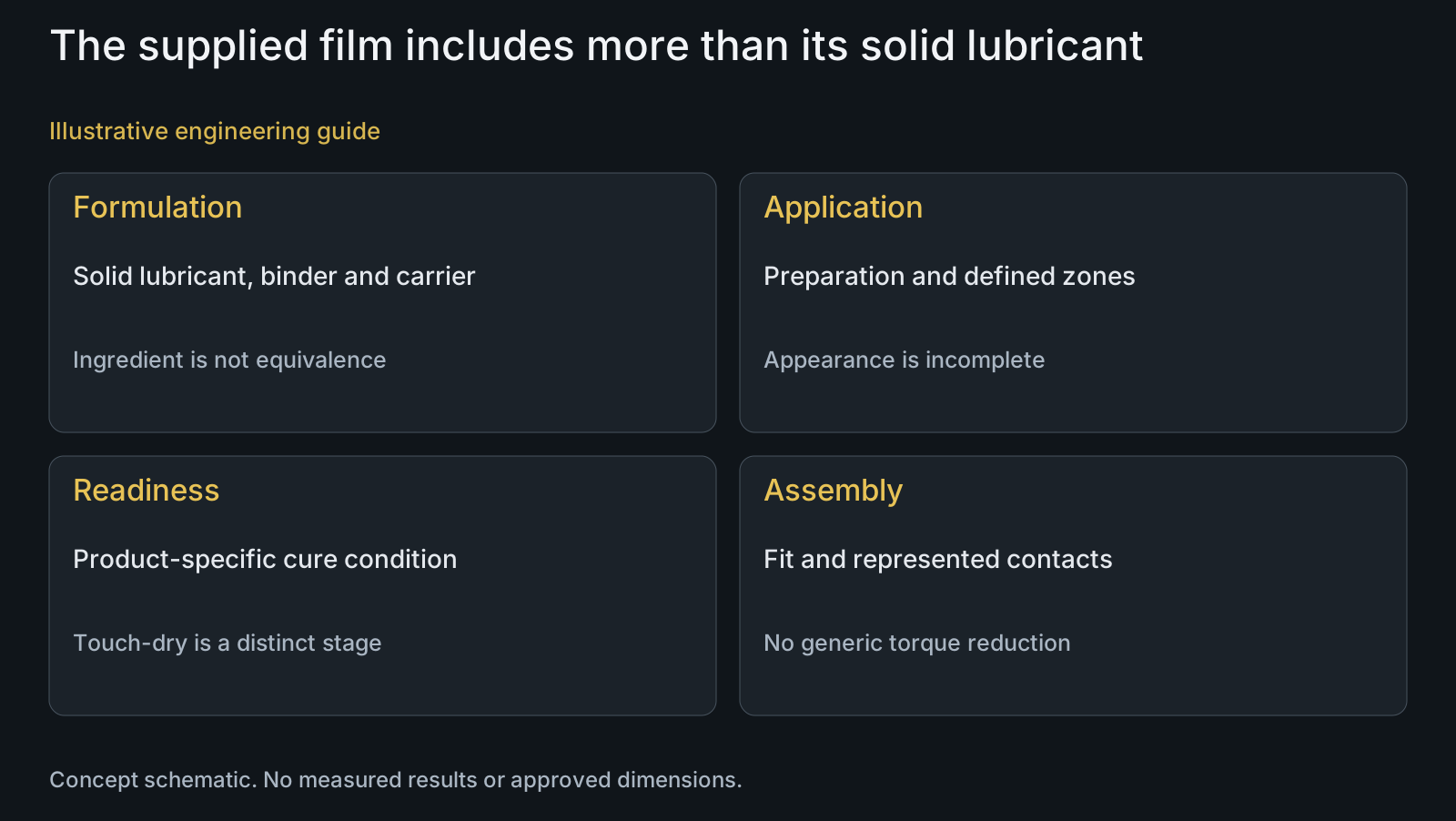
Dry to touch is not the same as ready for assembly
D-321 R's sheet distinguishes a touch-dry stage from its fully cured, ready-for-use condition. The D-7409 sheet instead identifies a heat-curing film and describes curing at object temperature. A shared dry-film label does not authorize the same readiness instruction.
Ask which product-specific condition must be achieved before handling, inspection or assembly. Do not use appearance or a convenient waiting period as an unverified replacement for that instruction. Where thermal curing is proposed, review the substrate condition and relevant final features with the provider.
The heat-treatment callout guide discusses process exposure and final state. A coating cure is not automatically a material heat treatment, but its exposure still belongs in the manufacturing compatibility review. No universal curing schedule is prescribed here.
Read wear and friction evidence in the represented state
The manufacturer guide illustrates running-in behavior and identifies the test context for its typical friction comparisons. A friction figure without contact, load and stage information is incomplete. Do not treat one generic MoS2 range as the constant behavior of every formulation.
D-7409's technical sheet differentiates test results by preparation and test conditions and cautions against using typical data as specification limits or as the sole design basis. That is not evidence of a wear life or corrosion interval for the ordered bicycle pivot.
As engineering review, identify the actual motion, counterpart, exposure and intended endpoint: acceptable sliding behavior, coating integrity, assembly function or another requirement. Evaluate the relevant coated condition. Color retention alone cannot establish every one of those functions, and a dry laboratory comparison does not represent unspecified wet or dirty service.
Keep contact coverage connected to tightening and fit
Distinguish working threads, head bearing face and shoulder contact. A treatment defined for one zone cannot silently become an assembly instruction for all three. State whether the counterpart carries another lubricant or finish, and identify any locking-product combination requiring confirmation.
Retain the approved tightening method for the represented joint until the responsible team approves a change. A sliding-friction test does not establish the thread and bearing-face conditions needed to justify a torque change. Do not add a paste over the film as an undocumented precaution.
For final dimensions, agree the accepted coated state and affected features, including female-thread clearance where relevant. The 6g/6H guide separates fit from lubrication. No universal thickness allowance or arbitrary torque reduction is supplied.
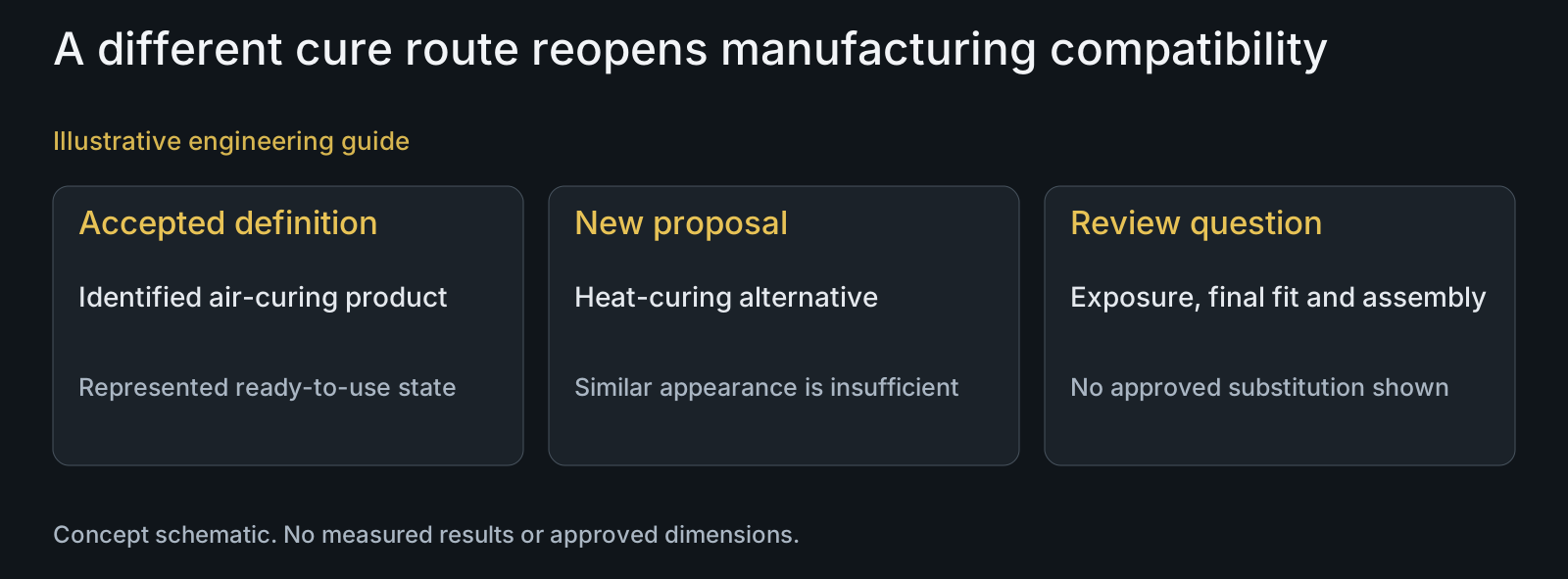
A cure-route substitution can change more than the container
Illustrative engineering example: assume a buyer's accepted application definition uses a specified air-curing dry film. A provider proposes a heat-curing alternative described with similar solid-lubricant terminology and gray-black appearance, while leaving the drawing and assembly instruction unchanged.
The reviewer compares product identity, preparation, readiness and thermal compatibility rather than approving from color. The final feature state and represented tightening configuration must also remain justified. The proposal may be viable, but visual similarity does not close those questions.
No actual curing trial, adhesion result or friction improvement is assumed. PremFixer can discuss surface-treatment coordination for the defined drawing and order; provision of the selected formulation and application route requires confirmation. No owned coating line or blanket commercial-product approval is claimed.
Questions buyers need to confirm
Can a dry film replace anti-seize without a configuration review?
No. Identify the complete product and application state, then review contacts, final fit and tightening requirements. A shared ingredient or generic friction value cannot approve the change.
Are all MoS2 dry-film formulations interchangeable?
No. The binder, carrier and application requirements are part of the system. Request the actual product and provider instruction rather than specifying only the solid lubricant.
Can a touch-dry film be treated as fully cured?
Not automatically. The cited air-curing example distinguishes those states. Use the applicable product's readiness requirements rather than infer assembly suitability from appearance.
Is a heat-curing alternative equivalent if it has the same color?
No. Review the changed cure route, substrate exposure and final features. Visual similarity is not evidence of manufacturing or assembly equivalence.
Does a published lubricant friction range set the tightening torque?
No. Identify the relevant test and coated contacts. The actual thread and bearing-face assembly needs its approved tightening basis, not an unsupported correction from sliding data.
What should the coating application RFQ include?
Send material condition, drawing and STEP, complete product proposal, preparation and cure instructions, coverage and exclusions, final fit and assembly configuration. Include service conditions and the performance question the film must address.
Technical references and scope
DuPont: Anti-friction coating guide. Binder/solid-lubricant context, boundary/mixed lubrication and condition-specific running-in example. No permanent-life or numeric friction guarantee transferred.
DuPont: MOLYKOTE D-321 R technical sheet. Application-form instructions and touch-dry versus ready-for-use distinction; not an approved pivot product or copied recipe.
DuPont: MOLYKOTE D-7409 technical sheet. Heat-curing example, preparation-dependent test context and typical-data limitations. No numeric cure, endurance or corrosion result transferred.
Explore related component, material and sourcing decisions in the customer decision knowledge center. For a drawing review, use the Drawing/BOM RFQ path.
Specify the complete dry-film application state
Send the drawing and BOM, substrate condition, proposed lubricant technical sheet, preparation and cure route, and marked thread, head and shoulder coverage. Include final-fit and tightening requirements. PremFixer will review application provision and manufacturing compatibility without treating color or ingredient identity as a qualified substitution.
Discuss the drawing and BOM