
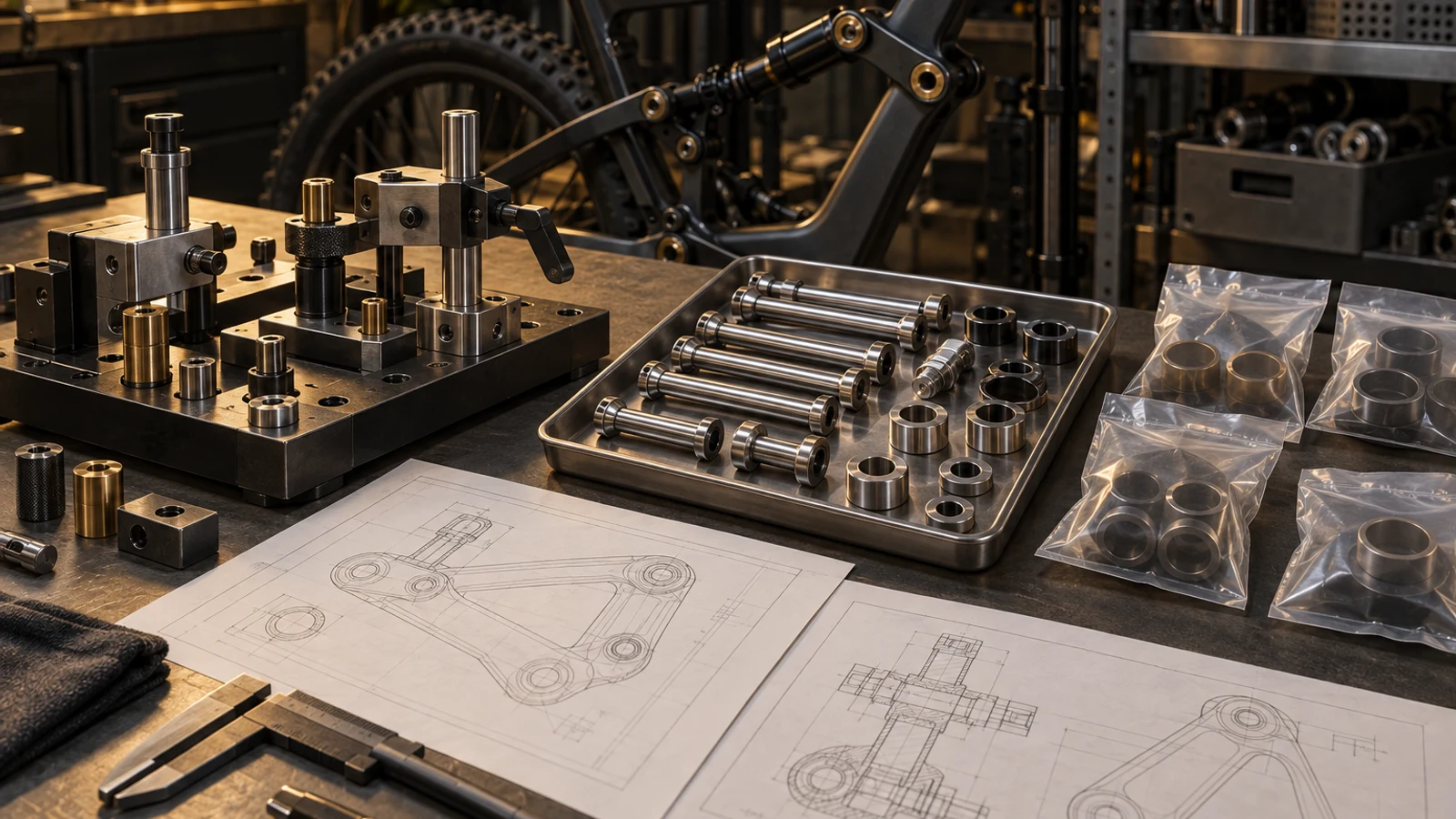
Existing tooling or surplus pivot hardware can be a useful option only when its actual condition, authorized use and compatibility are established. A fixture or die is a production resource; a finished axle, spacer or bearing is inventory. They need different evidence and cannot share a single 'reuse approved' conclusion. Compare adaptation, inspection and implementation work with a new-resource option before calling the old resource cheaper. For a prototype, define what the item is allowed to demonstrate rather than assume all requirements disappear. No available PremFixer surplus, transferable tool rights or universal noncritical-part exemption is promised here.
Hero: concept illustration of example hardware and its application. It is not a factory photograph, tested component or approved production geometry.
Identify the resource before choosing its review
A holding fixture positions and supports work for a particular operation. A forming die affects produced geometry through its relevant process. A gauge represents a measurement relationship, while finished stock represents parts already made. Calling all four 'old tooling' hides the decision being made.
Record identity, applicable definition and known history to the extent available. Separate the right to possess an item from permission to use another project's tooling or definition. Resolve rights in the relevant agreement rather than infer them from a seller's ability to deliver the item.
The manufacturing overview describes project manufacturing scope. It does not establish that an existing resource fits any drawing, that another customer's tool may be used, or that a listed machine route eliminates the need for a current resource review.
For a fixture, evaluate the current locating and support relationship
Compare the actual locating contacts, support, clamping and tool access with the current operation. A fixture that physically accepts an axle can still position it from the wrong feature or obstruct a changed operation. 'It fits in the jaws' is not a complete suitability statement.
Carr Lane describes locating pins as elements that position a workpiece or align fixture members. That general role helps direct the review toward the actual locating relationship; its catalog does not qualify an existing pivot fixture or confirm PremFixer uses those products.
Examine relevant contact condition and replaceable elements, then identify any adjustment or refurbishment proposed. Verification of produced characteristics must represent the resulting route. Do not carry an old favorable report forward after changing the features or process that made it relevant.
| Resource | Relevant comparison | Risk | Useful evidence or action |
|---|---|---|---|
| Holding fixture | Current locating, support and access | Physical fit mistaken for correct location | Contacts, condition and represented output |
| Forming die | Applicable geometry and route | Previous output assumed current | Tool state and current process evaluation |
| Gauge | Required characteristic and relationship | Old check used for changed definition | Applicable measurement and condition review |
| Finished axle or sleeve | Revision, material and final interfaces | Appearance substitutes for identity | Traceable definition and relevant checks |
| Stored bearing | Exact item and storage condition | Generic age treated as shelf-life approval | Manufacturer guidance and known history |
| Limited-purpose prototype item | What the sample must demonstrate | Fit mock-up used as structural evidence | Purpose and representative characteristics |
| Reuse proposal | Avoided work versus implementation | Old purchase price called net saving | Comparable new-resource alternative |
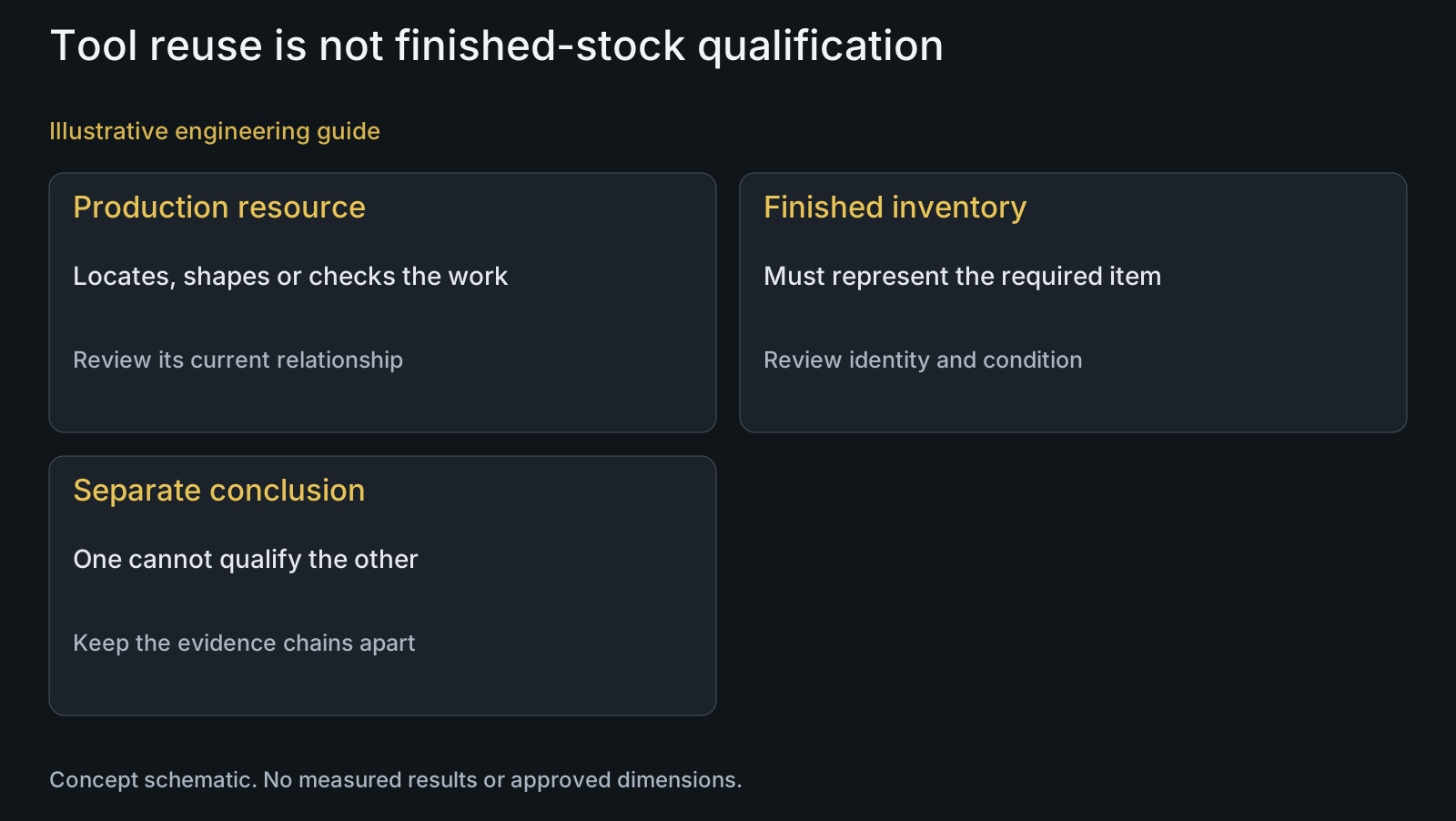
For stock, establish identity and condition independently
Match the part revision, material condition, treatment and finished interfaces to the current requirement. Similar appearance or a nominal thread size is insufficient. If the inventory belongs to a previous definition, use the revision compatibility review to identify the actual affected interfaces.
A current dimensional check answers represented geometry, not necessarily material history or surface condition. Identify the evidence needed for each unresolved subject. Do not claim that one chemical check reconstructs every process condition or that a clean-looking finish establishes its original treatment specification.
For bearings included in a proposed kit, NSK's storage guidance makes packaging, environment and preservative condition relevant. That bearing-specific guidance does not establish a shelf life for all pivot bolts or authorize every stored bearing. Review the actual bearing manufacturer's applicable instructions and known storage history.
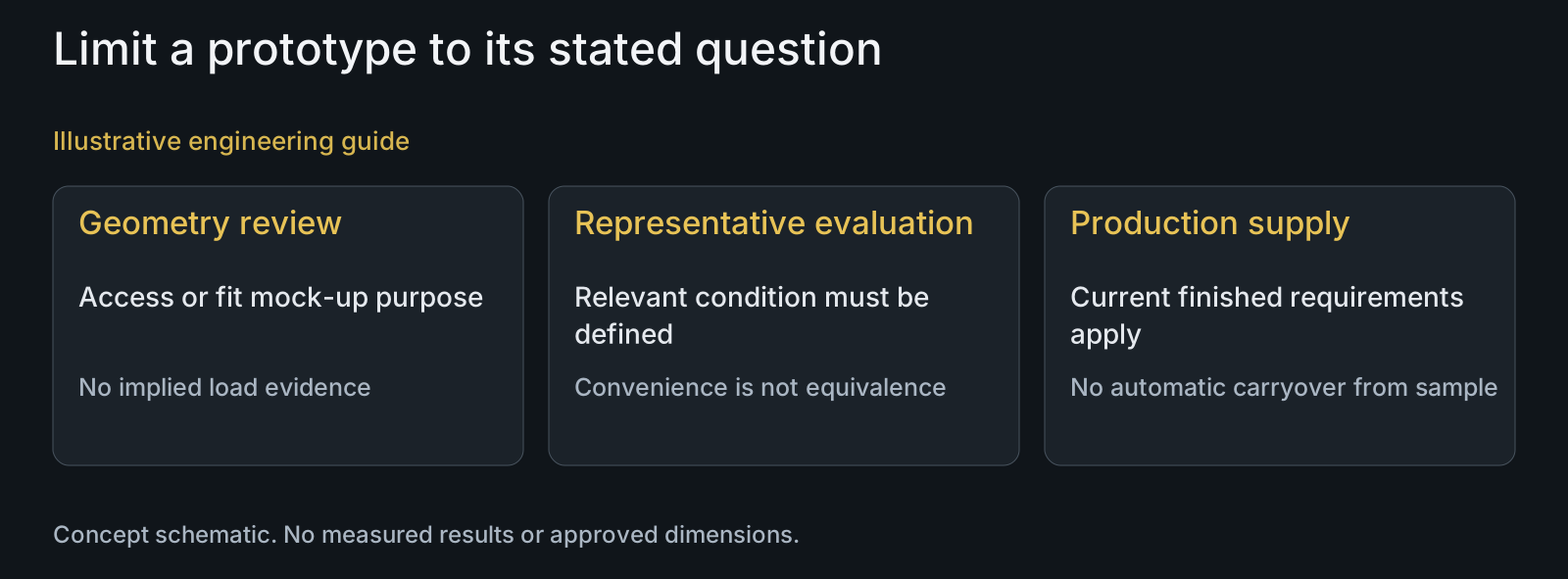
A prototype's purpose limits what reused resources can demonstrate
A non-riding fit mock-up and a load-representative evaluation are different uses. State the prototype's purpose and which characteristics must be representative. A geometry-only substitute may help an access review while remaining unsuitable as evidence for structural behavior or service life.
Do not use 'noncritical' as a universal waiver. Identify the actual function and relevant acceptance boundary. An apparently minor sleeve can influence axial support, and a reused fastener can affect a prototype's conclusions even if that sample is not intended for sale.
Keep limited-use items identifiable and separate from production kit supply. The rapid-prototyping discussion should connect the sample to its question; a low-cost temporary item does not become a released component because it was convenient during development.
Compare adaptation and verification with avoided work
Identify the new work needed: condition assessment, refurbishment, changed inserts or supports, programming, sample manufacture and applicable evidence. Then identify what a new resource would require. No net benefit is established by subtracting the used item's purchase price from a new-tool price alone.
For surplus stock, include the required sorting or identity review and any permitted processing needed to reach the current finished condition. If the necessary history is missing, do not presume that additional testing can always make the stock eligible. Some uncertainty can prevent the intended use rather than merely create another fee.
The value-engineering option sheet keeps required functions and implementation burden together. The reuse option can be accepted, adapted, limited to a stated purpose or rejected. This is a suitability comparison, not a promise that old resources always reduce cost or delivery time.
Review example: the fixture can be adapted but stock remains unresolved
Illustrative engineering example: assume a project has an existing holding fixture and a box of visually similar axles from an earlier configuration. The current drawing changes a locating relationship. No actual tool condition, stock certificates, costs or produced results are supplied.
The reviewer separately examines whether the fixture can locate the new operation after an identified adjustment and whether the stored axles represent the required finished definition. A proposed fixture adaptation does not establish the axles' material, revision or treatment history.
The project may pursue a defined fixture evaluation while leaving the stock out of production supply pending evidence. Neither resource is declared approved. The example shows why one reuse decision must not be used as a blanket release for unrelated existing resources.
Questions buyers need to confirm
Can an old fixture reduce the project cost?
Possibly, if its locating, support and access suit the current operation and required adaptation is worthwhile. Compare condition assessment and verification with a new fixture rather than assume reuse is cheaper.
Can surplus axles be mixed into a new kit?
Not automatically. Establish revision, material condition, treatment and compatible interfaces first. A visually similar component is not evidence of the current required finished item.
Does a fresh dimensional report establish the stock's material history?
No. It addresses the represented geometry. Material identity, product condition and process history need applicable evidence; one measurement cannot reconstruct all missing manufacturing records.
Are reused parts acceptable for every prototype?
No. Define whether the prototype addresses geometry, assembly or a load-representative question. Limited-purpose substitutes must remain identifiable and cannot support conclusions for unrepresented conditions.
Does a stored bearing have the same shelf life as a pivot bolt?
Do not transfer that rule. Bearing packaging, lubricant and environmental guidance are product-specific. Consult the applicable manufacturer information and known history, without applying a universal storage period to every kit member.
What information makes a reuse proposal reviewable?
Supply the resource identity, authorized-use boundary, known condition and history, current drawing and intended operation or sample purpose. Identify adaptation and verification work so the alternative can be compared without an invented saving.
Technical references and scope
Carr Lane: locating pins. General workpiece/fixture locating role only; no tool-condition qualification or adoption of catalog claims.
NSK Technical Insight: Bearing Storage. Bearing-specific packaging, environment and preservative relevance; numerical storage periods and guarantees not extended to pivot hardware.
Explore related component, material and sourcing decisions in the customer decision knowledge center. For a drawing review, use the Drawing/BOM RFQ path.
Review each existing resource on its actual intended use
Send current drawings, STEP, mating BOM and required condition, plus the existing resource's identity, known history and proposed use, through the Drawing/BOM RFQ path. PremFixer can review manufacturing compatibility and identify what evidence or adaptation remains necessary; no surplus availability is assumed.
Discuss the drawing and BOM