

Pivot hardware value engineering starts with what the joint must do, not with deleting the most visible part. Define location, clamp support, retained movement, tool access and the applicable acceptance conditions, then compare solutions that preserve those outcomes. A spacer's function may move into another feature, but it does not disappear because the BOM is shorter. Include changes to mating components, fixtures, samples, instructions and verification in the decision, not only the proposed piece price. The direct answer is to compare complete functional alternatives with explicit evidence needs. No reduction in quality, universal saving or approved design follows from a simpler-looking assembly.
Hero: concept illustration of example hardware and its application. It is not a factory photograph, tested component or approved production geometry.
Describe the required function independently of the current component
Ask what the axle, receiver and supporting members accomplish in the actual joint. Separate radial location, axial support, retention and access rather than treating 'pivot bolt' as one undifferentiated purpose. The application determines which subjects carry those functions.
FHWA's public VE explanation places function analysis before generating and evaluating alternatives. Its highway program is not a bicycle standard; the general distinction used here is between the needed outcome and the current solution. This article does not claim a certified formal VE study.
Write the retained condition as well as the positive task. Providing clamp support must not create an unintended contact that prevents required movement. A component reduction that keeps assembly possible but changes its load path remains a different solution requiring review.
Map where each function goes in the alternative
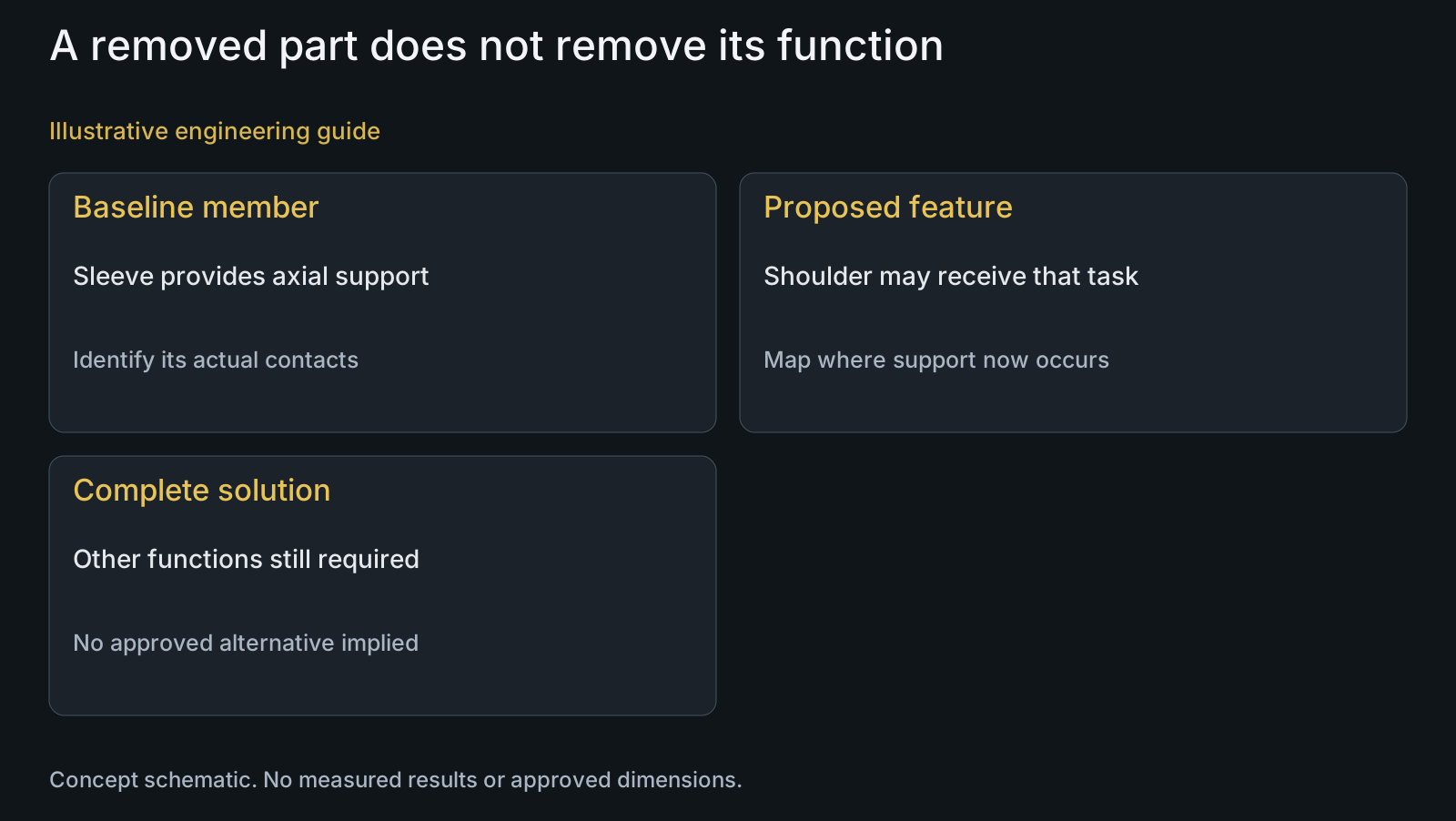
If a separate sleeve is consolidated into a shoulder, identify the new axial contacts and the geometry that establishes their separation. The former sleeve may also have supported replacement, treatment separation or assembly identification. A function map must include those relevant consequences, not just the nominal length.
If a drive is standardized, identify the tool, access envelope and service setting it must support. A familiar drive form is not equivalent when its surrounding clearance or engagement is inadequate. Keep the required operational result distinct from the appeal of a commonly sourced tool.
The DFM/DFA review examines manufacturing and assembly tradeoffs. Here the wider buyer question is how several complete solutions allocate required functions and what each option requires before it can be considered eligible.
| Required function | Candidate solution | Risk or added burden | Verification basis |
|---|---|---|---|
| Axial support | Separate sleeve or integrated shoulder | New contacts and replacement boundary | Complete represented stack and contacts |
| Radial location | Required locating feature retained | Another surface assumed equivalent | Mate definition and final geometry |
| Tool access | Current drive or coherent alternative | Clearance or engagement changes | Assembly and service envelopes |
| Required movement | Contacts preserve intended motion | Clamp support creates unwanted contact | Complete joint arrangement |
| Identification and handling | Part marking or permitted kit presentation | Useful information removed | Required identity and receiving task |
| Manufacturability | Existing definition with route alternative | Acceptance method or datum changes | Required output and evidence |
| Implementation scope | Retain, revise or defer option | Samples and validation omitted | Quantity horizon and actual offers |
Compare more than one way to serve the same need
Consider retaining the current definition with a different manufacturing organization, changing an assembly aid, or proposing a coherent hardware alternative. These act at different boundaries. Do not force every cost discussion into a geometry or material change when the relevant work may sit elsewhere.
Keep the baseline as a candidate. It can be preferable when a proposed simplification creates new interface uncertainty or disproportionate implementation work. Value engineering is not obliged to produce a revised part, and a selected alternative still needs the customer's relevant design authority.
The drawing-stage cost review identifies specific removed and transferred machining work. Use its findings as inputs to the complete option comparison, not as proof that a shorter tool path preserves every joint function.
Include the cost of changing the solution
Identify drawing and mating-part updates, fixture or programming changes, samples, evaluation and instructions affected by each option. Distinguish these from recurring supplied-unit work. Do not compare a mature baseline's full cost with an alternative's optimistic cycle estimate.
State the quantity and configuration horizon over which the proposed alternative will be used. An implementation burden may be material for a short run even if its recurring work could later differ. No break-even quantity can be asserted without actual offered and implementation inputs.
Use the controlled quotation template to preserve the baseline and alternatives. Manufacturing can clarify the proposed route; a supplier quotation does not establish the buyer's complete redesign or validation cost.
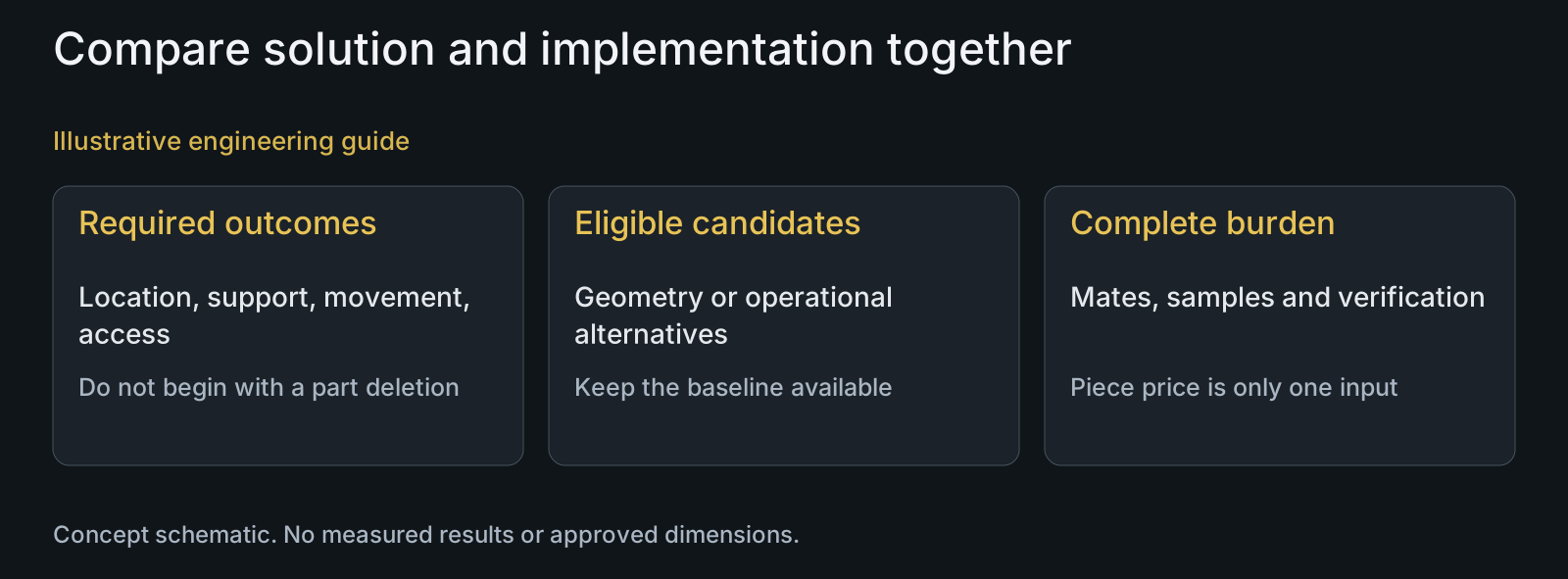
Match verification to the function affected
A proposal changing axial contacts needs review of the contact arrangement and represented stack, not only a measurement of the new part's overall length. A material proposal may require a different evidence question from a packing change. Name the affected function before choosing what would demonstrate it.
Separate dimensional conformity of the alternative from application suitability of the assembled system. A component can match a proposed drawing while the complete joint still lacks evidence for its use conditions. Do not replace system validation with a generic material certificate or appearance sample.
Carry the relevant receiver, bearing and spacer conditions into the review. The full-suspension solution context identifies the application boundary, not universal fit. No load, torque, tolerance or service-life value is prescribed by this option sheet.
Review example: the sleeve disappears but its task remains
Illustrative engineering example: assume a current pivot uses a separate sleeve for defined axial support. A proposed shouldered member would serve that task without the separate piece. No dimensions, loads, materials, cost estimates or evaluation results are supplied.
The reviewer maps the proposed axial contacts, mating clearances and replacement implications, then identifies manufacturing and verification work for the new geometry. They compare that option with retaining the sleeve and changing only kit presentation. The latter acts on handling rather than moving the support function.
Neither option is declared better. The comparison shows that part count, functional allocation and implementation burden are different measures. A useful VE review can retain the original design while identifying an operational alternative, rather than describe every removed BOM line as a proven improvement.
Questions buyers need to confirm
Does removing a spacer automatically improve value?
No. Identify its axial support, clearance, replacement or handling roles and where each moves in the alternative. A shorter BOM is not evidence that required function or total burden improves.
Can a process-only change be a useful alternative?
Yes, where it changes work while preserving the required output and acceptance basis. Keep it distinct from a drawing revision and examine any effect on datum relationships or evidence.
What separates value engineering from price negotiation?
VE examines the technical or operational solution serving the required function. Commercial negotiation can change terms without changing that solution. Record them separately rather than claim a discount proves functional improvement.
Which implementation costs belong in the comparison?
Include affected drawings, mates, tooling, programming, samples, evaluation and instructions where required. Distinguish them from recurring manufacture and state the configuration and quantity horizon represented.
Is a conforming prototype enough to validate the joint?
Not necessarily. Its measurements address the represented component definition. Application suitability requires evidence appropriate to the assembled interfaces and use conditions, especially where contacts or load paths changed.
What if no alternative has a supported advantage?
Retaining the baseline is a valid review outcome. Record the unresolved function or disproportionate implementation burden rather than force a design change or invent a cost benefit.
Technical references and scope
Federal Highway Administration: VE Process and Job Plan. General function analysis, alternatives, evaluation and implementation distinction; highway program requirements and numerical examples not transferred to bicycle hardware.
Explore related component, material and sourcing decisions in the customer decision knowledge center. For a drawing review, use the Drawing/BOM RFQ path.
Review complete functional alternatives, not only cheaper pieces
Send drawings, STEP, complete mating BOM, assembly and service context, retained requirements and proposed alternatives through the Drawing/BOM RFQ path. PremFixer can review manufacturing consequences and identify the interface and evidence questions that need the customer's design decision.
Discuss the drawing and BOM