

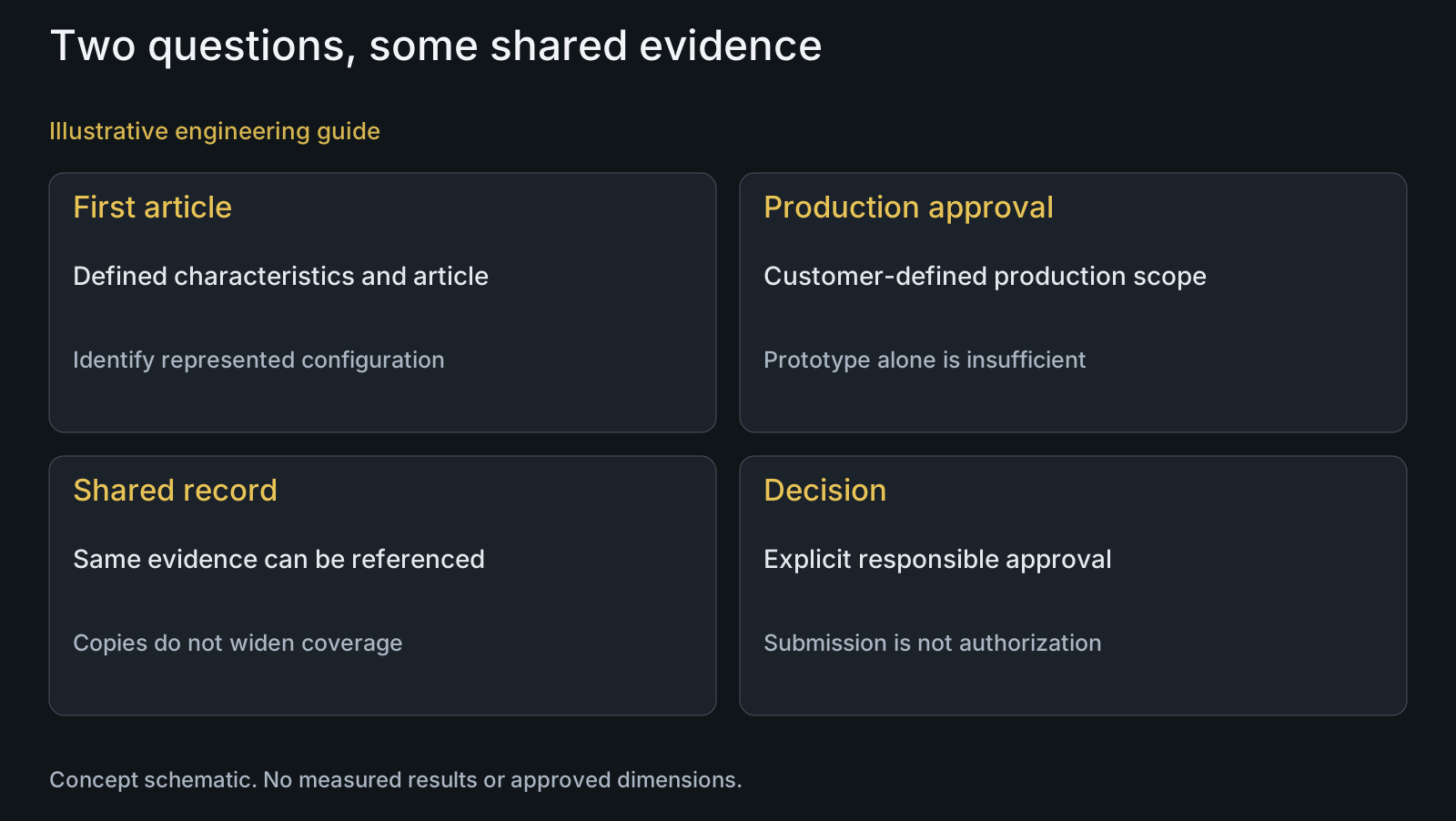
FAI and PPAP are not interchangeable approval labels for a bicycle pivot bolt. A first-article review addresses the required characteristics of an identified article and its represented configuration; production approval asks a broader question about the proposed production process and the customer's specified submission. Some evidence can serve both purposes, but a dimensional pass cannot close every process or approval requirement. Specify which question the OEM needs answered, the applicable requirements and the production conditions represented. Do not automatically request both packages for every supplier or call a familiar spreadsheet a compliant submission. Completed documents, conforming samples and customer authorization remain different states.
Hero: concept illustration of example hardware and its application. It is not a factory photograph, tested component or approved production geometry.
Begin with the approval question
Ask whether the immediate decision is design fit, first-article conformity or approval of the proposed production arrangement. Prototype fit can be useful without representing production tooling, stock or surface processing. List these differences explicitly rather than treating the word sample as a complete description.
AIAG's public PPAP overview emphasizes understanding the processes needed for consistent quality during an actual production run at production rates. That purpose is different from presenting only an isolated favorable dimensional result. The applicable customer requirements determine how the production evidence is requested and assessed.
Choose the obligation, not a prestige label
SAE's public AS9102C scope establishes requirements for performing and documenting FAI and says they complement customer and applicable legal requirements. An AS9102 reference does not automatically make a bicycle component aerospace certified or replace the order's requirements.
Decide whether the customer wants an adapted first-article format or conformity to a named standard and edition. The AS9102 deliverable guide explains that distinction. For PPAP, likewise identify the applicable manual, customer-specific instructions and requested submission rather than assuming a familiar level number defines every project detail.
| Buyer task | Relevant evidence | Common overreach | Verify before acceptance |
|---|---|---|---|
| Prototype fit | Identified prototype and interface review | Called production approval | Represented route and limitations |
| First article | Characteristics for defined configuration | Report layout called conformity | Requirements and evidence map |
| Production approval | Customer-defined process submission | One sample treated as process proof | Actual represented production conditions |
| Shared document | Valid common supporting record | Copied record gains wider scope | Identity, revision and supplied state |
| Changed route | Review of affected evidence | Old approval follows part number | Applicable change requirements |
| Shipment decision | Defined customer authorization | Submission assumed to permit dispatch | Authority and unresolved conditions |
Share evidence without expanding its meaning
A valid dimensional report, material record or specified test may be relevant to more than one submission. Reference the same evidence where its part identity, revision, supplied state and production scope remain applicable. Two copies do not add a second independent observation.
Build a requirement-to-evidence map for each approval question. A report on a prototype's shoulder does not establish a later finished seat after a changed surface operation. A record for one stock identity cannot automatically represent another. Shared evidence should reduce duplication while leaving each decision's missing information visible.
Represent the route that will actually supply the order
Describe relevant material condition, tooling, machining and thread route, surface processing, inspection and participating locations. Do not imply that all coordinated operations are performed in-house. Review the proposed manufacturing scope against what the submitted samples and reports actually represent.
If the production route changes after evidence is collected, identify which characteristics or process questions were invalidated or never represented. Agree the necessary review under the applicable requirements. Merely retaining the same part number cannot prove that earlier evidence covers an altered route.
An accepted sample can leave production approval open
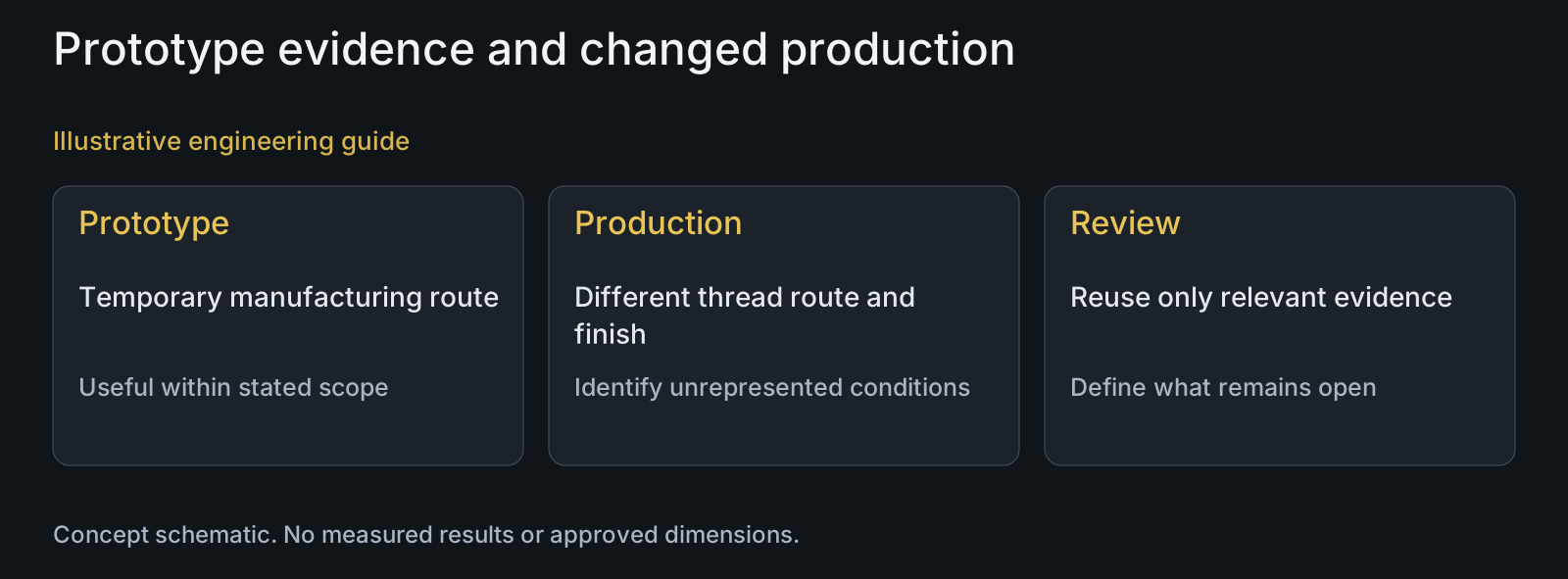
Illustrative engineering example: assume an OEM reviews a prototype pivot axle made by a temporary machining route. Its dimensional report addresses the prototype drawing, while the proposed production uses a different thread route and specified final finish. No measured values or accepted customer package are assumed.
The prototype may still support the design discussion. It cannot silently supply evidence for the unrepresented production conditions. The buyer identifies which existing records remain useful, what new production evidence is needed and who will make the approval decision. Producing two report covers for the same prototype would not close those gaps.
Separate submission, approval and shipment authority
Record what has been submitted, what the customer has reviewed and any outstanding or conditional matters. The purchase agreement should define who can authorize shipment and how that decision is communicated. Do not interpret a report upload, received email or dimensional signature as broader permission without the defined scope.
PremFixer can review a requested evidence package for custom pivot manufacture, including qualified-partner work where applicable. A fully conforming FAI or PPAP deliverable requires project confirmation; this article establishes neither an already approved package nor a universal capability promise. Component approval also does not substitute for the OEM's complete-joint application validation.
Questions buyers need to confirm
Must every new pivot supplier provide both FAI and PPAP?
Not automatically. Define the customer decision, contractual requirements and risk first. Request evidence that supports an additional question rather than two differently labelled copies of the same report.
Can one dimensional report appear in both packages?
Yes, where its represented scope is valid for both requirements. Confirm part identity, revision, surface state and manufacturing configuration. Reusing a record does not turn prototype measurements into production evidence.
Does AS9102 mean the component is aerospace certified?
No such product or company certification follows from a first-article reference. State the required standard edition or adapted format. Confirm conformity and any separate contractual obligations through the actual project requirements.
Does a PPAP level number define the complete order scope?
Do not rely on the number alone. Obtain the applicable manual and customer-specific submission instructions, including required evidence and approval responsibilities. This comparison is not a substitute for the complete requirements.
What happens if the manufacturing route changes?
Review which earlier evidence no longer represents the proposed supply. Provide the old and new routes, affected characteristics and change details. The applicable requirements determine the additional submission or approval needed.
Can completed paperwork authorize dispatch?
Only the defined authorization and scope can do that. Distinguish document submission from review, unresolved conditions and shipment permission. Identify the authorized customer decision and its relationship to the purchase order.
Technical references and scope
AIAG, Production Part Approval Process overview. Public explanation of production-run and consistent-quality purpose; no paid manual clauses or submission-level tables reproduced.
SAE, AS9102C public scope. Publisher's FAI scope and complementary customer requirements; not the full implementation procedure.
Explore related component, material and sourcing decisions in the customer decision knowledge center. For a drawing review, use the Drawing/BOM RFQ path.
Specify the approval package you actually need
Send the drawing and BOM revisions, intended production route, customer FAI or PPAP instructions and required reports through the Drawing/BOM RFQ path. PremFixer can review the represented manufacturing scope and clarify evidence deliverables before quotation.
Discuss the drawing and BOM