

A bolt near a bicycle handlebar does not become a food-contact component simply because riders touch it or the bicycle is shared. The relevant question is whether its intended use involves food contact, not whether stainless steel appears in the drawing. For a genuine food-contact application, define the contacted food, surface system and service conditions, then obtain the appropriate application-specific assessment. Do not present a chromium percentage or a generic material certificate as FDA approval of a finished bolt. PremFixer's bicycle manufacturing scope does not establish a food-contact authorization, and this guide does not determine the regulatory status of an unspecified special-use product.
Hero: concept illustration of example hardware and its application. It is not a factory photograph, tested component or approved production geometry.
Describe what contacts what in the intended application
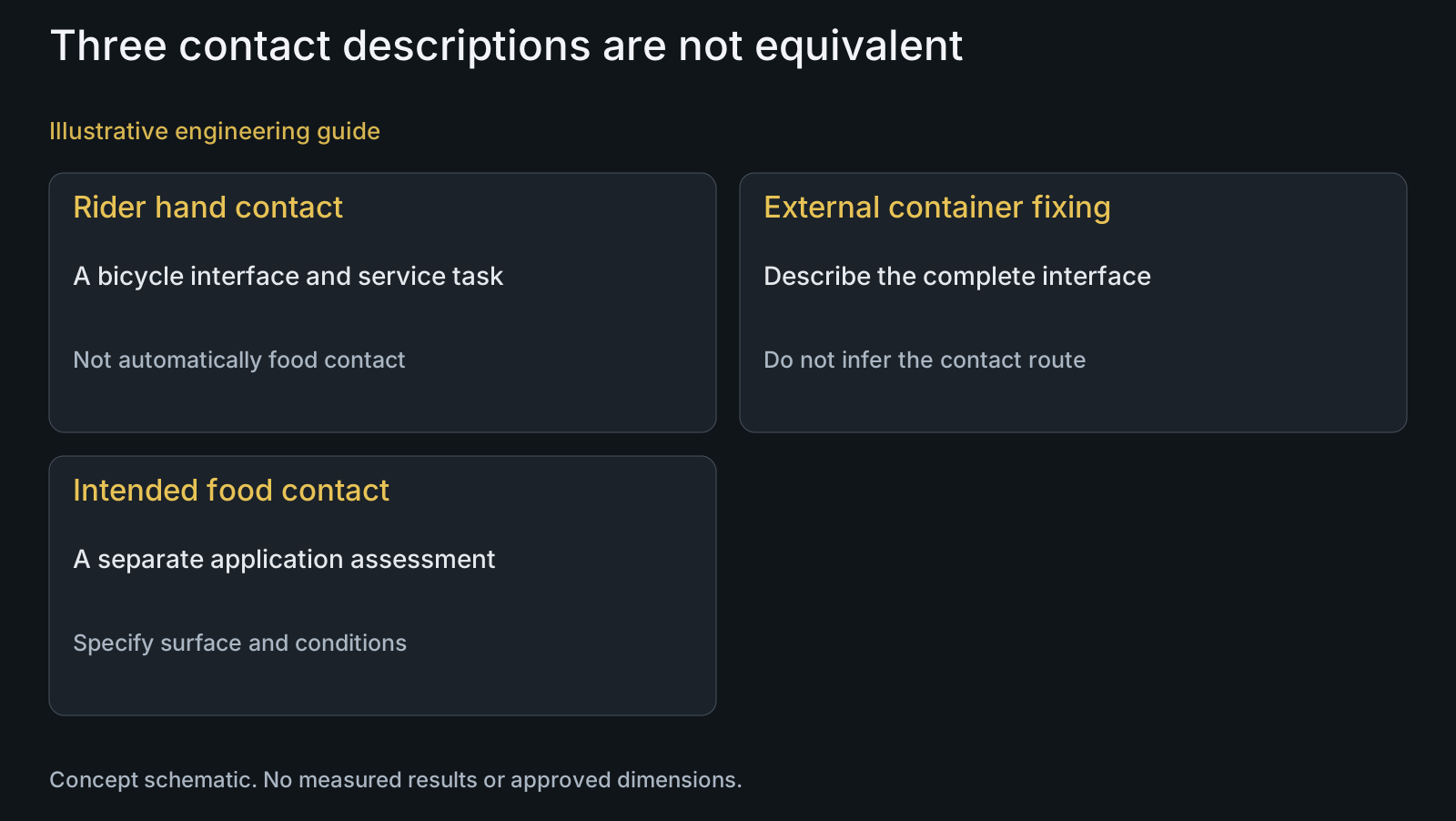
Separate three descriptions: a rider touches a bolt, a bolt secures a container externally, or a fastener forms part of a surface intended to contact food. They are not interchangeable statements. Request an assembly section or annotated photo showing the actual interfaces rather than infer the use from a purchasing template.
FDA's consumer explanation describes food-contact substances in relation to packaging, processing equipment, preparation surfaces and cookware. That scope supports asking about the actual food-contact function. It does not turn every public-touch object into food-contact equipment.
An ordinary pivot axle still needs its defined mechanical, corrosion and assembly requirements. Removing an unsupported FDA claim does not remove those engineering obligations. Use the customer decision knowledge center for the relevant bicycle component decisions.
Do not turn an alloy label into finished-product approval
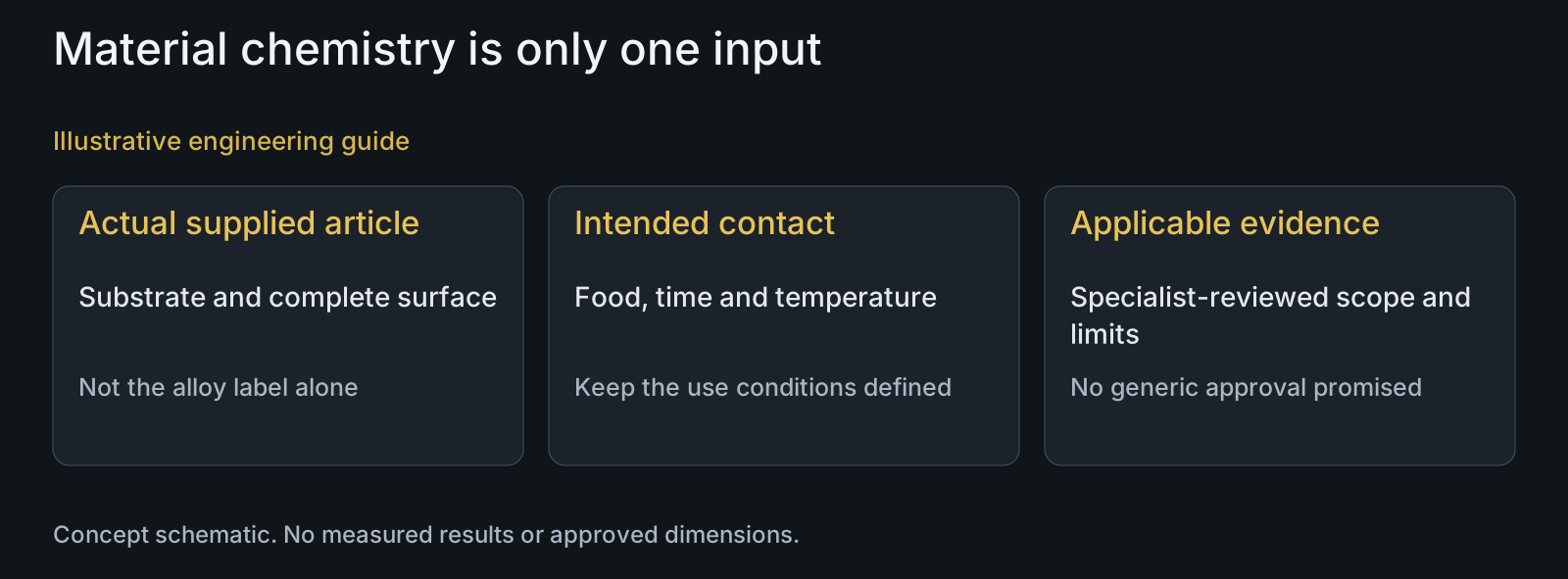
A chemistry result identifies reported material information. It cannot, by itself, identify every added surface material, finished configuration or use condition. A familiar stainless designation does not answer whether the actual supplied article is suitable for a particular food-contact application.
FDA's regulatory-status guidance organizes the review around substance identity, specifications and limitations on conditions of use. A chromium percentage cannot substitute for that application-specific review. This article therefore makes no universal chromium threshold or GRAS claim for bicycle fasteners.
Read the CoC and CoA comparison when selecting the document. A supplier statement and analytical results answer different questions; neither title creates a food-contact authorization for an otherwise undefined component.
| Described application | Decision to clarify | Risk of the shortcut | Useful input |
|---|---|---|---|
| Rider touches a clamp screw | Ordinary bicycle service requirements | Hand contact is labelled food contact | Drawing and actual assembly location |
| Hardware outside a closed food container | Whether the intended configuration creates relevant contact | Transporting food is treated as automatic direct contact | Container interface and defined use |
| Fastener in an intended food-contact fixture | Application-specific assessment basis | The alloy name is treated as approval | Contact surface, food and service conditions |
| Coated stainless special-use part | Complete final surface configuration | Bare-stock chemistry is extended to the coating | Substrate, treatment and added materials |
| Changed finish or contact temperature | Whether existing evidence still represents the use | An earlier document is reused without scope review | Changed drawing and assessed conditions |
| Buyer asks for an FDA certificate | The specific evidence and destination need | A generic commercial statement promises authorization | Intended use and responsible specialist's request |
Identify the complete supplied surface before discussing evidence
For a special-use inquiry, name the substrate, treatment and any supplied coating, compound or other material relevant to the contact surface. Specify whether the questioned surface is bare metal, coated metal or another component of the assembly. Do not let an invoice description of stainless steel hide the final supply configuration.
Ask whether cleaning, repeated use or wear changes which surface the application exposes. These are inputs to the responsible specialist's assessment, not a prediction of unsafe migration or a substitute for required evaluation. No universal cleaning recipe or migration-test protocol is prescribed here.
The surface-treatment page explains a manufacturing discussion. It does not qualify every finish for food contact. If the buyer changes the finish after reviewing the substrate, return the changed surface configuration to the assessment instead of assuming the earlier evidence automatically carries over.
Describe contact conditions rather than request an undefined FDA certificate
Name the food or food category, contact location, anticipated time and temperature, and whether the use is repeated. FDA's food-type and use-condition tables distinguish different food and thermal contexts. They are a reference for notification information, not a universal finished-fastener acceptance table.
Record whether a fastener remains outside a sealed container or is intended to contact contents. Identify any uncertainty about seals, openings or use practices instead of declaring an indirect route irrelevant from a single photograph. The product's responsible compliance specialist should determine the applicable basis for the described application.
Include the destination market. FDA information addresses a US context; it is not a universal document for every importing jurisdiction. A quotation request should state what assessment or evidence the customer actually needs rather than use FDA as a general synonym for clean or corrosion-resistant.
Illustrative engineering example: one material name, two different uses
Illustrative engineering example: assume a buyer has a stainless handlebar-clamp screw and also proposes similar-looking hardware for a food-processing fixture. The drawings have not defined the fixture's contact surface, finish or cleaning conditions. No real customer application or regulatory result is assumed.
The bicycle screw is reviewed against its own specified interface and service needs. The proposed fixture is returned for a defined food-contact scenario and specialist assessment. The reviewer does not copy a stainless chemistry document between the projects and announce that both products have FDA approval.
The comparison shows why an additional application requires additional definition even when the metal name is unchanged. The outcome is a clarified information request, not an approved material, completed migration test or demonstrated food-contact manufacturing capability.
Keep the supplier's manufacturing scope and regulatory decision separate
PremFixer manufactures custom fasteners to customer inputs and an agreed supply scope. Share drawings, BOM and surface requirements for a focused manufacturing discussion. Do not treat the materials overview as a list of FDA-approved finished components.
If a genuine special-use application requires additional evidence, identify the responsible assessor and the requested basis before promising a document. No universal availability of food-contact declarations, authorization records or testing is established here.
The custom-order document guide helps distinguish material, conformity and inspection records. Retain the specific intended use and any limitations with the evidence. A different destination, finish or contact scenario should not be silently covered by a general bicycle declaration.
Questions buyers need to confirm
Does touching a bicycle screw create a food-contact requirement?
Hand contact alone does not establish the intended food-contact application described here. Explain the actual use and interfaces. Keep the bicycle's mechanical and corrosion requirements separate from any genuine special-use assessment.
Does a stainless chromium percentage prove FDA approval?
No product-specific approval should be inferred from that figure alone. Identify the finished article, complete surface and intended contact conditions, then obtain the appropriate assessment. A chemistry value is not a substitute for that scope.
What if a bolt attaches a food container to a bicycle?
Describe where the bolt sits and what it is intended to contact. An external mounting and a food-contact surface are different scenarios. Provide the container interface, sealing arrangement and use conditions for the responsible specialist's applicability review.
Can a bare-metal report cover a later coating?
Do not assume that. Identify the complete supplied surface and any added materials. A change in finish can change the evidence question even if the base alloy remains identical; return the changed configuration for review.
Which conditions belong in a genuine food-contact inquiry?
Provide the food or category, contact location, time and temperature, repeated-use and cleaning context, destination and final surface definition. These describe the assessment subject rather than preselect a universal certificate or test.
Does PremFixer guarantee FDA food-contact documents for bicycle hardware?
No such universal guarantee is established here. Share the defined special-use application and required evidence so the manufacturing scope and any additional specialist work can be discussed without inventing approval or test availability.
Technical references and scope
FDA: Food-contact information for consumers. Public explanation of food-contact uses and intended-use safety review. No determination that ordinary bicycle hand contact is a food-contact authorization scenario.
FDA: Regulatory status of components of a food-contact material. Public substance-identity, specification and use-limitation review framework. No particular fastener authorization, generic chromium threshold or completed GRAS determination asserted.
FDA: Food types and conditions of use. Notification reference categories demonstrating why food and thermal context matter. No copied numerical acceptance threshold or prescribed migration protocol.
Explore related component, material and sourcing decisions in the customer decision knowledge center. For a drawing review, use the Drawing/BOM RFQ path.
Clarify the application before requesting special-use evidence
Send the component drawing, assembly section, BOM and final surface definition. For a genuine food-contact use, include the food, contact conditions, cleaning context, destination and your specialist's evidence request so PremFixer can discuss the manufacturing scope and unresolved assessment inputs.
Discuss the drawing and BOM