
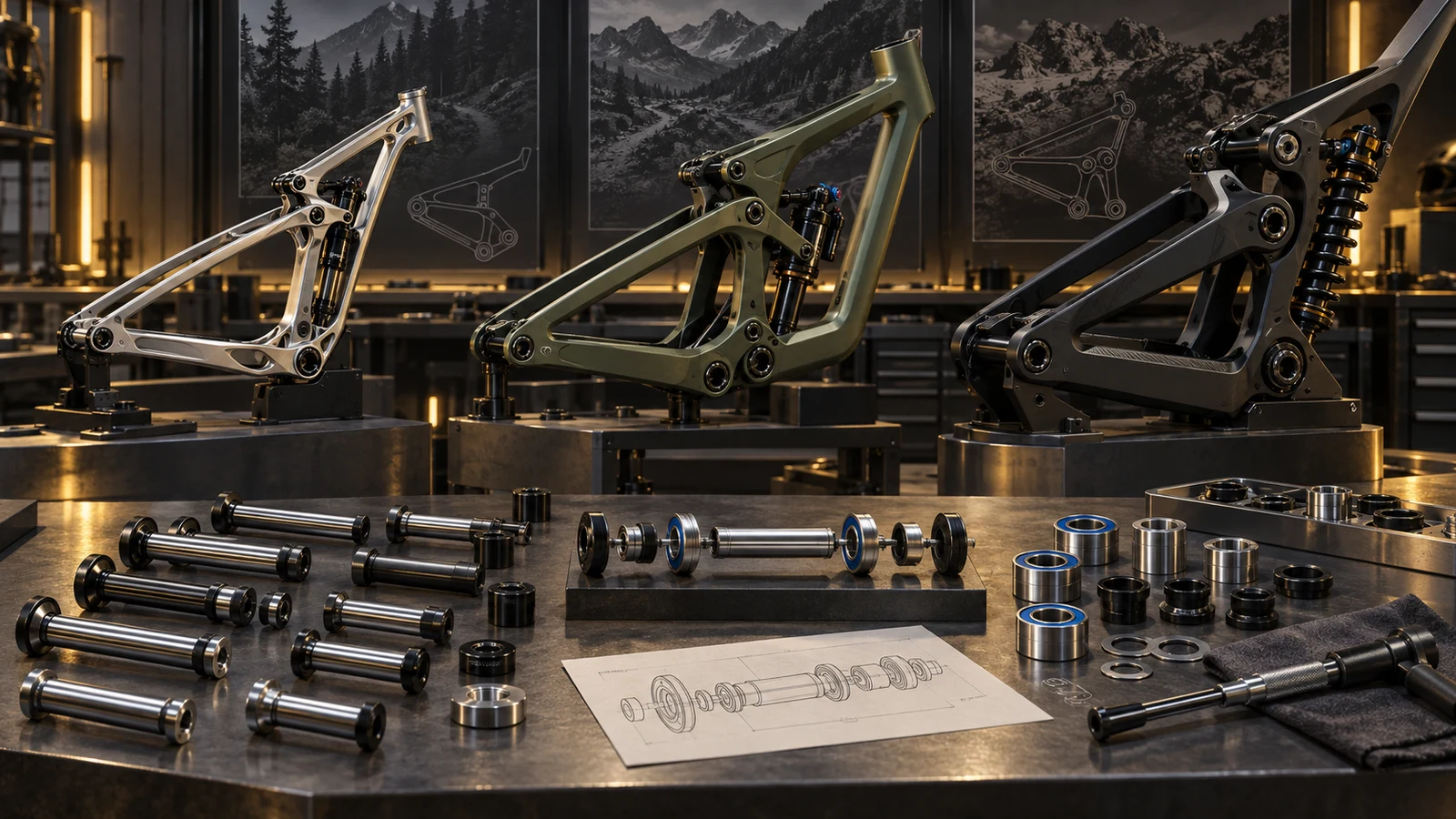
XC, trail and downhill frame labels do not define a custom pivot bolt's material, dimensions or allowable load. They help describe intended use, but the hardware specification must follow the actual joint: linkage geometry, supported bearing locations, spacer stack, mating threads and the OEM's application requirements. A downhill program cannot be specified by multiplying an XC load by an unsupported constant. For a full-suspension MTB pivot enquiry, supply the assembly definition as well as the individual component drawing. Compare what changes at each interface and which validation assumptions remain valid before sharing hardware between platforms or choosing a lighter alternative.
Hero: concept illustration of example hardware and its application. It is not a factory photograph, tested component or approved production geometry.
Translate riding categories into application inputs
Trek's mountain-bike guide describes XC, trail and downhill through intended terrain and riding style. It also notes that trail and enduro terminology can be subjective. That is useful application context, not a component-level design specification or evidence of a fixed force ratio between categories.
For the OEM program, state the intended use, relevant rider and equipment assumptions, and the load cases owned by the frame design team. Identify impact, repeated loading or other conditions that require review. Do not ask the supplier to infer allowable use from a model name, suspension travel or an image alone.
The full-suspension solution area provides an enquiry starting point. It does not establish universal fit. Keep the program's released requirements separate from broad application illustrations and from a supplier's proposal for manufacturable hardware.
Map the supported joint before comparing bolts
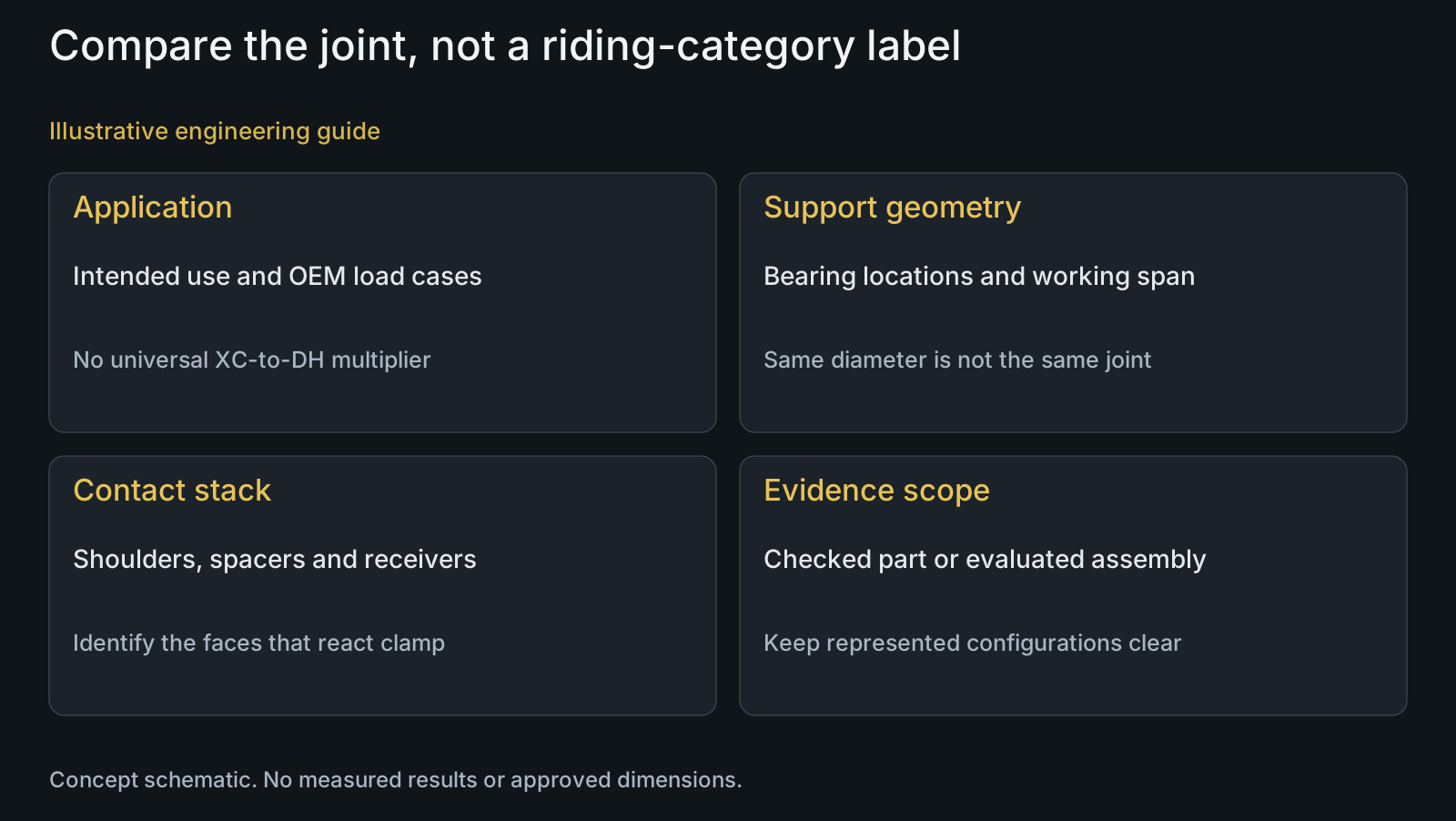
Show which members locate the pivot shaft, which bearings or bushings move relative to it, and where clamping force is reacted. Include shoulders, caps, spacers and receiver features. A drawing of the bolt alone can leave the working span and intended contact faces ambiguous.
Compare bearing locations and supporting features between frames. Matching nominal diameter and thread does not show that the same shoulder length supports the same ring or that tightening closes the intended stack. Contact with an unintended face can alter the assembly even when the bolt enters the receiver normally.
Use the pivot tolerance-stack discussion when the axial relationship is uncertain. The relevant question is which surfaces meet in the assembled, finished condition, not whether every individual part has a familiar catalogue dimension.
| Comparison | Required input | Risk of a shortcut | Review or verification |
|---|---|---|---|
| XC versus trail or DH | OEM intended-use and load-case definition | Assuming a fixed category multiplier | Confirm represented application conditions |
| Same thread and diameter | Complete bearing, shoulder and spacer layout | Assuming interchangeability | Overlay assembled contact relationships |
| Different bearing support | Ring loading, seats and support geometry | Copying an unrelated fit class | Review bearing-maker guidance and final seats |
| Lighter shaft option | Material condition and proposed geometry | Preserving CAD fit but changing duty | Separate geometry and material assessments |
| Common part across frames | All interfaces and application requirements | Extending one frame's evidence to another | Identify compatible and changed requirements |
| Supplier's measured sample | Feature coverage and represented configuration | Treating dimensions as bicycle validation | Match each result to its actual purpose |
Select bearing seats from the bearing arrangement
SKF's installation guide explains that fit selection considers loading relative to the ring, load magnitude, clearance, temperature, support material and mounting needs. Its general guidance is not a bicycle-specific fit prescription. An oscillating linkage still needs its actual ring support and loading reviewed.
Establish whether the shaft is a bearing seat, a clamped locating member or another feature in the joint. Do not copy a press-fit class from an unrelated rotating shaft. Identify the bearing specification and manufacturer's application guidance, the final seat dimensions and any coating on the contacting surfaces.
A tighter seat is not automatically an improvement. Its effect must be assessed alongside bearing clearance and the surrounding support. Separate seat-fit requirements from threaded tightening requirements; increasing installation torque cannot correct an incorrectly defined locating geometry.
Compare material and geometry as a combined choice
Do not prescribe titanium for one category and stainless steel for another without checking the design. Material condition, section geometry, surface requirements and the actual joint duty all matter. A weight objective is a constraint to evaluate, not permission to reduce a shoulder or hollow a shaft without reassessment.
Distinguish a material substitution from a geometry change in the proposal. If both change together, the customer needs to understand which assumptions and evidence are affected. Retain the required receiver engagement, tool access and service arrangement instead of optimizing an isolated CAD mass value.
The material-selection guide organizes those inputs. PremFixer can review manufacturing against the requested drawing and final condition; a general materials discussion is not a supplier-issued approval of the frame's strength, fatigue life or intended riding category.
Decide what can be common across frame programs
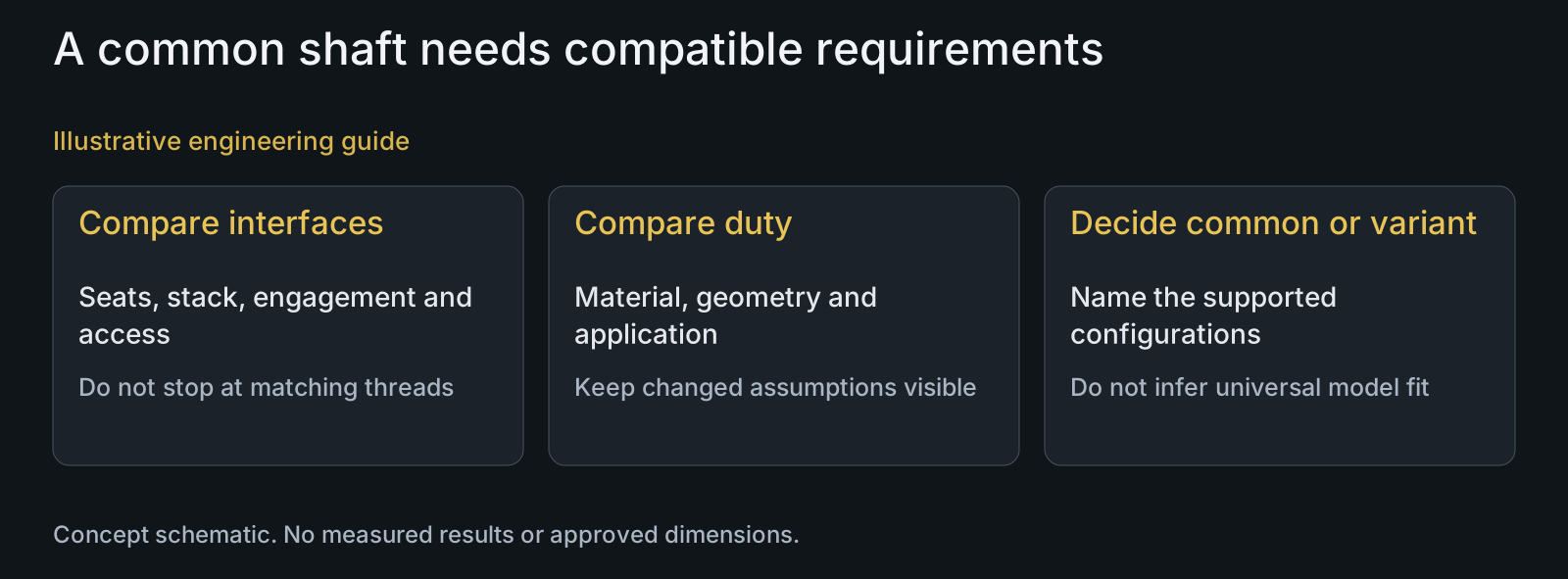
Common hardware can simplify purchasing only where the complete requirements are compatible. Compare locating dimensions, engagement, final surface state, mating components, assembly method and application evidence. Similar appearance is insufficient, and identical part numbering must not conceal different released definitions.
Separate component conformity from system validation. A dimensional report can establish checked features on the identified shaft; it does not establish how a different frame behaves under its intended use. State which configuration each assembly evaluation represents and which changed interfaces need further work.
Send a program-specific BOM and identify variants in the pivot RFQ inputs. For manufacturability questions, use the CNC turning overview. Keep required outputs and exclusions readable rather than asking for a universal 'DH-grade' bolt.
Review example: matching threads, different support geometry
Illustrative engineering example: assume an OEM considers one pivot shaft for an XC frame and a trail frame. The drawings show the same nominal shaft diameter and receiver thread, but the trail assembly places its bearing supports differently. No real customer, dimensions, force values or test results are represented.
The reviewer overlays the assembled contact relationships, not just the shaft outline. The proposed common shoulder no longer corresponds to the same supported surfaces. The team therefore cannot infer compatibility from thread engagement alone; it must resolve the seat and spacer definitions for each assembly.
The useful output is a documented common-versus-variant decision with identified application evidence still needed. It is not an automatic rejection of shared hardware or proof that the trail frame requires a stronger material. Geometry compatibility and validated duty are separate questions, and either can require a distinct part.
Questions buyers need to confirm
Is a downhill pivot always exposed to a fixed multiple of XC load?
No universal multiplier is established here. Provide the intended-use definition and OEM-owned load cases with linkage and support geometry. A category name does not determine the forces at an individual pivot or the evidence needed to qualify it.
Can two frames share a bolt when their threads match?
Only if the other requirements are compatible too. Compare shoulder length, bearing seats, spacer stack, contact faces, receiver engagement and tool access. Matching threads confirms one interface, not the entire assembled joint.
Should a downhill program automatically use titanium or stainless steel?
No. Specify the material condition alongside geometry, final surface requirements and joint duty. A category-based recommendation cannot establish strength or service life. Identify the proposed substitution and the application assessment it requires.
Does an oscillating linkage need the same fit as a continuously rotating shaft?
Not automatically. Review loading relative to each ring, bearing specification, support geometry, clearance and mounting needs with the bearing manufacturer's guidance. The shaft's actual function determines which seat and tolerance requirements belong on the drawing.
What assembly information should accompany the bolt drawing?
Provide the bearing or bushing definition, spacer and cap layout, receiver features, final contact relationships and relevant mating drawings or STEP model. Identify supplied and customer-sourced parts. These inputs explain where the shaft locates and how the joint closes.
Does a conforming sample prove fit for XC, trail and DH programs?
No. Its measured features establish only the identified component evidence. State which complete configuration has been evaluated and which interfaces or duty conditions change between programs. The OEM must resolve the application approval separately from manufacturing conformity.
Technical references and scope
Trek MTB buyer's guide. Manufacturer's intended-terrain and riding-category context, including subjective trail/enduro labels. Not a pivot-load multiplier, component specification or PremFixer compatibility claim.
SKF Bearing Installation and Maintenance Guide. General fit-selection factors and bearing-ring load relationship, printed pages53–55. Reference guide explicitly not a design manual; no universal bicycle seat class derived.
Explore related component, material and sourcing decisions in the customer decision knowledge center. For a drawing review, use the Drawing/BOM RFQ path.
Review a frame-specific MTB pivot requirement
Send the component drawings and STEP assembly, pivot BOM, bearing or bushing information, material and finish requirements, intended-use definition and the decision about common or variant hardware. Add quantities and the evidence requested for the samples. PremFixer can review the manufacturable component scope and interface questions without assuming compatibility from the frame category.
Discuss the drawing and BOM