
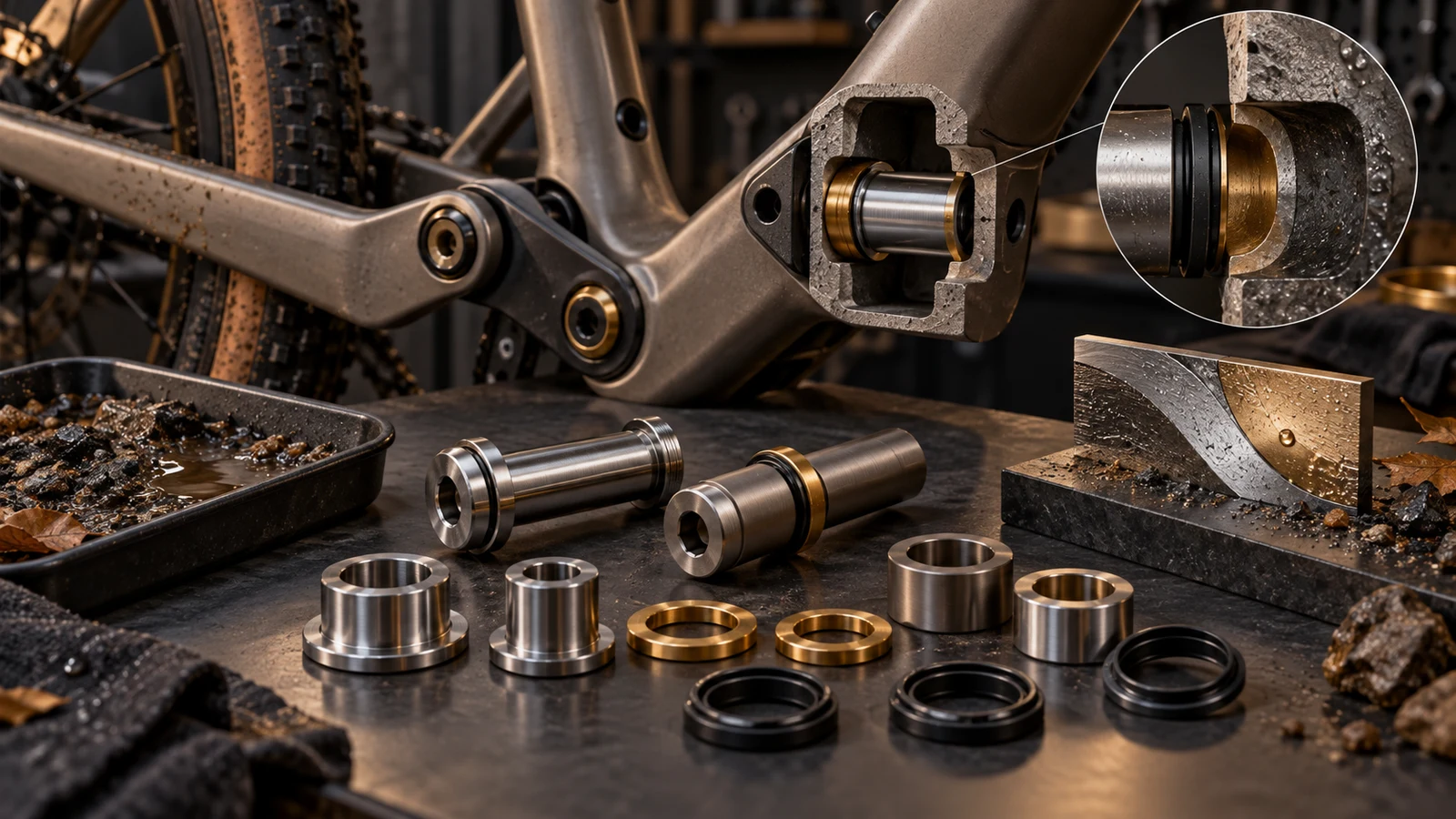
A corrosion-resistant bolt alone does not establish corrosion protection for a gravel pivot assembly. First identify the actual moving or clamped interface, its mating materials and the surfaces exposed to wet grit, cleaning and storage moisture. A stainless or titanium option must still be reviewed with the receiver, spacers, barriers and final fits. The critical region may be hidden beneath a contact rather than on the visible head. Specify the represented assembly and the observations needed to judge protection; a salt-spray duration cannot be converted into years of riding or treated as proof that every part of the joint remains serviceable.
Hero: concept illustration of example hardware and its application. It is not a factory photograph, tested component or approved production geometry.
Identify the gravel interface instead of assuming rear suspension
A gravel bicycle may use a rider-compliance mechanism, a rotating connection or a stationary clamp; it does not automatically have an MTB-style rear pivot. Show the part's function and mating assembly before selecting a protection route. Different contact arrangements expose different regions to moisture and movement.
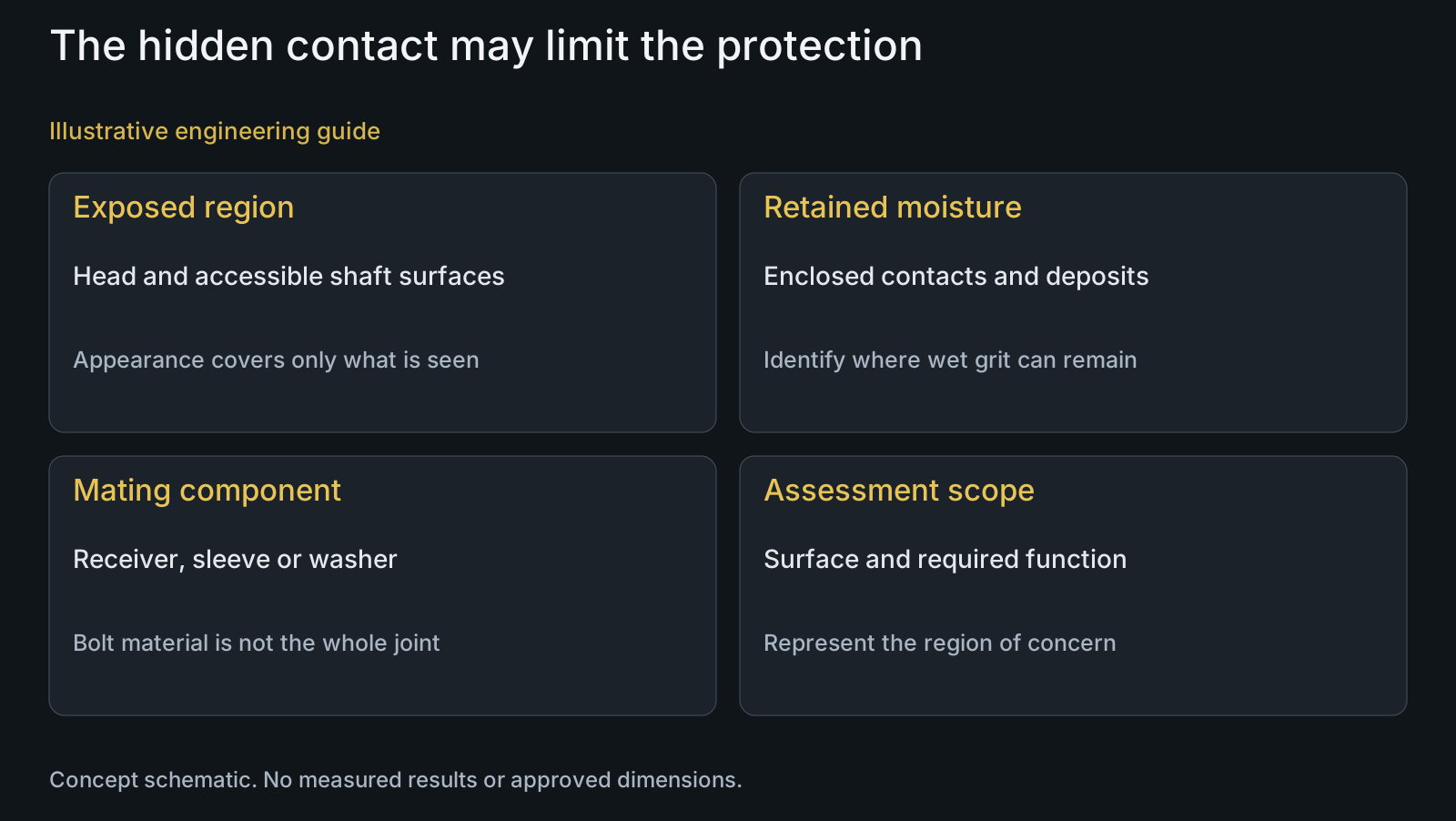
Locate the visible surfaces and hidden contacts separately. Include receiver threads, shoulders, sleeve interfaces and the relevant washers or spacers. A photograph of the installed head cannot explain whether water remains behind it or which other material is in contact with the shaft.
Use the road compliance hardware guide where the mechanism is unclear. For this corrosion review, the required output is a defined interface and exposure question, not a claim that a pictured product fits an unspecified gravel model.
Treat wet grit and retained moisture as a combined review
Describe where contamination can enter and remain during the intended use and cleaning arrangement. A surface that dries openly is not equivalent to an enclosed contact retaining wet deposits. Identify access for cleaning or inspection without prescribing an unsupported maintenance interval.
Grit contact and corrosion are different mechanisms that can coexist. A finish comparison should consider whether movement or assembly can disturb the intended protected surface, then examine the affected contact. Do not assume that an untouched coupon represents a joint with repeated contact or trapped contamination.
Keep the service procedure consistent with the component manufacturer's instructions. A proposal to add a seal, drain feature or barrier needs assessment of the actual interface and permitted movement. More enclosure is not automatically better if the design changes where moisture remains or makes the relevant region inaccessible.
| Region or proposal | Decision-relevant input | Main risk | Useful assessment |
|---|---|---|---|
| Exposed bolt surface | Alloy, final surface and exposure | Judging the entire joint by appearance | Defined surface observations |
| Enclosed contact | Geometry and retained wet deposits | Omitting the hidden limiting region | Represented contact and access for assessment |
| Mixed-metal receiver | Both materials, barrier and electrolyte path | Assuming a resistant bolt protects its mate | Assembly-specific interaction review |
| Moving grit contact | Motion and protected surface condition | Using an untouched coupon for disturbed contact | Relevant surface and functional assessment |
| New coating or barrier | Final dimensions and contact arrangement | Solving exposure but changing fit | Finished-feature and assembly review |
| Salt-spray report | Specimen, method and criterion | Converting hours into gravel riding life | Bounded conclusion for the tested scope |
Select a material without declaring immunity
worldstainless explains stainless corrosion resistance through its passive film while also identifying localized attack under certain conditions, including chloride-bearing exposure. Stainless therefore means a material family to specify, not a guarantee that every gravel contact remains unchanged.
Specify the exact alloy and condition alongside the functional geometry. If comparing 316 and a titanium candidate, identify the requirements each must meet rather than assigning either universal suitability. Corrosion resistance does not settle thread behavior, structural requirements or the receiver's response.
The materials overview and pivot material-selection guide organize the enquiry. A recommendation needs the actual exposure and interface information; a generic premium-material description is not evidence of a passed test or approved bicycle application.
Evaluate the receiving component and final surface system
At a mixed-metal contact, evaluate both components, the electrical contact and the available electrolyte rather than naming only the bolt alloy. worldstainless describes the conditions for galvanic interaction; the actual severity still needs the represented geometry and environment. A better-looking bolt can leave the receiver as the region of concern.
State the complete proposed finish, including coated or masked features and relevant contact barriers. Check which dimensions apply after treatment and whether the assembly disturbs that final condition. Changing the surface route without revisiting a locating seat can create a separate fit problem.
Discuss the actual finished features through surface treatment and the anti-corrosion solution area. Electropolishing is a candidate route to assess, not an automatic company-wide operation or proof of a passed corrosion exposure.
Make corrosion evidence cover the question being asked
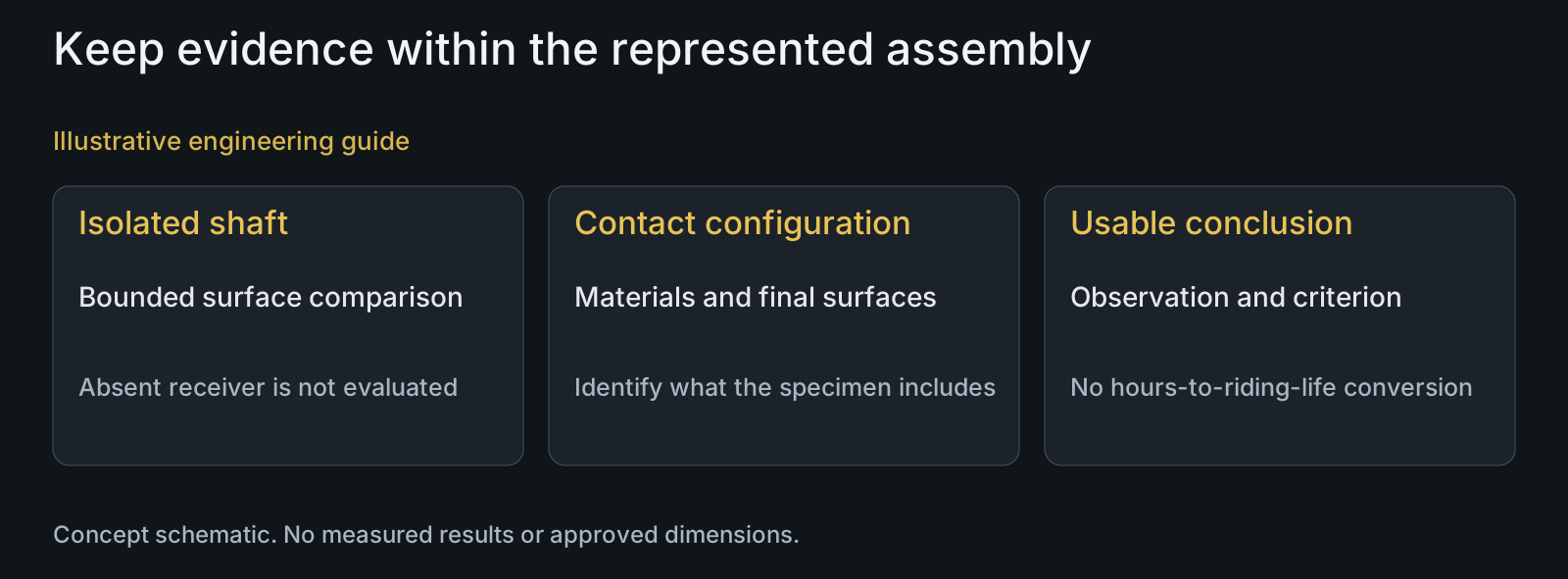
For a visible finish comparison, define comparable substrates, surfaces, specimen preparation and observations. If the concern is a receiver or enclosed contact, include that region in the represented specimen. Testing only the isolated shaft cannot establish what happened to an absent mating component.
ASTM B117's public significance-and-use statement describes a controlled exposure for relative specimen information and cautions against standalone prediction of natural-environment performance. It does not establish a universal gravel duration or riding-life conversion. State the method, tested configuration and criterion beside any result.
Separate appearance from function. Where relevant, identify observations at hidden contacts and the requested post-exposure assessment of fit or serviceability. The neutral-versus-cyclic corrosion guide addresses method selection; this article addresses whether the gravel interface is represented at all.
Review example: exposed shaft versus enclosed receiver
Illustrative engineering example: assume a gravel-program engineer compares two bolt material and finish proposals for the same enclosed receiver interface. Wet contamination can remain near the contact, while the exposed head is easy to inspect. No real customer, corrosion observations or test outcome is assumed.
An isolated-bolt test proposal omits the receiver and the retained-moisture region. The reviewer therefore keeps it as a bounded surface comparison and defines a separate represented-contact question. It also specifies whether the hidden region will be examined and what post-exposure function matters.
The useful decision is not that one material wins by name. It identifies the missing interface, the protection arrangement to compare and the evidence each proposal can support. A visually acceptable head would not by itself establish an acceptable receiver, and neither proposal supports a riding-life guarantee without further application evidence.
Questions buyers need to confirm
Does stainless gravel hardware never corrode?
No. Specify the alloy, final surface and exposure and inspect the relevant contacts. Stainless can experience localized attack under certain conditions. Its name alone does not establish the behavior of an enclosed or mixed-material joint.
Will replacing the bolt with titanium protect its receiver?
Not automatically. Review the receiver material, contact, surface barriers and electrolyte path as well as the bolt. A material change can improve one component without establishing protection of the mating assembly.
Why does wet grit matter beyond visible rust?
It can affect the actual contact and the condition represented by a finish evaluation. Identify movement, deposits and moisture retention rather than assume an untouched open specimen represents an enclosed assembly. Assess relevant hidden regions and required function.
Can a coating change be specified without changing the fit drawing?
Not if it affects a functional dimension or contact condition. Identify coated and masked surfaces and the final-state size requirements. Review the locating and clamping relationships so the proposed protection does not introduce a separate assembly problem.
Does a long salt-spray result prove years of gravel riding?
No universal conversion is established. State specimen, surface, method and acceptance observations and keep the conclusion within that scope. Riding includes conditions and interactions that a standalone accelerated exposure may not represent.
What should a gravel corrosion enquiry include?
Send the part and mating assembly drawings or STEP, exact materials, surface definitions and relevant contacts. Describe wetting, grit, cleaning and storage conditions and the observations or functional criterion needed. Include quantities and whether the proposed evaluation covers an isolated part or assembled interface.
Technical references and scope
worldstainless: corrosion properties. Industry-association explanation of stainless passivity, localized attack and mixed-metal interaction. No project-specific corrosion ranking or numerical exposure limit derived.
ASTM B117 public significance and use. Controlled comparative exposure and limited standalone natural-environment prediction. Use the project-required edition; no paid test recipe or universal acceptance duration reproduced.
Explore related component, material and sourcing decisions in the customer decision knowledge center. For a drawing review, use the Drawing/BOM RFQ path.
Review protection at the actual gravel interface
Send the hardware and receiver drawings or STEP, BOM, exact alloy and finish definitions, and the intended exposure and cleaning context. Identify hidden contacts and the corrosion or post-exposure function the project needs to judge. PremFixer can discuss manufacturing and coordinated treatment scope without promising a universal salt-spray rating or gravel riding life.
Discuss the drawing and BOM