
A thicker hard-anodized coating does not by itself establish lower wear in an aluminum pivot. For a sleeve running against a bushing, the useful comparison must represent the alloy, finished surface, counterface and contact conditions. Thickness and hardness readings answer narrower questions than the wear of that assembled pair. Before selecting a coating from a supplier report, check whether the proposed alternatives were evaluated under comparable conditions and against the same endpoint. Also retain the required finished fit: a coating choice that changes the mating geometry cannot be approved solely because a coupon performed well in an abrasion test.
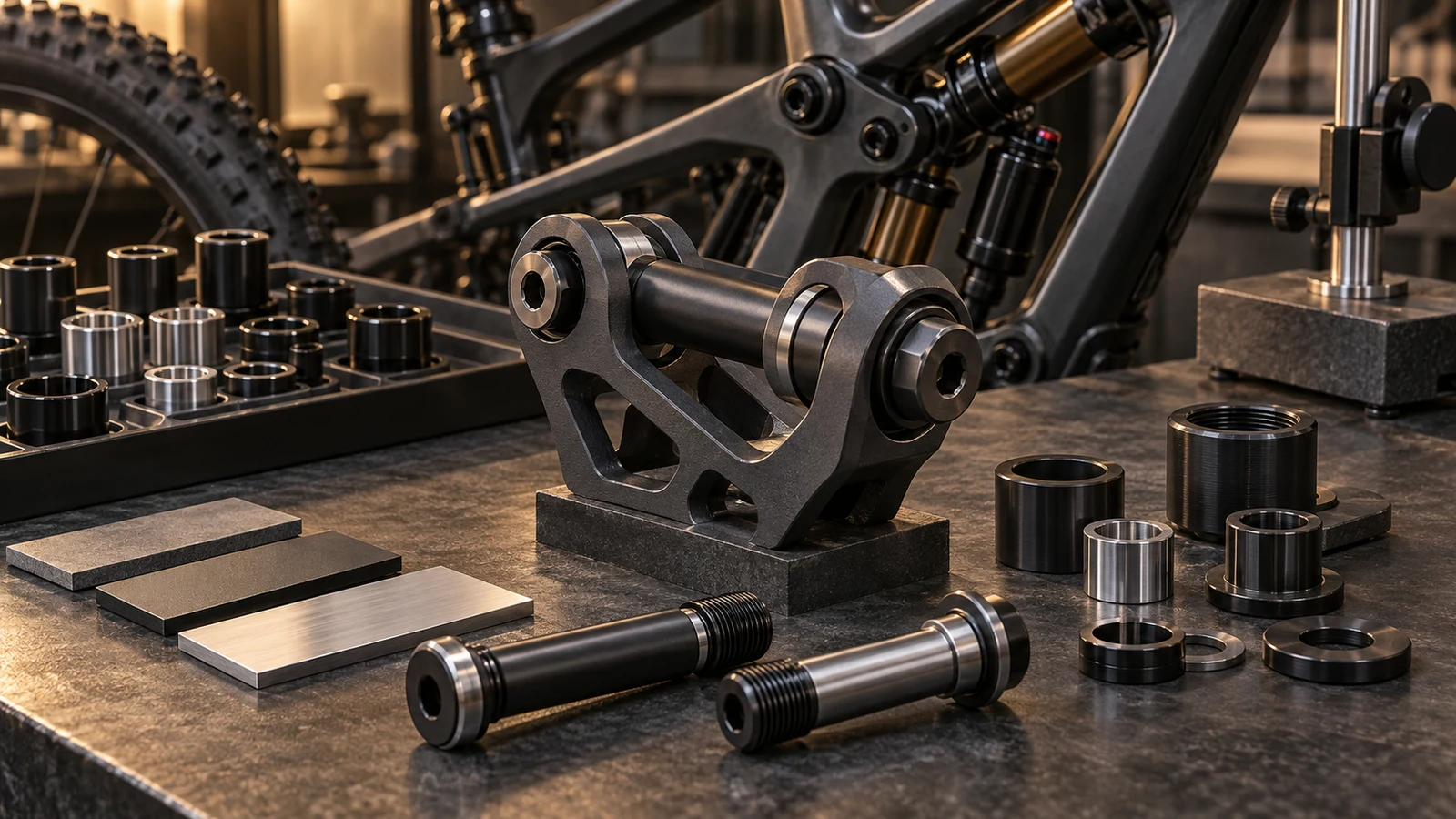
Hero: concept illustration of example hardware and its application. It is not a factory photograph, tested component or approved production geometry.
Turn the wear complaint into an observable endpoint
Name the interface and the problem: material loss at a sliding sleeve, increased clearance, a damaged counterface or an appearance mark. These observations are not interchangeable. Decide which one the coating comparison is intended to address and how it will be assessed.
For an intended stationary bearing seat, investigate unintended movement as a fit and support issue before asking for a longer wear life from hardcoat. For a sliding bushing pair, describe its motion and counterpart. The 7075 hard-anodized interface guide develops that initial surface-selection decision.
This article addresses the next question: whether the supplied evidence actually distinguishes candidate finish conditions. A test can be useful without being a complete pivot-service simulation, but its result must be labeled with the decision it supports.
Thickness, hardness and abrasion results are not substitutes
The Aluminum Anodizers Council hardcoat guideline distinguishes application-related checks and explicitly separates hardness from proof of wear resistance. Its abrasion section recognizes that particular industries can need application-specific evaluations. Do not turn a hardness reading into a life multiplier.
A thickness result establishes the represented coating thickness under its measurement method. It does not establish how the surface pair behaves. A hardness result similarly needs its method and represented surface; an isolated number does not describe contact motion, debris or the counterpart.
For a comparison request, ask for the specimen identity, measurement location and the stated objective of each result. Retain the actual alloy and condition of the pivot. A report for a different substrate or a convenient flat specimen needs a clear explanation of what it represents.
| Evidence offered | Useful conclusion | Transfer risk | Review action |
|---|---|---|---|
| Coating thickness at identified points | Represented thickness requirement | Thickness treated as wear life | Keep the wear objective separately defined |
| Hardness with a named method | Represented hardness response | Hardness substituted for abrasion | Request the evidence for the actual performance question |
| Coupon abrasion comparison | Ranking under stated test conditions | Different substrate, seal or test settings | Identify matched and unmatched attributes |
| Sliding-pair laboratory test | Pair behavior under represented conditions | Motion, lubricant or debris unlike the pivot | State the scope of the screening inference |
| Component comparison with changed clearance | Behavior of the changed assembly | Geometry effect assigned to coating thickness | Separate fit and finish changes in interpretation |
| Unspecified life multiplier | No usable comparison basis | Unknown baseline and failure endpoint | Require conditions and supported result before using the claim |
Compare complete finish conditions, not thickness labels
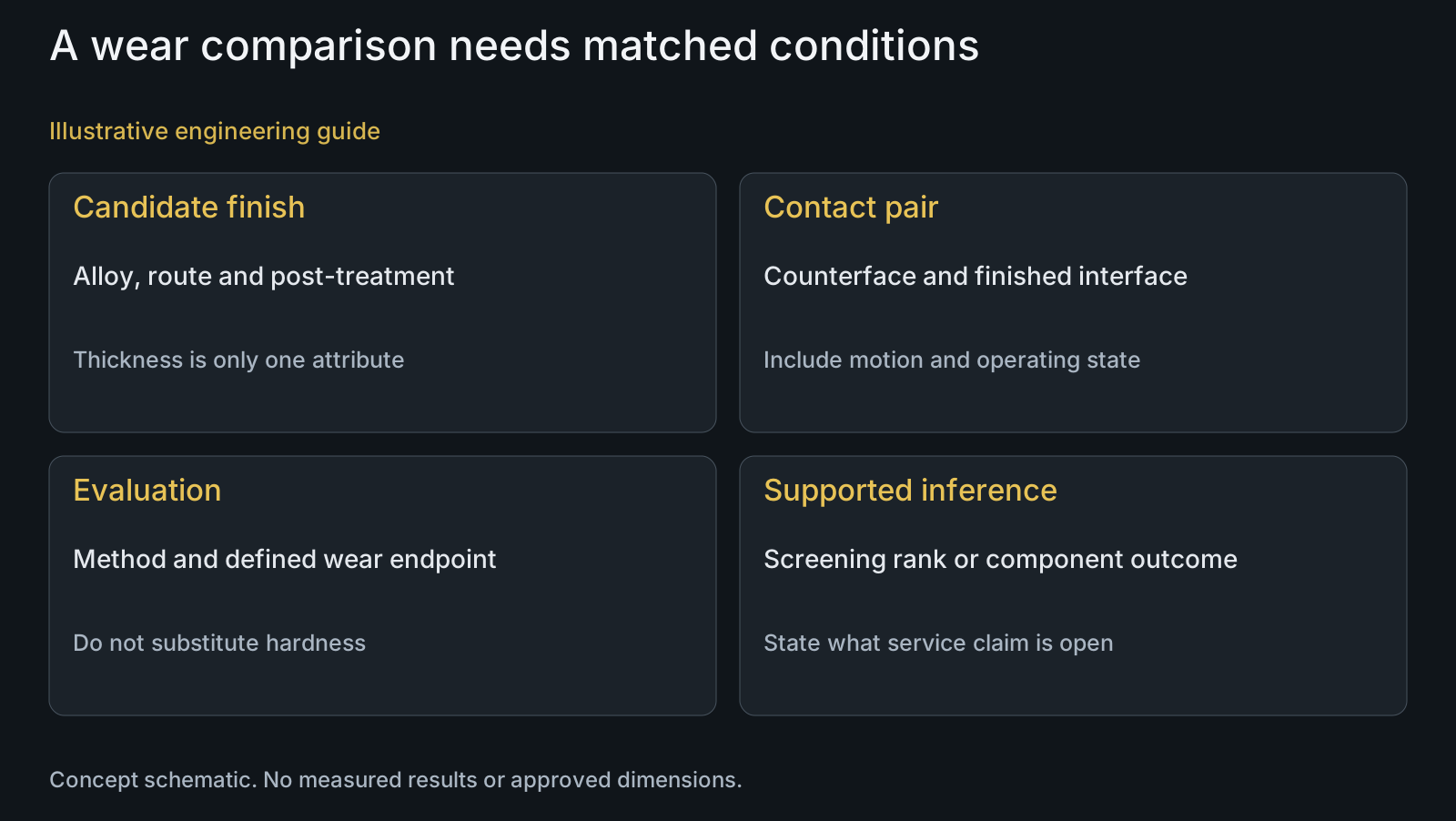
As an engineering comparison, changing coating thickness while also changing sealing or another post-treatment does not isolate the effect of thickness. List the complete candidate routes. Identify the attributes held constant and the ones intentionally changed.
AAC's specifying-anodized-aluminum guidance notes that hardcoat and sealing choices involve surface-property tradeoffs. That context does not prescribe sealed or unsealed hardware for every bicycle. Make the intended wear and environmental objectives explicit when selecting the complete finish.
Use a named coating specification when the order requires one. ISO 10074's public scope concerns hard anodic oxidation coatings and their test requirements; it distinguishes that family from plasma-electrolytic and related processes. No unread numerical limits or universal coating recipe are inferred here.
Read the test conditions before transferring the ranking
ASTM G99-23's public significance statement identifies load, motion, environment and material pairing as relevant to sliding wear. It warns against assuming that the represented laboratory conditions predict wear under different service conditions. This is context for interpreting a test, not a requirement to use that apparatus for every pivot.
For the actual review, compare counterface material and surface, motion pattern, loading, lubrication, contamination and evaluation endpoint. A continuous sliding comparison and an oscillating bushing connection are different represented contacts. Explain the relationship rather than rename one as the other.
A ranking under a defined test can screen candidates. A service-life claim needs a supported connection to the component's operating conditions and failure definition. No fixed multiple of improvement is established merely by a thicker film, a harder coating or the presence of a standard number on a report.
Keep the interface geometry controlled in the comparison
Check whether the finish alternatives produce the same specified final shaft and mating-bore relationship. If the clearance or contact support differs, the assembled wear comparison no longer changes only the coating condition. Identify that geometry difference before attributing any observation to film thickness.
Do not treat total film thickness as an automatic dimensional offset. The finished-state anodizing guide covers that allowance question. Here the important comparison input is the actual accepted interface after the complete finishing route.
For surface-treatment coordination, specify which coating checks and component evaluations are supplied by the partner and which remain with the OEM validation team. PremFixer reviews drawing-based manufacture and the agreed scope; this does not imply an owned abrasion laboratory or a demonstrated universal wear capability.
Two supplier reports may not answer the same question
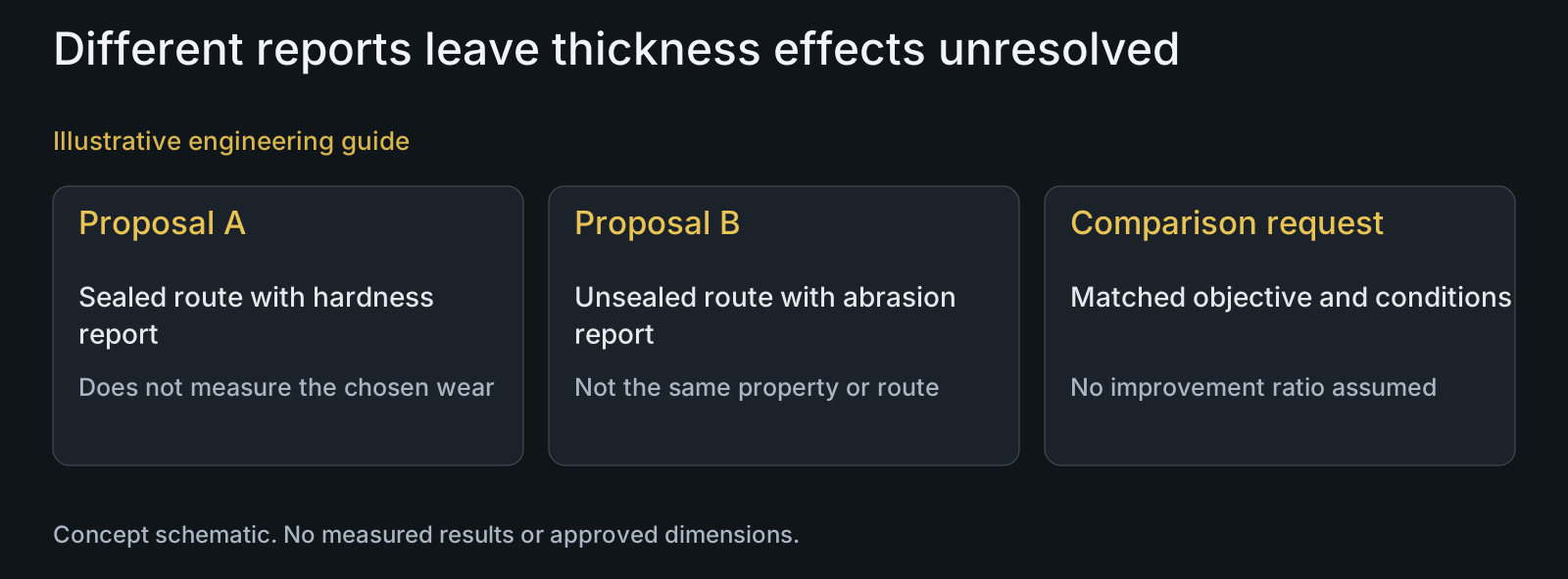
Illustrative engineering example: assume an OEM compares a thinner sealed hardcoat proposal with a thicker unsealed proposal for an aluminum sleeve. One report gives hardness on a coupon; the other gives abrasion loss under a stated laboratory method. Neither provides a result for the intended bushing pair.
The reviewer cannot infer a thickness-related wear benefit because both the finish condition and the measured property differ. The next decision is to request a comparable evaluation for the intended screening objective, identify any unmatched conditions and retain the same specified final interface.
The scenario contains no failed specimen, measured improvement or service duration. It demonstrates a procurement distinction: unequal reports are not automatically bad reports, but they may be insufficient for the comparison the buyer is trying to make.
Questions buyers need to confirm
Is a thicker hardcoat always better for pivot wear?
No. Compare complete finish conditions and the represented contact pair. Thickness alone does not resolve final fit, counterpart behavior or the relevant wear endpoint.
Does high coating hardness prove longer wear life?
No. Hardness and wear are different properties. Define the wear question, test conditions and represented surface before using a hardness result in the decision.
What changes between ordinary anodizing and hardcoat?
The specified process and coating requirements differ; similar color does not make the routes equivalent. Ask for the complete treatment designation, actual alloy, intended property and required final interfaces rather than select by appearance alone.
Can I compare a sealed thin coating with an unsealed thicker one?
Yes as complete candidate routes, but not as an isolated thickness experiment. Record the post-treatment difference and use comparable evidence for the same objective.
Does a laboratory abrasion result establish pivot service life?
Not by itself. Explain how the specimen, contact conditions and failure endpoint relate to the actual application. Keep a screening ranking distinct from an unsupported duration or improvement multiplier.
What should I supply for a hardcoat wear review?
Provide drawing, aluminum alloy and condition, mating part and contact motion, specified final fit, complete finish alternatives, operating environment and the problem to be assessed. Include available reports with their methods, specimen identities and endpoints.
Technical references and scope
AAC: Hardcoat application guideline. Distinct property checks and application-specific abrasion evaluation. Historic referenced editions and default figures are not adopted as current universal requirements.
AAC: Specifying anodized aluminum. Hardcoat and post-treatment context, not a pivot-specific wear result or recipe.
ISO 10074:2021 public scope. Hard anodic coating family and excluded processes only; no unread clause requirements.
ASTM G99-23 public significance and scope. Condition-dependent laboratory sliding-wear interpretation. Not a mandatory pivot test or prediction of field life.
Explore related component, material and sourcing decisions in the customer decision knowledge center. For a drawing review, use the Drawing/BOM RFQ path.
Make the hardcoat comparison answer your wear question
Send the drawing and assembly section, aluminum specification, counterface information, final fit, candidate finish conditions and available wear or coating reports. PremFixer will review manufacturing and partner-finishing scope and identify which evidence can support the proposed comparison, with component validation responsibilities kept explicit.
Discuss the drawing and BOM