
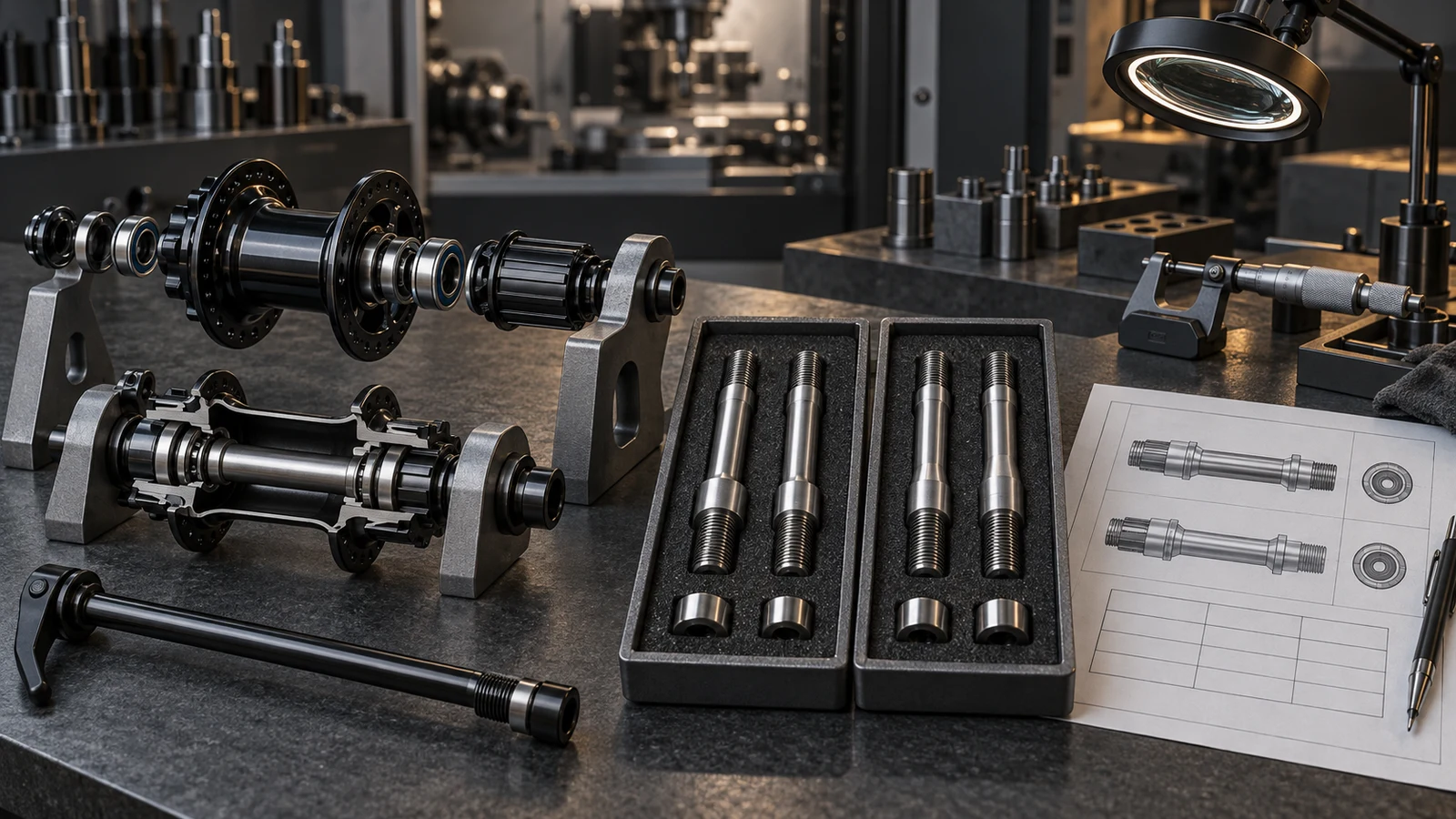
A hub axle fatigue review should connect a proposed manufacturing change to the feature it is intended to improve. The OEM or buyer is deciding whether rolled threads, a revised transition or a specified surface process deserves a controlled component comparison. First identify the ordered part, its motion, supports and relevant loading; a rotating wheel does not establish rotating-bending duty for every hub component. Then define what changes and what remains comparable. Generic titanium fatigue values cannot establish finished-part life, and a process label cannot replace evidence for the actual geometry, material condition and installed interfaces.
Hero: concept illustration of example hardware and its application. It is not a factory photograph, tested component or approved production geometry.
Turn a process proposal into a specific engineering question
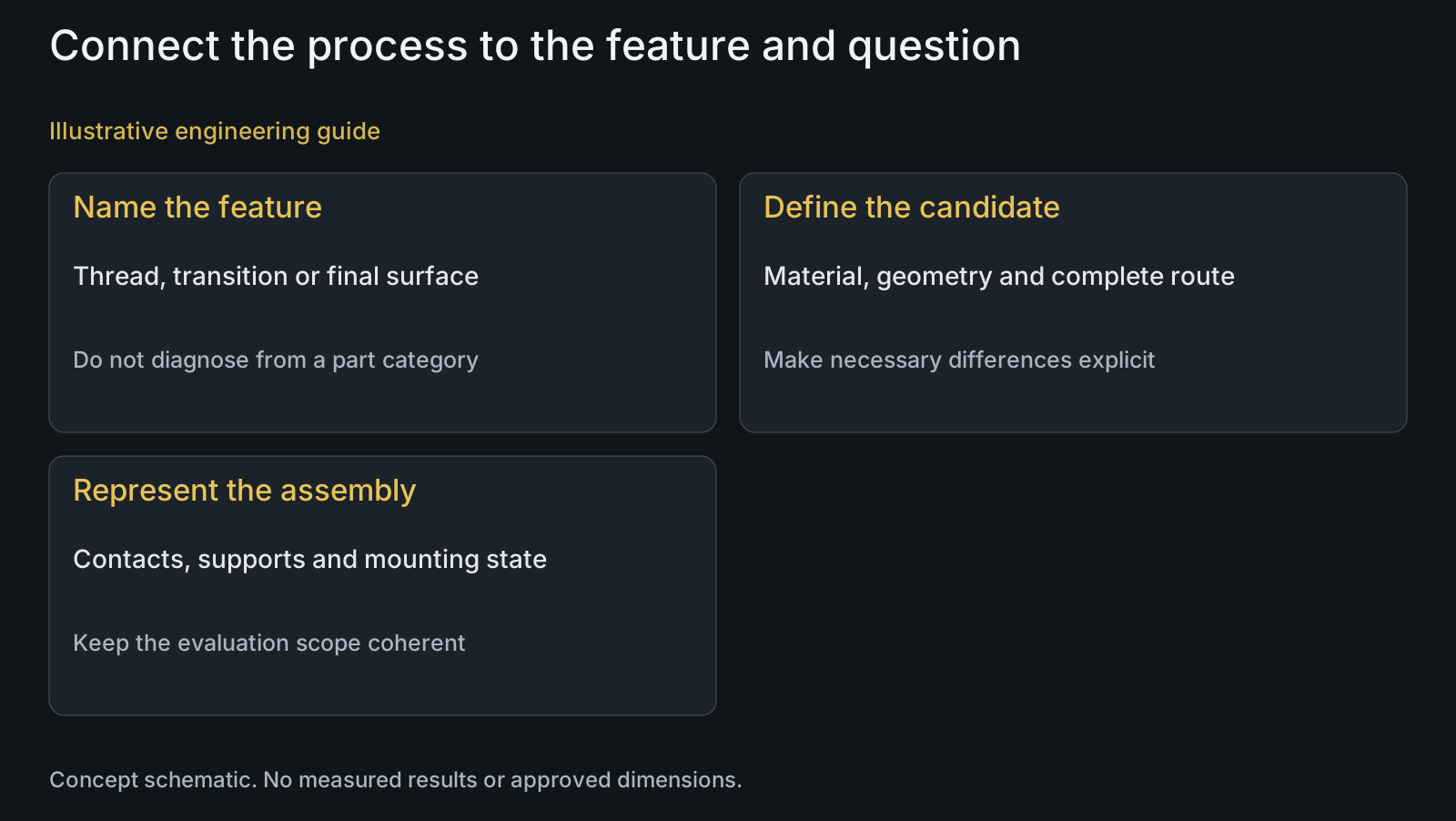
Replace improve fatigue with a feature-level question. Is the proposal intended to address a threaded region, a shoulder transition, a surface condition or another identified concern? Locate that region on the drawing and explain why it is relevant to the expected loading or observed damage.
The hub motion and failure-investigation guide establishes what rotates and which evidence an investigation needs. Here the next decision is how to compare manufacturing alternatives after that component question has been defined. Do not use a comparison plan as a completed diagnosis.
Name the central axle, wheel-retention hardware, end cap and internal screw separately. A supplier familiar with pivot hardware can review manufacture, but cannot transfer a pivot's support assumptions to a hub simply because both parts are turned and threaded.
Freeze the assembly conditions that the comparison represents
Record bearing contacts, end interfaces, receiver engagement and the represented mounting condition. State the motion of the member being evaluated separately from the shell. The engineering team must relate the chosen loading and constraints to this configuration rather than infer them from wheel speed alone.
DT Swiss's bearing explanation includes wheel-mounting clamp effects on its axle and bearing behavior. It is a useful manufacturer-specific reason to describe the installed state, not a construction or adjustment rule for all hubs. A free-standing sample and a mounted assembly need not answer the same question.
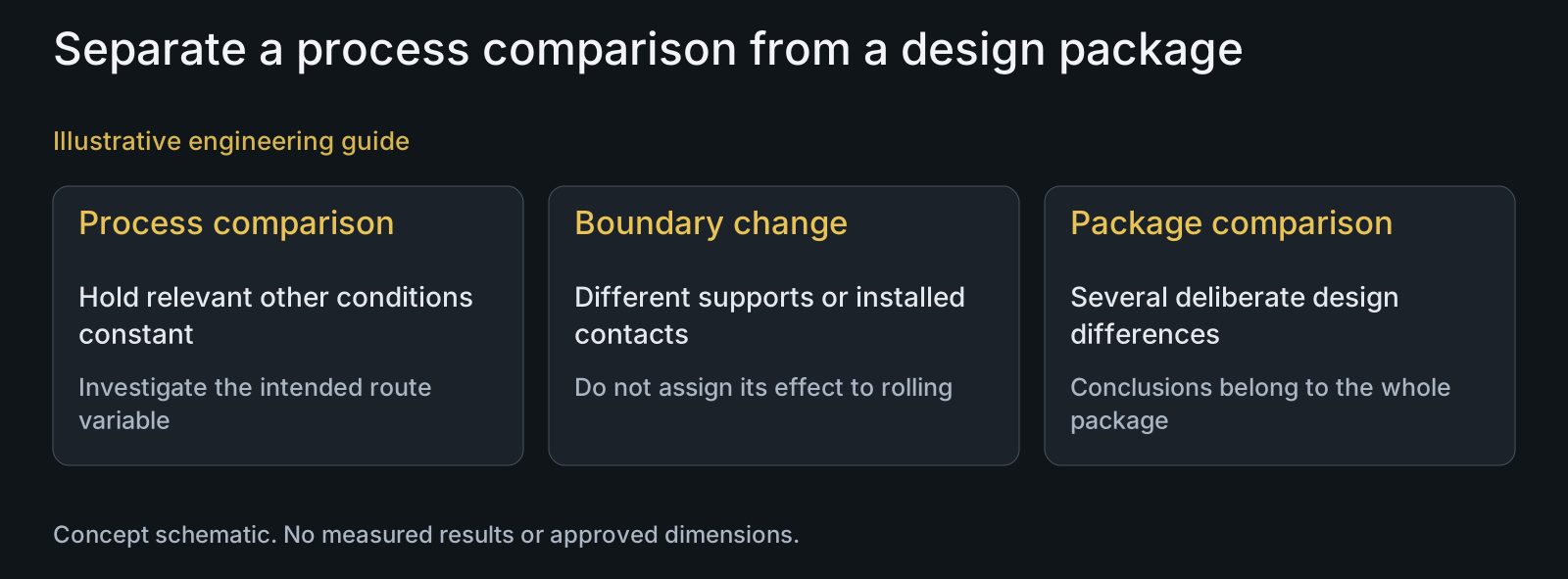
If a fixture changes the support positions or end contacts, document what that difference means for the comparison. Holding force magnitude constant does not establish equal component stress when the represented load path has changed. That limitation should be resolved before interpreting an apparent process advantage.
| Proposed comparison | Useful condition | Risk or limitation | Evidence to resolve it |
|---|---|---|---|
| Generic alloy fatigue data | Screening material candidates | Specimen evidence called axle life | Actual component and loading applicability |
| Cut versus rolled thread | Question concerns a defined thread feature | Geometry or material state also changes | Finished definitions and controlled groups |
| Untreated versus specified surface route | Treatment addresses an identified region | Process label hides condition differences | Treatment scope and final acceptance |
| Different shoulder geometry | Transition is the design variable | Result attributed to thread process | Feature change separated from route change |
| Same part with different supports | Assessing boundary sensitivity | Fixture effect called manufacturing benefit | Relationship to installed contacts |
| Two complete design packages | Selecting between integrated alternatives | No isolated process conclusion | Explicit package-level evaluation scope |
Compare rolled and cut threads at the finished feature
CJWinter describes thread rolling as shaping ductile metal by displacement rather than removing material to cut the profile. That process distinction supports examining an alternative route. Its general marketing improvement figures are not accepted here as evidence for a particular hub axle.
Request a route-specific review of material condition, blank preparation, tooling access, runout and the finished thread definition. Ask what remains identical between the candidates and what necessarily differs. If changing the process also changes the transition or usable thread length, record those as separate variables.
Retain drawing acceptance for the thread, bearing seats and adjacent transitions after the full manufacturing route. A fatigue comparison does not excuse dimensional nonconformity. Use the manufacturing review to establish feasible routes before asking for a process benefit that has not been demonstrated.
Treat a surface process as a controlled condition
A peening proposal needs a defined treatment area, process requirements and final acceptance basis. Do not substitute the word peened for a specification. Identify which seats, threads or contact surfaces must be protected or assessed after the proposed route.
NASA's published study summary concerns defined 4340 steel and 2024 aluminum specimens and distinguishes fatigue-life and crack-growth assessments. It illustrates that evidence belongs to a material, specimen and test condition. Its findings are not transferred to titanium bicycle hardware or used to promise a life increase.
Review the interaction with later operations through the surface-treatment discussion. State the final surface and material condition being compared. No supplied peening capability, universal treatment requirement or recovery of an already damaged axle is claimed.
Buy a comparison that can support the intended decision
Define the comparison groups before producing samples: the represented geometry, material condition, finished route and assembly boundaries for each. Identify whether the question concerns a material specimen, a finished part or the installed system. The answer should not silently move between those evidence levels.
Agree the evaluation method, acceptance basis and responsibility with the product engineering team. Record sample identities and relevant manufacturing variation. A sample count, isolated pass or supplier capability statement cannot alone establish a general durability conclusion.
Quote tooling, candidate sample quantities, required inspection and externally specified evaluation separately where applicable. The buyer can then distinguish the cost of making an alternative from the cost of obtaining usable evidence. Prototype manufacture is not itself an approval of hub life.
Review example: the process and support change together
Illustrative engineering example: assume an OEM compares an existing cut-thread axle with a rolled-thread candidate, but the candidate evaluation uses a different support spacing. No dimensions, load cycles, failure diagnosis or measured improvement are supplied.
The reviewer identifies two changed variables: thread manufacturing route and represented support geometry. Even if a later evaluation produces different outcomes, the comparison would not isolate the contribution of rolling. The team resolves the support relationship and records any unavoidable geometry differences first.
The result of this review is a clearer candidate definition and evaluation question, not a finding that either process is superior. If the purpose is instead to compare two complete design packages, label it that way; do not advertise the package comparison as a process-only benefit.
Questions buyers need to confirm
Does wheel rotation mean every hub part needs rotating-bending testing?
No. Establish each part's motion relative to its supports and the actual loading history. A shell can rotate around a constrained axle. Select the evaluation from the ordered component's conditions, not from wheel rotation alone.
Are rolled threads always the right response to a broken hub axle?
No. Identify the affected feature and investigate the cause first. A thread process comparison needs a relevant question; it does not automatically address damage at a shoulder, seat or another contact. No universal prevention claim is supported.
Can a titanium fatigue strength value establish component life?
No. The value has a material, specimen and method scope. Finished geometry, material condition, surface, loading and contacts must be related to the component question. A generic figure is not a life rating for ordered hardware.
What if the candidate needs a different runout geometry?
Record that as a geometry change alongside the route change. Decide whether the evaluation compares complete alternatives or must isolate manufacturing effects. A result from changed geometry cannot be attributed solely to rolling without further evidence.
Should shot peening be added to every hub axle RFQ?
Not by default. Identify the target region, defined process and finished acceptance requirements before evaluating suitability. Published results from different specimens do not establish a requirement or improvement for your axle, and no supplied peening service is assumed here.
What inputs make a process-comparison RFQ useful?
Provide part and assembly drawings, STEP or represented samples, the existing and proposed routes, material conditions, supports and intended loading. State the feature-level question, inspection requirements and candidate quantities. Separate manufacture from the responsible team's evaluation and acceptance scope.
Technical references and scope
DT Swiss bearing technology. Manufacturer-specific discussion of axle compression and bearing behavior in the wheel-mounted condition, not a universal hub adjustment rule.
CJWinter thread rolling explanation. Displacement-based thread forming compared with cutting. General improvement percentages are not adopted as part-specific fatigue evidence.
NASA peening study public summary. Defined 4340 steel and 2024 aluminum specimen investigations; fatigue-life and crack-growth evidence is not transferred to titanium bicycle components.
Explore related component, material and sourcing decisions in the customer decision knowledge center. For a drawing review, use the Drawing/BOM RFQ path.
Define the hub axle manufacturing comparison
Send the part drawing and STEP, assembly interfaces, BOM, existing and proposed process conditions, intended loading and prototype quantities through the Drawing/BOM RFQ path. PremFixer can review manufacturability and candidate scope while your team defines the evaluation needed for the component decision.
Discuss the drawing and BOM