
Every plated stainless pivot bolt should not receive the same bake merely because it is stainless steel. For an electroplated shoulder bolt, establish the finished alloy condition, required mechanical properties and actual coating specification before deciding whether hydrogen-relief processing applies. If treatment is required, its sequence and acceptance must follow the applicable requirement and responsible engineering approval. A temperature-and-time record shows an operation, not an achieved hydrogen concentration or a guarantee against fracture. Keep those conclusions separate from thread fit and finish appearance. This prevents both an unjustified treatment instruction and an unsupported assumption that an optional-looking bake can simply be omitted.
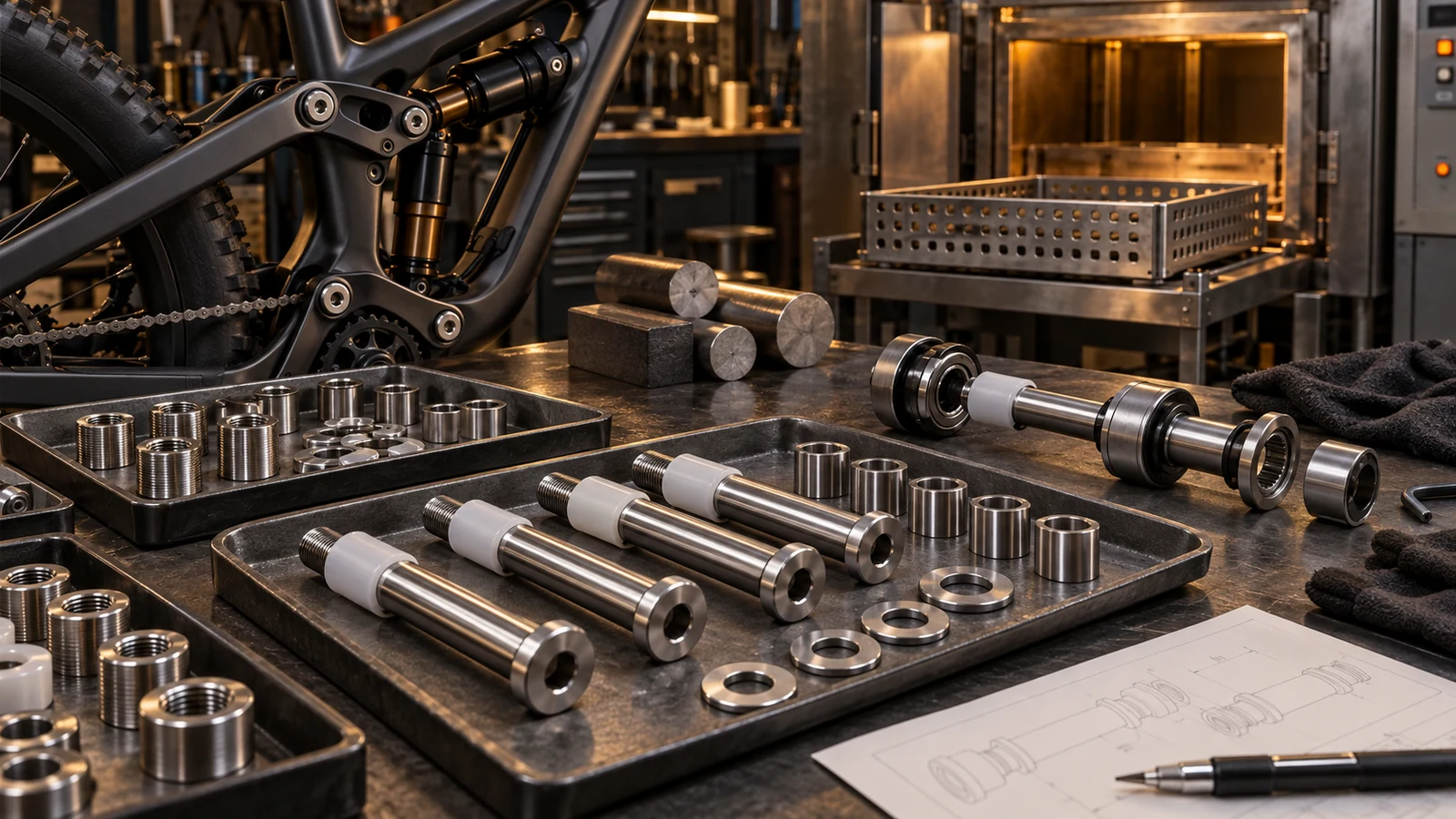
Hero: concept illustration of example hardware and its application. It is not a factory photograph, tested component or approved production geometry.
Establish applicability before requesting a bake certificate
Provide the alloy, supplied condition and required finished properties, including any cold work or hardening relevant to the ordered component. Add the complete preparation and deposited-coating route. The material name and plating color do not define a post-treatment requirement.
ASTM B850's public overview concerns reducing susceptibility in some steels. It identifies actual tensile strength as a selection basis, with exceptions for surface-hardened and shot-peened parts, and warns that treatment does not guarantee complete freedom from hydrogen degradation. It is not a universal stainless-fastener instruction.
The plated stainless hydrogen-risk guide examines whether the overall process evidence represents the component. This article addresses the narrower purchasing decision: what justifies a post-plating treatment instruction and which evidence can close that instruction.
Check fastener scope and the specified revision
ISO 4042's public scope addresses electroplated fasteners and distinguishes its principal coating systems from other systems covered for limited dimensional requirements. Its catalog lists an amendment. Select the applicable coating and revision; do not infer identical hydrogen requirements from a standard number alone.
An old reference to ISO 9588:2007 needs attention: its public scope excluded fasteners, and the catalog marks it withdrawn. Its replacement, ISO 24251-1:2025, provides guidance for high-strength steel components. A replacement title does not establish applicability to every stainless pivot.
If the drawing cites an older edition, ask the design owner to resolve the intended contractual requirement. Do not silently change the drawing or assume that either a newer publication or a copied legacy recipe approves the ordered route. Only public scopes are summarized here, not unexamined treatment clauses.
| Available item | What it can establish | What it cannot establish alone | Decision-changing input |
|---|---|---|---|
| Stainless grade designation | Nominal alloy identity | Universal bake applicability | Finished condition and mechanical requirements |
| Referenced fastener/coating specification | Applicable requirements within its scope | Every coating covered identically | Coating system, edition and amendments |
| Recorded treatment cycle | Execution evidence within the record's scope | Residual hydrogen concentration | Applicable instruction, load and sequence mapping |
| Hydrogen analysis report | Result for a stated method and sample | Complete mechanical safety of the joint | Sampling state and specified analytical criterion |
| Mechanical process qualification | Result for represented process and specimens | A chemical concentration or material ranking | Method scope and accepted relationship to the order |
| Final fit and appearance inspection | Specified delivered feature attributes | Hydrogen-related acceptance | Independent process or test requirement |
The required sequence is part of the instruction
Where applicable, B850's overview places post-plating treatment before a secondary conversion-coating operation. That sequence context is another reason a generic 'baked after finishing' declaration is incomplete. Identify what had been applied when the treatment occurred.
For the order review, distinguish preparation, plating, required relief, conversion layers and any lubricant or topcoat. Ask the responsible provider to identify the applicable sequence, timing and loading controls in its instruction. Do not invent allowable delays, dwell times or part-temperature rules from a topic summary.
The thermal-callout guide connects sequence with final acceptance. A later operation can change the condition represented by an earlier record; state which manufacturing condition the required evidence covers rather than collecting an undifferentiated furnace certificate.
Separate cycle execution from hydrogen measurement
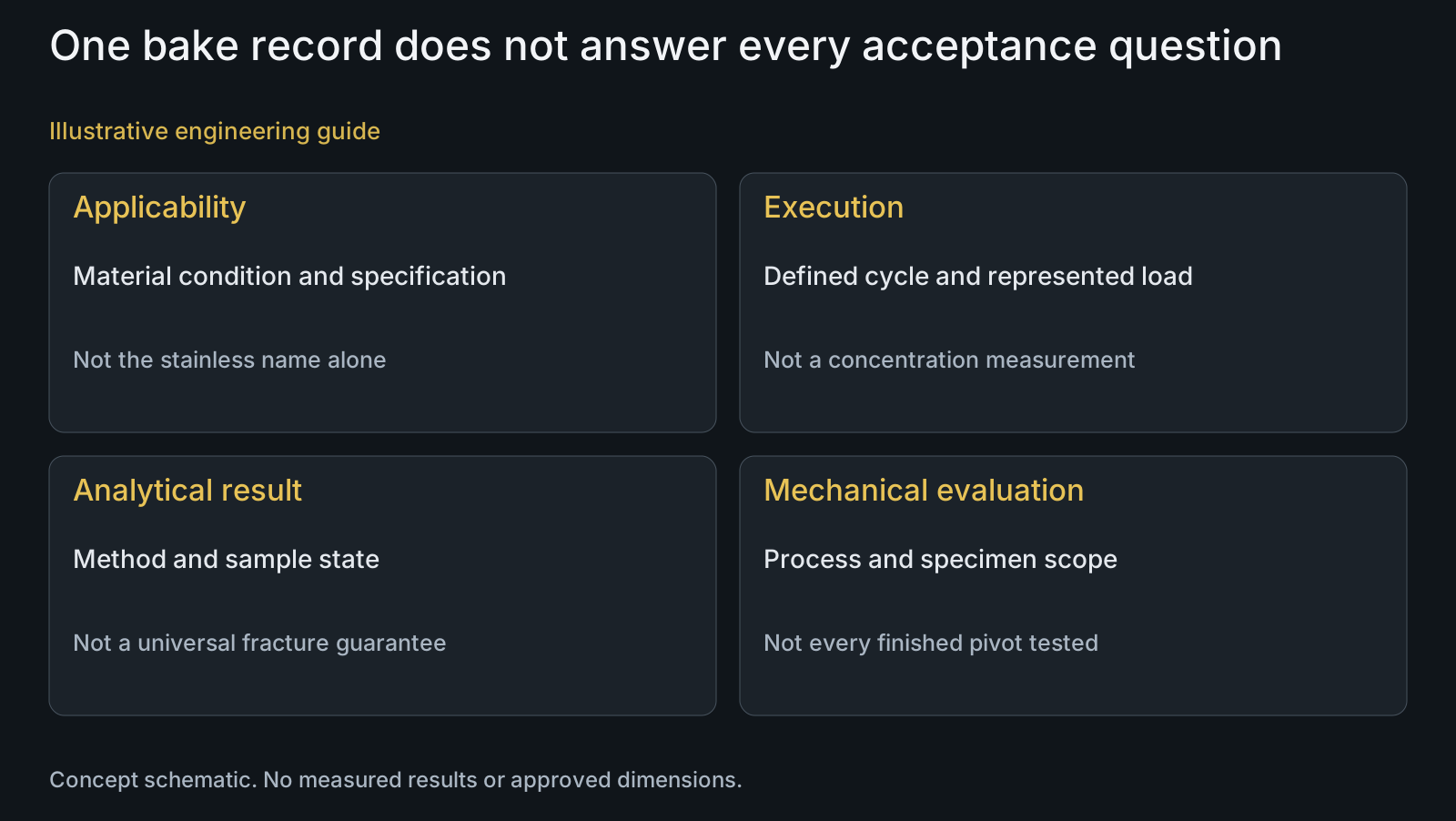
A treatment record can support execution of the specified operation. It does not, by itself, establish a measured residual hydrogen concentration. If a concentration limit is actually required, identify the measurement method, represented sample, sampling stage and acceptance basis.
As engineering analysis, a concentration claim and a mechanical-effect claim have different endpoints. Do not describe an analytical result as proof that a loaded finished bolt cannot suffer hydrogen-related degradation, or describe a mechanical test as a chemical concentration measurement.
Likewise, an incomplete process record is not evidence that a component failed. Resolve whether the missing item is an applicable instruction, execution evidence or a separate test result. That distinction determines the next useful action and avoids an unjustified instruction to repeat heating.
Mechanical process qualification is not a universal material ranking
ASTM F519's public scope and significance describe mechanical evaluation and qualification of plating/coating processes, including defined specimen conditions. The method is not intended to rank the relative susceptibility of different steels. Do not present a process-specimen report as a hydrogen-content measurement.
Ask which process and specimen the report represents and what conclusion the applicable requirement permits. A named mechanical method is not automatically a test of the customer's finished pivot or complete bicycle assembly. Avoid importing its specimen loading or duration into an unrelated acceptance plan.
Retain final dimensional and finish requirements after the specified route. A working thread can meet its fit requirement without settling hydrogen-related acceptance, and a relevant process qualification does not inspect every delivered shoulder. Discuss partner surface-treatment coordination with these scopes separated.
A generic bake statement cannot approve a changed substrate
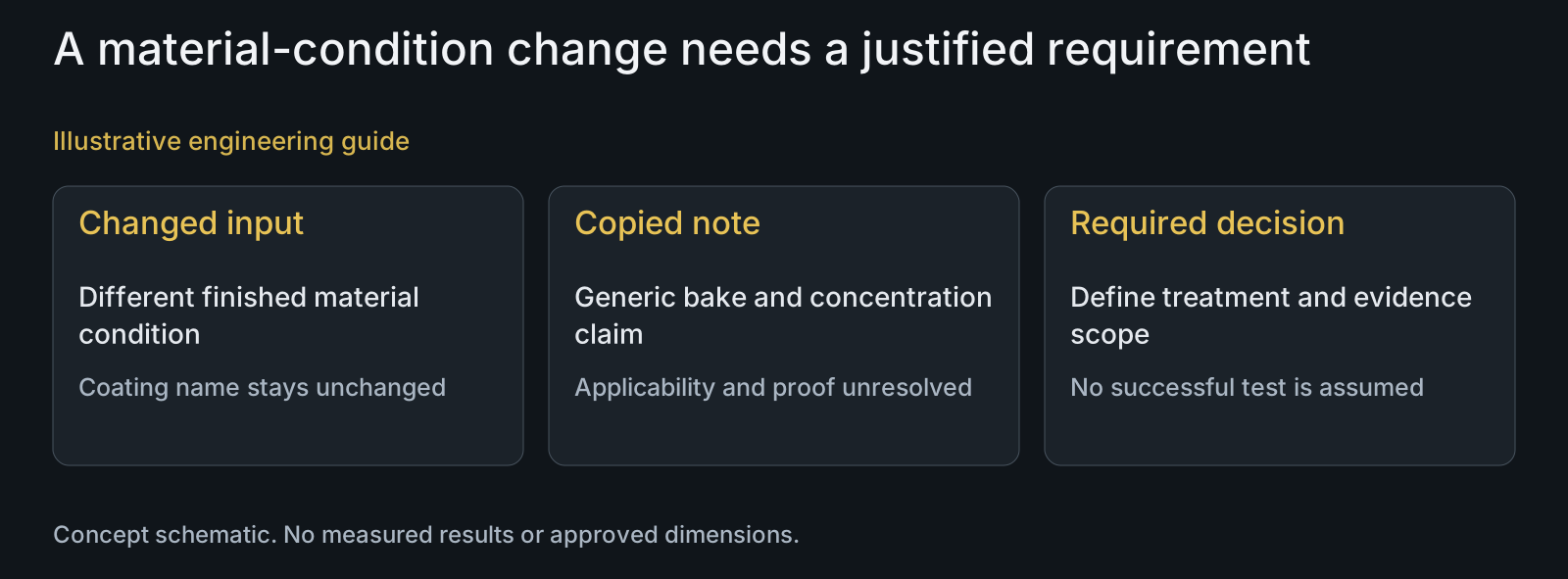
Illustrative engineering example: assume a plated pivot order changes the required finished material condition while retaining the coating name. The quotation carries over a generic bake statement and adds an unsubstantiated claim that hydrogen is below a stated concentration.
The reviewer does not automatically demand a longer cycle. First, the design owner and provider establish whether the new condition changes the applicable treatment requirement. Then they identify execution evidence and any separately required analytical or mechanical evaluation. Final coating and interface requirements remain independent checks.
No measured concentration, approved cycle or successful fracture test is asserted. The example demonstrates why a copied treatment note can leave both applicability and proof unresolved even when the finish and visible geometry appear unchanged. PremFixer can review the supplied drawing and coordinate the requested service scope, not invent that missing qualification.
Questions buyers need to confirm
Does every plated stainless pivot need hydrogen-relief baking?
No universal requirement follows from the name stainless. Establish the finished material condition, plating route and applicable specification. Do not omit a required treatment or impose an unsupported one without resolving that basis.
Can an article's temperature and time be used on the purchase order?
Not as a substitute for the applicable provider instruction and engineering requirement. Confirm material applicability, sequence and execution controls; no generic recipe is supplied here.
Does a bake certificate prove a residual hydrogen level?
No. It documents an operation within its recorded scope. A concentration claim requires a relevant analytical method, represented sample and acceptance criterion.
Can ISO 9588 simply be copied into a pivot-fastener specification?
Resolve its scope and revision first. The withdrawn 2007 document excluded fasteners. Its replacement concerns high-strength steel components; neither title alone establishes the ordered stainless bolt's requirement.
Does an F519 report rank stainless grades or measure hydrogen concentration?
No. Its public scope concerns mechanical process evaluation and does not rank relative material susceptibility. Review the represented process and specimen rather than relabel the result.
What should an RFQ include for a post-plating treatment review?
Supply the drawing, alloy and finished condition, mechanical requirements, complete coating route and specified standard revisions. Include the proposed treatment instruction, available execution or test evidence and any concentration claim requiring verification.
Technical references and scope
ASTM B850-98(2022): Public overview. Some-steel applicability, selection context, conversion-coating sequence and non-guarantee. No full treatment table or universal cycle asserted.
ISO 4042:2022: Public scope. Fastener/coating applicability and revision context only; no unexamined hydrogen-treatment clause reproduced.
ISO 9588:2007: Historical public scope. Fastener exclusion and withdrawn status; not an instruction to use this document on a new order.
ISO 24251-1:2025: Public scope. High-strength steel component guidance and replacement context; not blanket stainless applicability.
ASTM F519-23: Public scope and significance. Mechanical process-evaluation purpose and material-ranking limitation. No analytical concentration, component acceptance or numerical loading prescription transferred.
Explore related component, material and sourcing decisions in the customer decision knowledge center. For a drawing review, use the Drawing/BOM RFQ path.
Resolve post-plating treatment applicability and evidence
Send the drawing and BOM, finished material requirements, plating specification and complete proposed sequence. Include the provider's treatment proposal and any analytical or mechanical reports. PremFixer will review the manufacturing and partner-treatment scope while keeping applicable process requirements separate from unsupported hydrogen or safety claims.
Discuss the drawing and BOM