
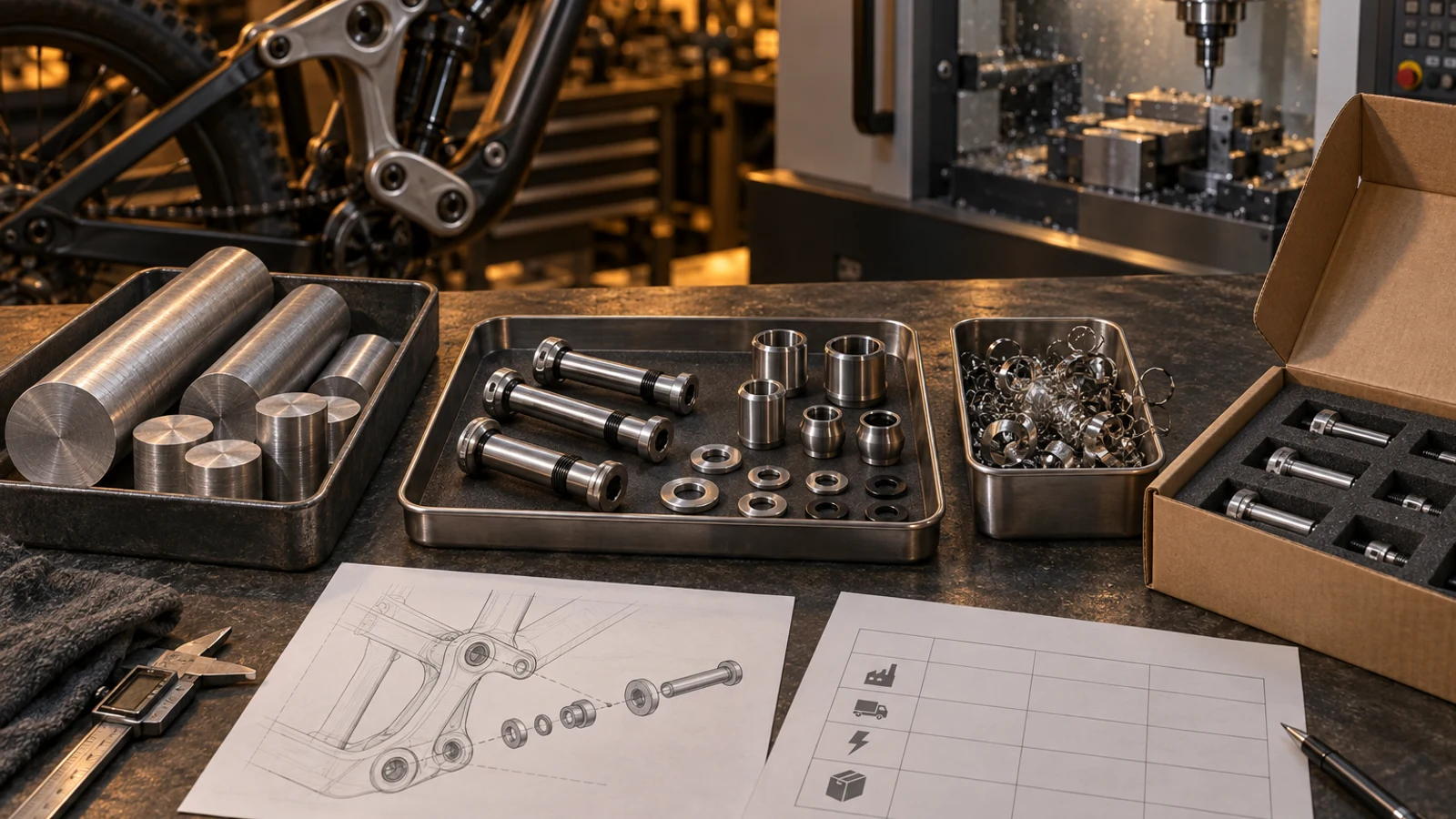
Start a pivot-bolt carbon-footprint request by defining the product and data boundary, not by asking for a lower-carbon alloy. State whether the output is a named accepted component or complete kit, which supply and manufacturing stages are included, and what the customer will do with the information. Then request inputs that actually represent that configuration. Finished mass is useful but does not describe all purchased stock or process activity. PremFixer can discuss available manufacturing inputs for a defined project; this does not promise a verified footprint, an emissions factor for every operation or a universal ranking of titanium, aluminum and stainless steel.
Hero: concept illustration of example hardware and its application. It is not a factory photograph, tested component or approved production geometry.
Specify the study output before assigning data owners
Use the drawing revision and BOM to identify the represented hardware. For a fixed component, name its accepted output quantity. For a kit, include each delivered item rather than let bolt refer to receivers, spacers and washers inconsistently. If the study concerns equivalent service, define that function separately and do not invent a service-life assumption.
ISO 14067:2018 addresses product and partial product carbon-footprint quantification. Its public scope is limited to climate change and excludes carbon-offsetting and footprint communication. A requested factory-gate result should therefore be described with its actual boundary, not treated as the only possible study or a complete sustainability approval.
The footprint comparison guide addresses whether offered results can be compared. Here the buyer's earlier task is deciding what suppliers need to collect before a calculation or comparison exists.
Draw the route and identify the boundary handoffs
Put the selected material source, stock preparation, component manufacture, specified treatment and packing on a simple route sketch. Mark the agreed endpoint and any delivery stage requested beyond it. Each included operation needs an identified information provider; an outside process is not absent merely because another organization performs it.
Use the actual manufacturing scope and chosen surface-treatment route. PremFixer's accountable component supply can include coordinated partner operations. That manufacturing relationship does not establish that all relevant energy or material data are already available from one internal meter.
At every handoff, ask what the incoming record represents: stock supplied to a job, a treatment batch, an accepted shipment or a different period of production. Do not silently join those records solely because they contain the same part name.
| Data subject | Useful request | Risk of an ambiguous entry | Review action |
|---|---|---|---|
| Represented output | Drawing revision, BOM and accepted quantity | Bolt count may exclude other kit items. | Name the same output in every request. |
| Stock supplied to the job | Material source, stock quantity and record coverage | Finished mass may be mistaken for purchased input. | Explain which job and output the record represents. |
| Manufacturing information | Operation, units and represented production period | A plant total may be read as a part result. | Identify the calculation owner's proposed separation. |
| Treatment information | Selected finish route and represented batch | An invoice may be assumed to contain process data. | Ask the process owner what information is available. |
| Packing and delivery scope | Included materials and stated endpoint | Different endpoints may be mixed silently. | Keep the agreed boundary visible. |
| Study deliverable | Inputs, calculation or independent assessment | A request may promise more than the available evidence. | Agree work, remaining gaps and review responsibility. |
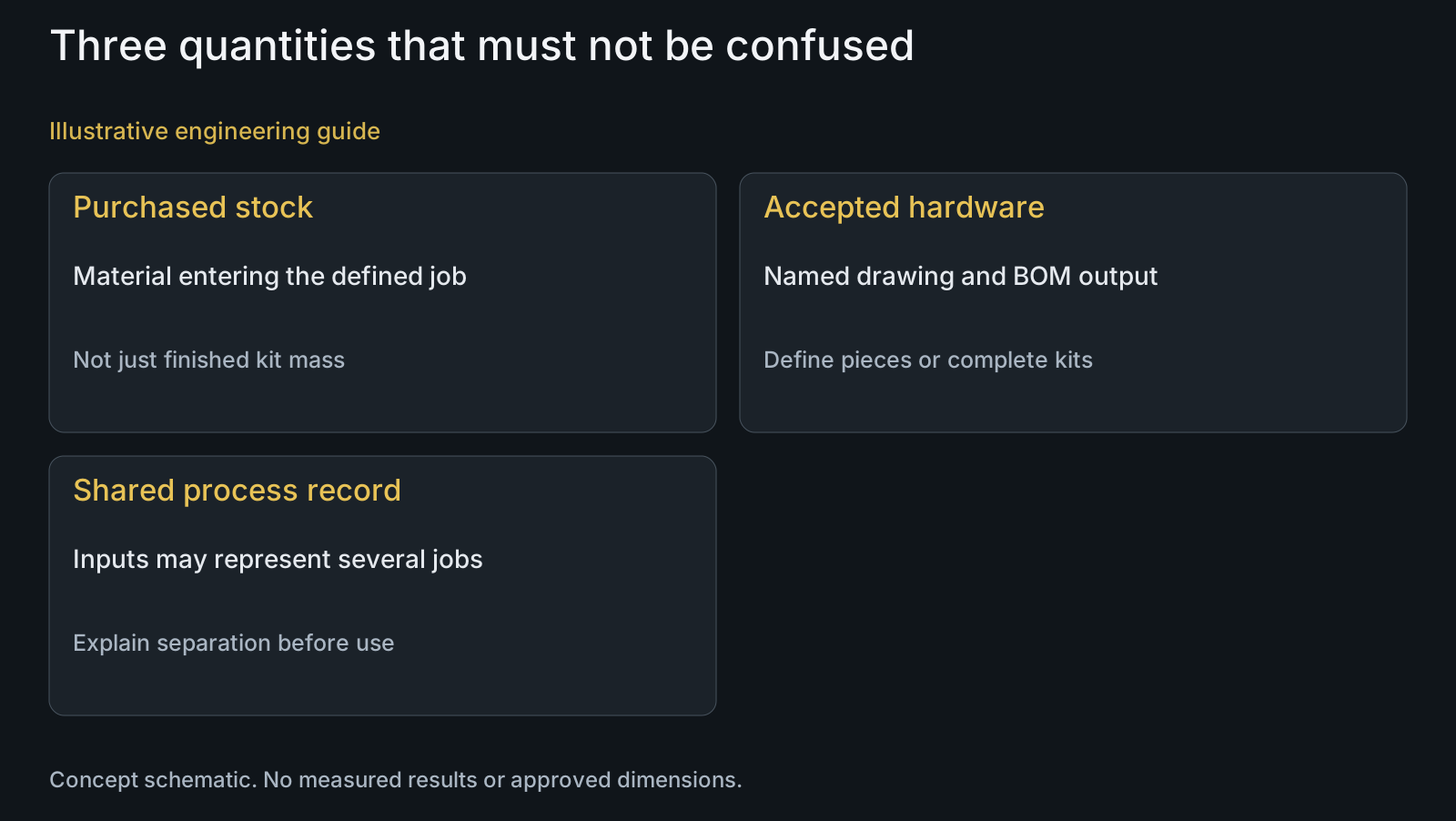
Distinguish a quantity from the factor applied to it
GHG Protocol's Product Standard distinguishes activity data, emission factors and direct emissions information. Its data-quality guidance addresses technology, geography, time, completeness and reliability. These distinctions help a reviewer explain what an input means; they do not supply missing numbers for this pivot project.
In a supplier request, keep the amount and unit of an input separate from any factor proposed for use with it. State the represented operation and period. If the supplied item is already a calculated footprint, ask for its included stages before deciding where it belongs in the study.
A spreadsheet column labelled carbon may hold a raw amount, a factor, a partial result or a whole-product result. Ask which one it is before using it. A clear field definition prevents the same upstream contribution being added again under a second heading.
Make shared inputs and accepted output explainable
For a turning job, request the stock input and accepted output definitions used in the proposed inventory. A finished axle's mass does not show whether a stock record refers to the entire order or only one cut length. Keep machining chips and their treatment visible as distinct information questions, without assigning an invented recycling credit.
If a record covers mixed products, ask how the assessment separates the studied pivot's contribution. A process-specific record and a plant total are different starting information. The calculation owner needs an explained method, not a division by an arbitrary count chosen because it produces a convenient number.
Ask what would change if the represented production quantity, process route or shared batch changed. The buyer does not need to prescribe an unsupported universal allocation recipe; it needs a method and supporting quantities that the assessment owner can defend for the study.
Illustrative engineering example: a meter and a mixed output list
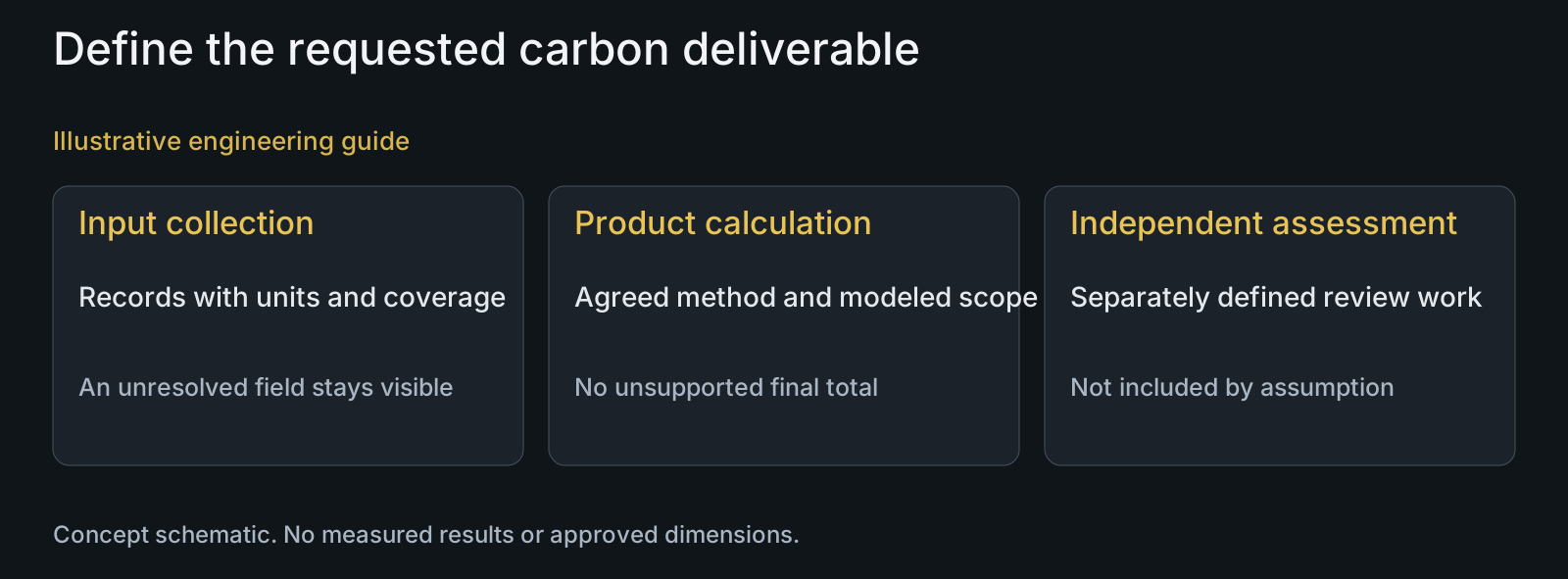
Illustrative engineering example: assume a buyer wants a factory-gate footprint for an axle-and-receiver kit. The available records include purchased stock for a job, a machine energy record covering several jobs and a finishing invoice without a treatment-data basis. No actual quantities, emissions factors or results are assumed.
The reviewer does not multiply net kit mass by a generic material factor and call the inventory complete. It identifies which stock belongs to the named kit, asks the calculation owner how the mixed energy record could represent that production, and requests the missing finish information from the responsible process owner.
The usable output is a defined data request with three different gaps, not a numerical winner among materials. If a gap cannot be resolved, the assessment must explain the remaining basis and limitation. A newer spreadsheet date cannot independently turn the missing treatment input into zero.
Agree the deliverable and keep missing evidence visible
Specify whether you need an input collection sheet, a calculated product result or independent assessment. These are different scopes of work. Attach the intended reporting method and review requirements rather than assume a quotation automatically includes all three.
For each unresolved input, identify the represented operation and information owner. Keep available measured, calculated and assumed entries distinguishable. Do not postpone every limitation until a final total has made the dataset look more complete than it is.
Use the materials page for manufacturing choices and the customer decision knowledge center for related procurement questions. A company-wide inventory, mass reduction or recycling claim should not replace the defined product-data deliverable.
Questions buyers need to confirm
Can PremFixer automatically provide a verified carbon footprint with every quote?
No automatic deliverable is established here. Define the product boundary, reporting method and whether you need data, calculation or independent assessment. Available inputs and additional work must be discussed for the actual source and manufacturing route.
Is the finished pivot mass enough for the material input?
Not by itself. Ask what stock quantity and job the inventory represents. The net component mass cannot explain all purchased input or removed material, and it does not supply the rest of the manufacturing information.
Can I use one machine record for a mixed-product batch?
Only with an explained representation method appropriate to the study. Provide the covered jobs and output definitions to the assessment owner. An arbitrary bolt-count division does not explain why the record represents the requested kit.
Does a finishing invoice supply the treatment's footprint?
Not necessarily. Check whether it contains actual process information or merely a commercial charge. Request the defined treatment, batch coverage and available data from the process owner rather than treating the price as a verified product result.
Can missing partner-process information be entered as zero?
No. Identify the missing operation and information owner, then state the assessment's remaining basis or limitation. A partner's involvement does not make that process disappear from an agreed included boundary.
What should I send for a focused product-data discussion?
Send the drawing or STEP file, BOM, represented output, material and finish requirements, intended endpoint and reporting method. Identify existing data and whether the requested deliverable is an input sheet, calculation or independent assessment so the work can be defined accurately.
Technical references and scope
ISO 14067:2018 public scope. Product and partial-footprint quantification, climate-change impact scope and excluded subjects; no full paid-standard interpretation or completed study inferred.
GHG Protocol Product Standard: data collection and quality. Chapter 8 data types and quality context. The pivot-specific request sheet and illustrative data-gap analysis are engineering procurement aids, not reproduced standard instructions or actual inventory results.
Explore related component, material and sourcing decisions in the customer decision knowledge center. For a drawing review, use the Drawing/BOM RFQ path.
Define the pivot footprint data your project needs
Share the drawing or STEP files, BOM, material and finish requirements, represented quantity, study boundary and intended reporting method. State whether you need an input collection sheet, a calculation or independent assessment so PremFixer can discuss available process information and the gaps requiring a defined data owner.
Discuss the drawing and BOM