

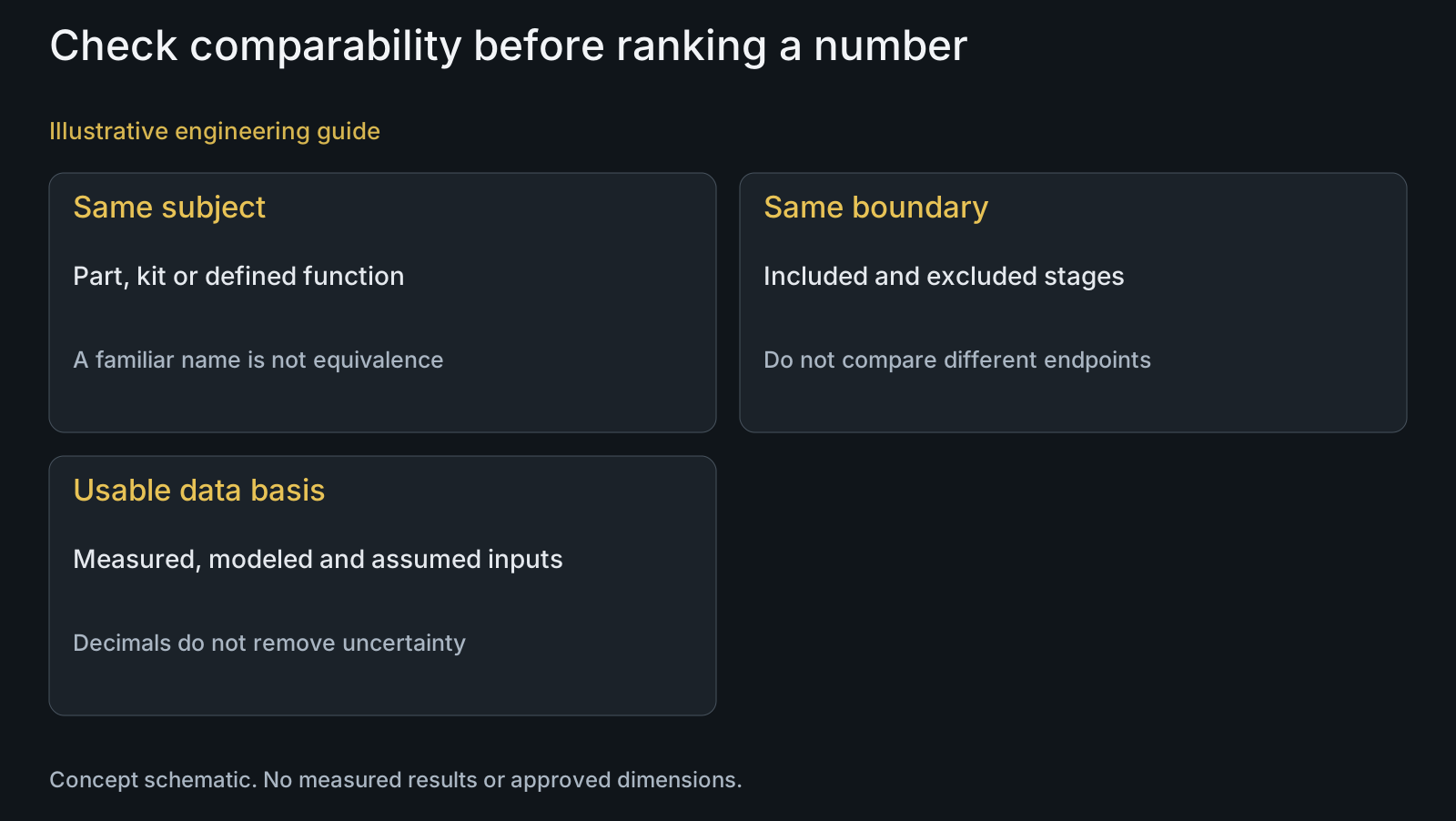
A carbon-footprint comparison of titanium, stainless and aluminum pivot hardware needs equivalent products and accounting boundaries before it can support purchasing. Identify the part or complete kit, reference quantity, required function and included life-cycle stages. A per-mass factor for raw stock is not directly comparable with a per-kit figure that includes machining, finishing and delivery. Lighter hardware also does not supply the missing emissions data. Ask what each result represents before ranking the numbers, then keep measured inputs, modeled data and assumptions distinct. Without that common basis, neither a material hierarchy nor an apparently precise quotation establishes which delivered configuration has the lower footprint.
Hero: concept illustration of example hardware and its application. It is not a factory photograph, tested component or approved production geometry.
Choose the decision and reference output first
Decide whether procurement is comparing two production routes for the same part, two complete kits or redesigned components delivering a defined function. A per-piece comparison can be useful for a fixed drawing, but different designs may require a function-based comparison rather than matching only their component names.
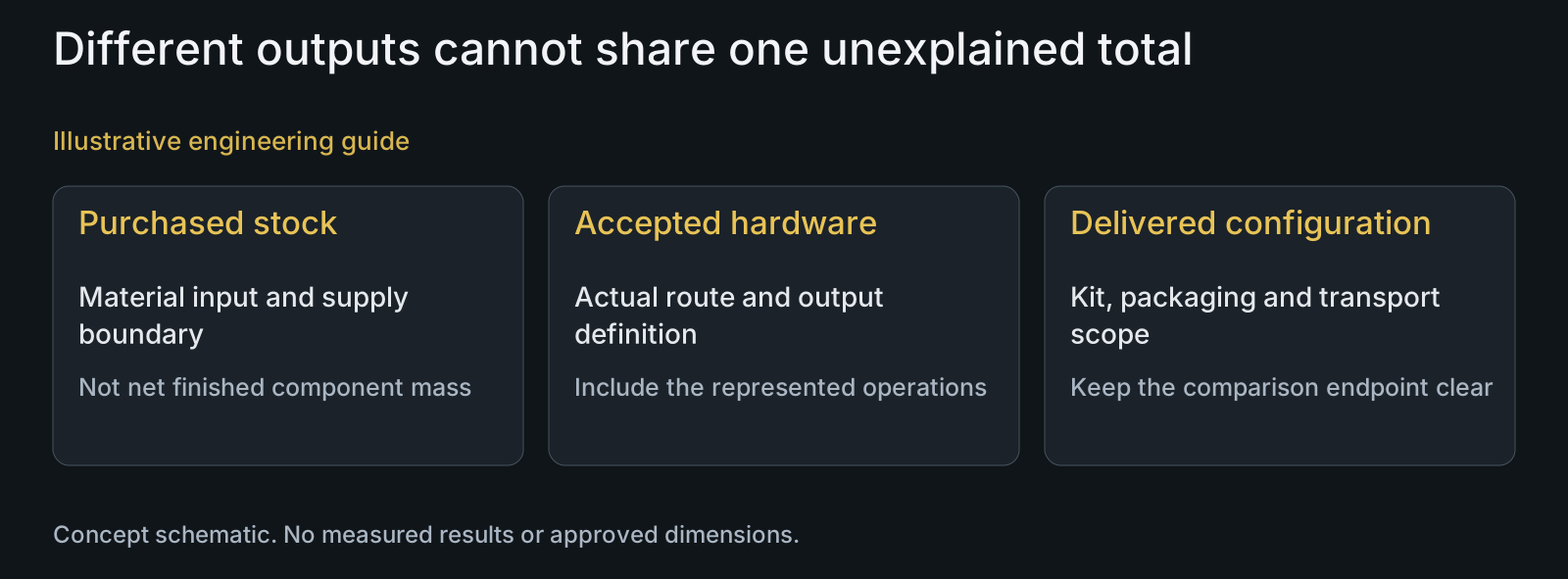
State the represented quantity and configuration. A kilogram of purchased bar, one accepted finished pivot and one complete hardware kit are different outputs. Multiplying a stock factor by net finished mass does not account for the stock removed or other included manufacturing inputs.
ISO 14067's public scope addresses quantification and reporting of product carbon footprints, including partial footprints. Its climate-change scope is not an assessment of every environmental, social or economic impact. Keep the intended carbon question specific rather than label a smaller figure universally more sustainable.
Check what each result includes and excludes
List the stages represented by each offered figure. A stock-supply result, a factory-gate component result and a delivered-kit result have different boundaries. One cannot be called lower merely because it omits stages included in the other.
GHG Protocol's Product Standard overview identifies product life-cycle stages and explains that product rules provide more specificity for comparison than the general standard alone. A common reporting title does not make every supplier's number immediately comparable.
Treat a partial result as partial. It may help identify a manufacturing improvement even when it cannot answer the customer's whole-product question. Show excluded stages explicitly rather than hide them behind a single total or silently fill them with zero.
| Reported figure | What it represents | Why a direct ranking fails | Needed comparison input |
|---|---|---|---|
| Per mass of stock | Specified material supply scope | Finished output and processing absent | Stock use plus represented route |
| Per accepted component | Identified drawing and included stages | Kit composition may differ | Equivalent configuration and quantity |
| Per delivered kit | Kit and stated delivery boundary | Other offer stops at factory gate | Matching included stages |
| Per assumed service period | Function and modeled replacements | Durability assumption unsupported | Supported equivalent function |
| Company-wide figure | Organization and reporting period | Not allocated product evidence | Defined product accounting basis |
| Partially estimated result | Measured and modeled inputs | Precision hides source uncertainty | Data basis and scenario limitations |
Translate the manufacturing route into represented inputs
For the chosen boundary, connect the purchased stock, accepted output and relevant processing. CNC turning, partner finishing and delivery can involve distinct data sources. Identify which operations are actually represented before attributing a result to the finished hardware.
Keep measured process information separate from a database estimate or supplier-average value. Identify the represented time, region and production context where they matter. A highly detailed decimal does not remove uncertainty in an input that does not represent the proposed supply.
Shared or batch-dependent inputs need a stated allocation basis. A plant-level total cannot be divided by an arbitrary bolt count and called a reliable product footprint. Explain the accepted output and included route so changing order quantity does not create an unexplained comparison.
Do not substitute mass or recycling language for emissions evidence
A weight result answers a mass question. The titanium kit weight guide treats matching BOMs and measured or calculated mass. Converting that difference into a carbon-saving percentage needs a separate supported method and inventory.
Recycled content, outgoing scrap recovery and a finished-product footprint also represent different subjects. The aluminum environmental-data guide develops those distinctions for stock and machining scrap. This guide focuses on deciding whether complete offered footprint results share a usable comparison basis.
Do not supply missing use-phase assumptions by claiming that one alloy lasts longer. A modeled service period or replacement scenario must be supported and stated. If that evidence is unavailable, narrow the comparison to a defined boundary that the data can actually support.
Make uncertainty visible in the purchasing comparison
Separate comparable information from unresolved fields before choosing between offers. If one offer lacks finishing data, record that gap rather than automatically treat it as the cleaner route. If both lack a relevant stage, their totals still may not answer a whole-life question.
Where assumptions could change the ranking, show the alternative scenarios and why they matter. No numeric sensitivity result is implied here. The point is to avoid presenting a fragile conclusion as an established winner when reasonable unresolved inputs could reverse it.
PremFixer's manufacturing scope can support an input discussion for the defined configuration. A verified product footprint, environmental declaration or company-wide neutrality claim is not automatically included with a standard hardware quotation. Agree the requested study and data deliverables separately.
Illustrative review: raw-stock factor versus delivered-kit figure
Illustrative engineering example: assume offer A provides a material factor per mass of stock while offer B provides a modeled figure per delivered kit. Both concern pivot hardware, but the buyer has not established a common function, output or stage boundary. No actual emissions numbers or supplier data are assumed.
The reviewer does not convert the stock factor using finished bolt mass and declare a winner. It identifies the actual stock consumption and missing machining, finishing and transport information, then asks whether both offers can be represented on the agreed comparison basis.
If that cannot yet be done, the comparison records the available evidence and missing fields without a ranking. This is useful procurement information, not a completed life-cycle assessment or proven emissions reduction. Engineering acceptance of either component remains a separate requirement.
Questions buyers need to confirm
Can alloy names alone establish a carbon ranking?
No. Define equivalent products, function and accounting boundaries, then use representative data. A generic hierarchy does not establish the emissions of a finished pivot. Material sourcing and actual manufacturing inputs must be represented within the chosen comparison.
Can a stock factor be multiplied by net bolt mass to get the full footprint?
Not as a complete result. Net mass does not represent all stock consumption or included processing. Identify the factor's boundary, actual input material and other relevant stages. State a partial estimate as partial rather than a delivered-product total.
Does one lighter kit automatically save carbon?
No. It supports a mass comparison, not missing emissions information. Keep equivalent function, represented processes and any supported use assumptions explicit. Do not turn a gram saving into an environmental percentage without the relevant inventory and method.
Can two reports using the same standard be ranked immediately?
Not merely from that label. Compare the product definitions, boundaries, data and applicable comparison rules. A shared standard reference does not erase different included stages or assumed functions. Identify those differences before choosing a winner.
Can unknown manufacturing data be treated as zero?
No. Record the gap and explain what the partial result represents. A missing stage is not an established absence of emissions. Additional information or a narrower justified comparison may be needed.
What should accompany a product-footprint inquiry?
Send the drawings and BOM, equivalent-function definition, reference quantity and included-stage boundary. Add actual source and process data, existing footprint reports and known assumptions. Specify whether you need an input inventory, calculation or independent assurance rather than assume they are one deliverable.
Technical references and scope
ISO14067:2018 public scope. Product and partial-carbon-footprint quantification subject and single climate-change impact category; no completed study or clause-level certification claimed.
GHG Protocol: Product Standard overview. Product-life-cycle context and need for more specific product rules for comparison; no fabricated emissions factor or comparative assurance result.
Explore related component, material and sourcing decisions in the customer decision knowledge center. For a drawing review, use the Drawing/BOM RFQ path.
Define a comparison both offers can represent
Share the part or kit BOM, required function, reference quantity and intended footprint boundary. Include available material, processing and transport data and mark estimates separately. PremFixer can review the manufacturing-input scope without inventing an emissions figure or unsupported material ranking.
Discuss the drawing and BOM