
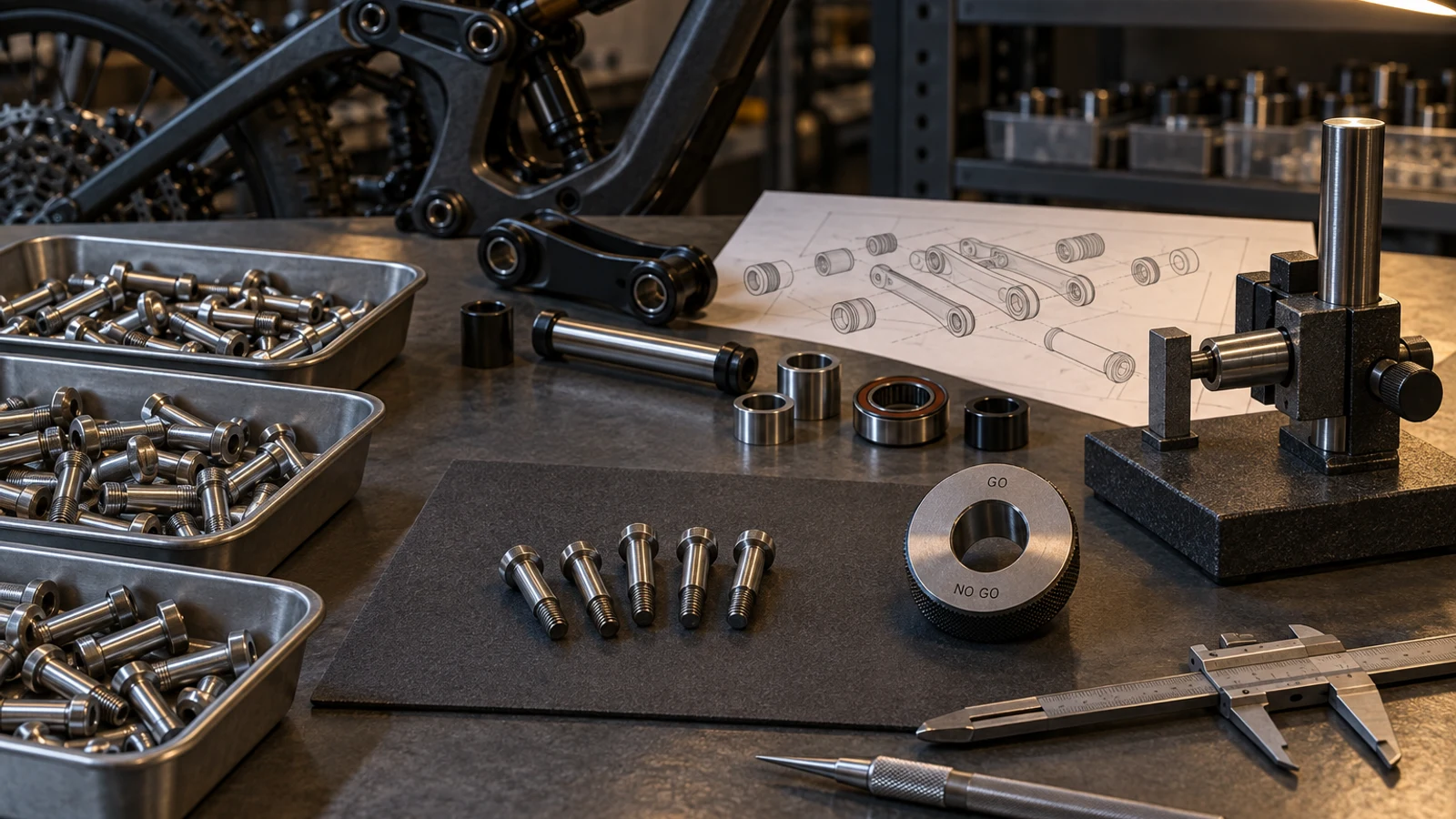
There is no universal AQL for bicycle pivot bolts. Define the lot, inspected unit, characteristics and their failure consequences before choosing an applicable acceptance scheme with the buyer. A shoulder fit, damaged thread and cosmetic mark do not become the same risk because they appear on one part. ISO 2859-1 addresses acceptance sampling by attributes; a lone AQL number does not describe a complete decision rule. Keep safety-related design and process controls separate from the shipment decision. Neither a passed sample nor an unspecified '100% inspection' statement establishes that every requirement or every possible defect has been checked.
Hero: concept illustration of example hardware and its application. It is not a factory photograph, tested component or approved production geometry.
Name the part and population before choosing a number
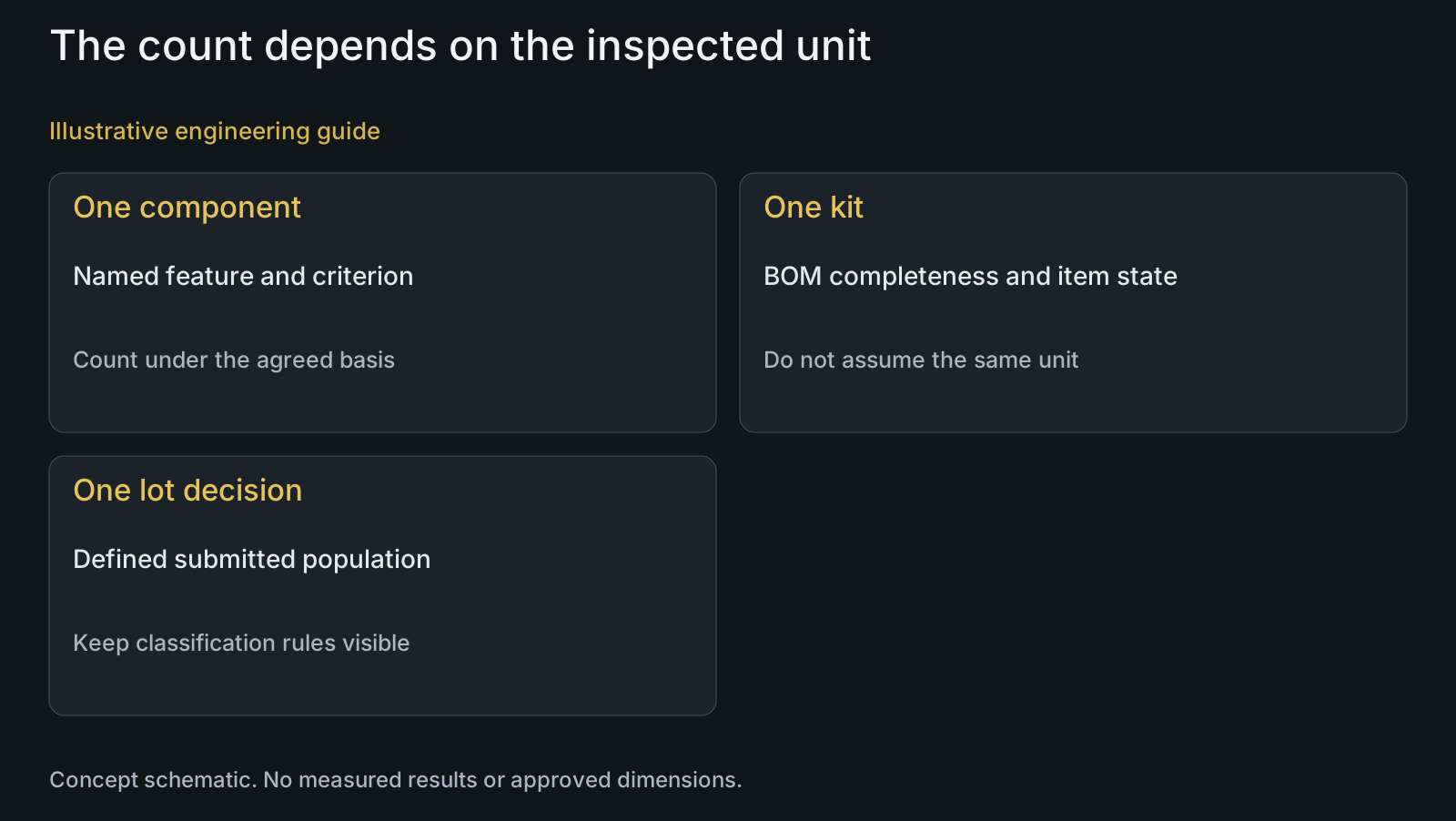
Is the inspected unit one axle, one washer or a complete kit? Define it explicitly. A missing washer in a kit and a dimensional departure on an axle require different descriptions; otherwise two inspectors can count the same delivery differently.
Identify the lot submitted for the decision, including relevant part revision and supplied state. Mixed items, revisions or conditions should not disappear behind one shipment heading. Confirm how the actual grouping relates to the proposed scheme before selecting samples.
A selection made only from the easiest open container can leave the rest of the defined population unrepresented. Plan access and selection for the submitted grouping rather than rely on convenient pieces or preselected demonstration samples.
Classify a defined nonconformity by its consequence
Start with the acceptance criterion for each characteristic. Name the shoulder limit, thread requirement or surface criterion and the method that can assess it. A word such as 'major' is not a measurable requirement by itself.
Connect classification to the actual interface and failure consequence. A mark outside a working contact can have a different relevance from damage at a locating seat. Do not assign the same class solely because both observations are described as scratches.
The cosmetic-acceptance guide addresses appearance criteria, while the final-inspection guide addresses named features and coverage. Specify how observations are counted under the chosen plan instead of interchange nonconforming units and individual observations.
| Input | Choice that matters | Risk if unclear | Useful confirmation |
|---|---|---|---|
| Inspected unit | Single part or complete kit | Different observations counted as equivalent | Name unit and counting basis |
| Submitted lot | Relevant identity, revision and condition | Mixed goods hidden by shipment number | Define represented population |
| Characteristic | Criterion and suitable method | Subjective classification changes outcomes | Link to drawing or approved requirement |
| Failure classification | Functional consequence and context | Generic AQL substitutes for risk review | Identify affected interface and consequence |
| Sampling scheme | Edition, parameters and decision rules | AQL treated as a complete plan | Confirm applicable authorized scheme |
| Every-piece screening | Named feature and response | Coverage confused with every requirement | State subject, method and limitations |
Specify the complete scheme and edition
ISO's current catalogue lists ISO 2859-1:2026 as the published third edition, replacing the 1999 edition and its amendments. Its public description addresses AQL-indexed schemes and switching between inspection states; this article does not reproduce its sampling tables.
A quality arrangement should identify the agreed standard and edition, lot parameters, inspection level, scheme, current inspection state, characteristic classifications and decision rules. Obtain the applicable authorized tables and conditions when specifying actual sample sizes and acceptance/rejection values.
Keep the rule for successive lots and the response to a nonaccepted lot visible. Do not turn a favorable sample into permission to reduce later inspection outside the agreed conditions, or take repeated samples until one happens to pass.
Keep statistical lot acceptance separate from safety controls
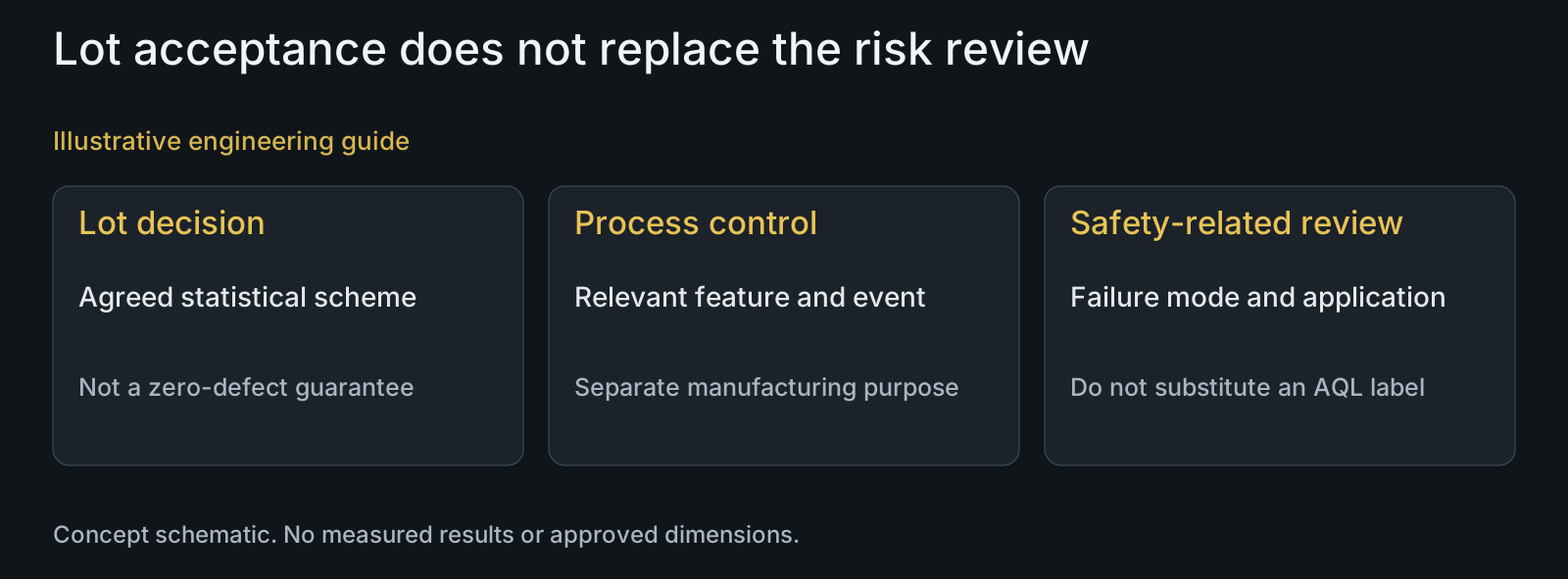
The NIST acceptance-sampling handbook explains sampling decisions and producer/consumer risks. Its operating-characteristic concept describes acceptance probability against lot quality, not a promise that an accepted lot contains no nonconforming units.
For the actual pivot application, decide separately which design, manufacturing or verification controls address a safety-related failure mode. Reducing an AQL cannot by itself answer whether the drawing addresses the required load path or whether the process check can detect the relevant departure.
If every-piece screening is requested, name the feature, supplied condition, method and response. It does not automatically include destructive checks or every requirement. The quality-stage comparison discusses when checks occur; this article defines the final lot-decision basis.
Make a nonacceptance response usable
Before inspection, identify who controls the affected goods and decides their disposition. Keep suspect grouping and identity intact while the departure is reviewed. Do not mix returned or screened pieces into another lot without an agreed basis for their status.
Correction, screening, replacement or another disposition must address the actual nonconformity. A new delivery label does not change a damaged working surface, and a dimensional recheck does not independently resolve missing material evidence.
State any agreed conditions for resubmission and the records needed to connect it to the affected goods. This is a contract-specific response discussion, not an invented ISO clause or a universal PremFixer sorting policy.
Review a kit with two different observations
Illustrative engineering example: assume an OEM receives pivot kits and records a missing spacer in one selected kit and a superficial mark on an axle elsewhere. No actual sample size, AQL, defect count, lot result or customer event is assumed.
The reviewer first confirms the inspected unit and the criteria for kit completeness and surface condition. The observations need their applicable classifications and decision rules; they cannot be combined casually into a single count merely because the box contains one product family.
The mark also needs location and functional relevance before classification. Separately assess any safety-related consequence of the missing spacer. Bring the BOM and named characteristics to the manufacturing discussion and drawing RFQ, not just an isolated AQL number.
Questions buyers need to confirm
Is there a standard AQL for all bicycle pivot bolts?
No value is prescribed here for the product name alone. Define the application, characteristics, consequences and applicable scheme with the responsible buyer before assigning a complete acceptance plan.
Can I give the supplier only an AQL number?
It leaves the decision incomplete. Include the inspected unit, lot, characteristics, classification, edition and relevant scheme parameters and rules so the number refers to a defined requirement.
Should a scratch always be treated as cosmetic?
No. Identify its location and relevance to the working interface, then apply the agreed criterion. A description without location cannot establish whether the observation is appearance-only or functionally important.
Can a kit and an individual axle use the same counting basis?
Do not assume that. State the inspected unit and how observations are counted under the applicable scheme. A completeness issue and a feature departure must retain their defined subjects and rules.
Does 100% inspection mean all requirements are checked?
Not without a defined scope. Name the screened feature, condition, method and response, and identify requirements outside that check. No universal every-piece inspection commitment is claimed here.
What should purchasing send for the acceptance-plan review?
Provide the drawing and BOM, submitted grouping, supplied state, characteristic criteria, application risks and any customer scheme. Include the required disposition and resubmission basis rather than send an isolated AQL value.
Technical references and scope
ISO 2859-1:2026 official catalogue and public description. Current edition and public attribute-sampling scheme description; no numerical tables or contract-specific selection reproduced.
NIST acceptance sampling handbook. Lot sampling decisions, risks and operating-characteristic meaning, not a current ISO table or guarantee.
Explore related component, material and sourcing decisions in the customer decision knowledge center. For a drawing review, use the Drawing/BOM RFQ path.
Bring the acceptance subject, not just the AQL
Send the drawing, STEP or sample reference and kit BOM with lot definition, supplied state, feature criteria and customer inspection requirements. Identify failure consequences and required screening or disposition so PremFixer can discuss the manufacturing and acceptance scope without implying a universal AQL or zero-defect policy.
Discuss the drawing and BOM