

For an OEM buying pivot bolts or complete hardware kits, an ISO 4210 edition transition calls for a requirement review and separate decisions for existing stock, open orders and new requests. Start with the named standard part, relevant requirement and actual bicycle configuration. Do not infer a universal higher tightening torque, rejected inventory or delivery cutoff from a revision headline. The applicable project basis and evidence determine what needs attention; purchasing then needs a clear disposition for the represented items. PremFixer can discuss drawing-led manufacturing and documentation scope, but no full-series compliance result or universal transition policy is claimed here.
Hero: concept illustration of example hardware and its application. It is not a factory photograph, tested component or approved production geometry.
Identify the change before changing the purchase requirement
The official ISO 4210-2:2023 preview identifies a technical revision from the 2015 edition and a change concerning minimum failure torque. Its public notice is a starting point, not a complete comparison of the normative requirement.
Name the series part and clause actually used by the product team. Obtain the applicable full text through the authorized standards channel for a detailed comparison. A generic purchase note saying 'latest ISO 4210' can leave different teams referring to different documents or unresolved interpretations.
The failure-torque interpretation guide addresses the represented joint and evidence. This article concerns the resulting stock and order decisions. It does not supply a new installation value or invent a numerical change between editions.
Separate the technical conclusion from the purchasing disposition
First identify what the review found: an unchanged requirement, a documentation ambiguity, missing relevant evidence or a changed product requirement. These findings have different consequences. An edition reference alone does not show that every existing bolt must be physically changed.
Then identify which purchasing objects are affected. An available stock lot, an accepted order, an unaccepted quotation and a future-model request are not the same commitment. Keep the technical finding visible beside each object's actual configuration and agreed basis.
If a material, finish or locking condition changes, do not hide it behind an unchanged part number. Conversely, do not require a new geometry solely because a document date changed. The responsible engineering and quality reviewers determine the technical need; the applicable agreement defines the supplied work.
| Review finding | Existing items | New or open order | What closes the decision |
|---|---|---|---|
| Reference lacks the exact part/edition | Do not infer acceptance from age | Clarify the required basis | Responsible requirement interpretation |
| Requirement confirmed unchanged | Evaluate represented configuration | Keep consistent applicable scope | Documented relevant review |
| Report lacks needed configuration detail | Name the unresolved conclusion | Specify relevant evidence scope | Appropriate identified assessment |
| Supplied condition must change | Decide affected lot disposition | Agree the changed deliverable | Technical authorization and scope agreement |
| Destination basis differs | Assess permitted intended use | Keep market and contract bases visible | Applicable compliance decision |
| Transition event is undefined | Avoid blanket scrap or use instruction | Agree what the cutoff represents | Named milestone and affected objects |
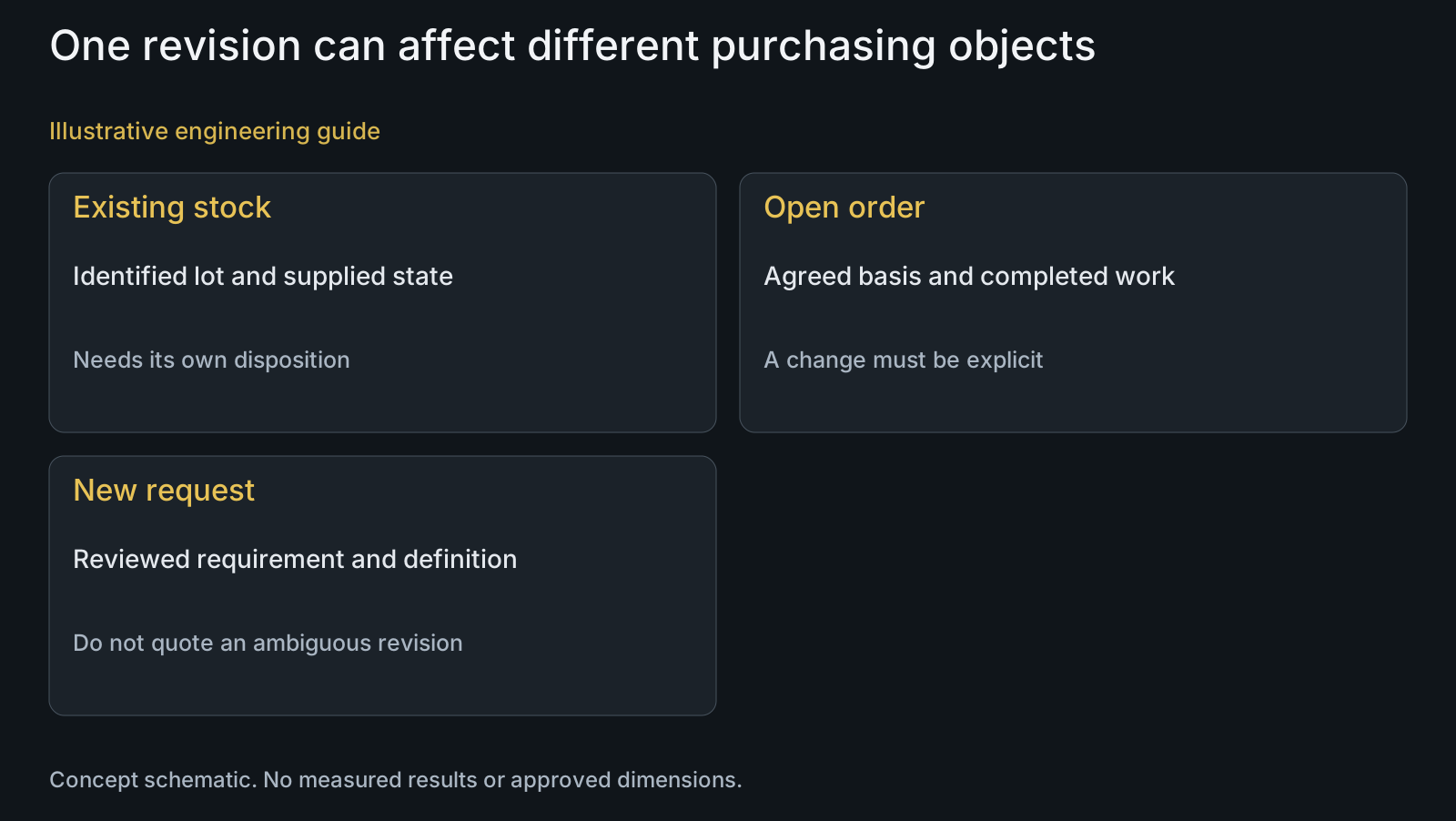
Give existing stock a reasoned disposition
Identify the existing items and the requirement under which they were supplied. Compare their represented configuration with the reviewed product need. A stock label with an old date is not, by itself, evidence of a defect or permission to use the items in a revised application.
Where evidence is incomplete, name the unresolved conclusion before deciding whether to hold, assess or use the stock for a permitted purpose. Do not mark it approved simply because the geometry looks unchanged. Do not claim a universal scrap rule without an applicable basis.
Keep a revised purchasing description distinguishable from physical stock identity. The quality-report discussion helps define the document's represented subject. It cannot independently authorize using an older lot under a different requirement.
Clarify open orders and new requests independently
For an open order, state the agreed drawing, supplied condition and standard basis, then identify the proposed change. Ask which work has already occurred and what a changed deliverable would require. A standards announcement does not silently amend an accepted order or assign its commercial consequences.
For a new RFQ, include the required edition and affected requirements with the actual part definition. If comparison or interpretation is still pending, disclose that open item rather than request an unconditional quotation for an undefined 'new-standard bolt.'
Use the RFQ file guide to keep model, drawing and BOM references consistent. A change in the purchase note should not leave the supplier manufacturing from an older incompatible definition. Any scope, timing or price effect belongs in the applicable discussion, not a guessed universal rule.
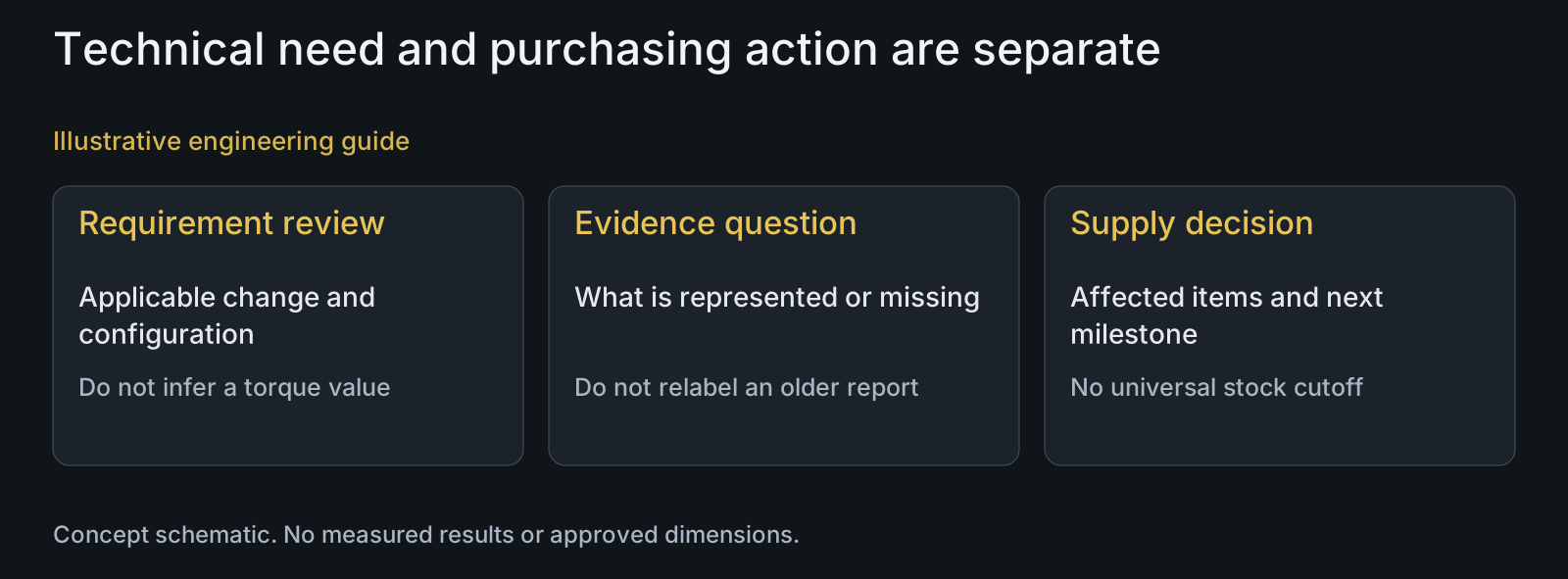
Review one unchanged geometry across stock and a new order
Illustrative engineering example: assume an OEM has an existing pivot lot and is preparing a new purchase request while reviewing a revised standard reference. The component geometry is initially unchanged, but the team's earlier evidence summary does not identify the relevant assessed configuration. No real lot, test result or acceptance decision is assumed.
The team identifies the missing evidence question before declaring the stock usable or obsolete. It gives the existing lot a separate disposition and states the reviewed requirement for the new request. If additional assessment is needed, its subject and purpose remain explicit rather than become a blanket test on every bolt.
If the review later calls for a changed supplied condition, the new order and affected stock need an appropriate updated decision. The example shows why stock status and order scope cannot be inferred from the same unchanged CAD image; it does not establish a compliance outcome.
Agree the transition event instead of relying on a publication date
Name what a transition point means for the project: requirement approval, first order under the revised basis or a specified receiving milestone. Those events can occur on different dates. A supplier delivery cutoff needs an applicable agreement, not a date copied from a standard cover.
Keep market applicability separate from the contract edition and the manufacturing schedule. This guide does not establish destination law, a universal regulatory grace period or the status of any specific bicycle. Ask the responsible compliance reviewer for the applicable market basis.
PremFixer's manufacturing scope and material information support a discussion about the defined items and relevant operations. The OEM's bicycle application and product requirements remain necessary context. No owned certification laboratory or completed full-series verification is asserted.
Questions buyers need to confirm
Did ISO 4210-2:2023 identify a minimum-failure-torque revision?
Yes, the official public foreword identifies that subject. It does not provide the full normative comparison here. Read the relevant complete requirement before assigning its consequence to a particular joint or purchasing request.
Must every older pivot stock lot be scrapped?
No universal rule follows from the edition date. Identify the supplied configuration, applicable intended-use basis and relevant evidence, then obtain the responsible disposition. Neither an old label nor unchanged appearance settles the decision.
Does the new edition automatically amend an accepted order?
Do not assume that. Identify the agreed deliverable and the proposed technical change, then discuss the applicable scope and terms. Standards interpretation and an order amendment are separate actions.
Should we raise tightening torque during the transition?
Not from a revision headline. Failure evidence and installation instructions serve different purposes. Use the approved instruction for the exact joint; any changed instruction requires an appropriate engineering basis, not a universal percentage increase.
Can publication date be used as a supplier delivery cutoff?
Not automatically. Define the applicable requirement and what the transition event means for the project. Market applicability, contract edition and receiving milestone are different fields; no universal legal deadline is established here.
What information supports a focused transition discussion?
Provide the relevant standard part/edition, affected requirement, drawings and supplied condition, intended application and existing evidence. Identify which stock lots, open orders or new requests need a decision. This makes the technical and purchasing consequences distinguishable.
Technical references and scope
ISO 4210-2:2023 official public foreword and scope. Confirms technical revision and the minimum-failure-torque change subject; public informative view is not full normative comparison or a destination legal deadline.
Explore related component, material and sourcing decisions in the customer decision knowledge center. For a drawing review, use the Drawing/BOM RFQ path.
Identify the objects affected by your standards review
Share the drawing or STEP and BOM, relevant standard part/edition, intended application and the evidence already available. Separate existing stock, open orders and new requests so PremFixer can discuss the applicable manufacturing and documentation scope without assuming a universal transition rule.
Discuss the drawing and BOM