
ISO 4210-2:2023 identifies a revision concerning minimum failure torque, but that notice is not a new installation setting for every bicycle pivot. For an OEM updating a frame program, the immediate decision is whether the relevant requirement and existing evidence match the actual joint. Read the applicable full clause before accepting a test or revising a specification. Keep destructive failure evidence separate from the manufacturer's tightening instruction. A stronger bolt, a higher wrench setting or an older report with an ISO heading does not establish conformity with a changed requirement or demonstrate that the assembled bearing and receiver remain functional.
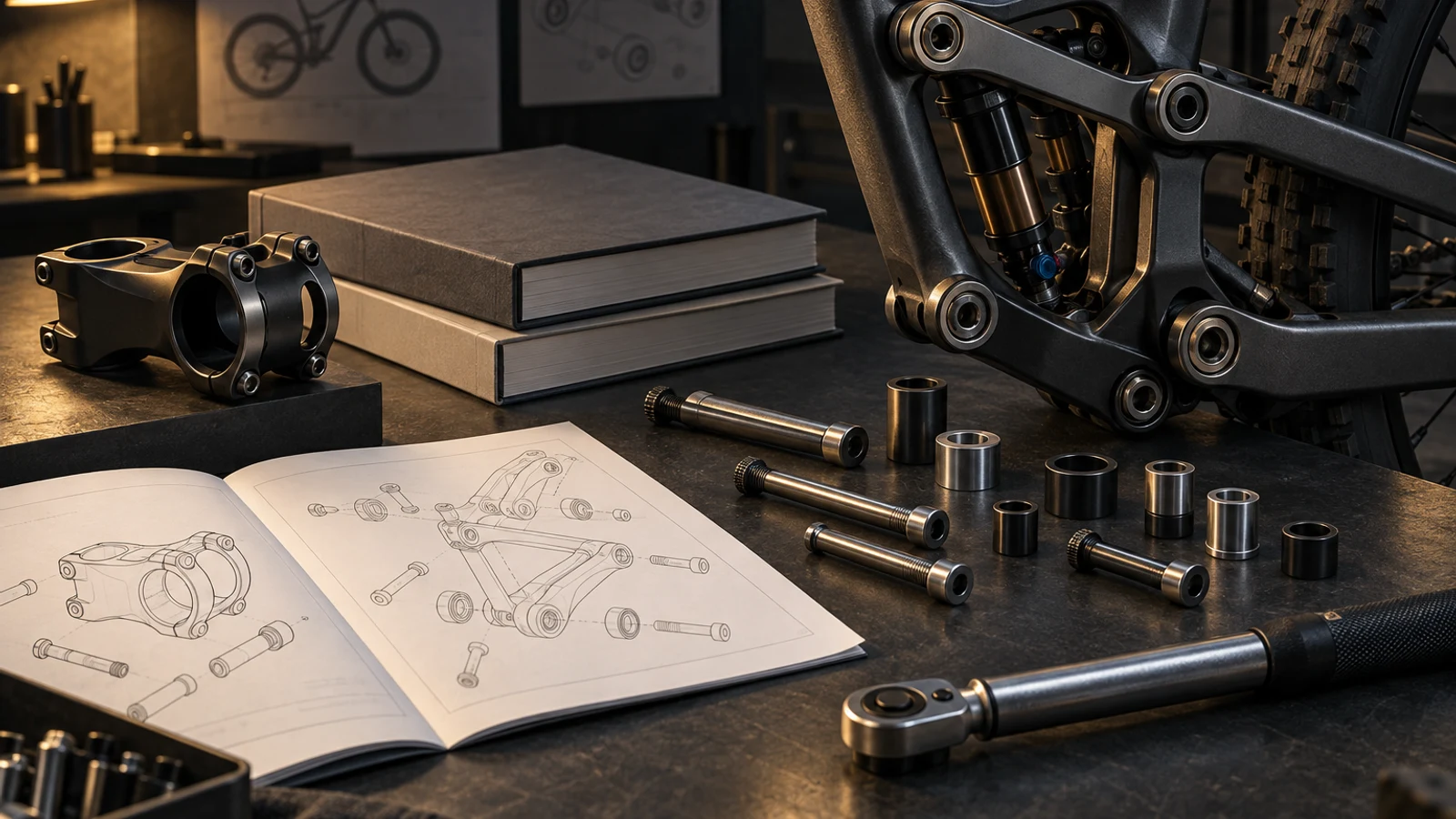
Hero: concept illustration of example hardware and its application. It is not a factory photograph, tested component or approved production geometry.
Identify the confirmed change without inventing its magnitude
The official ISO foreword identifies an improvement to clause 4.3.2, Minimum failure torque, in the 2023 edition. That establishes a subject requiring review. It does not establish that every numerical limit increased or that all bicycle fasteners have the same requirement.
Compare the complete relevant text with the edition used for the existing project. Identify changes in wording, covered connections, referenced methods and evidence expectations. A public change list cannot substitute for this comparison; avoid describing a specific threshold or procedure that has not been verified.
For a buyer, the useful output is a statement of what changed for this configuration and why. A claim that a supplier completed compliance early needs the corresponding document, represented hardware and acceptance basis. No such PremFixer test result is asserted here.
Determine which joint the requirement actually addresses
Identify the bicycle application and the joint's function before assigning a clause. Suspension pivots, stem clamps and seatpost connections do not become the same test object because they all contain bolts. Check product coverage and the complete clause's named connections with the responsible standards reviewer.
Within a pivot, distinguish the fastener from its receiver and bearing-spacer contacts. An isolated bolt specimen represents a narrower question than the assembled joint. The relevant evidence must describe the interfaces that the requirement actually expects, rather than whatever fixture was convenient.
The standards-applicability guide separates document roles. For the bicycle-specific boundary, see ISO 4210 and stainless pivot hardware. Those decisions precede any conclusion about a changed test requirement.
| Finding | Decision it supports | Wrong response | Evidence or action |
|---|---|---|---|
| Public revision notice only | Locate the changed requirement | Invent a universal higher torque | Read full relevant clause and edition |
| Unclear covered connection | Resolve applicability first | Apply one clause to every bolt | Identify bicycle category and named joint |
| Older report with suitable detail | Compare represented evidence | Reject solely because it is old | Check requirement and configuration |
| Different receiver in report | Limit the conclusion | Call it current assembly compliance | Assess actual interface relevance |
| Confirmed assembly limitation | Address the limiting mechanism | Only increase bolt strength or wrench setting | Joint-specific design and verification |
Keep failure torque separate from the usable assembly setting
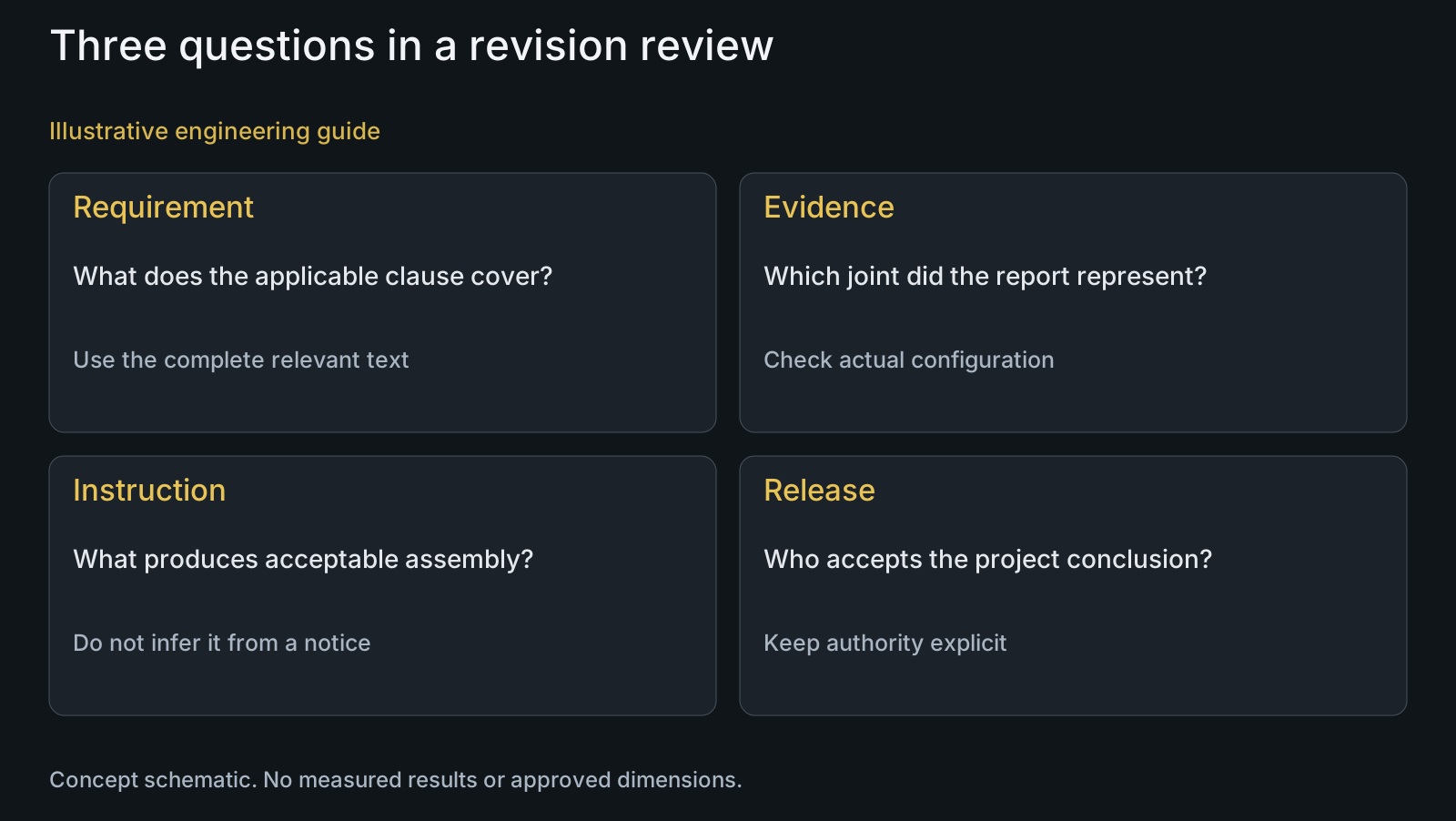
Failure torque describes a terminal event under a defined configuration. Installation torque is an instruction for producing acceptable assembly behavior. Using one as the other can hide receiver stripping, drive damage or unwanted bearing contact that occurs before the bolt itself ruptures.
A generic increase in the wrench setting is therefore not a safe response to a revised failure requirement. The contact path, thread engagement, surface condition and locking system still determine how the actual joint behaves. A torque-only reading does not directly demonstrate the clamp force achieved.
The destructive-torque article explains specimen and endpoint interpretation. Assembly torque development addresses the separate instruction. This revision review decides which evidence or document needs attention, rather than deriving a universal ratio between those quantities.
Assess whether an older report answers the revised question
Do not accept or discard a report solely by its date. Check the method actually used, specimen identity, joint configuration, material and finish, engagement and recorded endpoint. A report can be older yet relevant to one unchanged requirement, while failing to represent another changed requirement.
A title stating ISO 4210 tested is insufficient when the underlying pages do not identify the relevant assessment. Request the clause, edition, test configuration and conclusion needed for the current decision. A drawing revision made after testing also needs a reasoned comparison with the tested hardware.
If the available report does not cover the required question, name that gap and obtain the appropriate assessment. Do not relabel the report as current compliance or replace a missing result with a supplier assurance. Acceptance belongs to the project authority reviewing the actual evidence.
Choose the corrective action that matches the evidence gap
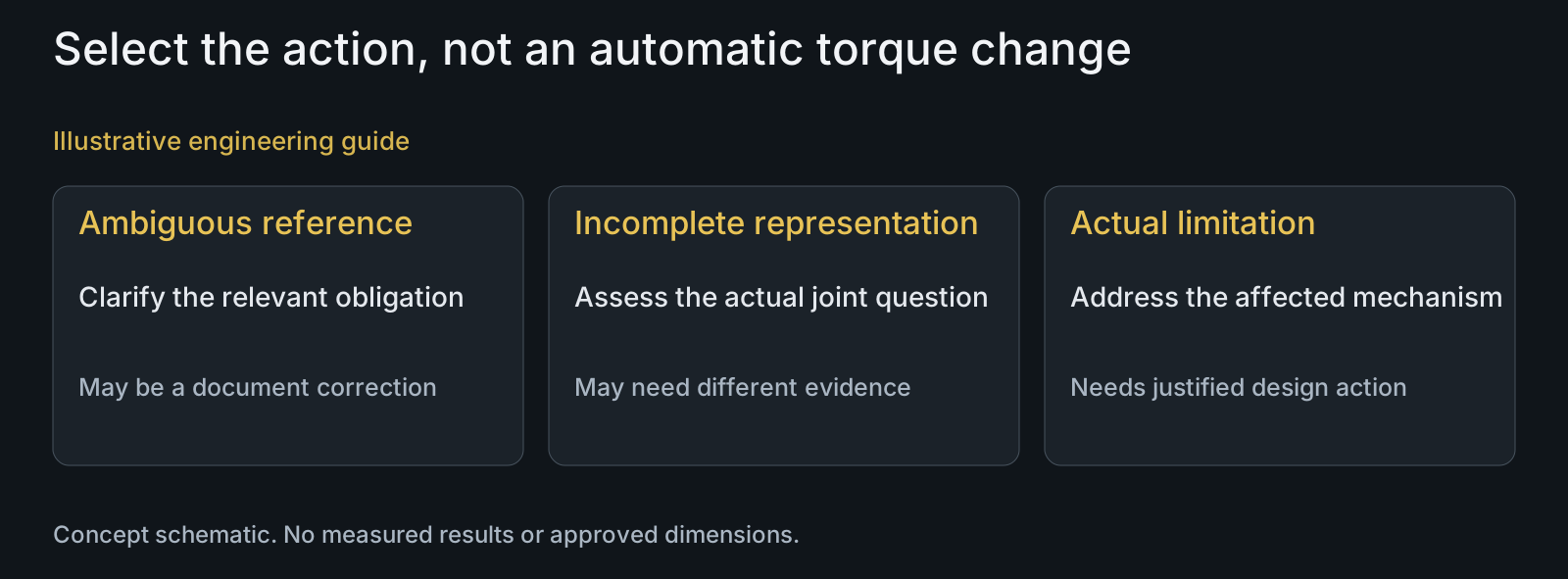
Some reviews lead to a document correction because the requirement was poorly identified. Others reveal a nonrepresentative specimen, missing assessment or actual design limitation. These outcomes need different actions; producing a stronger bolt does not correct a report that tested the wrong receiver.
If a geometry, material, finish or locking change is proposed, identify the evidence affected by that change. Do not assume one successful destructive event validates repeated assembly, useful motion or the bicycle's broader durability. Preserve the distinction between component manufacturing evidence and system release.
PremFixer can discuss the defined manufactured part and coordinated inspection or testing scope through drawing-based manufacturing. No owned standards laboratory, complete bicycle validation service or automatic inclusion of every test in a hardware quotation is implied.
Illustrative review of an ambiguous legacy report
Illustrative engineering example: assume a frame team has an older torque report described only as an ISO test. It concerns a custom pivot assembled with a laboratory receiver, while the current bicycle uses a different receiving interface. No torque result, actual customer or compliance outcome is assumed.
The team first establishes the relevant clause and edition. It then checks whether the reported configuration answers that requirement and whether the new receiver changes the engineering question. The report may remain useful as component evidence without supporting the current assembled-joint conclusion.
The resulting action is a targeted evidence review or representative assessment, not a blanket increase in tightening torque. Send the drawing revisions and existing report through the RFQ-input path, identifying the missing conclusion before requesting a new part or test quotation.
Questions buyers need to confirm
Did the 2023 edition identify a failure-torque change?
Yes, its official foreword identifies an improvement to the minimum-failure-torque clause. That notice does not supply every applicable detail. Compare the complete relevant text and prior project basis before concluding what changed for a particular connection.
Should all suspension pivot tightening values be increased?
No automatic increase follows from the change notice. Identify the relevant joint and clause, then assess actual assembly behavior and evidence. Receiver geometry, contact stack, supplied surfaces and locking method remain necessary inputs to any justified instruction change.
Is a report from an earlier edition automatically unusable?
No. Its usefulness depends on the actual requirement, procedure and represented configuration. Request the method, specimen and endpoint details. It may support an unchanged question while leaving a revised requirement or new receiving interface unresolved.
Does a bolt's high breaking torque prove joint conformity?
No. An isolated bolt may have been supported by a receiver unlike the bicycle's actual interface. Identify what failed, which configuration was assessed and what the applicable requirement demands. A high terminal reading cannot replace that interpretation.
Can a supplier claim compliance without sharing the relevant assessment?
The claim cannot be evaluated on that basis alone. Request evidence connecting the applicable requirement to identified hardware and an accepted conclusion. A standards number, generic assurance or manufacturing certificate does not identify the needed assembled-joint assessment.
What information helps decide whether another test is needed?
Send the applicable edition and requirement, bicycle application, bolt and receiver drawings, supplied surface and locking conditions, and the existing report. Identify the configuration differences and decision still unresolved. This can reveal a documentation gap, a missing assessment or a design question without assuming they are equivalent.
Technical references and scope
ISO 4210-2:2023 official public foreword and scope. Confirms revision of the minimum-failure-torque clause and informative application coverage; complete normative clause not available in this official public view.
Explore related component, material and sourcing decisions in the customer decision knowledge center. For a drawing review, use the Drawing/BOM RFQ path.
Review the requirement before changing a pivot specification
Send the referenced edition, relevant requirement, bolt and receiver drawings, BOM, finish and locking condition, and any available report. PremFixer can discuss the part manufacturing and coordinated evidence scope. Specify the project authority that will assess the bicycle-level conclusion; do not treat the quotation as a compliance release.
Discuss the drawing and BOM