
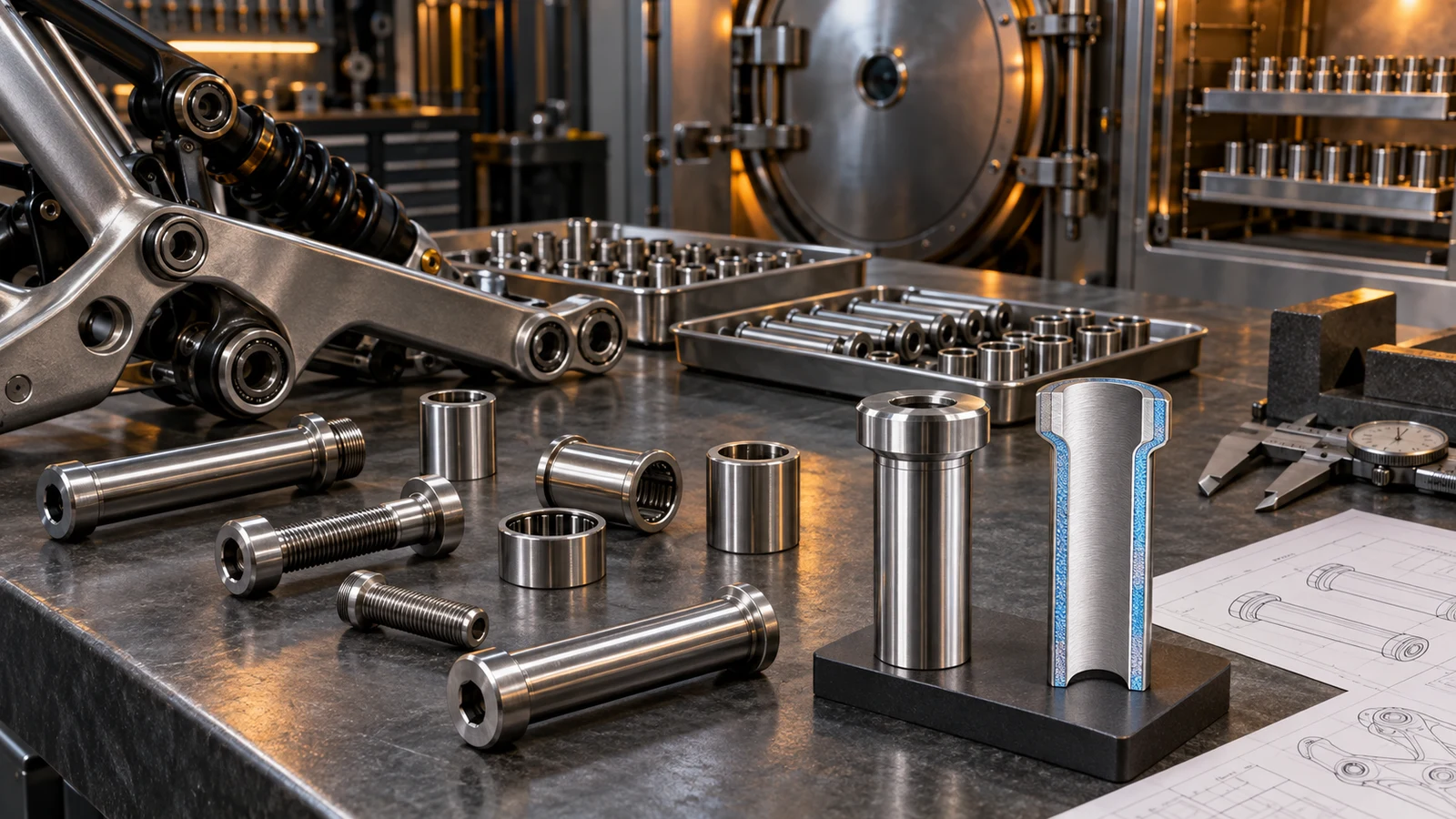
Stainless pivot parts can be candidates for low-temperature nitriding, but the treatment name does not guarantee hardness, wear behavior and corrosion resistance together. An OEM considering a harder axle or spacer surface needs to identify the stainless grade and condition, the actual diffusion route and the contact that needs improvement. The direct answer is to assess the modified surface and its delivered interface separately from the component's bulk strength. A temperature label or isolated hardness number cannot settle those decisions. Relevant evidence must describe the treated state, including any later finishing, rather than an unrelated alloy or demonstration coupon.
Hero: concept illustration of example hardware and its application. It is not a factory photograph, tested component or approved production geometry.
A diffusion region is different from an added coating
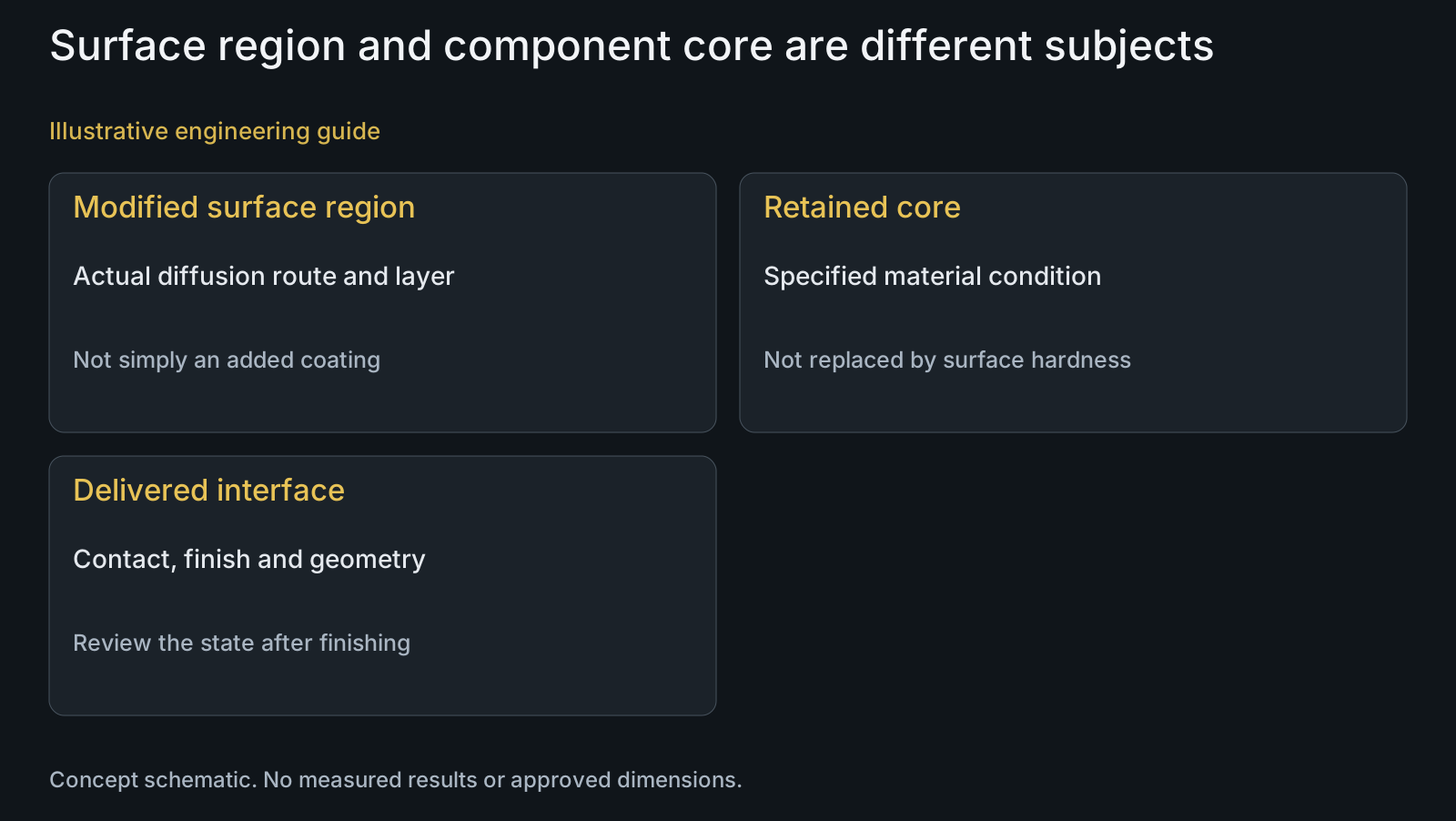
For suitable austenitic stainless routes, nitrogen can enter the near-surface structure and form nitrogen-expanded austenite. That description identifies a modified region in the substrate, not a film simply deposited on top. The proposed process and alloy condition must support the description; not every treatment called nitriding produces the same structure.
A 2021 study of active-screen treatment on AISI 316L examined nitriding and nitrocarburising under specified conditions. It assessed phase composition, hardness, roughness and electrochemical corrosion behavior. Those distinct assessments are useful context for a review, not a production recipe or approval of a bicycle axle.
Ask what the proposed process is intended to create and how its relevant layer characteristics are established. A coating adhesion report answers a different question from evidence for a diffusion-modified region. Neither should be substituted for the other's mechanism merely because both are marketed as surface hardening.
The stainless condition belongs in the process proposal
Specify the grade and delivered material condition, including relevant prior thermal and manufacturing history. Austenitic, martensitic and precipitation-hardening stainless materials are not one interchangeable substrate. A supplier's capability statement needs to identify the actual family and condition represented by its proposal.
Bodycote's S3P description distinguishes alloy-specific low-temperature carbon and/or nitrogen diffusion routes. It also identifies prior heat treatment and machining as relevant inputs. Its proprietary service information does not mean every route is nitriding or that PremFixer owns or routinely supplies that process.
Use the custom-fastener heat-treatment guide to distinguish surface modification from the base material's required strength condition. Do not change a tensile or core requirement into a surface-hardness requirement simply because the new surface is harder. The drawing still needs to describe the component that carries load.
| Decision | Relevant subject | Risk of shortcut | Useful evidence |
|---|---|---|---|
| Select a process | Actual alloy and prior condition | All stainless families treated alike | Identified substrate and specialist route |
| Describe the hard region | Diffusion-modified substrate | Generic coating mechanism assumed | Relevant layer and phase characterization |
| Specify hardness | Location, method and depth context | Maximum value called core strength | Defined hardness assessment and material condition |
| Evaluate the contact | Mating pair, motion and lubrication | Hardness called friction or wear approval | Representative contact assessment |
| Evaluate corrosion | Final surface and exposure endpoint | Coupon result called joint service life | Relevant corrosion method and specimen state |
| Accept the finished seat | Retained region and delivered geometry | Post-treatment cutting ignored | Final-fit and retained-surface review |
Temperature alone cannot define the delivered layer
A low-temperature designation is a useful process distinction, but not a complete specification. Identify the route, substrate preparation and intended modified region with the specialist provider. A proposed process window must be relevant to that material rather than copied from another alloy or a short topic summary.
Keep the desired layer description and the required property evidence connected. Ask whether reported hardness represents the surface region, a depth profile or the core, and identify the test method and location. A maximum value without that context cannot explain how much of the actual contact is represented.
Do not adopt a generic cutoff temperature as proof that every harmful phase is absent or that all corrosion behavior is preserved. The cited 316L experiment used a particular treatment and assessment; it does not turn its conditions into a universal rule for every threaded or locating component.
Contact performance and corrosion need their own evidence
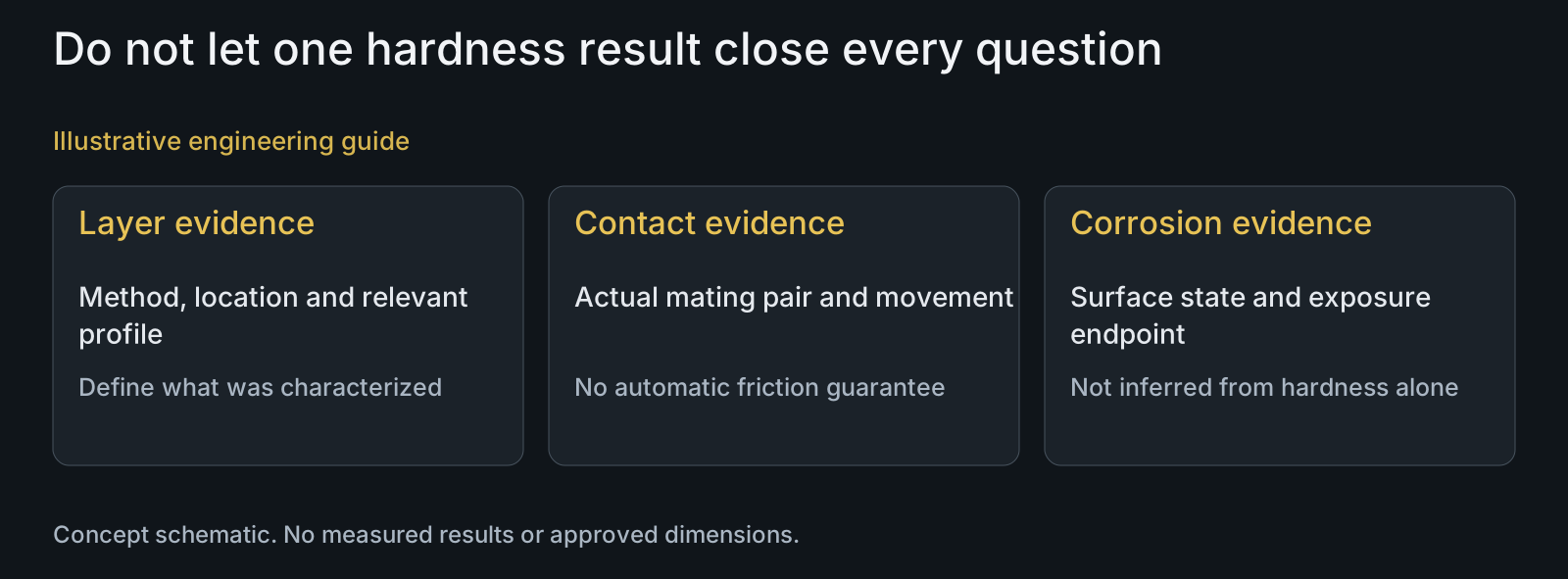
Identify whether the problem is sliding wear, adhesive damage during assembly or another contact mechanism. The mating material, motion, lubrication and relevant loading determine what a useful comparison should represent. A harder surface alone does not establish the friction behavior of a complete threaded joint.
Corrosion evidence needs its own exposure, specimen condition and assessment endpoint. Electrochemical evidence from the cited research concerns its prepared 316L specimens and method; it is not automatically a salt-spray qualification, outdoor service-life result or test of a finished bicycle joint.
Likewise, ordinary stainless passivation verification should not be relabeled as proof of a hardened contact's wear behavior. Keep the passive-surface question, modified-region evidence and relevant contact outcome distinct enough that the purchaser can see what remains unresolved.
Final machining can change the region being purchased
Map the working seat, sliding region, threads and protected surfaces. Ask which areas the selected route will treat and whether selective protection is feasible. Do not assume that every diffusion process reaches or excludes all features in the same way, or that a generic whole-part description defines your drawing boundaries.
If grinding, polishing or machining follows treatment, define the final surface that remains. Removing material from the treated region changes what is available at the interface; the effect needs a review of the actual layer and finishing route. Do not call an earlier layer assessment proof of an altered delivered surface.
Assess final geometry and texture at the relevant features, including any permitted finishing. A specialist's low-distortion claim is not permission to omit the customer's delivered-fit requirement. The surface-treatment scope provides a route for discussing those interfaces without prescribing one universal dimensional allowance.
A bearing-seat correction is not independent of the layer
Illustrative engineering example: assume a purchaser considers diffusion hardening for the sliding region of a 316L pivot axle. A machining proposal also leaves the nearby locating seat for correction after treatment. The proposal reports surface hardness but does not identify the region retained after that correction.
The review asks whether the final finishing removes or changes the region whose properties are being relied on, and whether the sliding region and locating seat need the same treatment boundary. It then distinguishes final geometry from layer characterization and the relevant contact and corrosion questions. Neither hardness nor nominal treatment temperature closes the whole review.
No successful treatment, dimensional result or wear improvement is claimed. PremFixer can discuss the manufacturing proposal from drawing, STEP, sample and BOM, including whether specialist treatment can be supported. The supplied material and surface requirements remain explicit rather than replaced by a broad low-temperature label.
Questions buyers need to confirm
Can austenitic stainless steel be surface hardened by low-temperature nitriding?
Suitable routes can produce a nitrogen-expanded surface region, as demonstrated in defined 316L research. Identify the grade, condition and actual specialist process. That evidence does not qualify every stainless component or establish routine availability for your order.
Is the hardened region an external coating?
Not in the same sense as an added film when the proposed route is diffusion hardening. Establish the actual modified structure and region rather than use coating terminology indiscriminately. Its surface-specific properties still do not replace the required core condition.
Does a low treatment temperature guarantee corrosion resistance?
No process label alone establishes the result. Identify the alloy condition, actual route, delivered surface and relevant corrosion assessment. Do not turn the conditions of one study into a universal temperature threshold or service guarantee.
Can final grinding after treatment be ignored?
No. Determine what treated region remains at the finished interface and whether the evidence represents it. State the permitted finishing, final geometry and relevant surface requirements so machining is not silently separated from the hardening decision.
Does high surface hardness prove the complete bolt is stronger?
No. Keep surface characterization separate from core material and structural requirements. Identify hardness method and location, then retain the drawing's relevant strength condition and component verification rather than substitute a surface maximum.
What should a low-temperature nitriding RFQ include?
Provide drawing, STEP or sample and BOM, stainless grade and condition, prior heat treatment, target contact and mating material, lubrication and movement, treatment boundaries and subsequent finishing. Include required layer, final-fit and corrosion evidence separately, with quantities and project stage.
Technical references and scope
Borowski, 2021: active-screen nitriding and nitrocarburising of AISI 316L. Original research context for defined expanded-austenite layers and separate characterization/corrosion methods; no experimental recipe or quantitative benefit transferred to pivots.
Bodycote: Specialty Stainless Steel Processes. Commercial diffusion-route identity and substrate/history context only; proprietary availability, hardness, dimensional guarantees and certifications not attributed to PremFixer.
Explore related component, material and sourcing decisions in the customer decision knowledge center. For a drawing review, use the Drawing/BOM RFQ path.
Review the hardened region in the final stainless interface
Submit drawing, STEP or sample and BOM with stainless condition, target contact, protected zones, final machining and required delivered fit. The review will connect the proposed specialist diffusion route to the retained surface region, while keeping core strength, contact performance and corrosion evidence distinct.
Discuss the drawing and BOM