

A blue-indication free-iron check and a report labeled salt spray do not automatically answer the same question about a stainless pivot bolt. First specify whether the requirement is contamination detection, qualitative passivation verification or a separate corrosion exposure assessment. Salt spray itself can be a qualitative verification alternative in ASTM A967; it is not always a long-term performance test. For a recessed receiver or shoulder bolt, identify the exact method, material condition, tested surfaces and acceptance rule. A result without that definition is difficult to use. Neither a quick indication nor an unqualified hour count can approve every surface or predict years of service.
Hero: concept illustration of example hardware and its application. It is not a factory photograph, tested component or approved production geometry.
Define the laboratory question before naming the test
Write the decision the result must support. Detecting contaminant iron, verifying the ordered passivation treatment and comparing corrosion behavior are related but distinct purposes. A request for 'prove passivation' can leave the laboratory choosing a method for a different purpose than purchasing intended.
ASTM A967/A967M-25's public scope identifies qualitative verification alternatives, including water immersion, humidity, salt spray, copper sulfate and potassium ferricyanide-nitric acid practices. These are not a mandatory invitation to order every method on every pivot.
State the selected practice, applicable edition and agreed acceptance basis. The passivation evidence guide addresses claims about corrosion improvement. Here the task is to select and identify an appropriate check before interpreting its result.
A blue indication needs an identified method and surface
The Nickel Institute's pickling and passivation guide describes a sensitive ferroxyl indication for free iron or iron-oxide contamination. This provides context for the term blue-point check, not permission to treat any blue stain as a valid standardized result.
Identify the actual laboratory method, applicable substrate and tested condition. A casual trade description does not establish which preparation, reagent system, observation rule or post-test handling was used. Have the laboratory confirm those matters under its applicable instruction; no reagent formulation or chemical handling recipe is provided here.
Treat a local indication as a local observation within the method's scope. Do not interpret color intensity as a calibrated contaminant concentration without supporting measurement evidence, or assume a clean open head represents a sheltered thread root. Identify the surfaces and areas the check actually reached.
| Intended question | Possible evidence category | What to identify | Conclusion to avoid |
|---|---|---|---|
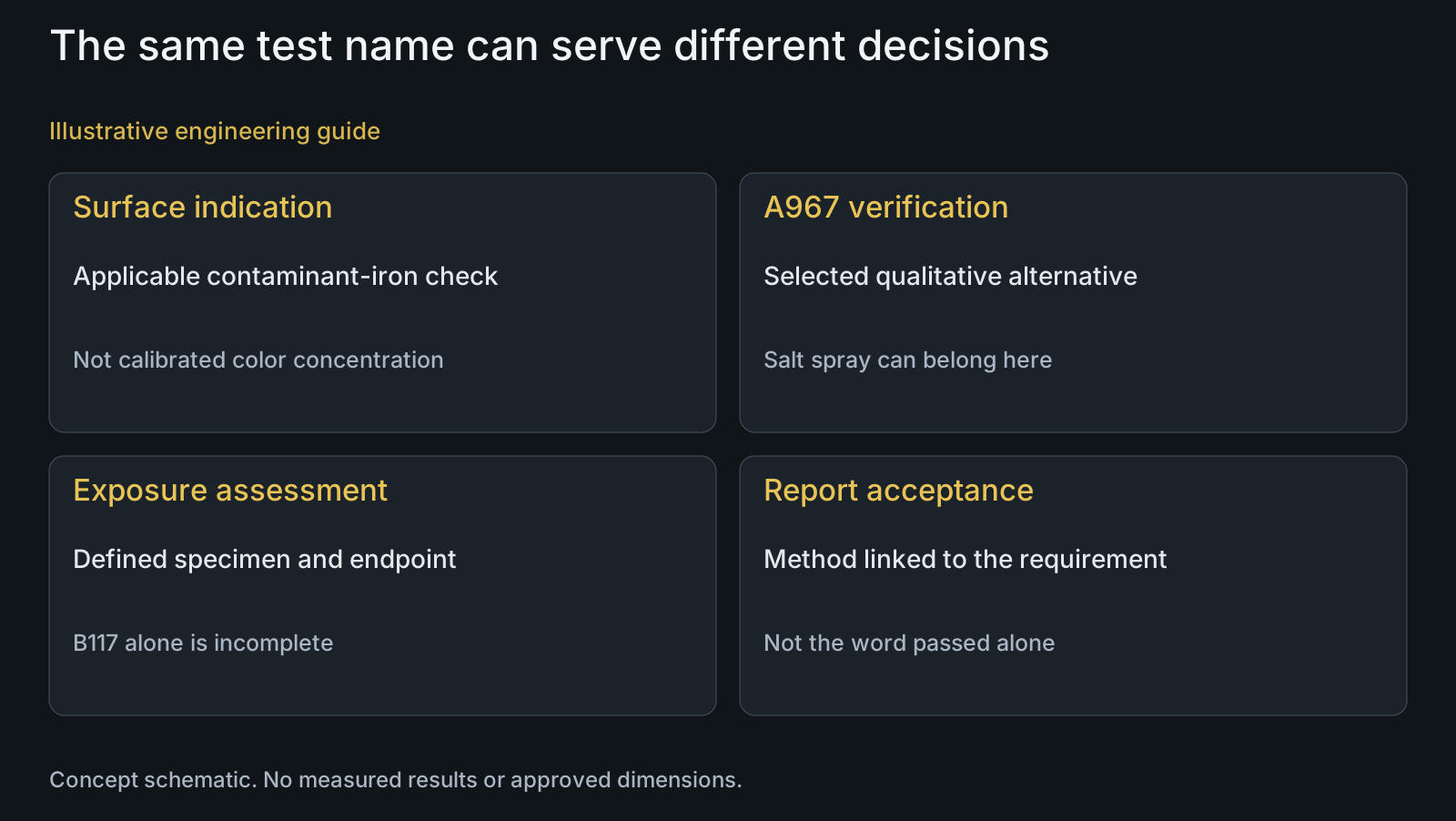
| Is relevant contaminant iron indicated? | Applicable surface-indication method | Actual method, substrate, location and criterion | A blue mark as an unsupported calibrated concentration |
| Does the ordered passivation verification pass? | Selected A967 qualitative practice | Practice identity and specified acceptance | Every alternative test required by default |
| Is salt spray being used qualitatively? | Identified A967 Practice C scope | Method and represented part state | Assumed long-term corrosion-life study |
| How does a configuration respond in an exposure? | Separate defined B117-based assessment | Specimen, duration, baseline and endpoint | Apparatus standard as a complete product criterion |
| Are internal or recessed surfaces represented? | Agreed feature-specific inspection scope | Access, selected locations and preparation | Clean head face used to approve all features |
| Does a vague existing report satisfy the order? | Clarified method and requirement mapping | What was performed and what remains open | Automatic repeat testing without identifying the gap |
Salt spray can have a qualitative verification role
A967's public scope lists Practice C, Salt Spray Test, among its qualitative passivation checks. Consequently, the phrase 'salt spray' alone does not establish that the laboratory performed an extended comparative corrosion program or determined a service-life endpoint.
For that verification role, identify the applicable practice and its required acceptance. Do not substitute a different long exposure and assume that more hours make it the same method. Conversely, do not reject a properly identified qualitative result simply because it is not a product-life study.
As an inspection decision, ask what the report calls a pass and what surfaces it evaluates. The selected requirement and documented method answer that question; a chamber photograph or a statement that the parts were tested does not. Avoid importing criteria from another coating or another stainless grade.
A separate B117 assessment needs a separate definition
ASTM B117-26's public scope describes creation and maintenance of the exposure environment. It does not specify the product specimen, exposure duration or interpretation. Those choices must come from the actual assessment requirement, not from the standard's name.
If the OEM needs a comparison, define the specimen configuration, surface state, baseline and observation criterion. For engineering assessment, an exposed loose receiver and a receiver covered by mating hardware represent different conditions. Specify the intended configuration instead of assuming either tests the other.
The practice cautions about extrapolation to natural environments. Keep the reported observation bounded to the defined assessment. It neither replaces a missing required contamination check nor becomes a riding-life guarantee merely because the duration is longer than a qualitative verification.
Do not let specimen access and preparation disappear
ASTM A380/A380M-25's public overview distinguishes contamination types and notes limits of ordinary visual inspection, including internal access and thin residual films. A bright exterior therefore cannot establish that every relevant surface has the required condition.
For the pivot inspection plan, mark the head, shoulder, bore, thread and any recess that matters to the requirement. Agree whether the check uses finished parts, selected locations or other represented specimens. A coupon can be useful within an agreed scope without being described as inspection of every actual feature.
Also identify any preparation before testing and the handling needed afterward. If a specimen's surface is changed for evaluation, document that represented state rather than silently calling it the untouched delivered condition. The pivot cleanliness guide treats residue and packing requirements separately from passivation test selection.
Resolve a vague report without ordering redundant tests
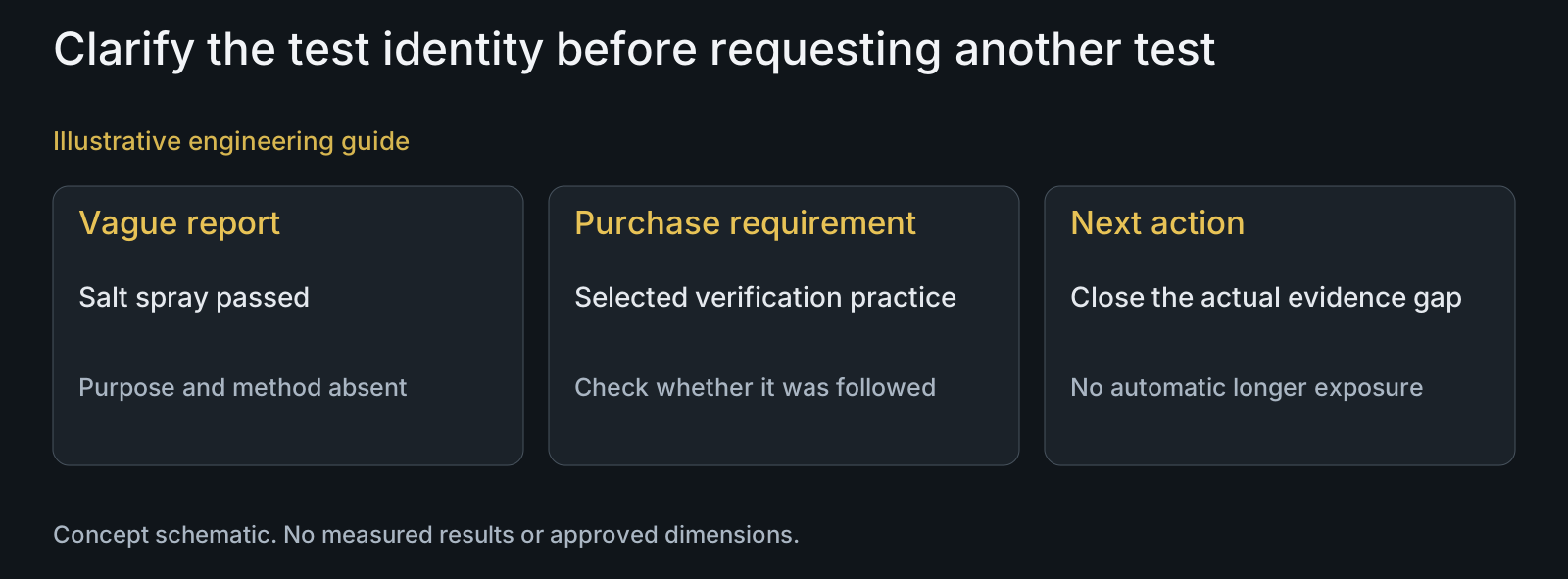
Illustrative engineering example: assume an SQE receives a report reading 'salt spray passed' for stainless receivers. The purchase requirement specifies an agreed passivation-verification practice, but the report does not identify whether it followed that practice or a separate exposure plan.
The first action is clarification of method, specimen state and acceptance, not an automatic additional blue-point check or a longer chamber exposure. If the existing work matches the ordered requirement, its report can be completed appropriately. If it addressed another question, define the still-missing verification.
No passing laboratory result or actual customer dispute is asserted. The example shows how test identity changes the decision. PremFixer can coordinate the agreed partner surface-treatment and inspection scope; laboratory provision and reports require order-specific confirmation, not an assumed in-house chemical facility.
Questions buyers need to confirm
Do free-iron checks and salt-spray reports prove the same thing?
Not by their names. Identify purpose, method and acceptance. Salt spray can be an A967 qualitative verification alternative or part of a separate exposure assessment, with different conclusions.
Is every blue indication a valid passivation-test failure?
Not without the actual method and observation context. Have the responsible laboratory interpret the result for the specified surface and criterion; a photograph or informal description is insufficient.
Should the buyer order every A967 test?
Not by default. Select the applicable practice and acceptance with the responsible parties. Its public scope describes alternatives; extra unrelated testing need not close the intended question.
Does B117 define how many hours a pivot must pass?
No. Its public scope does not prescribe the product specimen, duration or interpretation. Define those in the actual assessment requirement.
Can a head-face check approve recessed receiver threads?
Not automatically. Identify access, tested locations and specimen representation. An open surface does not silently establish the condition of every sheltered feature.
What should the inspection RFQ specify?
Send the grade and surface condition, drawing with relevant features, governing specification and selected method. Define specimen state, acceptance and report expectations; identify any separate comparative corrosion question explicitly.
Technical references and scope
ASTM A967/A967M-25: Public scope. Qualitative alternatives, including Practice C salt spray. No full method, mandatory universal test bundle or chemical recipe asserted.
ASTM A380/A380M-25: Public scope. Contamination categories, inspection and internal-access limitations. No paid procedure reproduced.
ASTM B117-26: Public scope and significance. Exposure practice versus separately defined product assessment and natural-environment limits. No duration or lifetime conversion.
Nickel Institute: Pickling and passivation guide. Ferroxyl free-iron/iron-oxide indication context only; no reagent formulation, concentration calibration or pivot-specific qualification.
Explore related component, material and sourcing decisions in the customer decision knowledge center. For a drawing review, use the Drawing/BOM RFQ path.
Select an inspection that answers the required surface question
Send the drawing, stainless grade, finishing route and marked surfaces requiring verification. Include the applicable specification, selected practice, specimen and report expectations, and any separate exposure objective. PremFixer will review the partner inspection scope without treating all test names or all passing reports as interchangeable.
Discuss the drawing and BOM