
Several bicycle platforms can share pivot hardware when their complete interfaces and requirements support the same part. An OEM considering SKU reduction should first separate common physical components from a family that only shares thread, head or manufacturing features. Shoulder span, receiver engagement, bearing and spacer contacts, tool access and service scope can still differ between models. Changing only overall length does not resolve every difference, and length variants remain distinct supplied items when their definitions differ. Standardize the genuinely common features, then map each finished component and kit to its evaluated platform scope instead of treating one supplier or one CAD family as compatibility evidence.
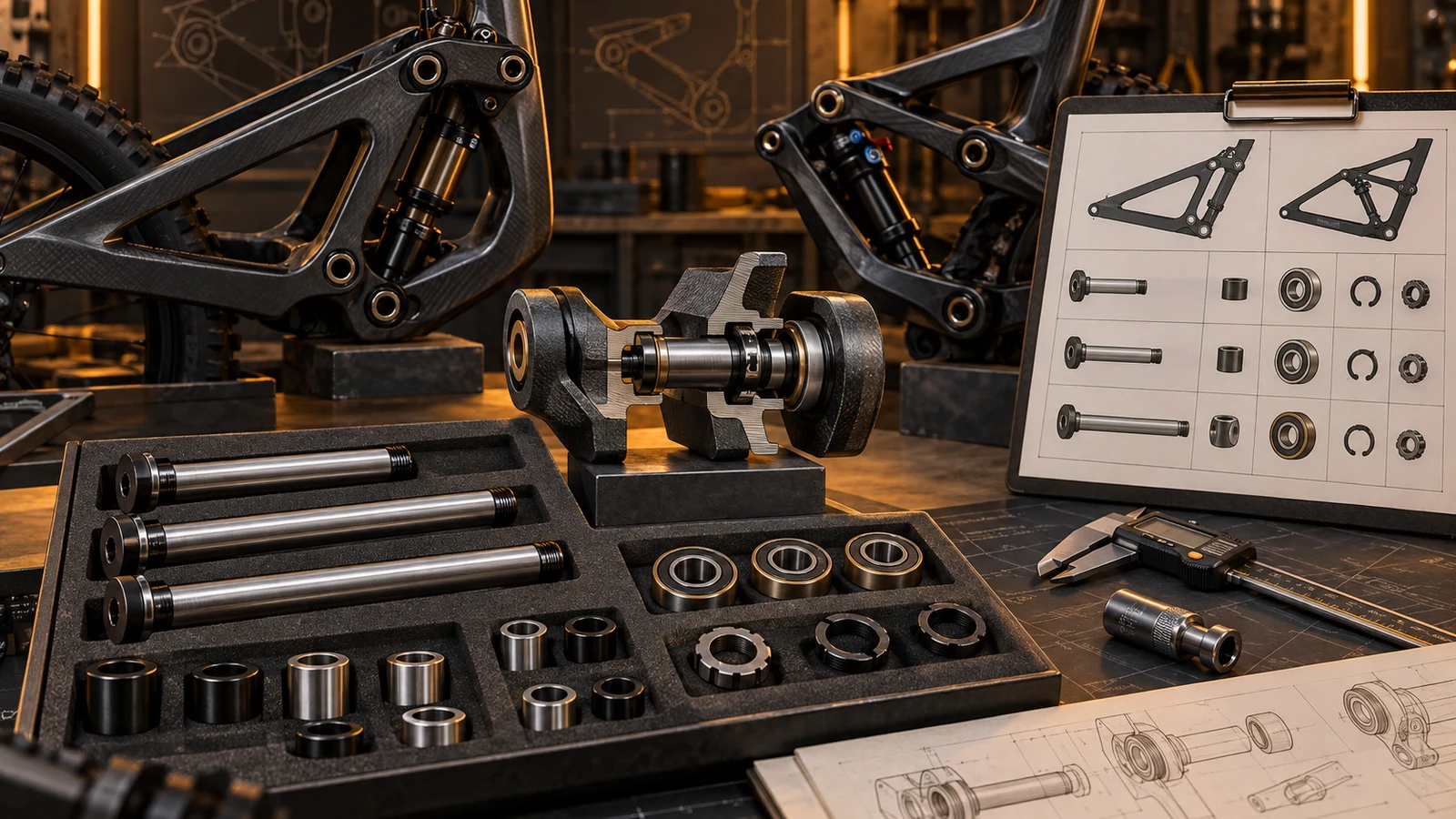
Hero: concept illustration of example hardware and its application. It is not a factory photograph, tested component or approved production geometry.
Choose which kind of commonality you want
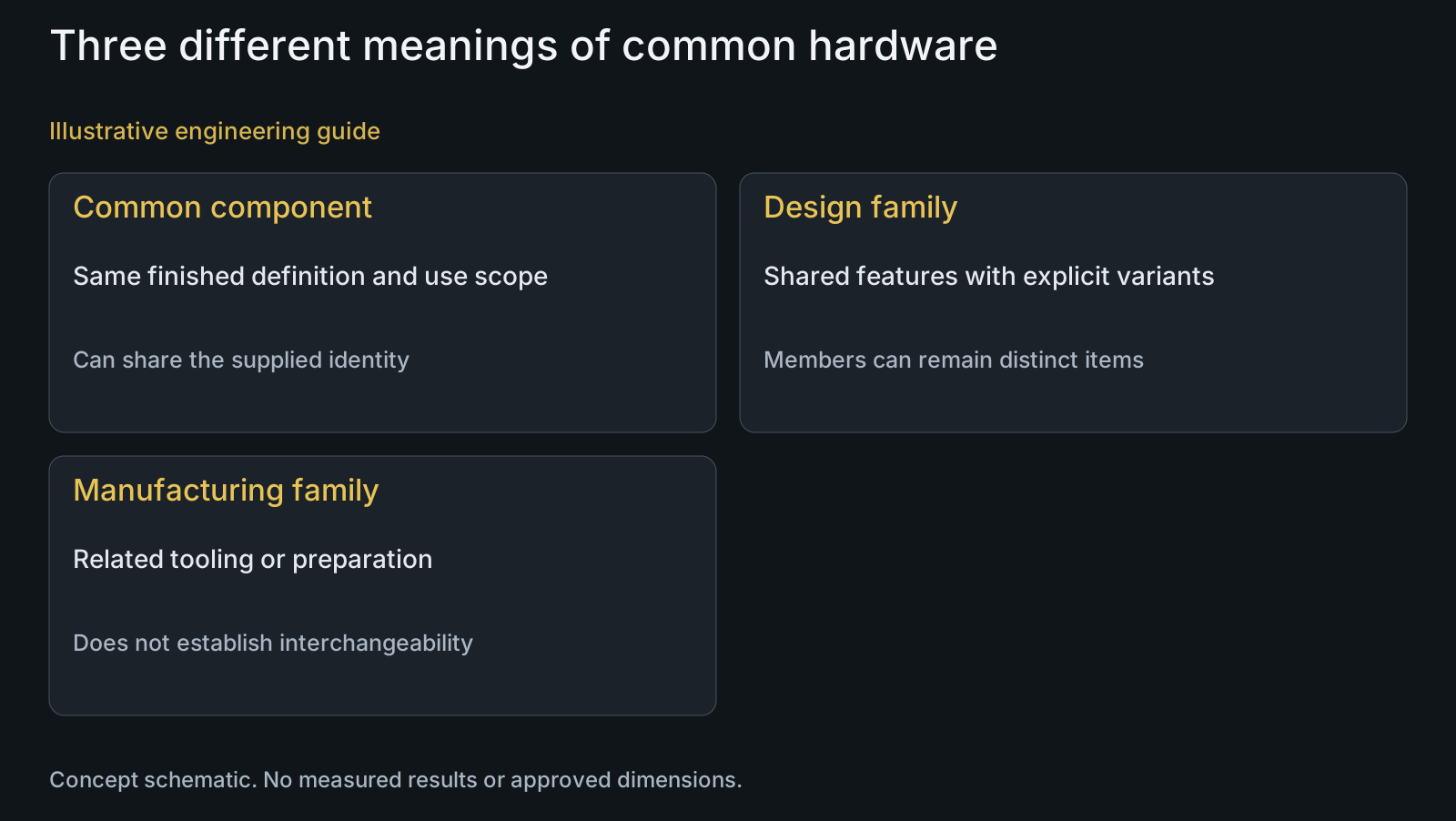
A common physical part has one controlled finished definition and an established use across the represented applications. A design family instead shares selected features while retaining defined variants. Common tooling or a similar route is a third relationship: it can simplify manufacture without combining the delivered items.
Make the project objective explicit. Reducing drawing maintenance, setup variety, purchasing lines and service-kit selection are different tasks. A proposal that helps one may add complexity to another. Do not call every shared feature a removed SKU before the physical definitions have been compared.
The revision-compatibility guide addresses changes and inventory cut-in. Here the decision comes earlier: which platform requirements should be common, and which should intentionally remain separate within the proposed family?
Compare the functional envelope, not only thread and head
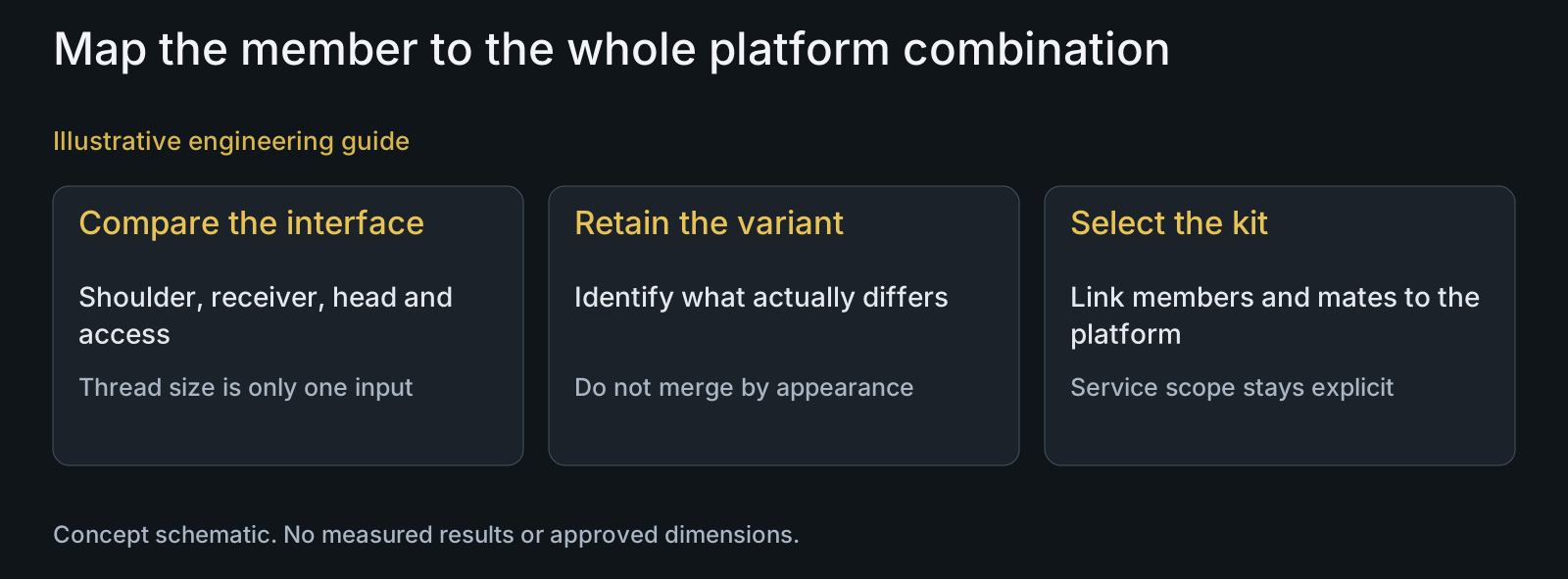
Map the shoulder's working span and contacts, thread receiver, head seating, spacer relationship and available tool space for each platform. Add the material condition, finish and assembly requirements where they differ. Two drawings with matching thread size can describe different clamped or rotating interfaces.
Review the assembled condition through the pivot fit definition. A shared outside diameter does not establish the same seating or clearance basis. If a variant changes where a shoulder ends, its transition and usable thread must still serve the intended mates.
As an engineering assessment, forcing a common component can shift complexity into spacers, receivers or assembly instructions. Compare the whole proposed kit rather than celebrate a simplified bolt drawing while overlooking additional mating-item variants. No universal spacer strategy is recommended.
| Commonality option | Useful condition | Risk or tradeoff | Review basis |
|---|---|---|---|
| Common finished component | Same complete requirements and applicable uses | An unreviewed platform inherits the part | Interface and application mapping |
| Shared head and thread family | Some features are stable across variants | Different spans disappear under one name | Common features plus member definitions |
| Shared manufacturing preparation | Routes or tooling can be coordinated | Cost commonality called interchangeability | Actual process and quantity mix |
| Common axle with variant mates | Assembly design supports that relationship | Complexity shifts into spacer kits | Complete combination and stack review |
| Common complete service kit | Represented models use the same contents | Kit approval treated as mixed-part approval | Model/version and constituent scope |
| Separate platform hardware | Functional differences justify distinct parts | Avoidable duplication retained | Compare benefits with redesign risk |
Use a family definition without losing variant requirements
List the common features explicitly and put each variable feature against an identifiable finished member. State whether overall length, shoulder length, thread reach, material condition or another attribute varies. Do not let the phrase length variant hide several independent dimensional changes.
PTC's family-table documentation separates a generic definition from named instances and their varying attributes. It also describes how changes to common features propagate across members. This is a useful representation example, not a requirement to use Creo or evidence that CAD interchangeability means acceptable physical service substitution.
Review a common-feature edit against all affected variants. A head change made for better access on one frame may affect another frame's seating envelope. The family's efficiency depends on keeping shared and instance-specific requirements deliberate, not on making every field common.
Keep platform and service selection unambiguous
Map each supplied member and complete kit to model, version and relevant assembly configuration. Record the established scope rather than infer it from visually similar frames. If applicability is unresolved, retain that uncertainty instead of merging purchasing identities prematurely.
Distinguish complete-kit substitution from individual-component substitution. A platform may use a shared axle with a different spacer set, or require a separate axle while sharing locking items. Approval of the whole combination does not automatically authorize selecting individual parts across the family.
Use a physical identification and package-labeling definition appropriate to the risk of mixing similar variants. Color alone should not carry the entire identity if finish can vary. Service instructions need the same selection relationship as the production BOM.
Compare family economics using the actual delivered mix
Provide quantities by variant and kit, not only an aggregate family volume. Ask which preparation, tooling and inspection features can genuinely be shared through manufacturing review. A common setup opportunity is not a promise of a particular unit-price reduction.
Include costs moved elsewhere in the proposal: additional spacers, differentiated inspection, separated packing and obsolete identities where relevant. Reducing the number of bolt definitions while multiplying kit combinations may not meet the buyer's original simplification goal.
State how prototype coverage relates to the family. A sample of one variant can answer its manufacturing question, but it does not establish every other member's interfaces or application scope. Review representative common features and variant-specific questions separately through prototype planning.
Review example: a shared head with different working spans
Illustrative engineering example: assume two platforms use the same nominal thread and head, but their bearing-and-spacer stacks require different shoulder spans. The buyer proposes one purchasing line to simplify ordering. No dimensions, quantities or compatibility results are assumed.
The reviewer compares the complete interfaces and identifies the span as a real variant requirement. A common design family may still be appropriate, with shared features and separately defined members. The order identifies which finished variant belongs to each kit rather than leaving selection to the supplier's visual judgment.
The resulting decision can reduce repeated design work without claiming one interchangeable part. If a later redesign can support a common finished component, that becomes a separate engineering proposal with its affected mates and application evidence, not a purchasing-name change.
Questions buyers need to confirm
Can different bicycle models share one pivot bolt?
Yes, when their complete requirements and evaluated applications support that part. Compare shoulder contacts, stack, receiver, seating, access and relevant material or assembly requirements. Matching thread and head alone cannot establish the shared use.
Does a length family reduce the number of physical SKUs?
Not necessarily. It can reduce repeated design or manufacturing work while retaining distinct finished lengths and identities. Count actual supplied definitions and kit combinations rather than treating every common feature as a removed purchasing item.
Can one CAD family prove service compatibility?
No. A family representation describes shared and varying attributes; it is not application approval. Map each physical member and complete combination to its platform scope, including relevant versions and mates.
Can extra spacers make one axle universal?
Only if the complete proposed combinations are engineered and evaluated for that scope. Spacer changes affect stack and contact relationships and can add kit complexity. They are not a default remedy for every shoulder or receiver difference.
Does using the same manufacturer make variants interchangeable?
No. Manufacturing origin does not establish common requirements or application scope. Two conforming parts made by one supplier can still serve different platforms, and shared tooling does not authorize substitution.
What should a modular hardware RFQ include?
Send platform assembly drawings, part and STEP definitions, mate references, common-versus-variable features and quantities by member and kit. Include the applicability map and prototype questions so the quote addresses the actual delivered mix.
Technical references and scope
PTC family-table structure. Software-specific generic, named-member and variable-attribute representation; not physical bicycle compatibility approval.
PTC modification of family tables. Common changes and table-driven instance changes within the documented CAD system; no claim that PremFixer uses this software.
Explore related component, material and sourcing decisions in the customer decision knowledge center. For a drawing review, use the Drawing/BOM RFQ path.
Review the common features and necessary variants
Submit platform drawings and STEP, bearing and spacer interfaces, proposed family definitions, kit BOMs and quantities through the Drawing/BOM RFQ path. PremFixer can review shared manufacturing opportunities and variant definition while your team controls platform compatibility.
Discuss the drawing and BOM