
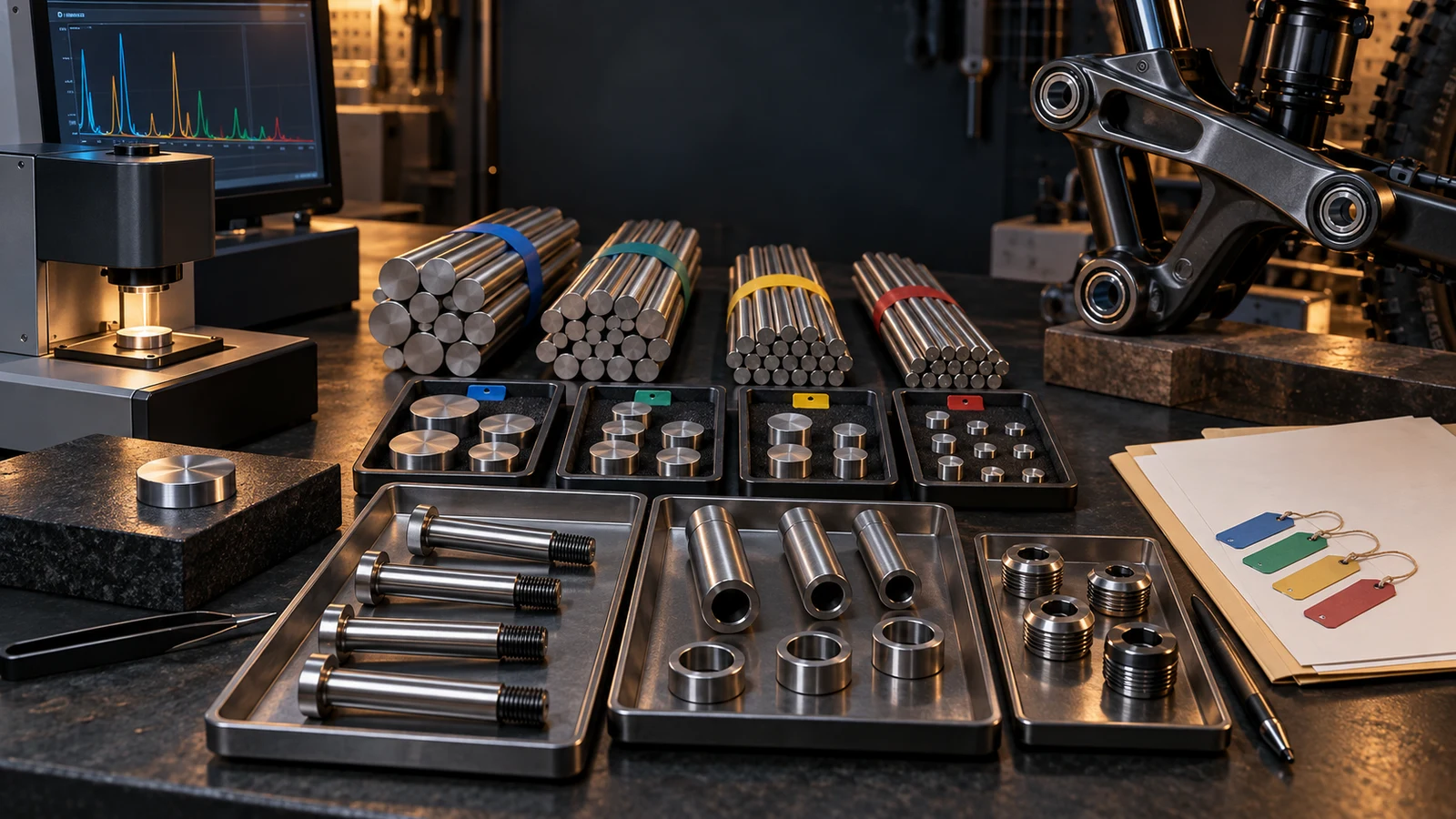
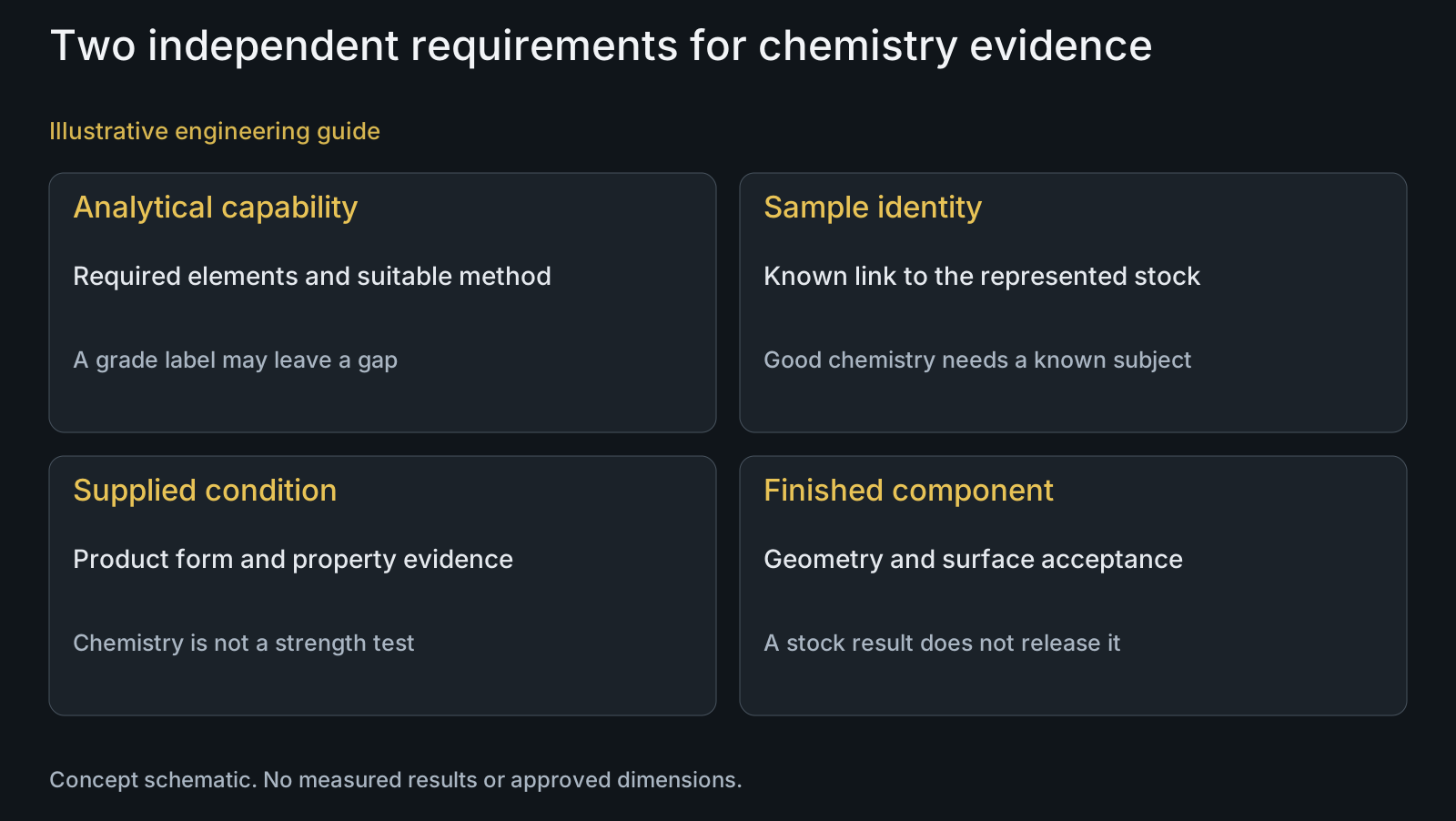
To verify stainless stock for a custom pivot bolt, compare the specified material chemistry with a suitable analysis of an identified sample. Optical emission spectrometry, or OES, can address elemental questions when its method, calibration and sample preparation suit the material. It does not alone establish the supplied condition, finished-bolt strength or identity of every piece in a shipment. For an OEM deciding whether stock is acceptable for machining, define the material specification, required elements and sampling scope first. Then connect the tested sample to its stock identity and retain that connection when bars are cut, moved or converted into parts.
Hero: concept illustration of example hardware and its application. It is not a factory photograph, tested component or approved production geometry.
Grade screening is not the same as specification acceptance
A displayed grade match is a useful screening result, but purchasing needs the material specification and edition, product form, condition and any additional requirements. The comparison must concern the required element limits, not merely a familiar alloy name. A database label should not hide an unmeasured element or replace review of the actual chemistry report.
For 304-versus-316 questions, composition is relevant, but the application decision is broader. Use the wet and coastal pivot-material guide to assess the service requirement. Chemical identification asks whether the sampled material matches the specified chemistry; it does not decide whether that specification is appropriate for the bicycle environment.
Choose a method that resolves the disputed element
The required distinction determines the analysis. A method that establishes certain alloying elements may leave a low-carbon designation unresolved. Hitachi High-Tech's stainless identification application note describes a prepared certified stainless reference sample and a configured portable OES method, including carbon analysis relevant to L-grade identification. It is a documented instrument example, not a PremFixer test record or a guarantee for any instrument configuration.
Hitachi's PMI application guidance distinguishes XRF and OES choices and asks whether carbon analysis and a test mark are acceptable. For a buyer, the useful question is which required elements the proposed method measures reliably in the actual matrix. Ask for that capability and its applicable range instead of assuming all positive material identification reports have the same coverage.
| Buyer question | Relevant evidence | Remaining risk | Acceptance review |
|---|---|---|---|
| Does the sample match the chemistry callout? | Suitable analysis and element results | Unmeasured or out-of-scope elements | Compare required limits and method coverage |
| Is an L-grade claim resolved? | Appropriate carbon measurement | A grade label without carbon evidence | Confirm required designation and analytical capability |
| Does the result represent this bundle? | Sample-to-stock identity | Unlabelled or mixed stock | Identify the represented population |
| Is the supplied condition correct? | Applicable condition and property evidence | Chemistry accepted as proof of strength | Review product-form and condition requirements |
| Can the finished part be tested directly? | Applicable specimen method and location | Unsuitable geometry or damaged interface | Confirm preparation and deliverable status |
| Does a stock result release the pivot? | Separate finished-part acceptance | Geometry or surface requirements omitted | Keep stock and component decisions distinct |
Sample geometry can determine whether a method is applicable
ASTM E1086-22 describes spark atomic emission analysis of austenitic stainless steel. Its public scope includes specified element ranges, suitable sample geometry and mass, and reference-material considerations. A small curved pivot shoulder is therefore not automatically an appropriate specimen for a method intended for suitably prepared samples. The laboratory must confirm applicability rather than copy a standard number onto an unsuitable test.
If analysis requires preparation or leaves a mark, agree where the sample comes from and whether it can remain a deliverable part. Avoid preparing a bearing seat, seal contact or stressed transition without design approval. A bar sample or reserved coupon may be more practical, provided its relationship to the stock being assessed is clear. Changing the specimen also changes what the result can legitimately represent.
A disputed result should trigger review of specimen identity, surface condition, preparation and analytical scope before a conclusion about substitution. If the selected method cannot resolve the required question, request an appropriate laboratory analysis rather than repeatedly testing under unsuitable conditions.
Connect the sample to stock without expanding its coverage
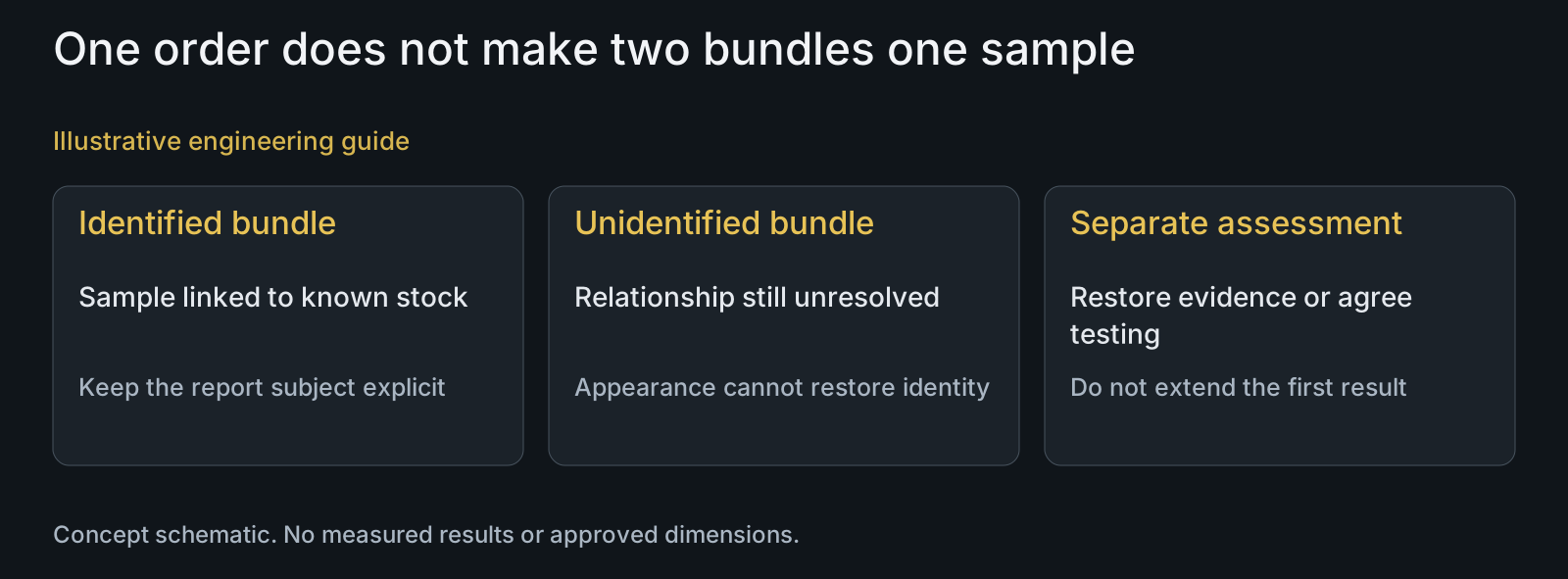
The report should identify the submitted sample, analysis method, reported elements and comparison specification. Separately establish which heat, bar bundle or other defined stock population that sample represents. One clean sample result cannot identify an unlabelled remainder by proximity. Nor does a supplier's certificate become a test of every finished bolt merely because both documents are attached to the same purchase order.
Decide whether the risk is wrong supplied stock, mixed bars during storage or lost identity during cutting. These require different controls. For a suspected mix-up, a sample from one known bundle does not settle the identity of another bundle. Retain separate stock identities until there is evidence supporting the intended relationship; do not merge them for administrative convenience.
A correct chemistry result can still leave the order unresolved
Illustrative engineering example: assume an OEM specifies stainless bar stock for a pivot axle and receives two bar bundles under one order. One identified sample is analyzed against the specified chemistry; the second bundle has lost its stock label. No test values or pass result are assumed. Even if the first sample is acceptable, the team cannot assign its identity to the second bundle solely because the bars look alike.
The decision is to restore evidence for the second bundle or assess it under an agreed method and scope. Meanwhile, keep it distinct from the identified material. If the supplied condition is also uncertain, chemistry testing does not close that separate question. The result is a bounded material decision, not an invented rejection rate or a claim that inspection has proved every requirement.
For the finished pivot, dimensional and surface acceptance still apply. The CMM feature guide concerns geometry, while the passivation discussion concerns a different surface decision. Neither can be inferred from the chemical identity of the incoming stock.
Agree the material verification scope before machining
Send PremFixer the material callout, product form and condition with the part drawing. Identify whether the concern is grade screening, a particular element, suspected substitution or a required independent analysis. In the materials review, keep proposed alternatives separate from the specified base material. Similar chemistry is not permission to substitute a different purchasing specification.
Confirm the sample population, report fields, laboratory or method requirements and any reserved sample before production consumes the stock. PremFixer's confirmed model includes in-house manufacturing and qualified-partner testing; it does not establish an owned OES laboratory or automatic chemistry testing of every incoming batch. Required verification and delivered documents belong in the agreed project scope.
Questions buyers need to confirm
Is checking chromium, nickel and molybdenum enough?
Only if that evidence resolves the defined question; it does not automatically establish complete specification compliance. List the required elements and limits, then compare them with the method's reported coverage. Unmeasured requirements need other appropriate evidence rather than a broad accepted label.
Can a PMI grade label prove that stock is 304L or 316L?
Not by itself. The low-carbon designation requires suitable evidence for the required carbon limit. Supply the complete material designation and ask whether the configured analysis can resolve that requirement; do not treat different instrument technologies as identical.
Should OES be performed on the finished bearing seat?
Not without confirming the method and approving the sample location. Preparation or a test mark can affect a functional surface. Provide the drawing, available stock or coupon and the intended deliverable condition so the laboratory can propose a suitable specimen without casually damaging the interface.
Does one analyzed bar establish the material of every bar in the order?
Only the agreed and supported sampling relationship can define that scope. Identify heat or stock groups and any mix-up risk. A result from one known bar cannot restore the identity of a different unlabelled bundle merely because both arrived under one purchase order.
Can acceptable chemistry confirm finished-bolt strength?
No. Chemistry, supplied condition and finished-component performance are different requirements. State the material specification, product form, condition and any required property or component tests. Review those separately from the elemental analysis.
Does PremFixer perform OES on every incoming material batch?
That routine is not established by the confirmed company records. Required analysis can be discussed within project testing scope. Specify the method, sample population, report fields and document delivery; do not assume an owned OES system or universal batch-testing policy.
Technical references and scope
ASTM E1086-22, Austenitic stainless analysis by spark atomic emission. Official public scope identifies analytical ranges and specimen considerations. Detailed implementation requires the applicable method and laboratory review.
Hitachi High-Tech, Stainless identification using portable emission analysis. Documented manufacturer application using a prepared certified reference sample; not a PremFixer case or a universal instrument guarantee.
Hitachi High-Tech, PMI inspection applications. Manufacturer method-selection context, including carbon analysis and acceptance of test marks. No equipment ownership or accreditation is attributed to PremFixer.
Explore related component, material and sourcing decisions in the customer decision knowledge center. For a drawing review, use the Drawing/BOM RFQ path.
Define the material question before ordering a chemistry check
Share the pivot drawing, material specification and edition, stock form and condition, quantities and available material documents. Identify the element or identity concern, required sampling scope and whether test marks are acceptable. PremFixer can review manufacturing and verification scope while keeping chemistry, stock identity and finished-part acceptance separate.
Discuss the drawing and BOM