
For a pivot bolt, axle or spacer, useful CAPA connects a defined nonconformity to supported cause analysis, a targeted change and an appropriate effectiveness check. Sorting, replacement or expedited supply may protect the immediate assembly need, but those actions alone do not establish that the cause was addressed. The buyer is deciding whether the supplier's response supports closure of a specific quality issue and a justified scope of repeat supply. Keep unknown causes and untested conditions visible. A completed form, a training signature or one acceptable replacement shipment cannot establish that the relevant problem will never recur across other setups, parts or process partners.
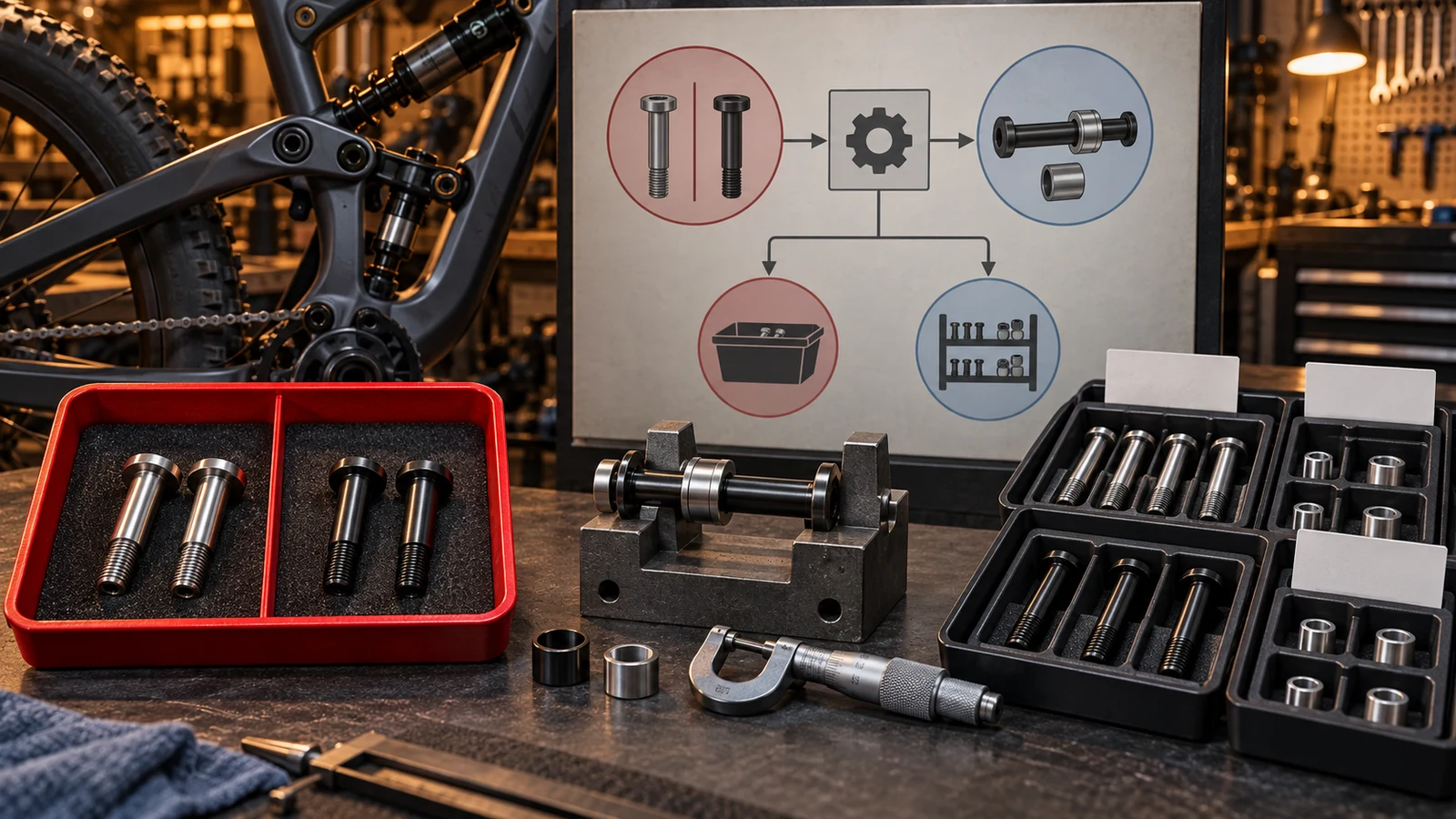
Hero: concept illustration of example hardware and its application. It is not a factory photograph, tested component or approved production geometry.
Describe the requirement and the observed departure
State the affected part and drawing revision, supplied condition, requirement and observed evidence. Distinguish a dimensional departure from an assembly complaint whose cause remains unknown. A report that the pivot feels tight needs further interface and assembly information before it becomes proof of an oversized bolt.
Identify the population currently in question, including material at the supplier, in transit and at the buyer. Temporary segregation or extra evaluation should address that population and the actual risk. Replacement availability and responsibility can be coordinated without pretending the technical investigation is already complete.
The ISO 9001 Auditing Practices Group paper on reviewing nonconformities distinguishes correction, cause analysis and corrective action. It is educational auditing guidance, not a new contractual requirement or proof of a PremFixer case.
Test the cause rather than naming the nearest person
For a wrong shoulder length, consider the drawing used, program or stop definition, setup, measurement method and identification of similar parts. Which observations support each explanation? Which evidence contradicts it? Keep a suspected cause separate from one that has been demonstrated for the affected condition.
Operator error can describe where a mistake appeared without explaining why the process allowed it. Training may be relevant when a knowledge gap is supported. It cannot replace resolving an ambiguous work instruction, an indistinguishable fixture setting or a measurement that does not evaluate the intended feature.
Also ask why the departure was not detected before the relevant handoff. Manufacturing cause and escape path may require different changes. The measurement review helps define what a check can actually detect; an inspection title alone cannot establish that it covered the problem.
| Response presented | What it can establish | What it does not establish | Buyer review |
|---|---|---|---|
| Replacement shipment | Immediate supply recovery | Removal of the cause | Keep issue resolution separate |
| Cause hypothesis | An explanation to investigate | Demonstrated cause by itself | Compare supporting and contrary evidence |
| Training completed | An instruction activity occurred | Ambiguity or fixture error resolved | Connect content to the supported gap |
| Process arrangement changed | Implementation at a named boundary | Effective performance in use | Observe the relevant recurring activity |
| No later complaints | No reports within the stated source | No recurrence under unobserved conditions | Check production and reporting exposure |
| Annual trend improved | A defined indicator changed | Every issue closed or action causal | Review category, units and comparable scope |
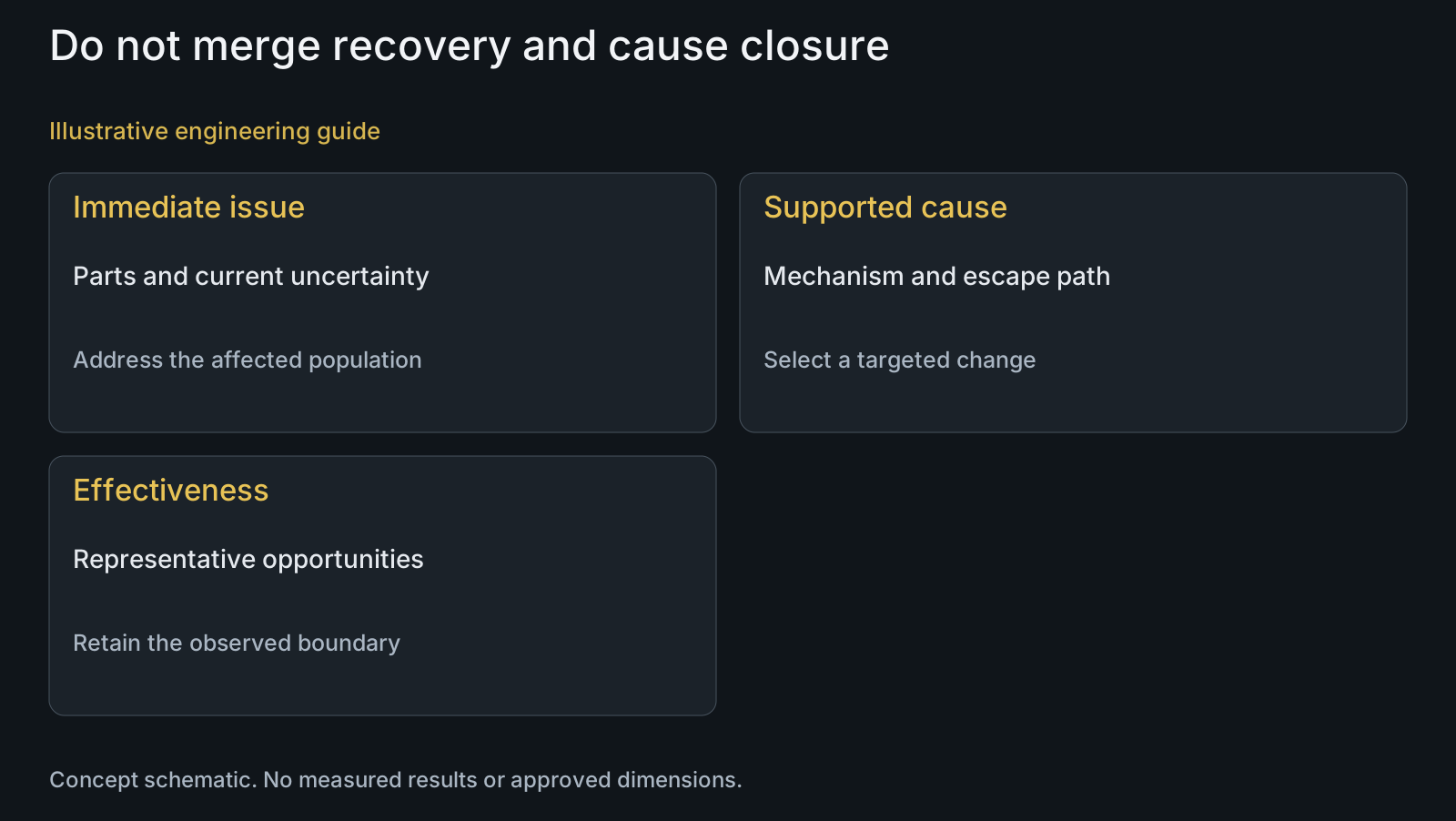
Choose a change that acts on the supported mechanism
Compare candidate actions with the demonstrated cause. If similar spacers were mixed at a shared refill point, clearer retained identity and physical separation address a different mechanism from changing a cutting program. The chosen action should explain why it affects the occurrence or escape path, not simply sound more rigorous.
Define what implementation means in the affected operation. A revised instruction in a folder is different from the current instruction being used at the actual station. A proposed fixture modification is different from a verified and authorized fixture change. Name the physical or informational boundary that changed.
Review collateral consequences. A new locating arrangement can affect another datum relationship; a packing divider can change the unpacking route. Customer design authority still applies to drawing-defined hardware. PremFixer's manufacturing coordination does not authorize an unagreed geometry or finish change.
Plan effectiveness checks before declaring closure
State which future conditions provide a useful opportunity to evaluate the action. If the suspected mechanism occurs during setup or refill, reviewing only uninterrupted production misses the relevant exposure. Observe the changed activity as well as the resulting parts under the agreed method.
Separate implementation evidence from effectiveness evidence. A divider installed or instruction issued shows that an action exists. A targeted review during representative handling and examination of the relevant output can address whether it works. Specify the observation scope and decision criteria without inventing a universal batch count or closure deadline.
A period with no complaint may contain no repeat production of the affected part. It may also reflect a different customer reporting route. Explain actual opportunities for recurrence and what was examined before interpreting absence of reports. Closure should retain this boundary rather than become a promise covering every future product.
Connect annual goals to the problem being improved
The Auditing Practices Group improvement paper discusses the relationship between objectives, customer needs and monitoring. Use it as dated educational guidance, not as an invented obligation to improve every process at once or achieve a universal percentage.
For a buyer review, make an objective interpretable: issue category, represented parts, counting unit, period and source of observations. A lower complaint count can reflect less production or changed reporting. Compare the relevant exposure and severity before treating the trend as proof of the corrective action's effect.
Keep a specific nonconformity response distinct from a wider joint improvement project on conforming hardware. Annual cost or convenience initiatives should not postpone necessary issue resolution. No PremFixer complaint trend, annual target or achieved reduction is reported here.
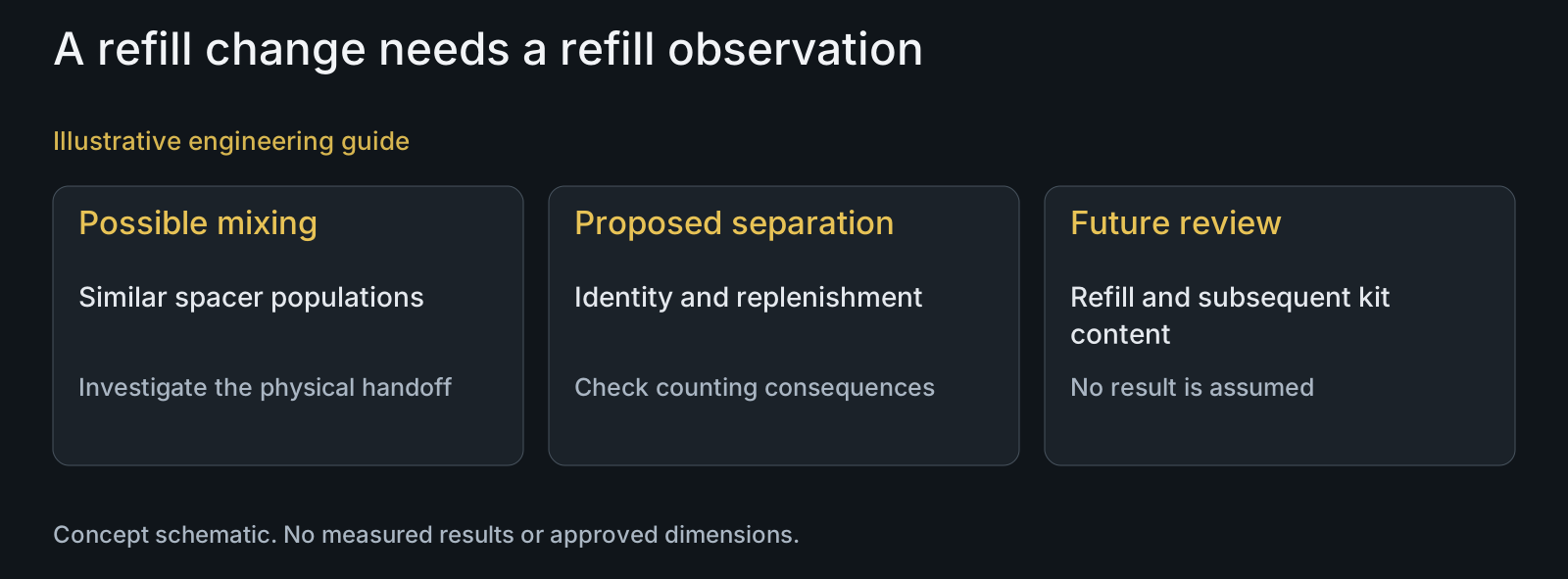
Illustrative review: spacer mixing at a refill point
Illustrative engineering example: assume an OEM reports a kit containing a spacer that does not match its specified position. Two visually similar spacer populations share a refill area. This is a hypothetical input, not a customer complaint, measured defect rate or completed investigation.
Sorting the affected packs addresses the immediate uncertainty. The proposed cause still needs evidence linking the mix to the refill activity rather than machining or a BOM revision. If that link is supported, the team can compare retained identity and separated replenishment arrangements while checking whether the change creates a new counting problem.
An effectiveness review should include the refill event and the relevant kit contents after it, not only photographs of new bins. The decision remains conditional until that evidence exists. The example shows how to ask for cause-linked closure without fabricating a successful outcome or demanding disclosure of another customer's confidential records.
Questions buyers need to confirm
Is sending replacement pivot hardware enough to close CAPA?
Not by itself. It can address the immediate supply need, while cause analysis and any needed corrective action remain separate. Review the particular issue, implemented change and relevant effectiveness evidence before accepting cause-linked closure.
Is operator training always a sufficient corrective action?
No. Relate training to a supported knowledge or instruction gap. An ambiguous setup, inadequate separation or unsuitable measurement may need a different change. A signed attendance record does not establish that the mechanism behind the problem was addressed.
How many batches are needed to verify effectiveness?
No universal number is specified here. Choose observations that represent the relevant opportunities, such as setup, refill or external-process return, and agree the criteria. Several uninterrupted runs may miss a problem that occurs only at a particular handoff.
Does no complaint during a review period prove the action worked?
No. Check whether affected parts were produced and used, how problems were reported and which conditions were observed. Absence of reports supports only its stated scope; it cannot establish behavior in an activity that never occurred.
Should every annual improvement target be a percentage reduction?
Not necessarily. Define the customer-relevant issue and useful evidence first. Counts, rates and implementation objectives answer different questions. If a rate is used, retain its denominator, reporting source and represented part scope so changes remain interpretable.
What should be supplied for a focused corrective-action discussion?
Provide the drawing revision, BOM position, required and observed condition, affected identities, permitted photographs or measurements and relevant production or handling events. These inputs help separate hypotheses from known facts and define the next review without exposing unrelated customer information.
Technical references and scope
ISO 9001 Auditing Practices Group, Nonconformity: review and closing. 2016 educational paper on correction, cause analysis, action and review of effectiveness; its disclaimer states it has not undergone ISO/IAF endorsement.
ISO 9001 Auditing Practices Group, Improvement. 2016 educational guidance on coherent improvement objectives and monitoring; not the current standard text or a universal improvement percentage.
Explore related component, material and sourcing decisions in the customer decision knowledge center. For a drawing review, use the Drawing/BOM RFQ path.
Connect the issue to the evidence needed for a decision
Use the Drawing/BOM RFQ path to share the affected drawing revision, BOM, observed condition, relevant identities and permitted evidence. Identify whether the discussion concerns a new supply requirement or an existing issue so PremFixer can clarify the appropriate manufacturing and quality-review scope without assuming an investigation result.
Discuss the drawing and BOM