
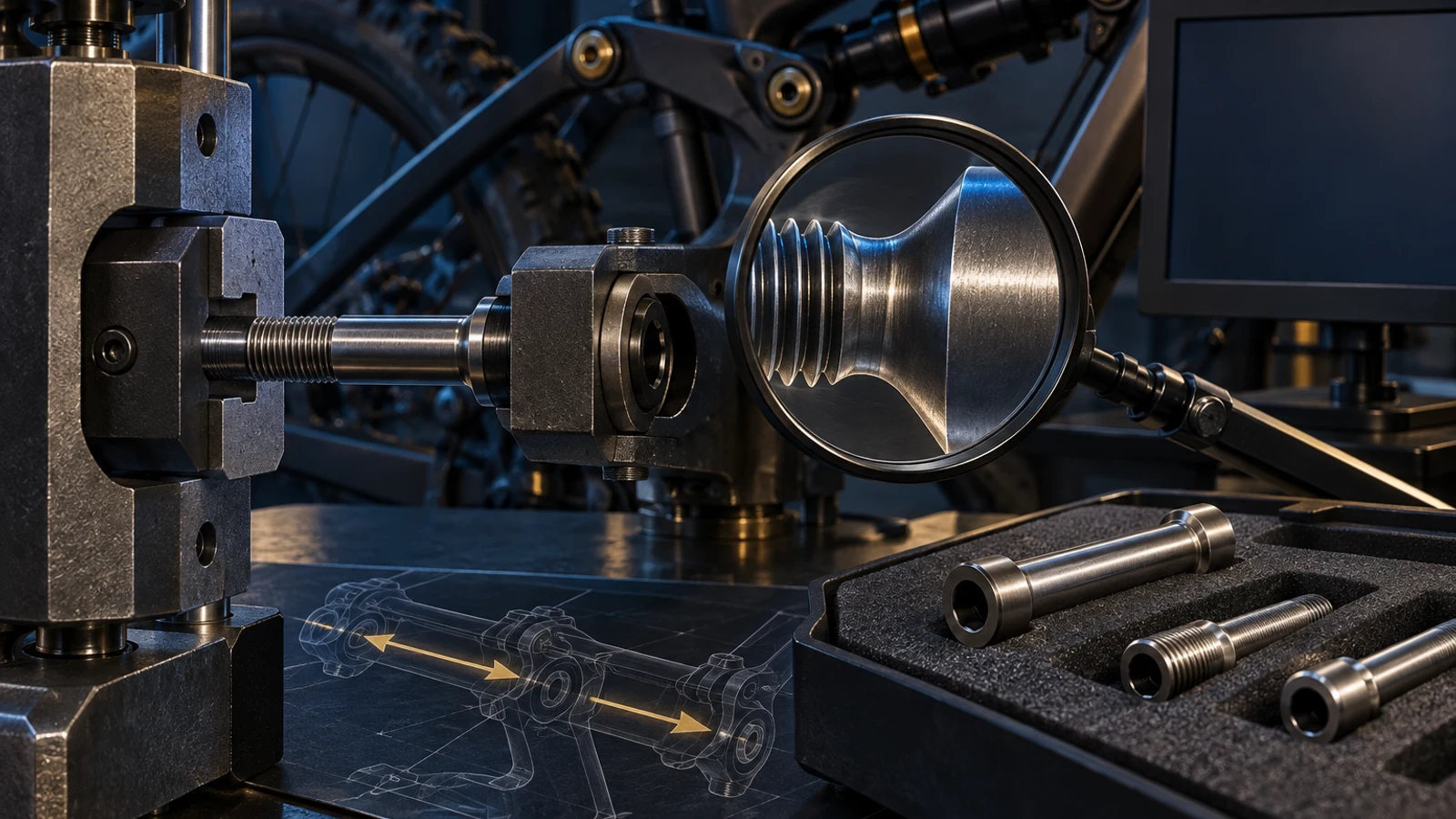
A pivot-bolt fatigue acceptance requirement needs more than a stress value and cycle total. Define the specimen's production geometry and surface state, loading mode, minimum and maximum loading, stress basis, fixture contacts, failure criterion and stopping point. Also agree how specimen-level outcomes will support the buyer's decision. ISO 3800 concerns axial-load fatigue of threaded fasteners, not a generic rotating-bending test. Reaching the selected stop without the defined failure shows only that bounded observation under the stated conditions; it does not establish unlimited riding life. Material reference values cannot be transferred to every TC4 pivot, shoulder or complete suspension joint without relevant evidence.
Hero: concept illustration of example hardware and its application. It is not a factory photograph, tested component or approved production geometry.
Choose the evidence subject for the requirement
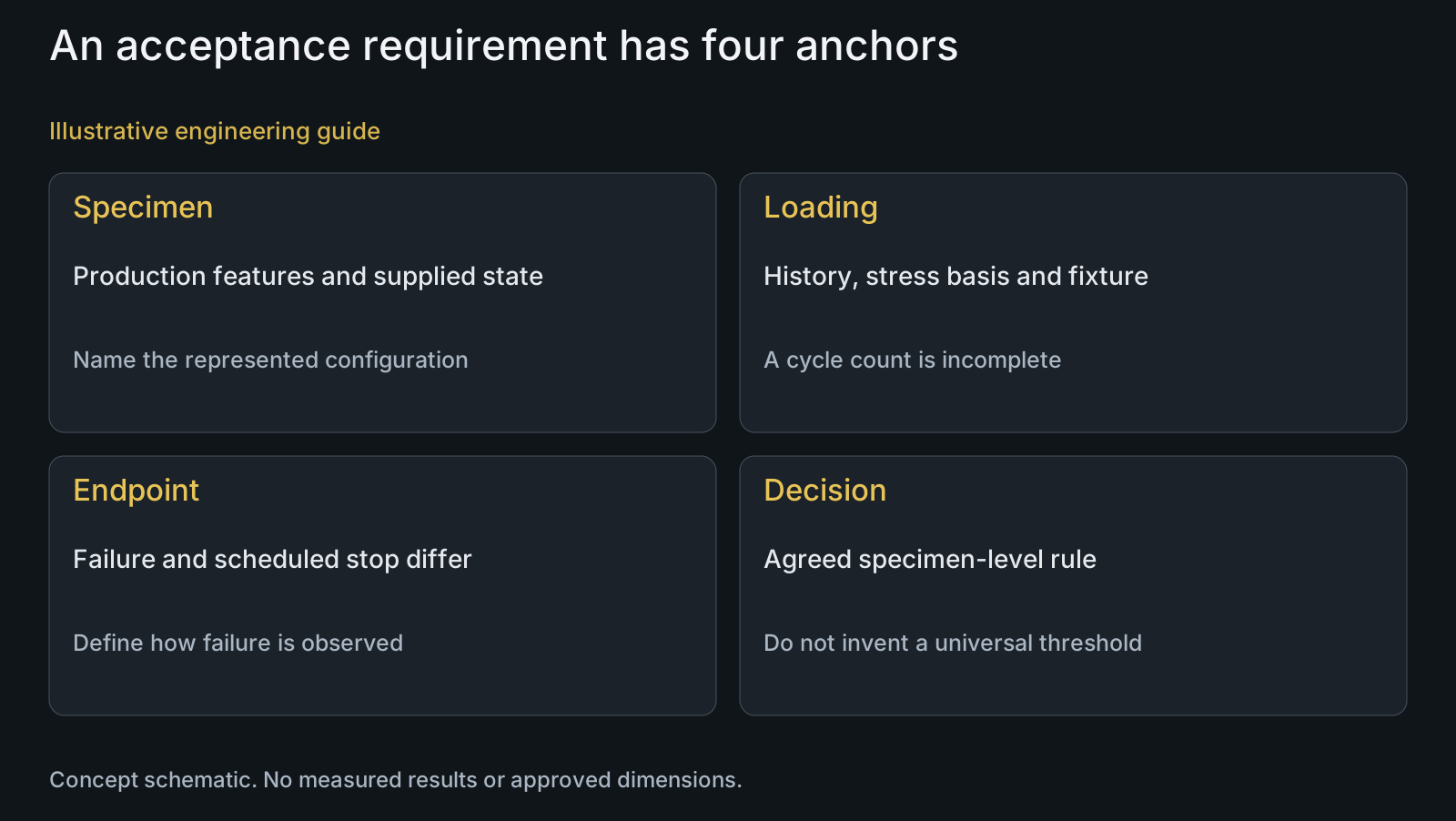
Identify whether the decision concerns a material comparison, the delivered threaded component or an assembled pivot. Retain the critical shoulder, bore, thread root and supplied surface when those features drive the question. A polished specimen that removes them answers a different question, even if the nominal alloy is unchanged.
The axial-versus-bending guide addresses method selection. Here the next decision is what the selected test must demonstrate. State the represented drawing revision and manufacturing state so the requirement cannot be satisfied by unrelated stock-bar data.
Write the loading definition so it can be reproduced
State minimum and maximum force or stress, sign convention and how the stress is calculated. A nominal section stress and a local thread-root stress are not interchangeable labels. For hollow or stepped geometry, identify the section and dimensional basis used. Keep the engineering load requirement distinct from the laboratory's instrument settings.
Specify relevant fixture contacts, engagement, support and alignment. ISO 3800's public scope identifies fluctuating tension unless otherwise agreed and excludes the effect of clamped-part compliance on fastener strain. Therefore its result cannot automatically represent every bearing, receiver and spacer arrangement in a bicycle joint.
| Observation | What it supports | Risk of misreading | Required review |
|---|---|---|---|
| Defined failure | Endpoint occurred under reported loading | All failures assigned the same mechanism | Location, detection and conditions |
| Runout | No defined failure before scheduled stop | Infinite life claimed | Stop and observed endpoint |
| No fracture observation | Fracture status only | Undetected crack criterion called passed | Detection coverage |
| Fixture-related event | Potential test-system problem | Unfavorable result silently excluded | Recorded cause and validity basis |
| Interrupted monitoring | Incomplete supported exposure record | Unrecorded cycles assumed valid | Applicable deviation treatment |
| Reference material curve | Bounded material evidence | Finished pivot automatically accepted | Geometry and condition differences |
Define failure separately from the scheduled stop
Decide whether the endpoint is fracture, a detected crack or another justified functional condition. Name how it is detected and assessed. A specimen can reach the requested cycles without fracture while an agreed crack criterion remains unexamined; that is not evidence for the unobserved requirement.
A runout reaches the scheduled stopping point without the defined failure. Record it as such rather than inventing a failure cycle or interpreting it as unlimited life. If the order requires statistical fatigue estimation rather than a simple demonstration, agree the appropriate method and data requirements with the responsible specialist.
Plan abnormal outcomes before they occur
Describe how a fixture-related break, lost monitoring, interrupted run or unsuitable specimen is investigated and recorded. Do not discard an inconvenient observation simply by calling it invalid. The reason and supporting evidence must distinguish a test-system problem from failure of the represented component.
Agree the specimen population, selection, permitted preparation, acceptance rule and treatment of missing evidence before testing. This guide supplies no universal sample count, load, survival probability or fatigue-strength threshold. Those choices depend on the design requirement and justified evaluation, not on a favorable headline from another project.
A fracture-only report can leave crack acceptance unresolved
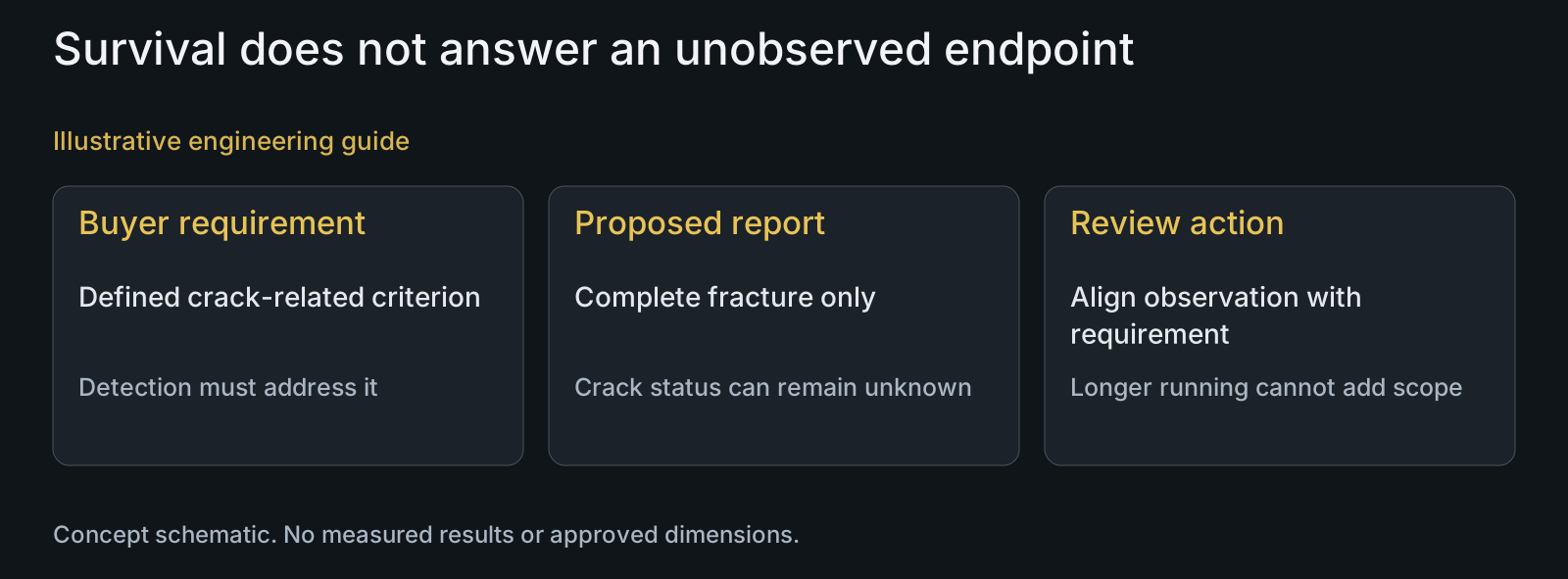
Illustrative engineering example: assume an OEM requests a fatigue demonstration for a threaded hollow pivot, with a specified crack-related endpoint. A proposal records only complete fracture and stops at a selected cycle limit. No actual stress, cycles or outcomes are assumed.
Even if a specimen survives the stop, the proposal has not established how the crack criterion is observed. The team adds the agreed detection and assessment basis or revises the requirement through authorized review. Merely increasing the stop count does not create missing crack evidence. Keep any fixture issue distinguishable from the component endpoint.
Limit the reported conclusion to the represented test
Request specimen identity, represented condition, loading definition, observed status and relevant deviations. A pass statement should reference the actual criterion and decision rule. Do not extend a sample result to all later routes, finishes or unrepresented joint contacts solely because the component name remains the same.
Discuss specimen manufacture through PremFixer's manufacturing team and the relevant full-suspension application review. Coordinated testing and fixture availability require project confirmation. No owned fatigue laboratory, completed endurance result or component-life guarantee is established by this article.
Questions buyers need to confirm
Is ISO 3800 a rotating-bending fatigue standard?
Its published subject is axial-load fatigue testing of threaded fasteners. Define the actual load mode before choosing the method. A rotating-bending proposal requires its own applicable procedure and represented specimen.
Does reaching the required cycles prove infinite life?
No. It records survival to a defined stop without the defined failure under the reported conditions. Specify the endpoint and evaluation rule, and keep the conclusion separate from unrepresented bicycle service.
Can we require a reference TC4 stress value for every pivot?
No supplied evidence supports that blanket transfer. Provide grade specification, condition, geometry, surface state and loading definition. A material reference does not automatically accept the finished component or assembled joint.
Is no fracture enough when cracks are the criterion?
Not without evidence addressing crack detection. State the detection method and assessment basis. A fracture-only monitor cannot prove that an unexamined crack requirement was satisfied.
Can a fixture failure be excluded from the results?
Only through a justified and recorded validity review under the agreed requirements. Retain the observation and cause evidence. Do not relabel an unfavorable component result as invalid merely to obtain acceptance.
What should a fatigue-test quotation define?
Provide drawing revision, critical feature, specimen and supplied state, load history, fixture relationships, endpoints and requested evaluation. Identify report fields and selection scope so manufacture and laboratory work can address the same decision.
Technical references and scope
ISO 3800:1993, Axial load fatigue testing. Official public method identity, fluctuating-tension scope and clamped-part compliance boundary; full paid procedure not reproduced.
Explore related component, material and sourcing decisions in the customer decision knowledge center. For a drawing review, use the Drawing/BOM RFQ path.
Define the fatigue evidence for your critical pivot feature
Send the drawing, critical location, relevant receiver and support geometry, loading definition and proposed endpoint through the Drawing/BOM RFQ path. PremFixer can review specimen manufacture and coordinated test scope without assigning unsupported component-life values.
Discuss the drawing and BOM