
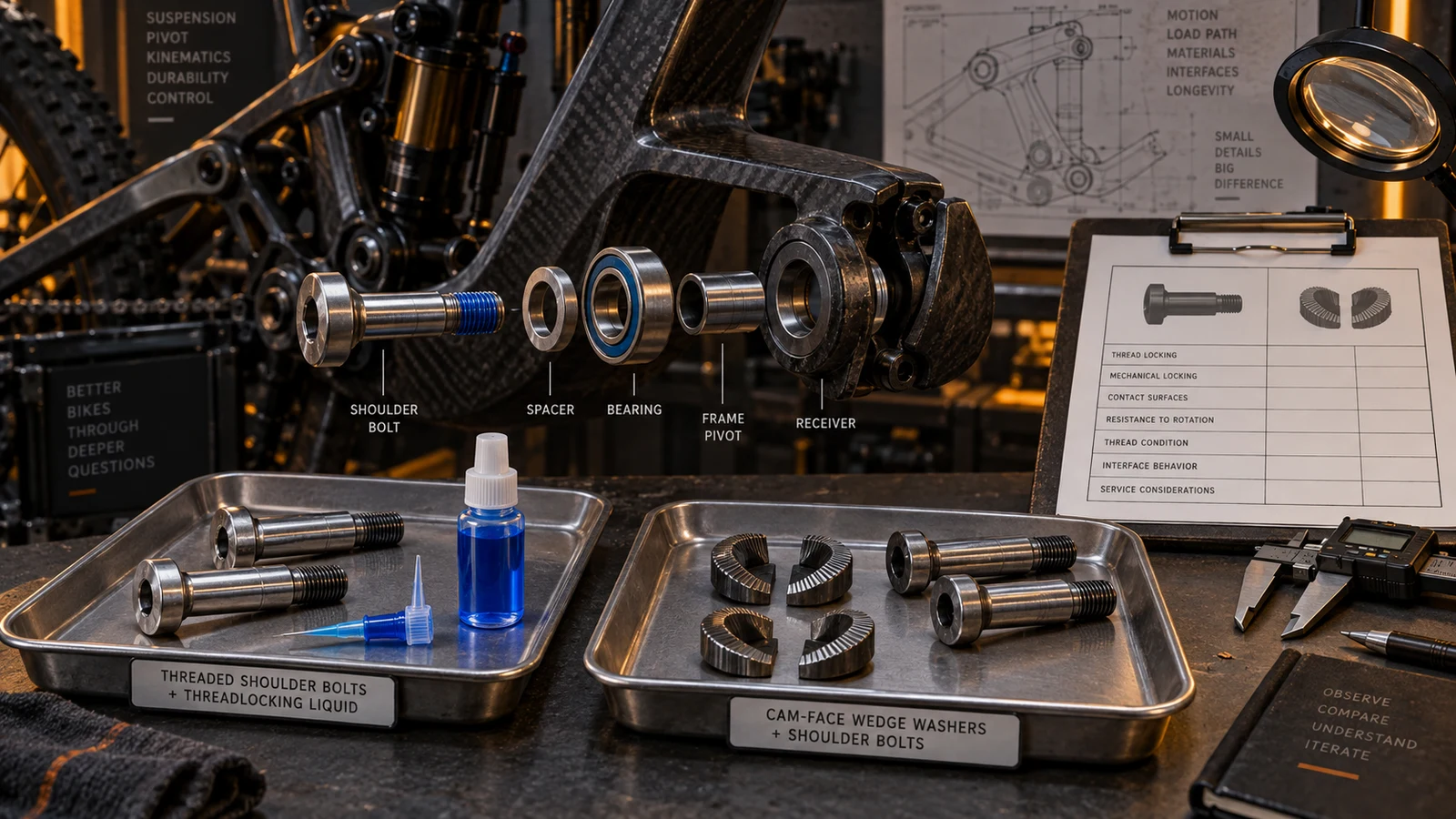
Threadlocker and mechanical locking should not automatically be combined on a bicycle pivot. An OEM considering extra retention must identify the concern, read each selected product's guidance and review the revised joint as a whole. Added thread resistance, washer thickness or changed contact action can affect tightening and seating; none alone proves that the intended stack remains clamped. Nord-Lock specifically advises against adding adhesives or prevailing locking systems to its washer system, so that combination is not recommended here. For an existing bicycle, follow the applicable OEM instructions. For custom development, resolve product compatibility, assembly conditions and service requirements before proposing evaluation.
Hero: concept illustration of example hardware and its application. It is not a factory photograph, tested component or approved production geometry.
Ask what the second element is supposed to achieve
Name the concern: threaded rotation, loss of clamping after settlement, slipping contacts or a separate captive-part requirement. Then explain the intended function of each proposed element. If both are added without identifying the problem, the extra complexity may conceal an unresolved seating or stack error.
The locking-method selection guide distinguishes chemical, prevailing and mechanical mechanisms. This article addresses a narrower decision: whether using mechanisms together creates a suitable system, rather than assuming their individual descriptions prove a combined benefit.
Do not treat high removal resistance as proof of retained clamp load. A locking feature can resist turning while a different contact has settled or the wrong shoulder has seated. Investigate those joint conditions separately before calling the assembly secure.
Let product-specific combination guidance control the proposal
Nord-Lock's additional-locking-system explanation recommends standard fasteners with its washers and advises against added adhesives or prevailing nuts. It identifies increased tightening friction as a concern. This directly contradicts an automatic adhesive-plus-washer recommendation for that named system.
That advice should be read alongside the actual washer and joint instructions, not generalized into a ban on every imaginable retention architecture. If a different product combination is proposed, obtain its applicable guidance and resolve the combined conditions with the responsible design team.
Specify product identity, not blue adhesive and locking washer. Different chemical products and mechanical features can have different preparation, contact and service requirements. A commercial product label is useful only when it leads to the correct controlled definition and instructions.
| Proposal | Useful question | Risk or restriction | Evidence or action |
|---|---|---|---|
| Specified adhesive alone | Is this thread product suitable? | Unresolved preparation or cure condition | Product and joint instructions |
| Specified mechanical feature alone | Does its action suit these contacts? | Wrong seating or moving mating surface | Mechanism and interface review |
| Nord-Lock plus added locking product | Does manufacturer guidance support pairing? | Named manufacturer advises against it | Do not make a routine combination recommendation |
| Added washer with old bolt | What does the new stack change? | Shoulder, engagement or recess mismatch | Complete assembled geometry |
| Changed product with old torque | Does tightening still meet the requirement? | Changed resistance called unchanged preload | Revised assembly basis |
| Serviced combined joint | What must be replaced or renewed? | Generic reuse or removal instruction | Product-specific and OEM service scope |
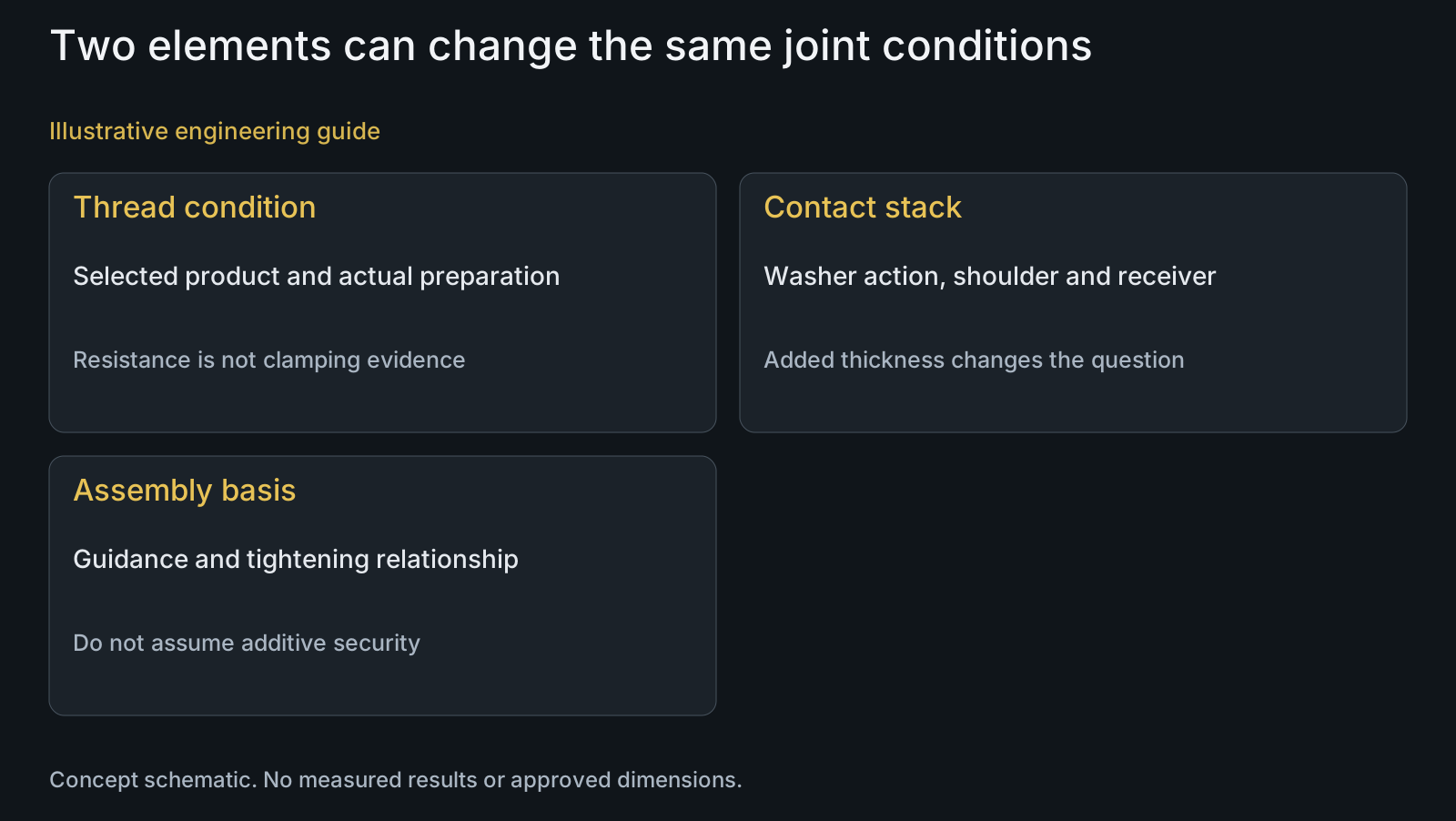
Review the changed stack and tightening question together
Locate the added washer pair relative to the head, shoulder, intended clamped components and receiver. Check recess space, engagement and the surfaces involved in its action. A pair added under an existing head can change the assembled geometry even if the bolt drawing is unchanged.
Nord-Lock's Original Washer guide identifies restrictions concerning moving mating surfaces, harder surfaces, very soft surfaces and large settlement. Those restrictions are relevant review inputs, not evidence of compatibility with every aluminum or carbon frame contact. Do not use the image of a washer as an approved pivot interface.
Keep the tightening specification tied to the revised surfaces and selected products. Changing friction can change the relation between applied torque and clamping. The torque-development guide discusses that basis; no arbitrary torque addition or carryover is prescribed here.
Define adhesive condition without confusing cure and clamping
For an adhesive proposal that is otherwise appropriate, identify its preparation, application region and evaluation condition. Henkel's LOCTITE 243 sheet describes cure influenced by substrate, gap and temperature. Its specified test values are not installation torques or universal cure instructions for a custom pivot.
State which surfaces may receive the product and which should remain in their specified bearing or contact condition. Resolve compatibility and migration concerns from the actual product information. Do not assume an oil-tolerant description permits any contamination or that a bottle color defines material compatibility.
Describe when the assembled item can enter the intended evaluation under the agreed procedure. A threadlocker cure condition and the mechanical seating of a stack answer different questions. Completing one does not establish the other, even if the fastener is difficult to turn.
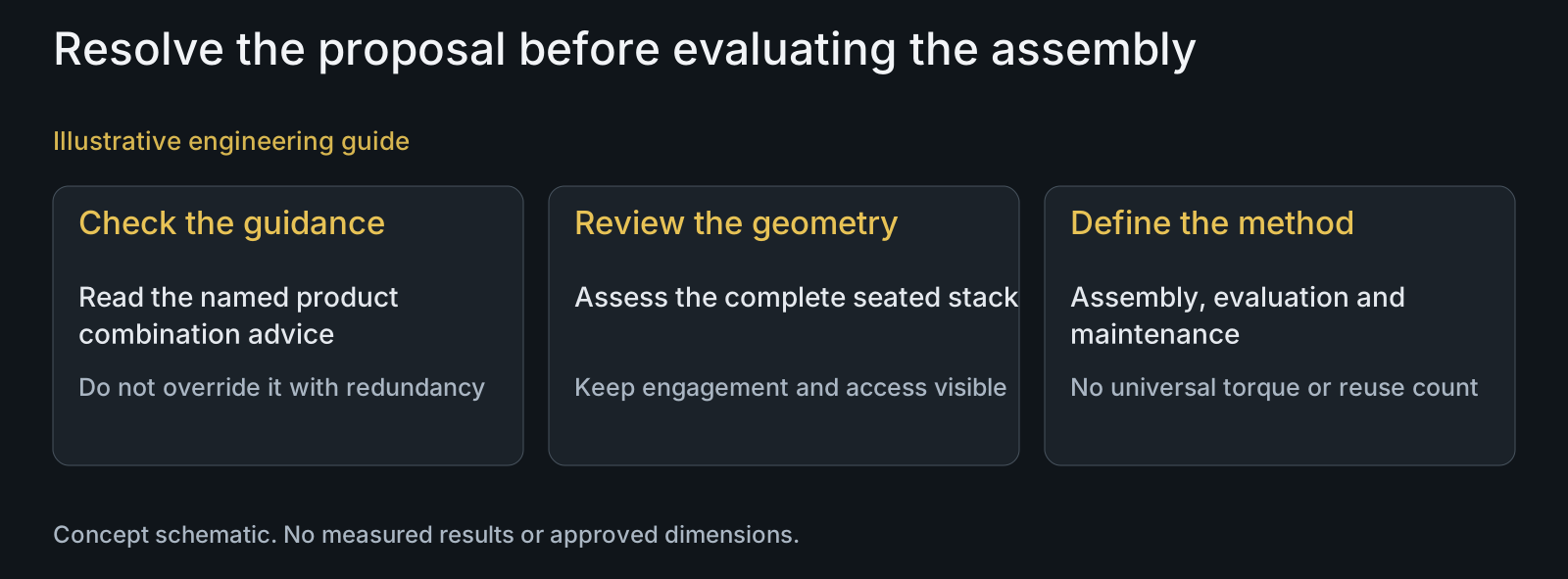
Make evaluation and maintenance match the selected architecture
Where an evaluation is justified, record geometry, surface state, selected products, assembly method and relevant preparation or cure condition. Compare candidates using the stated question. A vibration demonstration with different initial assembly conditions cannot establish a universal combination advantage.
Specify what is observed: rotation, clamping behavior, contact changes or another defined outcome. Keep installation checks distinct from application evidence. The anti-loosening solution discussion provides a route to component review, not a promise of a passed bicycle test.
Write product- and joint-specific removal, inspection, replacement or renewal instructions. Do not invent a reuse count or transfer a general adhesive heating procedure to a sensitive frame assembly. Include service access and responsibilities in the proposal rather than leaving them until the prototype is dismantled.
Review example: a second device changes the basis of assembly
Illustrative engineering example: assume an OEM proposes adding a wedge-washer pair and an adhesive to a recessed pivot while retaining its previous torque instruction. No observed loosening mechanism, measured preload or vibration outcome is supplied.
The reviewer identifies three unresolved inputs: combination guidance, the revised head-and-shoulder stack, and the tightening basis. For the named Nord-Lock system, the manufacturer's advice against added locking systems is a reason not to advance the proposed pairing as a routine solution.
The team returns to a supported architecture and its actual joint requirements. This is not a finding that the earlier configuration is acceptable or that any single device solves the concern. It shows why adding parts cannot replace resolving the installation and evidence questions.
Questions buyers need to confirm
Is threadlocker plus a wedge washer always safer?
No additive benefit is established. Review the products and their interactions with the complete joint. Nord-Lock advises against additional adhesive or prevailing locking systems with its washers, so that named pairing is not a routine recommendation here.
Can we keep the old torque after adding a locking element?
Do not assume so. Identify changed thread resistance, bearing contacts and stack geometry, then review the assembly basis. Arbitrarily increasing torque does not establish the intended clamp load and can introduce another uncontrolled change.
Does strong removal resistance prove the stack stayed clamped?
No. Removal resistance can reflect the locking product while contact settlement or wrong seating affects clamping. Define the observation you need and evaluate it separately from the effort required to turn the fastener.
Can a washer pair fit any recessed pivot head?
No. Compare its dimensions, contact action, shoulder relationship and receiver engagement with the complete recess. Apply the manufacturer's surface restrictions. A pair that physically enters the recess is not automatically suitable for the interface.
Can adhesive cure time be copied from a generic chart?
Not as a universal pivot instruction. Identify the actual product, substrate, gap, temperature and relevant preparation. Its data-sheet test conditions inform review but do not establish a custom assembly's installation torque or readiness by themselves.
What should a combined-locking review request contain?
Provide both mating drawings, stack and recess details, the actual concern, selected product identities, surface state and existing assembly instructions. Include service requirements and the proposed evaluation question so manufacture and application responsibility remain clear.
Technical references and scope
Nord-Lock guidance on additional locking systems. Manufacturer advice against added adhesive or prevailing locking systems with its washers, including tightening-friction concerns; no universal architecture ban inferred.
Nord-Lock Original Washer user guide. Named washer-system application and mating-surface restrictions; not approval for every bicycle pivot.
Henkel LOCTITE 243 technical data sheet. April 2025 product-specific substrate, gap and temperature dependence. No test torque, cure duration or removal heat prescribed for bicycle installation.
Explore related component, material and sourcing decisions in the customer decision knowledge center. For a drawing review, use the Drawing/BOM RFQ path.
Review the complete pivot locking proposal
Send joint drawings and STEP, receiver and spacer details, selected locking-product references, surface requirements and assembly/service inputs through the Drawing/BOM RFQ path. PremFixer can review the manufactured interfaces and supply definition while your team resolves product suitability and validation.
Discuss the drawing and BOM