
A lower unit price at the next pivot-bolt quantity tier is worthwhile only if its complete commitment makes sense for usable demand. The buyer should compare adjacent offered totals and determine how many additional finished kits the extra components can support. More discounted axles do not create more bicycles when the matching spacers or receivers are unavailable or changing revision. Keep the material, finish, evidence and supplied unit constant while reading the price schedule. Distinguish a minimum order from a discount threshold and label forecasts separately from firm purchases. No standard PremFixer MOQ or discount is stated here; the decision uses the actual offer and the project's component relationships.
Hero: concept illustration of example hardware and its application. It is not a factory photograph, tested component or approved production geometry.
Read the tier as a purchase commitment, not a target number
Ask what the quoted tier means: ordered pieces, produced pieces, complete kits or a specifically agreed mixed BOM. Identify the applicable revision and included charges. A threshold in a price table is not automatically the minimum accepted order or the economical batch for every process.
The MOQ scope guide explains samples, process minima and releases. This article addresses the next decision: whether stepping from one available offer to another justifies the additional commitment. It does not repeat a generic batch-economy explanation.
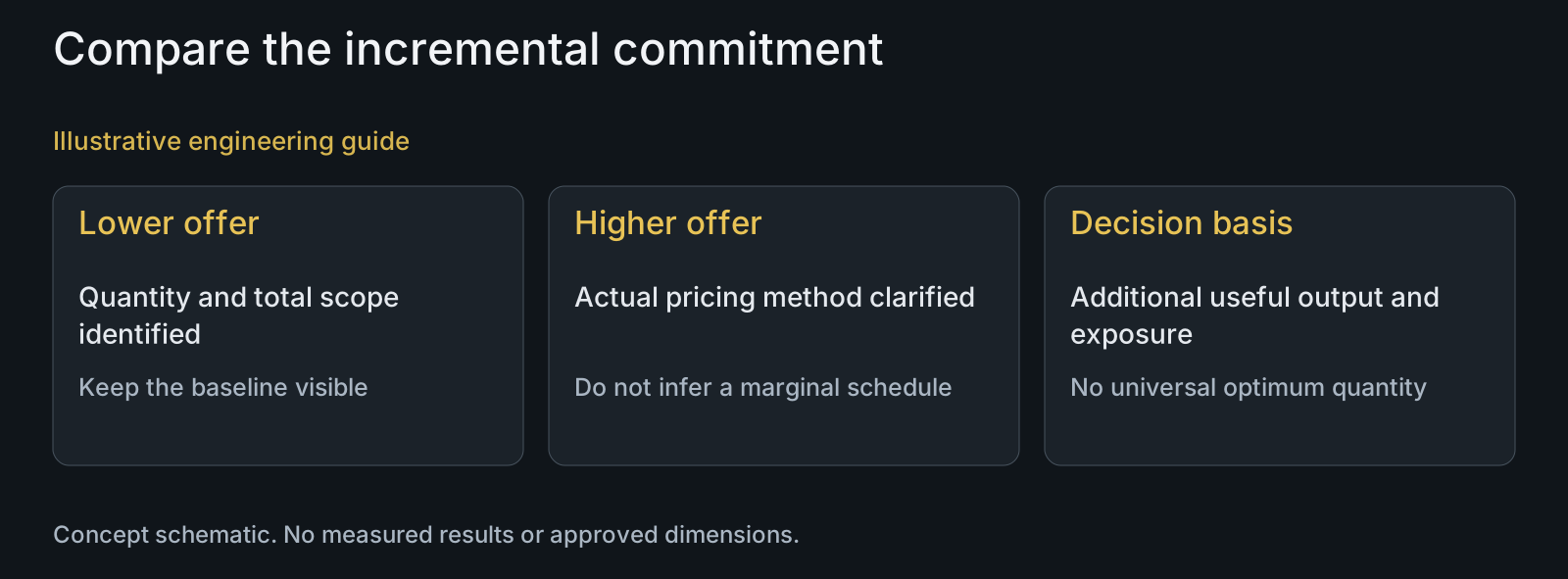
Confirm whether the offer is a price for the whole selected quantity or a marginal price for only the additional units. Do not infer the method from a column headed unit price. The supplier's written offer must establish how its schedule applies.
Compare adjacent offered totals before claiming a saving
For each option, record offered quantity, unit basis and separately included charges without counting them twice. Compare the resulting total commitment. If an offer changes setup, treatment or evidence at the higher tier, identify that scope difference before treating the comparison as quantity-only.
The incremental commitment is the higher option's total less the lower option's total on the same stated basis. It may differ from multiplying the extra quantity by the displayed higher-tier price, because the offer may also reprice the original quantity. Clarify the actual schedule rather than assume either behavior.
Protolabs' public pricing page shows that its service offerings and quantity-pricing arrangements are provider-specific. Its numerical thresholds, no-NRE descriptions and payment terms are not PremFixer terms. The useful action is to obtain the actual project offer, not borrow another service's price curve.
| Question | Comparison basis | Risk if ignored | What confirms the decision |
|---|---|---|---|
| What qualifies for the tier? | Pieces, kits or agreed BOM mix | Unlike lines aggregated automatically | Written offer unit and scope |
| How is pricing applied? | Whole quantity or incremental schedule | Extra-spend arithmetic is wrong | Actual quantity and total offer |
| What output does surplus support? | Complete kits or named spare demand | Extra bolts counted as extra assemblies | Compatible members and BOM quantities |
| When will the extra stock be used? | Stated demand and configuration horizon | Unknown future use treated as firm | Demand basis and interface applicability |
| Does staged delivery change commitment? | Production, ownership and release events | Stored stock assumed risk-free | Explicit arrangement and revision scope |
| Which alternative fits real need? | Comparable finished scope | Cheaper line omits needed deliverables | Selected offer and stated tradeoff |
Convert component tiers into complete kit availability
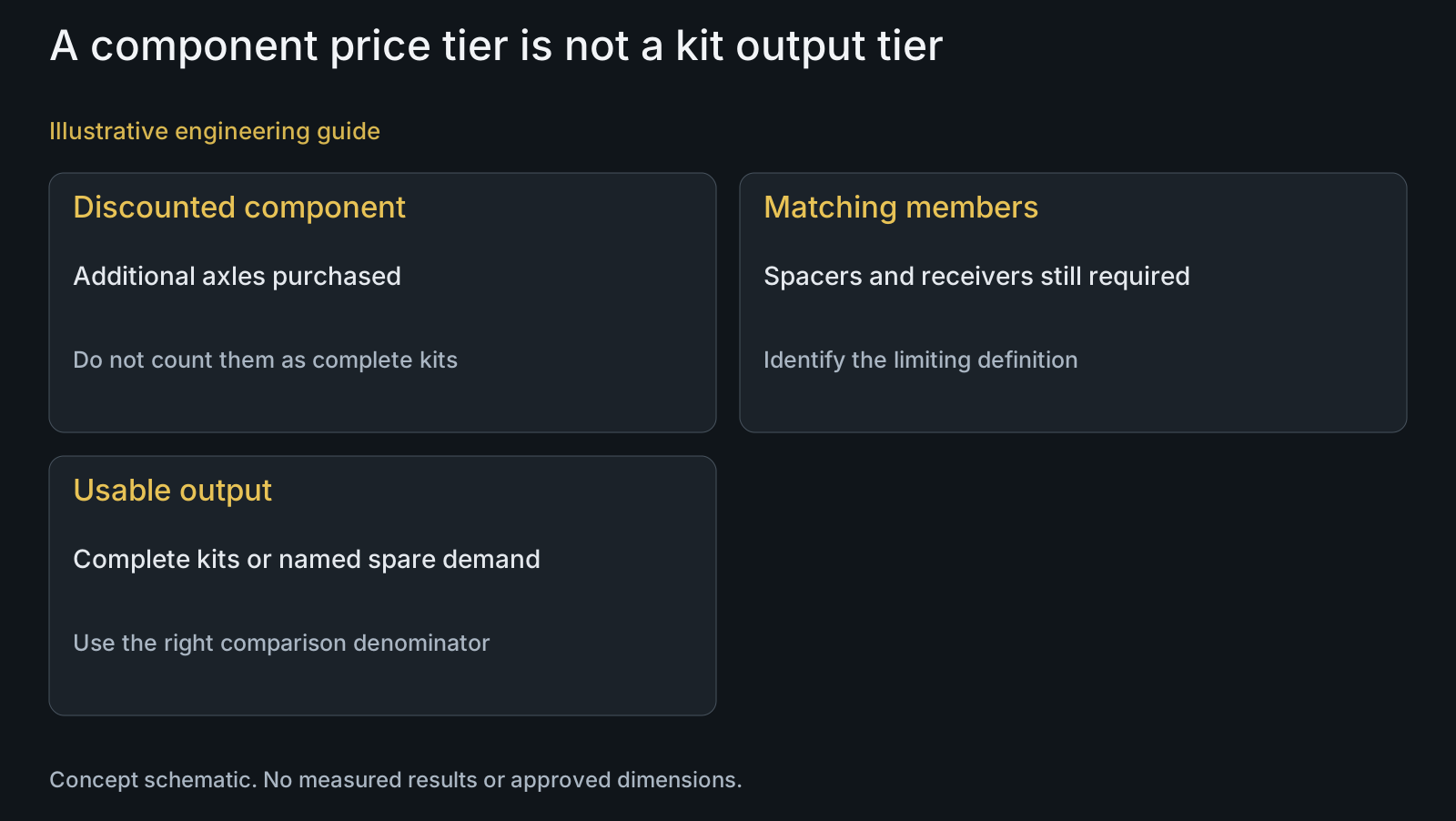
Map each purchased BOM line into its required quantity per kit. Then identify the member that limits complete assembly availability. One line's surplus cannot be counted as extra complete kits unless the necessary compatible members are also available within the decision's scope.
Keep production kits and service spares distinguishable. Additional axles may be useful as authorized spares even when they do not create complete production kits, but that is a separately stated demand. Do not assign all surplus to unspecified future service to make the larger tier appear economical.
Use the kit definition review to keep the supplied unit clear. The relevant comparison here is purchased commitment against actual usable output, not a claim that all items in an image belong to a stocked kit.
Place the extra quantity inside a revision and demand horizon
Identify the expected use of the incremental quantity, including its configuration and time horizon. A forecast for another model does not establish compatibility. Confirm that the intended receivers, spacers and complete BOM remain applicable before counting that forecast as a use for the surplus.
A known pending change is different from a vague possibility of future revisions. Describe which feature or mate is under review and how it could affect the extra inventory. Do not invent a probability of obsolescence or assume that every document revision makes all stock unusable.
Where the larger offer proposes staged shipments, state when production and commercial commitment occur. Holding pieces at the supplier does not necessarily remove their revision exposure. The revision-continuity guide addresses the authorized treatment of existing states separately.
Compare alternatives when the next tier adds unusable surplus
Ask for the offered quantity nearest the genuine need, a complete-kit tier where applicable, or another explicitly defined production arrangement. A supplier may or may not accept the requested alternative. Do not advertise free warehousing, mixed-part aggregation or a forecast-based price as an established service.
Keep engineering changes separate from quantity choices. If a proposal standardizes an interface so more demand can share a part, it is a design alternative requiring its own assessment. Purchasing cannot create interchangeable demand by combining similar part names in a spreadsheet.
Document which offer was selected and why: useful additional kits, required spare demand, lower complete commitment or preserved flexibility. No universal least-cost quantity is available without the actual demand, offer and responsibility boundaries. Review manufacturing inputs through manufacturing.
Review example: the axle tier does not increase build-ready kits
Illustrative engineering example: assume a complete kit uses an axle and a matched spacer. A higher axle tier offers a lower displayed unit price, but the spacer definition is still under review and only the current build's matching quantity is established. No actual prices, counts or stock arrangement are assumed.
The buyer compares the two total offers, then separates current complete-kit demand from the extra axles. They ask whether additional compatible spacers will be available under the intended definition and whether the surplus has a genuine approved service use. They do not count every extra axle as an additional build-ready kit.
The team can choose the larger tier if its stated commitment and usable demand justify it, or retain the smaller scope while the interface is unresolved. The example establishes neither a saving nor a rejection of bulk purchasing. It shows why the lower unit price is not the decision denominator.
Questions buyers need to confirm
Does the lowest unit-price tier give the lowest total spend?
Not necessarily. Compare the complete offered totals, including separately included work. A larger quantity can cost more overall even when its unit figure is lower; no actual ranking can be made without the offers.
Is a price-break threshold the production MOQ?
Not automatically. A minimum accepted quantity, a process charge and a discount threshold are different terms. Ask which one the schedule describes and whether it concerns pieces, complete kits or a specified BOM mix.
How should we calculate the extra commitment?
Subtract comparable offered totals rather than assume the displayed price applies only to extra units. Confirm whether the schedule reprices the whole quantity or uses incremental brackets, and avoid counting included setup twice.
Can extra axles be counted as additional kits?
Only when matching constituents in the required quantities and revisions are available for that use. Identify the limiting BOM member and distinguish complete production demand from authorized service-spare demand.
Can split shipments eliminate surplus risk?
No automatic elimination follows. The full quantity may already be produced or commercially committed. Clarify ownership, production timing and revision treatment separately from the shipment release quantity.
What quantity information should accompany a tier request?
Provide current complete-kit demand, named spare demand, forecast scope, required BOM quantities and known pending changes. Label firm versus indicative needs so the offer can be reviewed against usable output rather than a generic annual number.
Technical references and scope
Protolabs pricing and payment options. Provider-specific service/pricing structure and volume-offering context; all numerical prices, thresholds, NRE and credit policies excluded from PremFixer claims.
Explore related component, material and sourcing decisions in the customer decision knowledge center. For a drawing review, use the Drawing/BOM RFQ path.
Compare quantity tiers against complete usable demand
Send drawings, STEP, BOM member quantities and revisions, material and finish, required evidence, current kit demand, named spares and proposed release quantities through the Drawing/BOM RFQ path. PremFixer can review quantity alternatives with their actual scope and commitment assumptions.
Discuss the drawing and BOM