
Buying a pivot subassembly rather than loose fasteners requires agreement on what arrives assembled and what remains to be completed on the frame. The OEM is choosing a delivered state, not simply reducing supplier count. Specify included axles, bearings, spacers and locking items, their sourcing responsibilities, the proposed assembly operations and acceptance criteria. PremFixer's drawing-led manufacturing can be reviewed against that proposed scope; no general bearing-preassembly service is established by this article. Preassembly may relocate useful work, but it can also hide interfaces from incoming inspection. Decide how those interfaces will be checked before closure and which final frame-level checks remain with your team.
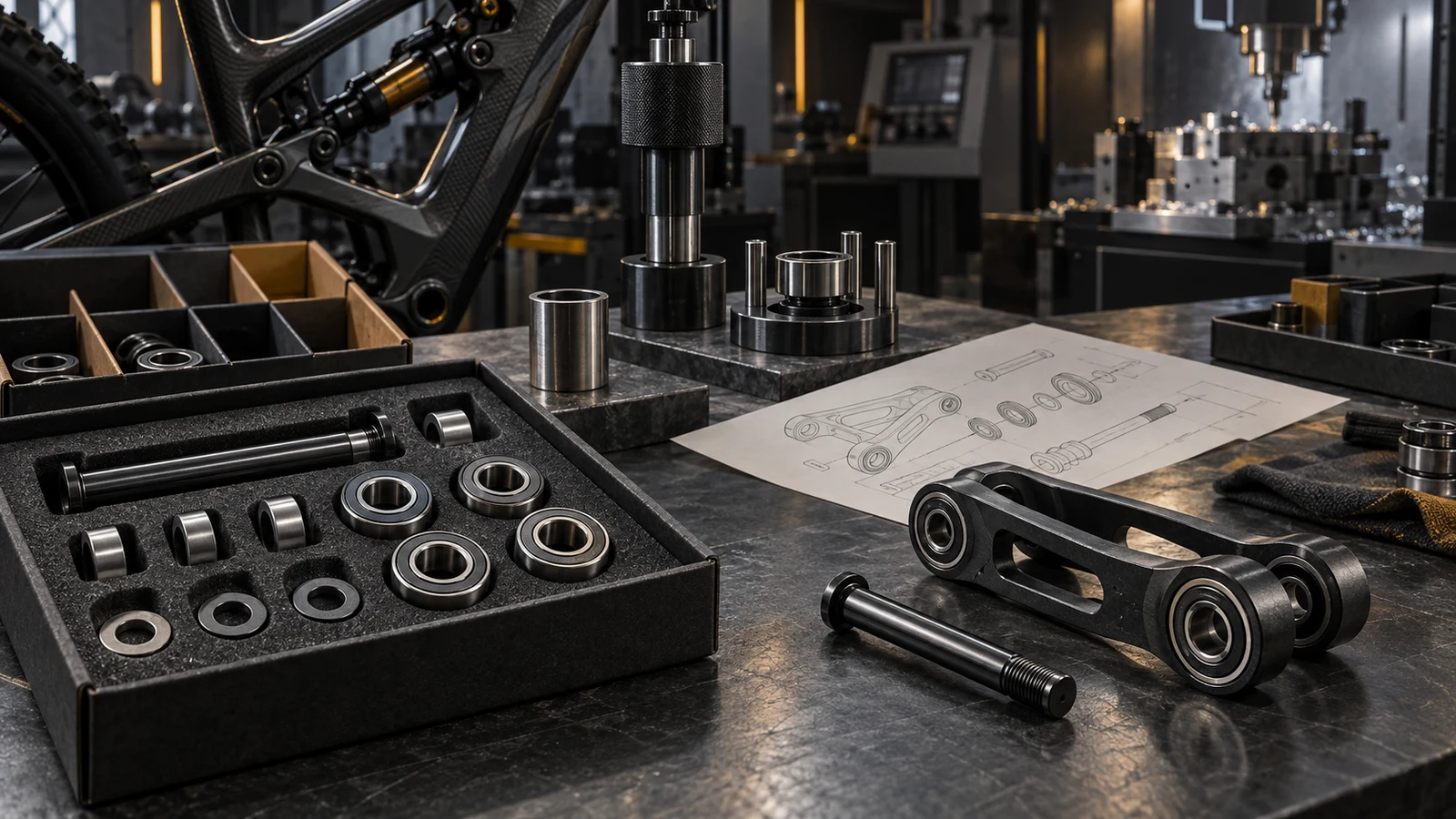
Hero: concept illustration of example hardware and its application. It is not a factory photograph, tested component or approved production geometry.
Name the physical deliverable before comparing suppliers
A loose kit is a grouped set of components. A subassembly contains components joined into an agreed intermediate state. A finished frame joint is another state again. Describing all three as complete pivot hardware conceals different manufacturing work and acceptance responsibilities.
Identify each constituent by its controlling definition, quantity and position. State whether bearings or links are supplier-sourced, customer-supplied or excluded. A picture of a suspension linkage does not establish that those items are included, available from stock or suitable for a particular bicycle.
The one-stop manufacturing guide follows final requirements across processing handoffs. Here the decision is where physical assembly stops and what the customer can verify at receipt. Discuss that proposed boundary through manufacturing.
Choose preassembly by the operation it removes or relocates
Ask which operation would actually disappear from the customer's line. Grouping an axle and spacers in one bag may simplify selection without removing a press operation. Seating bearings in a link relocates a different task and requires a defined component, housing, fit and supported mounting method.
NSK's mounting guidance explains that force for an interference-fitted bearing ring should act on that ring rather than pass through rolling elements. That principle makes tool access and support part of the proposed assembly review, not incidental workshop details. It does not prescribe a pivot-specific fit or prove that PremFixer has performed the operation.
For the actual bearing type, obtain its manufacturer's instructions and the mating definition. Review contact surfaces, access, seating and protection. Do not infer an acceptable force or mounting temperature from a general bearing image or a nominal bore size.
| Option | Useful when | Boundary or risk | What establishes scope |
|---|---|---|---|
| Loose component kit | Customer retains assembly operations | Completeness mistaken for assembled acceptance | Constituent identities and quantities |
| Matched loose set | Selection is resolved before delivery | Matching mistaken for installed performance | Defined member relationships and checks |
| Bearing-equipped link proposal | Seating operation is explicitly reviewed | Seat evidence hidden after assembly | Bearing/link definitions and preassembly evidence |
| Partly secured subassembly | Intermediate condition is intentional | Customer assumes locking is final | Specified operations completed and remaining |
| Complete service replacement | Design owner authorizes unit replacement | Partial substitution inferred without approval | Service scope and permitted combinations |
Define acceptance before the assembly hides the evidence
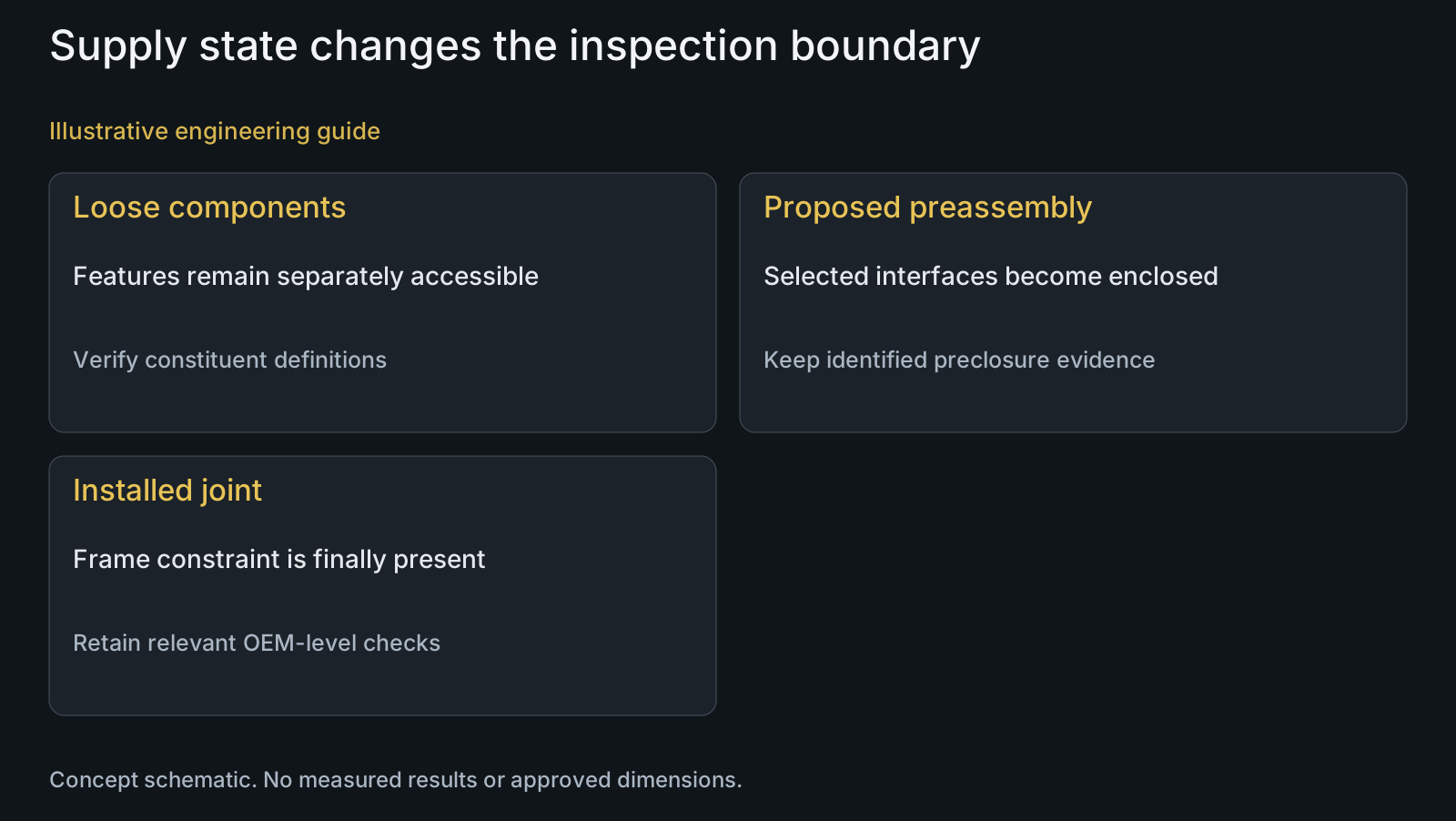
A dimensional feature that is accessible on a loose component can become difficult to measure after assembly. Decide whether evidence belongs before assembly, after assembly or at final installation. These stages answer different questions; neither a part report nor a completed-unit photograph covers all of them.
Receiving can check identity, visible completeness, orientation and the agreed delivered condition. Hidden seats or interface dimensions may need appropriately identified preassembly evidence. Specify which characteristics are represented and how the report connects to the supplied unit rather than ask for an unspecified inspection certificate.
An uninstalled unit may not reproduce the customer's frame constraint or final clamping state. Retain the relevant installed checks with the OEM. Use the pivot validation plan to allocate the questions without claiming that smooth free movement alone validates the final joint.
Compare total delivered scope without inventing savings
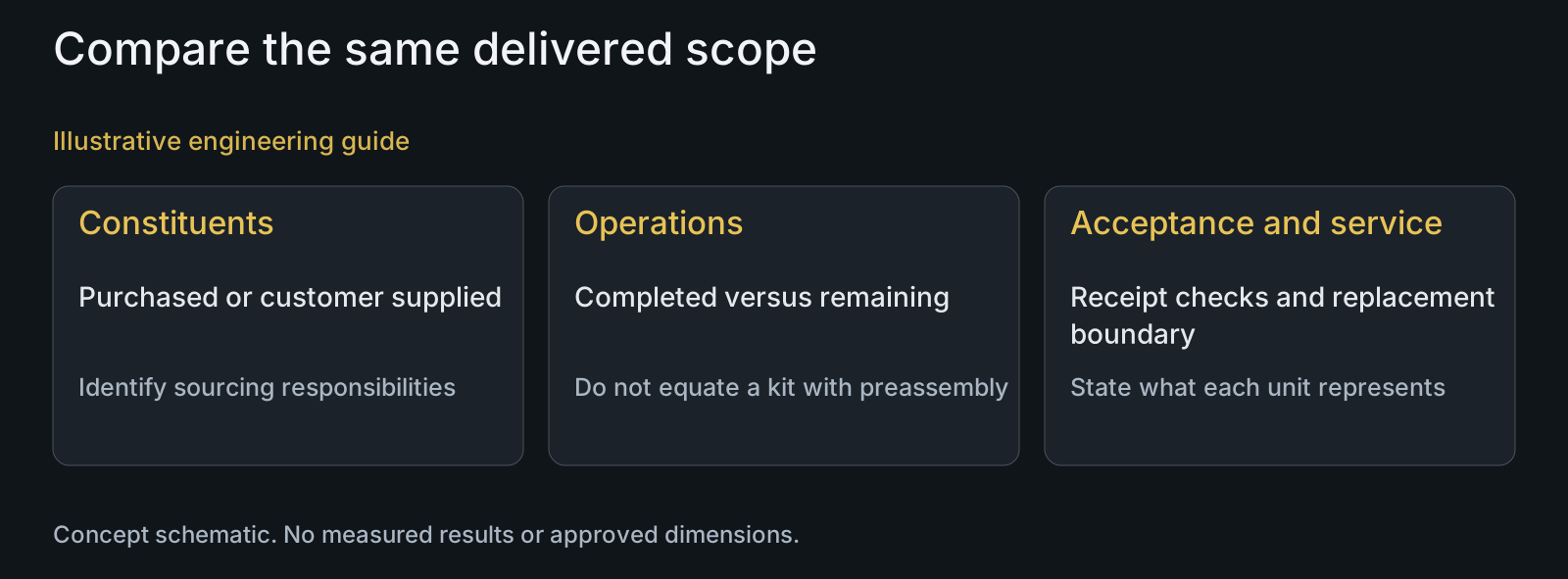
Separate constituent supply, assembly labor, fixtures, inspection and protective packaging in the quotation scope. They need not appear as separate invoice lines, but their inclusion must be clear enough to compare alternatives. A lower axle price does not establish a cheaper completed subassembly.
Customer-supplied components add another boundary: ownership, incoming condition, usable quantities and handling of nonconforming items. Agree those terms before scheduling assembly. A proposed supplier operation should not silently authorize replacement of a specified bearing or modification of a customer-owned link.
Review transport protection for the resulting state. Loose parts may need separation; an assembled unit may need protection against loads on exposed features or contamination. No universal cost reduction, shorter lead time or eliminated receiving inspection is promised by changing the delivery state.
Keep manufacturing receipt and service replacement distinct
The production line may receive one identified unit while service requires separate replaceable parts. Decide whether the service scope is a complete replacement assembly or selected constituents, and preserve the necessary identities for both. A complete production unit does not automatically authorize every partial substitution.
Assembly compounds, orientation or secured interfaces can affect disassembly. State any authorized service procedure and replacement boundary from the design owner. Do not add a generic removal method or assume that a bearing installed once is approved for reuse.
Carry changes through the parent BOM and its operational definitions using the ECN review. The delivered assembly and the loose service kit can require different constituent quantities even when they refer to the same frame interface.
Review example: bearing seating moves away from the frame line
Illustrative engineering example: assume an OEM proposes receiving a link with bearings seated, while the axle and final locking operation remain separate. No existing PremFixer preassembly project, measured saving or accepted sample is assumed.
The reviewer distinguishes bearing-to-link evidence from final axle-to-frame evidence. The proposed supplier scope needs the link and bearing definitions, mounting method and acceptance state. The OEM still owns the installed configuration and relevant final checks. Calling the delivery complete would obscure that unfinished boundary.
The buyer compares the proposed seated-link scope with a loose kit on equivalent quantities, component sources, inspection and packaging. If the operation or evidence cannot yet be supported, it remains an open quotation item rather than a promised service. The useful outcome is a clear supply decision, not a fictional successful production transfer.
Questions buyers need to confirm
Can PremFixer supply a preassembled pivot unit?
A proposed unit needs project-specific capability and scope review. Provide the complete assembly, constituent sources and required operations. This article does not confirm an existing general bearing-preassembly service or stocked assembly.
Is a loose hardware kit a subassembly?
No. Grouping components establishes a kit, not joined interfaces. State which operations have actually been completed and what remains for the customer, including final frame installation and locking.
What must be known before quoting bearing seating?
Provide the bearing identity, link or housing definition, required fit and seating state, and manufacturer mounting instructions. Tool support and access affect whether the proposed operation can be performed without loading the wrong interfaces.
Can receiving inspection omit hidden dimensions?
Only with an agreed acceptance basis that addresses the relevant requirements. Define appropriate preassembly evidence and its unit identity, alongside finished-state checks. A photograph of the assembled unit cannot substitute for every enclosed feature measurement.
Does preassembly validate the complete pivot design?
No. Manufacturing an intermediate state does not establish final frame-level behavior. Identify the remaining installed checks and design approval scope, especially where clamping and frame constraints are absent at supplier inspection.
How should spare parts be specified?
Identify whether service replaces the complete unit or authorized separate constituents. Keep component identities, permitted combinations and replacement procedures clear. Production packaging does not automatically approve partial service substitution.
Technical references and scope
NSK bearing maintenance tools: correct mounting. Manufacturer mounting-force guidance for interference-fitted bearing rings. Not a prescribed bicycle fit or evidence of PremFixer bearing-assembly capacity.
Explore related component, material and sourcing decisions in the customer decision knowledge center. For a drawing review, use the Drawing/BOM RFQ path.
Define the proposed subassembly before requesting its price
Send assembly drawings, STEP, the constituent BOM, bearing and mating-part information, required material and finish, proposed completed operations and receipt criteria through the Drawing/BOM RFQ path. PremFixer can review the manufacturing scope and identify assembly items requiring separate capability agreement.
Discuss the drawing and BOM