
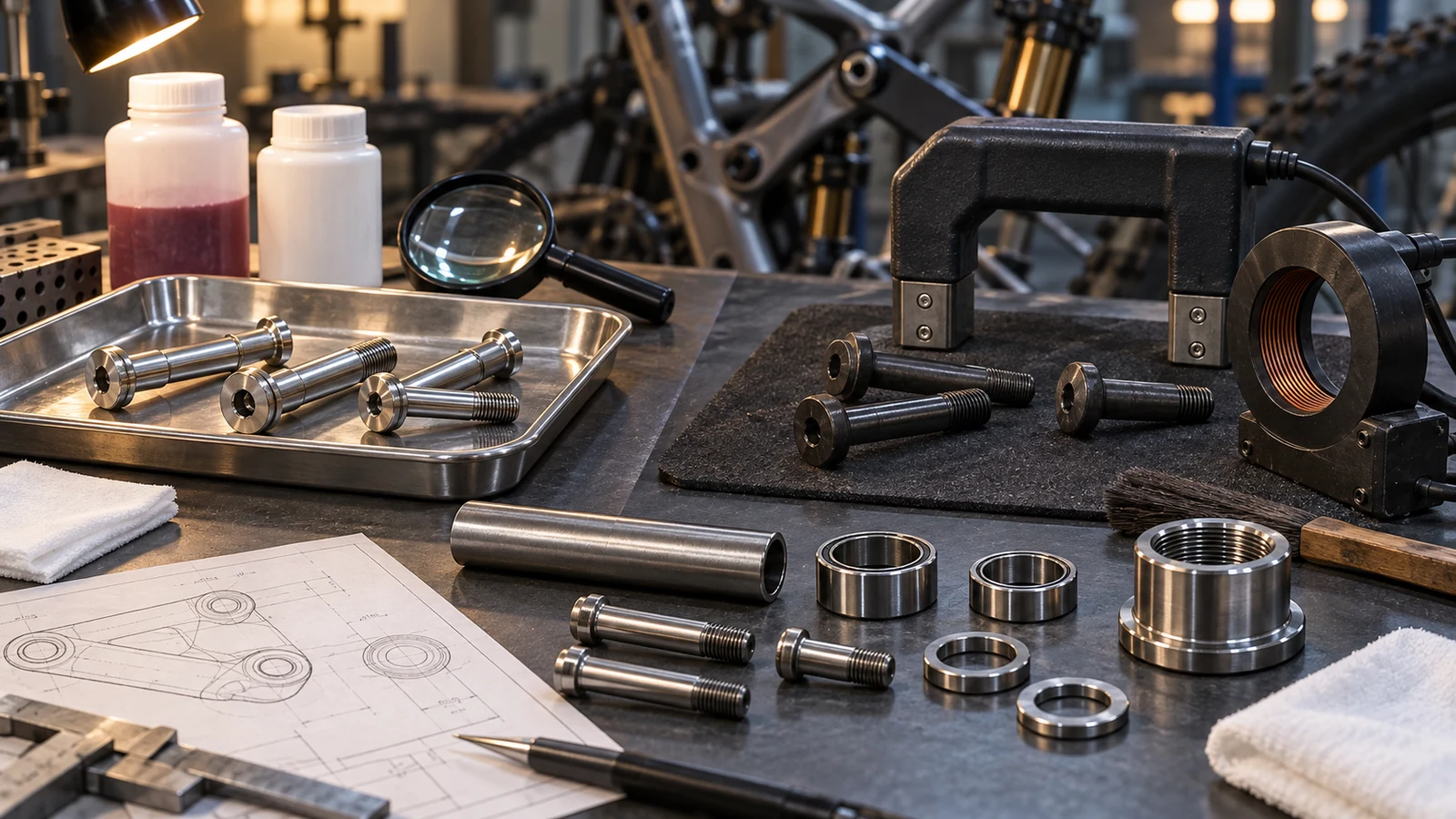
Specify penetrant or magnetic-particle inspection for custom pivot bolts by the material and suspected discontinuity, not simply by calling the part stainless or steel. Liquid penetrant testing, PT, addresses discontinuities open to an accessible, suitable nonporous surface. Magnetic-particle testing, MT or MPI, requires suitable ferromagnetic material and can address surface and near-surface discontinuities. Titanium is not a magnetic-particle inspection subject, while stainless families and supplied conditions need distinction. For an OEM or SQE requesting surface-crack evidence, identify the location, delivered surface and inspection stage first. A report with no relevant indications cannot establish freedom from defects that the selected method could not detect.
Hero: concept illustration of example hardware and its application. It is not a factory photograph, tested component or approved production geometry.
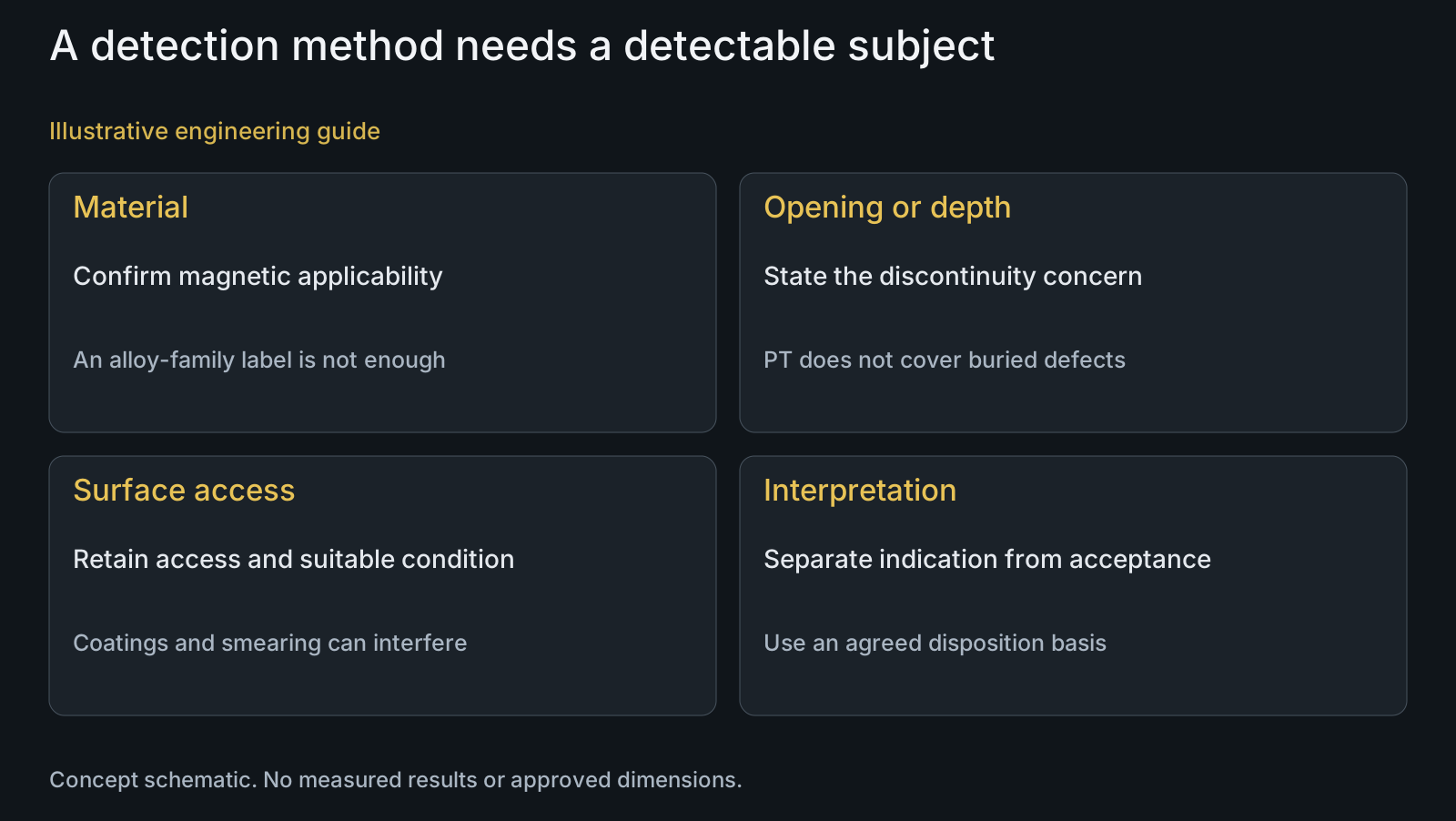
Stainless is not one magnetic inspection category
ASNT's magnetic-particle overview describes detection through magnetic flux leakage in ferromagnetic materials. That requirement is more precise than dividing all pivots into steel versus nonsteel. A stainless family label alone does not establish whether a particular supplied part can be effectively inspected by the proposed magnetic technique.
For ordinary titanium pivots, consider a suitable surface method such as PT rather than MT. For stainless pivots, supply the grade and condition and ask the testing provider to confirm method applicability. Some stainless conditions differ in magnetic behavior; do not turn a hand magnet response into qualification of an inspection technique.
The magnetic stainless pivot guide explains why attraction is not complete alloy identification. This article instead addresses inspection-method selection. Chemistry verification, magnetic response and crack detection remain different questions even when the same part raises all three.
Penetrant needs an opening, not just a surface location
ASNT's PT overview explains how penetrant enters surface-breaking discontinuities and developer produces an indication. The method does not reveal a completely buried discontinuity. A defect near the outer diameter is not necessarily open to that surface.
On pivot hardware, identify whether the inspection includes thread roots, under-head transitions, cross-hole edges or a hollow bore. A region needs access for the agreed preparation and examination, not merely a place on the drawing. Ask the provider to identify excluded or restricted regions rather than treating the phrase entire part as proof that every surface was examined.
If the concern is internal material integrity, neither a general PT request nor a near-surface MT request automatically covers it. Define that different defect question with the engineering and inspection teams. No universal detectable crack size or depth follows from an NDT label alone.
| Inspection question | Candidate basis | Main restriction | Verification focus |
|---|---|---|---|
| Titanium surface-opening concern | Suitable PT technique | No access to a buried discontinuity | Surface access and preparation |
| Ferromagnetic steel surface concern | Suitable MT technique | Field and geometry affect detection | Material response, region and orientation |
| Stainless part with unknown condition | Confirm material and applicability | Stainless label is insufficient | Grade, condition and provider review |
| Coated or mechanically finished part | Defined inspection stage | Openings may be masked or changed | Permitted preparation and later operations |
| Relevant indication found | Trained interpretation and agreed criterion | Method name does not decide acceptance | Location, classification and disposition |
| Delivery after examination | Agreed final supplied state | Residue or magnetism left unspecified | Cleaning, restoration and demagnetization |
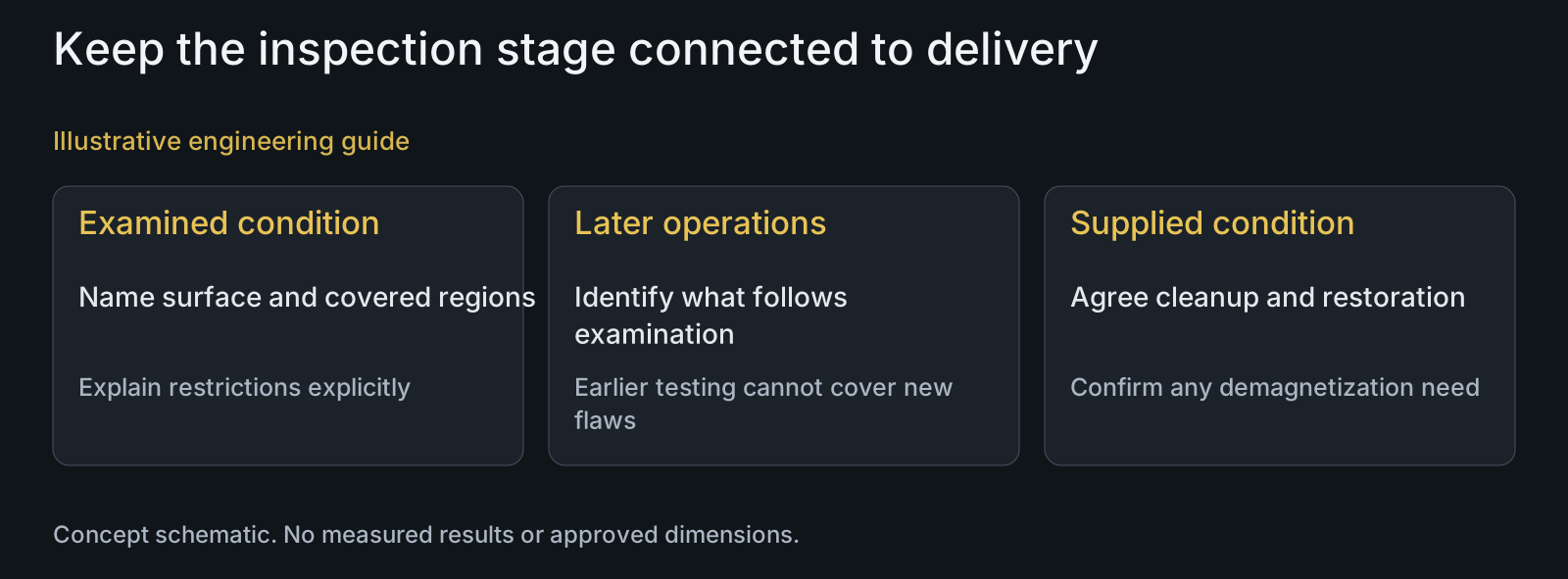
Inspection timing can change what is detectable
ASNT's penetrant process discussion identifies contamination and mechanically smeared or closed openings as limitations. A clean-looking blasted or polished surface is therefore not automatically a better PT surface. Preparation should suit the material and method instead of cosmetically hiding the condition under investigation.
Identify coating, lubricant, threadlocker and previous mechanical finishing before deciding when to inspect. Review whether the agreed process needs an uncoated inspection stage and whether later operations create a separate concern. Testing before a final operation does not by itself inspect discontinuities introduced afterward.
This is a route-specific decision, not an instruction to strip or chemically etch every pivot. Removal or preparation can alter finished dimensions, coating and traceability. Agree the permitted preparation, restoration and final supplied condition with the design owner. The surface treatment review is the manufacturing interface for those choices, not evidence of an approved NDT procedure.
An indication needs interpretation and an acceptance rule
ASTM E709 is a guide for magnetic-particle techniques, not a universal acceptance standard for every examined part. Its public scope calls for separate acceptance requirements and evaluation of indications. A technique can be appropriate while the order still lacks a criterion for disposition.
Specify the critical region and the applicable acceptance basis, including what the responsible team must do with a relevant indication. Thread geometry, transitions and retained inspection material require trained interpretation; do not identify every visible line as a crack or every absence of a line as proof of perfect material.
For PT, ASTM E1417/E1417M establishes process-control parameters and requires a detailed conforming procedure. Naming the standard does not supply every part-specific instruction. Confirm the required edition, personnel qualification basis, technique and report with the inspection provider; the article does not certify a supplier or a part.
Illustrative review: one request for two pivot materials
Illustrative engineering example: assume an OEM wants surface-crack inspection for a titanium shoulder bolt and a specified ferromagnetic steel axle. The drawings identify an under-head fillet and a cross-hole edge as the regions of concern. Both parts are intended to receive a later surface treatment. No defects, inspection outcomes or laboratory capability are assumed.
A single MT instruction for both parts is unsuitable because the titanium part does not satisfy the magnetic-material requirement. The review considers PT for its accessible surface-opening concern and a suitable MT technique for the steel part. It separately asks whether the under-head region and hole edge can be prepared and examined, and how the proposed fields address the suspected discontinuity orientation.
The team also defines whether inspection before the finish answers the required question and what later operations remain outside that result. It agrees acceptance and cleanup for each route. The outcome of this hypothetical review is a clearer inspection scope, not an accepted lot, a detected crack or a statement that either method guarantees bicycle safety.
Protect the supplied condition after inspection
Agree post-inspection cleaning and any required demagnetization as part of the supplied condition. A bearing seat, hollow passage or receiving thread should not arrive with unspecified inspection residues. If a finish or lubricant is restored, identify what was done and whether it changes the evidence being relied on.
The report should connect the examined part or lot, inspection stage, covered regions, method, findings and disposition basis. State sampling or full inspection explicitly when required; do not imply that every order receives every NDT method. Images of example hardware and inspection tools do not establish personnel certification, equipment ownership or completed testing.
PremFixer's manufacturing coordination can review drawings and the requested partner-inspection scope. Availability of the technique, preparation, personnel and reporting must be agreed for the actual project. A material certificate, dimension report or fatigue result does not replace the requested surface-discontinuity examination.
Questions buyers need to confirm
Can magnetic-particle inspection be used on titanium pivots?
No. MT requires suitable ferromagnetic material, which ordinary titanium pivot alloys do not provide. For an accessible surface-opening concern, review PT applicability with the inspection provider. Supply the grade, surface condition and critical regions rather than treating MT as a universal metal test.
Does every stainless pivot require penetrant instead of magnetic testing?
No single rule follows from the stainless label. Identify the grade and supplied condition, then confirm magnetic technique applicability. Hand-magnet attraction alone does not establish a suitable NDT procedure. PT may be appropriate for the defined accessible surface concern independently of that magnetic question.
Can penetrant detect a crack entirely below the surface?
No. It needs access to a discontinuity open or connected to the examined surface. Define whether the concern is surface-opening, near-surface or internal and identify restricted bore or thread regions. Select evidence appropriate to that scope rather than extending a negative PT report to buried flaws.
Should we inspect before or after coating and blasting?
Choose the stage that preserves detection access and answers the defect concern. Coating, contamination and mechanical surface changes can interfere with examination. Supply the operation sequence and permitted preparation; agree what later processing is outside the earlier result and what final restoration is required.
Does a no-indication report prove the part is defect-free?
No. It states the result within the method, preparation, coverage and detection conditions. Review those fields and the acceptance basis. It does not approve unrelated chemistry, dimensions, fatigue performance or inaccessible internal regions.
What must an NDT quotation include beyond PT or MPI?
Include part identity, material and condition, critical regions, finish and inspection stage, applicable method and edition, coverage, personnel requirements, acceptance basis and report. Add cleanup, restoration and any demagnetization requirement. These fields determine whether the proposed work answers the order rather than merely producing a method-named report.
Technical references and scope
ASNT, Magnetic-particle testing method. Professional body's public ferromagnetic-material, flux leakage, near-surface and technique limitations.
ASNT, Liquid penetrant testing method. Professional body's public surface-opening and suitable nonporous-material scope; no numerical sensitivity transferred.
ASNT, NDT method overview: liquid penetrant testing. Public original textbook excerpt on preparation, contamination and mechanical closure of openings; no etching recipe prescribed.
ASTM E709-21, Magnetic particle testing guide. Official active public guide scope, procedure and separate acceptance-rule boundary; no paid procedure reproduced.
ASTM E1417/E1417M-21e1, Liquid penetrant testing practice. Official active edition and public control-parameter/detailed-procedure boundary, not certification of an actual inspection.
Explore related component, material and sourcing decisions in the customer decision knowledge center. For a drawing review, use the Drawing/BOM RFQ path.
Specify crack inspection around the actual pivot surface
Send the pivot drawing and STEP model, material grade and condition, finish sequence, critical regions, quantities and defect concern. Include the required method and edition, coverage, acceptance and reporting basis, and post-inspection cleanliness or demagnetization needs. PremFixer can review manufacturing and coordinated inspection scope without treating a concept image or unperformed examination as evidence.
Discuss the drawing and BOM