
A moisture bag does not guarantee undamaged pivot hardware on arrival. It addresses moisture exposure only as part of a suitable sealed system; it does not stop bolts from striking each other or replace carton support. For custom pivot kits, identify vulnerable threads, bearing-contact surfaces and finishes, then map contact, movement, impact, compression and environmental risks along the proposed route. Select protective functions and evaluate the actual packed configuration against agreed damage criteria. The relevant evidence concerns that kit, quantity and packaging arrangement, not every possible shipment. PremFixer can discuss the required packing scope without claiming a universal zero-damage or corrosion-proof result.
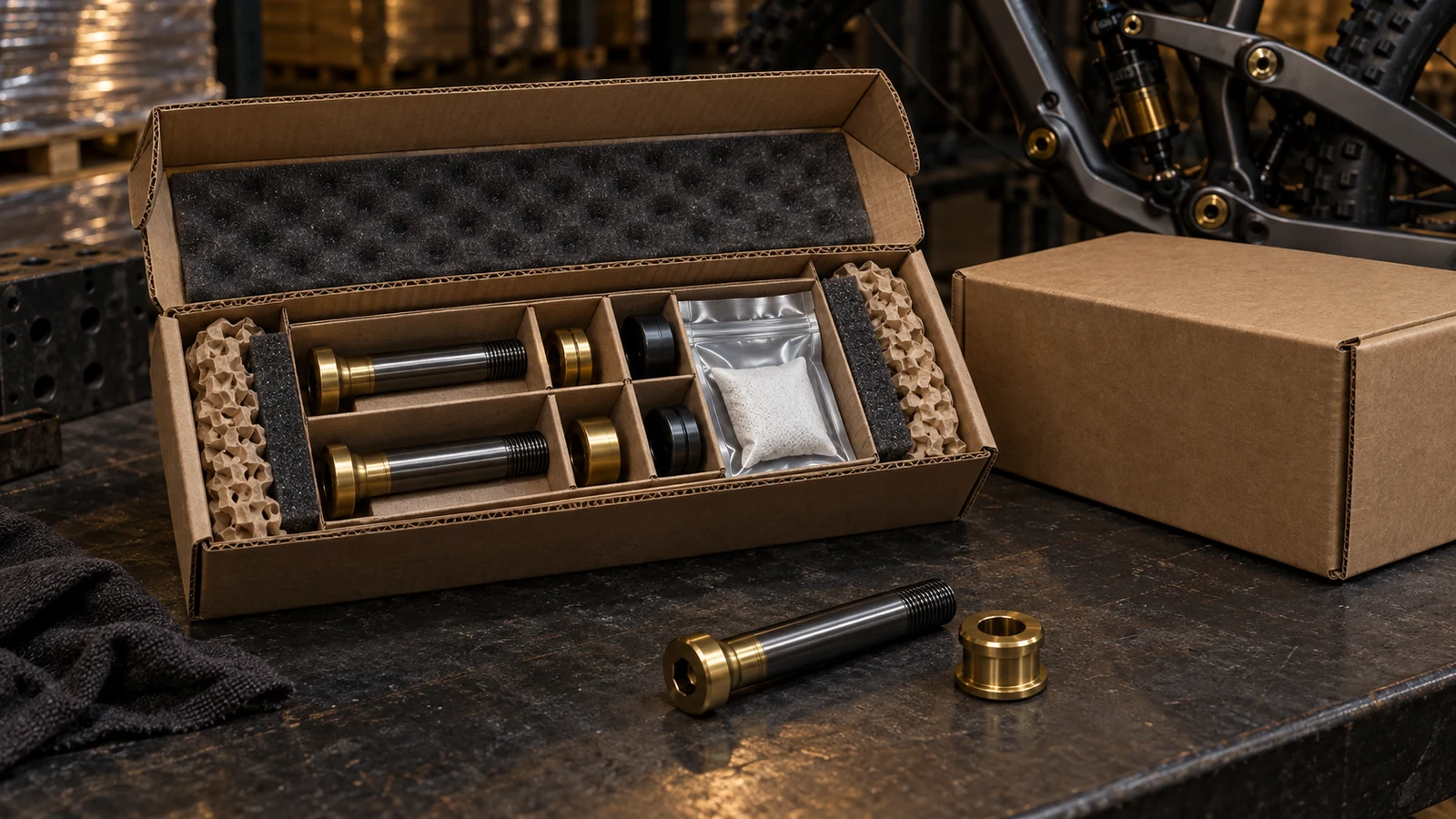
Hero: concept illustration of example hardware and its application. It is not a factory photograph, tested component or approved production geometry.
Start with the vulnerable feature and the handling route
Mark surfaces where contact damage would affect fit or acceptance. Threaded ends, bearing seats, sealing contacts and specified cosmetic areas can need different protection. Do not use one undifferentiated instruction such as 'avoid scratches' when a minor visible mark and a burr on a functional seat have different consequences.
Describe how the shipment will be handled: individual cartons, consolidated loads, pallet movement, storage and final receiving. If cartons are removed from a pallet for the last leg, evaluate that condition rather than assume they remain in their original unitized form throughout.
The international shipping guide separates transport endpoints. Here the question is what happens to the packed hardware through those handling conditions. The selected delivery scope helps establish which physical package configuration actually needs evaluation.
Separate contact control from cushioning and restraint
Individual sleeves or divided compartments can keep surfaces from contacting other metal parts. They do not automatically restrain the entire tray inside the carton. A separated bolt that moves freely can still strike a wall or another package after its protective layer shifts.
Specify how the hardware, tray and outer container remain located relative to one another. Consider threaded ends and heavy components that could concentrate contact at a small area. An insert should protect relevant features without pressing an unassessed material against a critical surface or leaving residue that conflicts with acceptance.
Cushioning and restraint are not interchangeable names for extra filler. Evaluate whether the arrangement controls the intended movement and handling event. The sealed packaging discussion addresses protection and identity; this assessment asks whether those functions survive the proposed transport configuration.
| Risk | Proposed function | What it does not prove | Evaluate |
|---|---|---|---|
| Metal-to-metal contact | Separate critical surfaces | Whole-pack restraint | Contact locations after relevant handling |
| Movement inside the carton | Locate hardware and inserts | Moisture control | Movement and concentrated load paths |
| Impact during handling | Suitable restraint and cushioning | Unlimited drop resistance | Packed-product damage against agreed criteria |
| Stacking or load pressure | Support the intended packed load | Protection after pallet breakdown | Actual outer and internal configuration |
| Moisture exposure | Barrier, closure and scoped desiccant | Cleanliness or universal corrosion-free life | Selected system and exposure assumptions |
| Wrong kit contents | Visible identity and BOM reconciliation | Transit resistance | Parts, revisions and quantities |
| Changed pack or route | Review applicability of prior evidence | Automatic coverage from identical box appearance | Affected conditions and relevant evaluation |
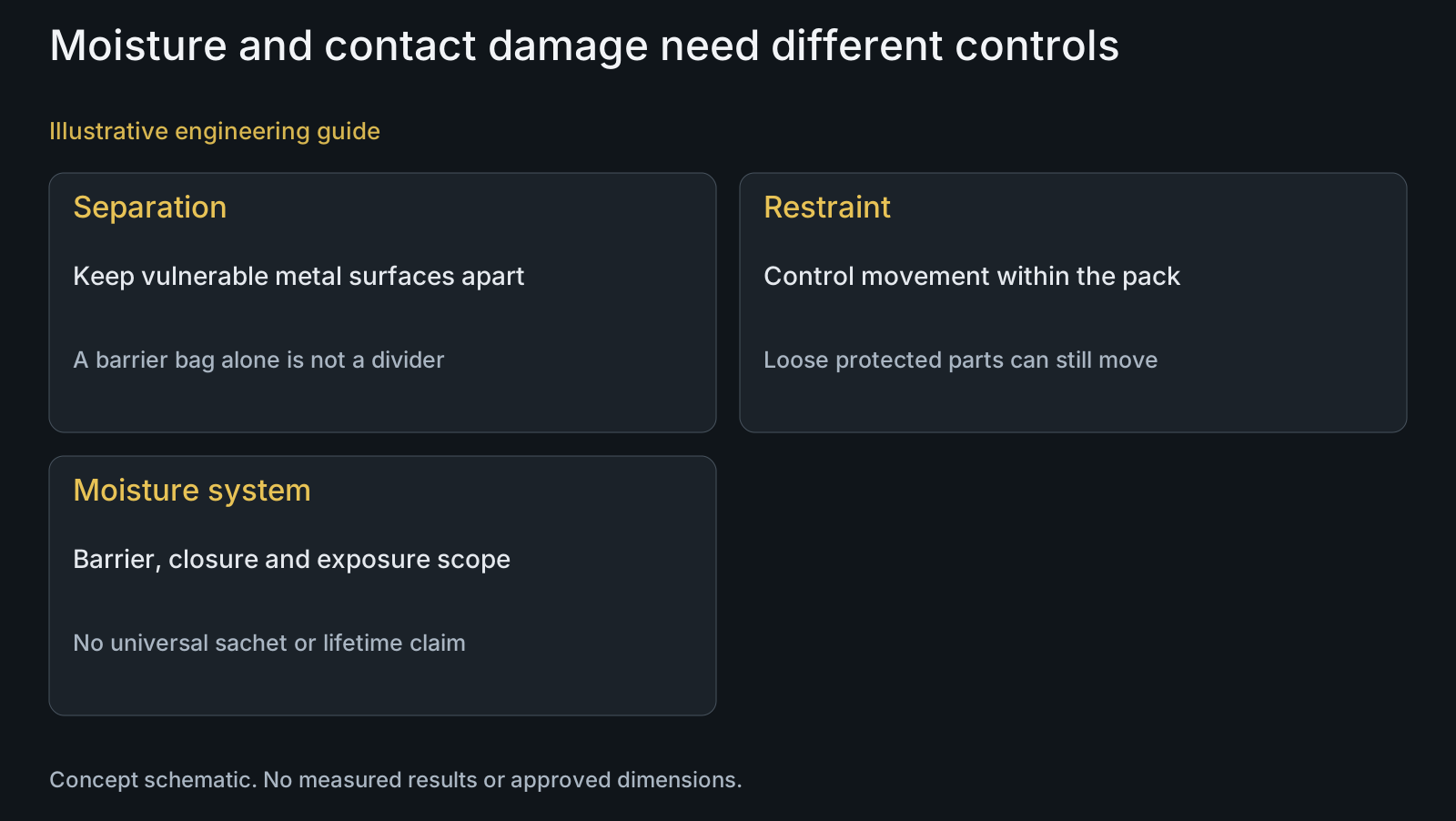
Treat moisture protection as a defined system
Desiccare's technical FAQ identifies package size, contents and barrier properties as inputs to desiccant selection, and recommends a suitable closed barrier or sealed container. Its guidance does not provide a universal sachet quantity or guaranteed protection period for bicycle hardware.
Specify the barrier, closure and intended exposure instead of using 'plastic bag' as a moisture-performance requirement. Discuss residual moisture and the condition in which parts enter the pack. Adding a desiccant does not resolve a damaged seal or an unspecified barrier material.
Keep moisture protection separate from cleanliness, surface acceptance and impact control. A dry-looking sealed package is not evidence of cleanroom preparation or a tested corrosion-free lifetime. Define any additional required condition and ask how it will be established rather than infer it from the presentation.
Evaluate the complete packed product with defined criteria
ISTA's guidance connects test selection to the actual distribution environment and the product-package combination. It calls for representative samples and damage criteria defined before testing. Select the current applicable procedure or agreed evaluation with a competent provider rather than declare one protocol mandatory for all pivot shipments.
Define what constitutes unacceptable damage to the hardware, loss of required identity and unacceptable package degradation. Inspect the relevant functional features and contents at the agreed point. An unbroken outer carton alone cannot establish that every bearing seat or thread remains acceptable.
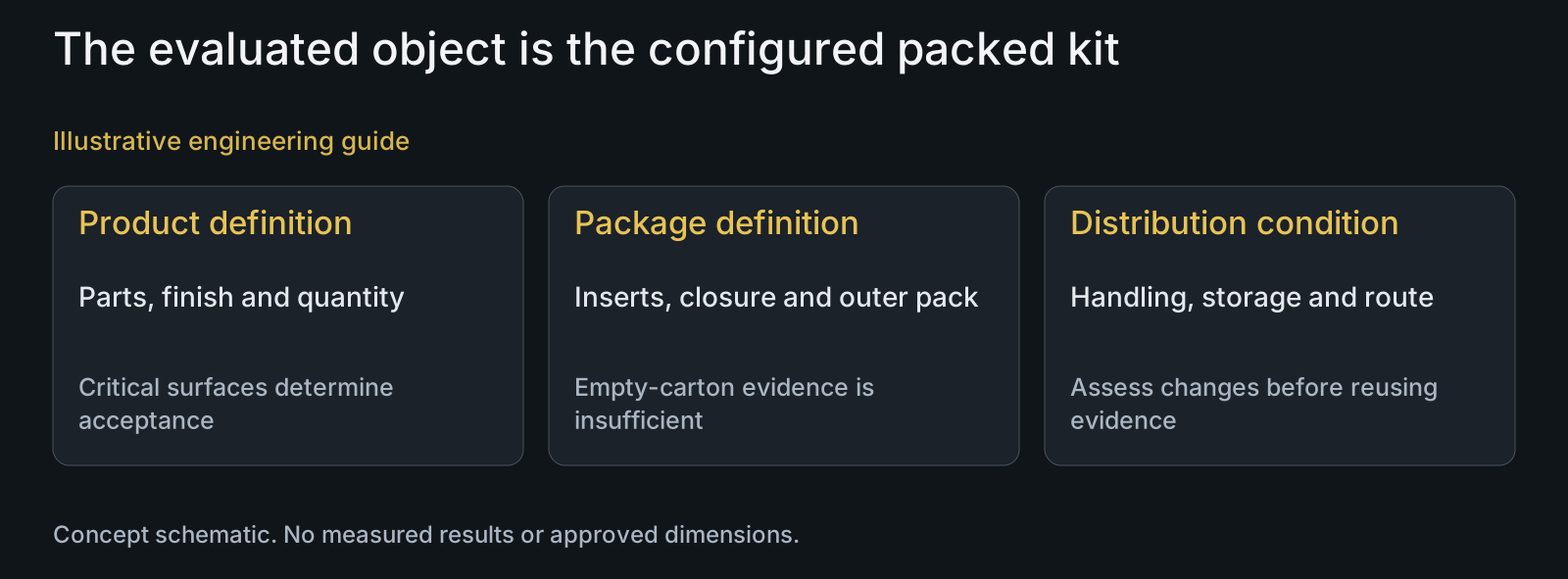
Identify the evaluated part, pack quantity, inserts, closure and outer configuration. Review the evidence if these change or the distribution route changes. A test on a different quantity or interior arrangement must not be described as a demonstrated result for the proposed kit without an appropriate basis. No package-test capability or certification at PremFixer is claimed here.
Preserve usability when the customer opens the pack
Protection must allow the receiving team to identify the part numbers, revisions and quantities against the BOM. A beautifully separated pack can still contain an incorrect spacer. Contents accuracy and transport resistance answer separate questions and need their own acceptance basis.
Plan how cartons are opened, where parts are stored and how they reach the assembly station. Removing all protection for receiving may create a different exposure from the original shipping condition. Agree the necessary information visibility without forcing needless disturbance of every protective layer.
If damage is observed, identify the affected hardware and packaging configuration and preserve useful evidence. A crushed outer box may require closer inspection, but it does not by itself determine the disposition of every component. Contact the responsible parties and follow the agreed acceptance process rather than silently returning damaged parts to unrestricted stock.
Review example: a sealed bag still permits metal contact
Illustrative engineering example: assume several finished pivot bolts and spacers are placed loosely inside one moisture-barrier bag. The bag addresses a stated environmental concern, but nothing prevents the components from touching during handling. No actual transport damage or test result is assumed.
The review identifies separation and restraint as missing functions. It proposes a divided arrangement compatible with the critical surfaces, then defines how the full pack will be evaluated. The outer carton, internal quantity and closure remain part of the evaluation rather than unrelated purchase details.
If an early sample uses a different insert or packed quantity, its evidence is identified accordingly. The conclusion is not that every divided tray passes transit testing. It is that moisture control cannot substitute for the mechanical protection the original configuration lacked.
Questions buyers need to confirm
Does individually bagging each bolt prevent transport damage?
Not by itself. A bag may separate surfaces, but assess its ability to remain intact and how the items are restrained inside the outer pack. Threaded ends and heavy components can create concentrated contact. Evaluate the actual packed configuration rather than the bag name.
Can one desiccant sachet protect every pivot shipment?
No universal quantity is established. Package size, contents, barrier, closure and exposure affect the selection. Obtain a suitable moisture-system assessment and keep it separate from mechanical protection; do not infer a guaranteed dry period from a generic sachet.
Is an undamaged carton proof that the hardware is acceptable?
No. Reconcile the contents and inspect the agreed relevant features. Hardware may move or contact other parts without obvious external damage. Outer condition is useful evidence, not a replacement for component and kit acceptance.
Must all pivot shipments use the same ISTA test?
No universal procedure is specified here. Select the current evaluation for the actual distribution environment, product and pack, with the required acceptance criteria. Do not claim certification or a full-protocol result from a limited informal check.
Does changing the tray quantity matter if the box is unchanged?
It can. Quantity changes mass distribution, contact and restraint within the pack. Identify the evaluated configuration and review which evidence still applies before describing the revised pack as demonstrated.
Should packing protect the kit after it is opened?
Discuss the actual receiving and storage task. Shipping protection may be removed at receipt, changing exposure before assembly. Keep identity, relevant surface protection and handling requirements understandable in the state the customer will actually use.
Technical references and scope
ISTA: getting started with design and testing. Distribution-specific selection, representative packed-product samples, pre-defined damage criteria and change review. No mandatory universal protocol or owned/certified test facility asserted.
Desiccare technical FAQ. Desiccant sizing inputs and appropriate barrier/container use. No supplier material endorsement, numerical dose or guaranteed dry period adopted.
Explore related component, material and sourcing decisions in the customer decision knowledge center. For a drawing review, use the Drawing/BOM RFQ path.
Specify protection for the actual packed pivot kit
Send the drawing and BOM, quantities per pack, finished surfaces and damage criteria, proposed handling and transport route, storage exposure and receiving process. Include existing pack details and any required evaluation. PremFixer can discuss the packing scope and identify which protective functions and evidence need agreement.
Discuss the drawing and BOM