

A pivot fastener supply interruption plan should select the recovery route that removes the actual obstacle to usable hardware. Start with the affected bolt, sleeve or kit configuration, its required revision, the quantity needed and the receiving milestone. Accepted accessible stock may bridge a shortage; an approved alternate process may address lost manufacturing availability; faster transport may help only once the represented parts can be released. Do not treat these as automatic escalation steps or relax technical acceptance because the order is urgent. Acknowledging the incident, containing its effects and confirming a recoverable delivery are different commitments that need different evidence.
Hero: concept illustration of example hardware and its application. It is not a factory photograph, tested component or approved production geometry.
Identify the interruption before choosing an emergency response
State what cannot proceed and why: input material is unavailable, a manufacturing operation is interrupted, a quality hold prevents release, or a transport movement is blocked. Record the affected parts and revisions rather than labelling every delayed item as the same supply failure.
Compare the customer's requirement with accessible, accepted hardware. Physical stock can be reserved for another order, held for investigation or incompatible with the required configuration. Its presence does not establish availability for the affected build. Complete-kit positions matter even when the interruption concerns a small spacer.
ISO's public description of ISO 22301 concerns a business-continuity management system for preparation, response and recovery. It does not prescribe this article's three recovery choices, an eight-hour response or PremFixer certification. The choices below are an engineering review aid, not a claimed certified emergency service.
Use stock only when the represented quantity is usable
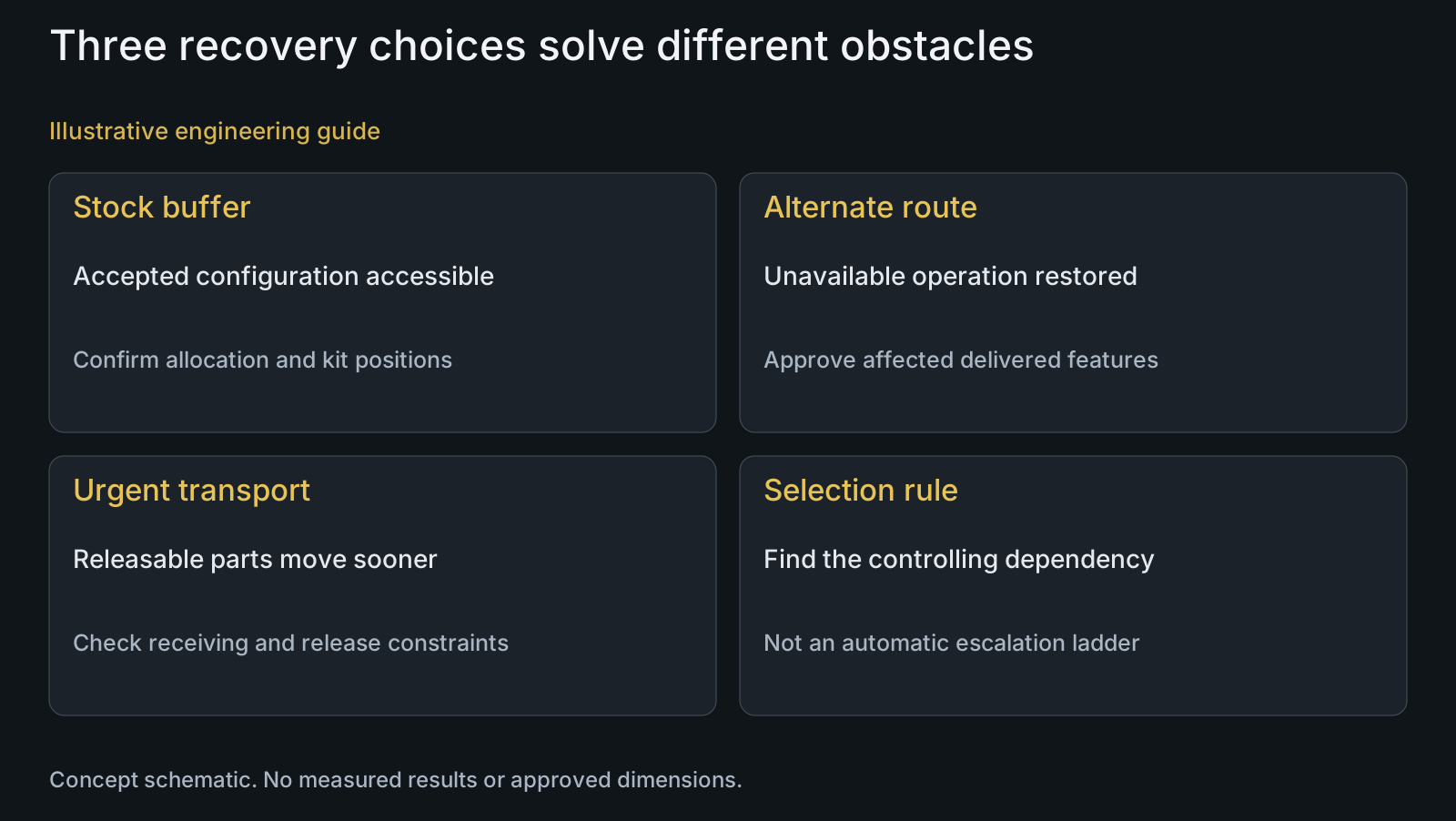
A stock buffer can remove a supply gap when the parts match the required revision and acceptance condition, are accessible and can be allocated with the necessary kit positions. Identify who can authorise that allocation and whether it changes another committed supply obligation.
Check why any stock is held. A quarantine boundary protects the investigation; urgent demand is not evidence that the hold can be removed. If only a subset is demonstrably unaffected, the authorised quality decision must define that subset and the basis for its release.
The complete-kit sourcing comparison explains why extra bolts do not necessarily restore assembly output. In an interruption, the additional question is whether the available kit can be released now without bypassing a reservation, identity or quality constraint.
| Recovery option | When it can help | Remaining risk | Evidence to review |
|---|---|---|---|
| Accessible stock buffer | Accepted matching configuration can be allocated | Held, reserved or incompatible stock counted as usable | Identity, release status, allocation authority and complete-kit balance |
| Alternate manufacturing route | The unavailable operation can be performed elsewhere | Capacity mistaken for equivalent delivered features | Affected characteristics, route comparison and approval evidence |
| Urgent transport | Releasable represented parts exist and movement controls timing | Express collection mistaken for quality release | Shipment contents, release status, movement constraints and receiving work |
| Combined option | Different dependencies genuinely require different actions | One unresolved condition hidden by activity elsewhere | Named owner and closure basis for each dependency |
| Containment while unresolved | A quality or identity question prevents safe commitment | Urgency treated as permission to bypass the hold | Affected population, protected boundary and authorised disposition |
Treat an alternate route as a controlled technical change
An alternate machine, production site or finishing provider may restore an unavailable operation, but capacity alone does not establish equivalent output. Identify which final characteristics the route can affect: locating diameters, shoulder relationships, thread condition, material condition or treatment-related dimensions.
Compare the proposed route with the approved requirements and determine the necessary evidence and authority before using its output. Some changes may preserve the existing requirement without a drawing revision; others require a customer decision. Neither possibility can be assumed merely because the alternate provider can start quickly.
Use the manufacturing overview, surface-treatment discussion and revision-compatibility guide to define the affected interface and delivered condition. PremFixer's coordinated supply scope does not establish a permanently reserved backup line or blanket permission to substitute a process.
Use urgent transport after checking release and receiving constraints
Urgent transport addresses a movement delay, not unfinished manufacturing or an unresolved acceptance decision. Ask which releasable parts exist, where they are located, what packages contain them and which collection and receiving constraints apply to the proposed route.
Compare a transport proposal against the milestone the customer actually needs. Earlier arrival may still miss usable release if receiving, required checks or missing kit positions remain unresolved. A partial shipment helps only when its represented configuration supports an agreed action at the destination.
The expedited-order guide considers urgent order timing and scope. An incident recovery decision has an additional boundary: decide whether the delay is actually a transport problem before incurring an express charge. A carrier quotation is not evidence of part acceptance or a guaranteed recovery outcome.
Review a quality hold without mistaking transport for recovery
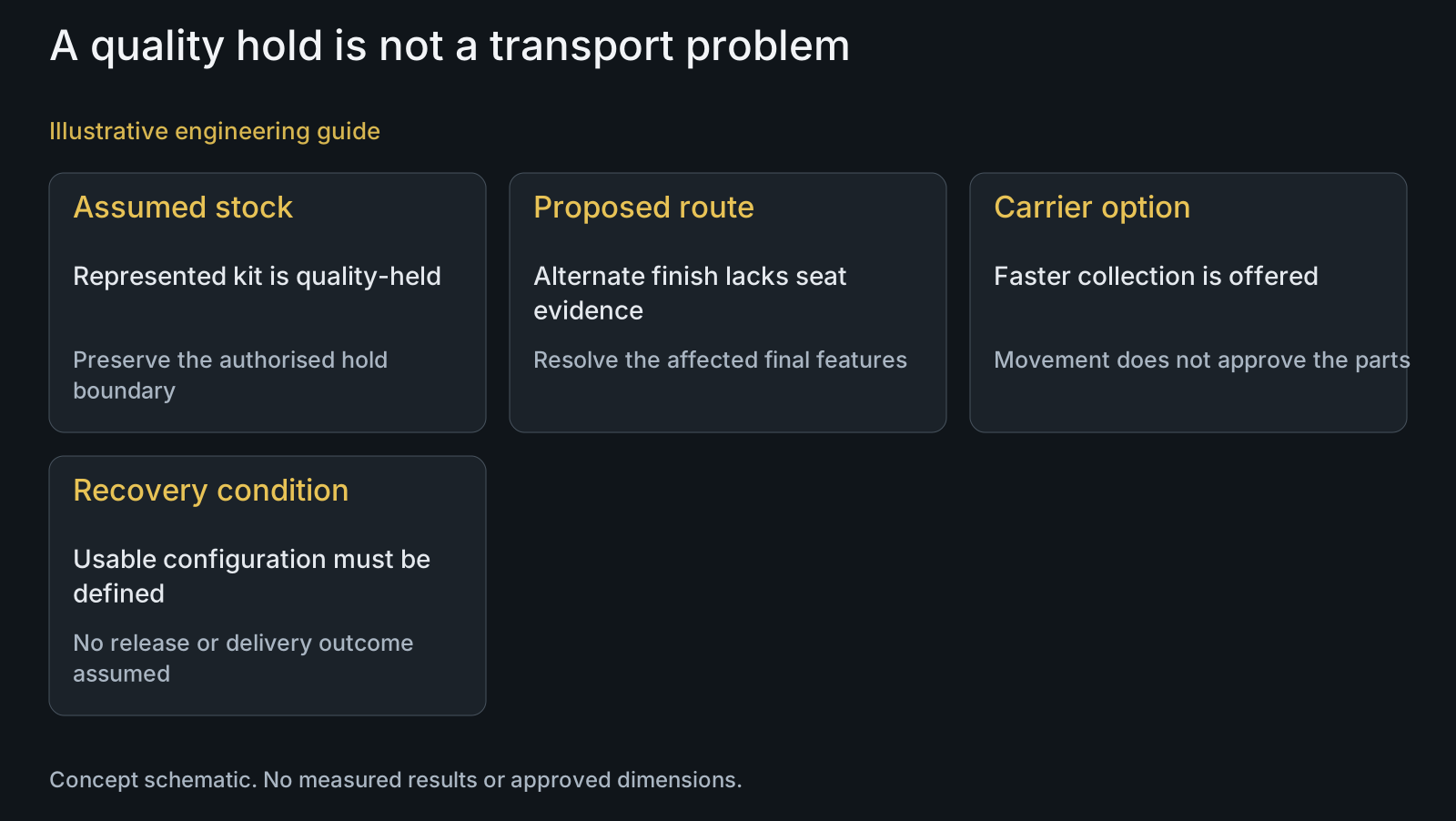
Illustrative engineering example: assume a pivot kit's available stock is quality-held, an alternate finishing route is proposed, and a carrier offers faster collection. The changed route has no accepted evidence for the final bearing-seat condition. These are hypothetical inputs, not a real incident, defect or delivery result.
The reviewer first preserves the held-stock boundary and identifies the release authority. It then asks which final seat characteristics the alternate route may change and what evidence would support its use. Paying for faster collection cannot answer either quality question.
Transport becomes a meaningful comparison only after a represented acceptable configuration is available or a conditional release plan has been authorised by the proper owner. The example assumes neither approval nor successful delivery. Its lesson is to select the recovery dependency before selecting the fastest-looking activity.
Separate response commitments and record the chosen boundary
An acknowledgement confirms that the interruption has been received. Containment identifies affected scope and protects against unintended use. A recovery proposal names an option and its unresolved conditions. A confirmed usable delivery needs evidence appropriate to the represented parts, release and receiving route.
Agree named contacts, decision owners and the next information needed for each commitment. Do not compress these into an unsupported universal response-time promise. If an input changes, explain how the selected route and its conditional expectation change rather than presenting an old forecast as a confirmed outcome.
Provide the drawing, material and kit definition through the materials overview and project RFQ path. Keep the chosen option, unresolved conditions and approval boundary visible to the customer. The knowledge center links related sourcing decisions; it is not proof that any particular emergency stock, alternate line or freight arrangement is available.
Questions buyers need to confirm
Must a recovery plan use stock, then a backup line, then airfreight?
No. Select the action that removes the actual dependency. Accepted accessible stock, an approved alternate route and faster movement address different problems. A combination may be appropriate, but activity at one point does not close an unresolved condition elsewhere.
Can physically available pivot stock be used immediately?
Only when identity, revision, release status and allocation authority support that use. Check every required kit position and any reservation or hold. Urgent demand does not itself release quarantined stock or authorise taking another project's allocation.
Is an alternate finishing provider automatically interchangeable?
No. Identify the final dimensions, surface condition and interfaces its work may affect. Compare the route against the approved requirements and obtain the applicable evidence and authority. Starting capacity is not evidence that the delivered condition is acceptable.
When does emergency airfreight help?
When releasable represented parts exist and transport is the timing constraint. Supply shipment contents, location, collection restrictions, destination and receiving requirements. It cannot finish manufacturing, remove a quality hold or resolve missing kit positions.
What does an incident acknowledgement establish?
That the message has been received, not that recovery is secured. Ask separately for affected scope, containment, the proposed option and its conditions. A confirmed usable delivery requires more evidence than an acknowledgement or a preliminary carrier quote.
What should I send for a recovery review?
Send the affected drawing and BOM revisions, part quantities, needed receiving milestone, actual usable balances and interruption evidence. Identify the technical and allocation decision owners. Those fields determine which options are feasible; no universal emergency response period or backup capacity is promised here.
Technical references and scope
ISO 22301:2019 public standard description. Public business-continuity management-system scope for preparation, response and recovery only. No detailed clauses, mandatory three-level sequence, response period or PremFixer certification inferred.
Explore related component, material and sourcing decisions in the customer decision knowledge center. For a drawing review, use the Drawing/BOM RFQ path.
Review the dependency blocking your pivot hardware supply
Send the drawing, STEP file or sample, affected BOM revisions, quantities and required receiving milestone through the Drawing/BOM RFQ path. Include the interruption, usable-stock position, held scope and authorised decision contacts. PremFixer can discuss the represented recovery options and evidence needed without treating faster transport as approval of changed hardware.
Discuss the drawing and BOM