
Choose single-source or multi-source pivot hardware against the usable kits you need after a specified disruption. For an OEM bolt, sleeve and washer package, an extra supplier matters only if its approved scope, activation work and available quantities support the required configuration at the required recovery point. Single coordination can reduce handoffs; multiple sources can create another recovery route, but neither guarantees continuity. Evaluate the accepted BOM and the limiting item rather than count vendor names. A qualified bolt source with no usable sleeves may restore component supply without restoring bicycle assembly, and a reserve quantity may be unavailable if its release terms remain unresolved.
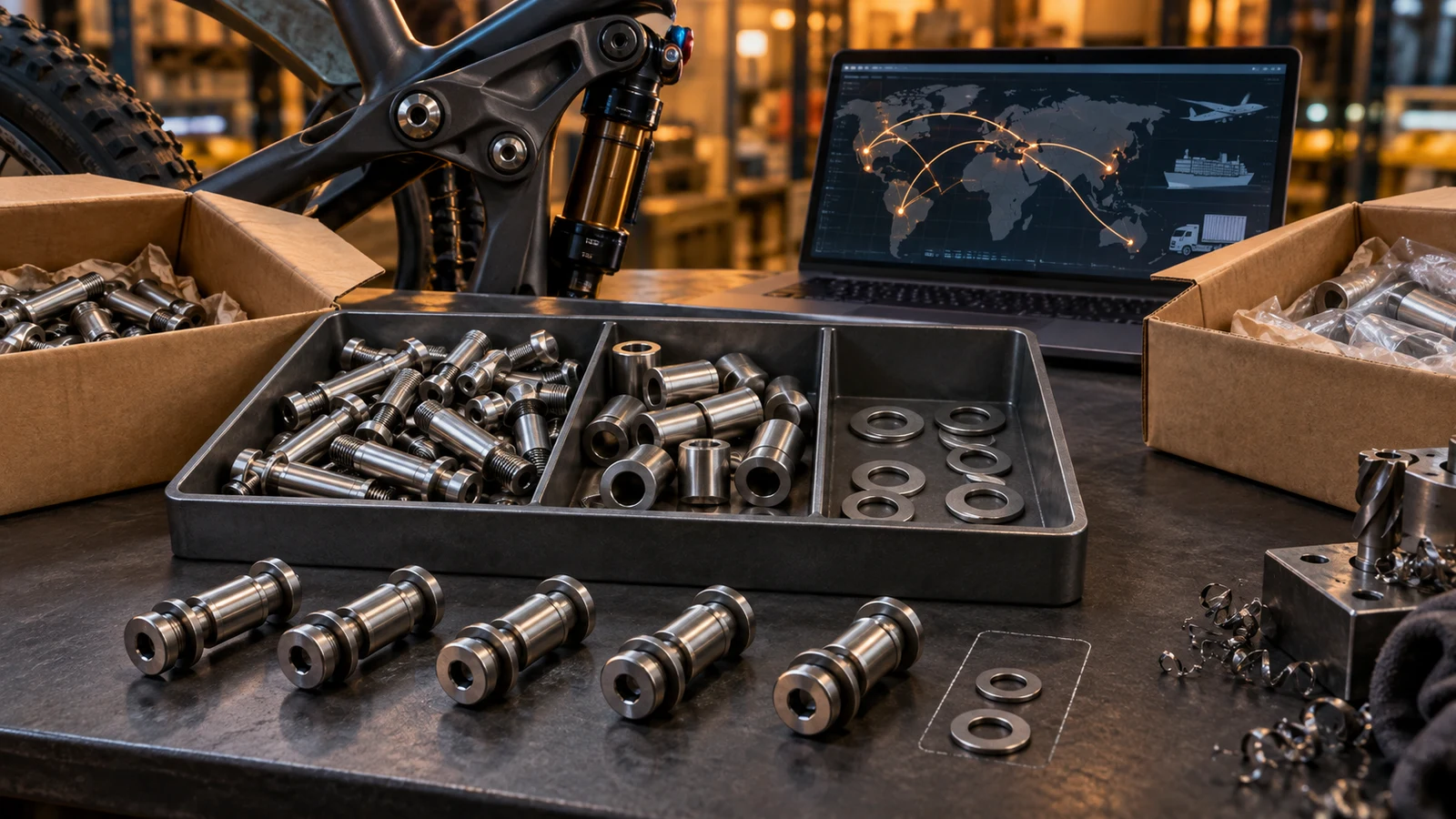
Hero: concept illustration of example hardware and its application. It is not a factory photograph, tested component or approved production geometry.
Set the recovery question before comparing vendor counts
Name the interruption, the work that must continue and the recovery point the buyer needs. Distinguish continuing assembly from replacing a material input or restarting machining. These are different outputs; a plan can solve one while leaving another blocked.
The existing sourcing-structure guide explains dependencies and alternate-source scopes. Use it to identify the risk, then use this article to test the output of the proposed fallback. Do not repeat source qualification as if it demonstrated actual recovery performance.
NIST's manufacturing risk guidance recommends mapping supply dependencies and considering how alternative sites can start shipping. Its general manufacturing advice supports reviewing activation rather than assuming immediate availability. It supplies no pivot-specific allocation ratio, recovery deadline or PremFixer continuity commitment.
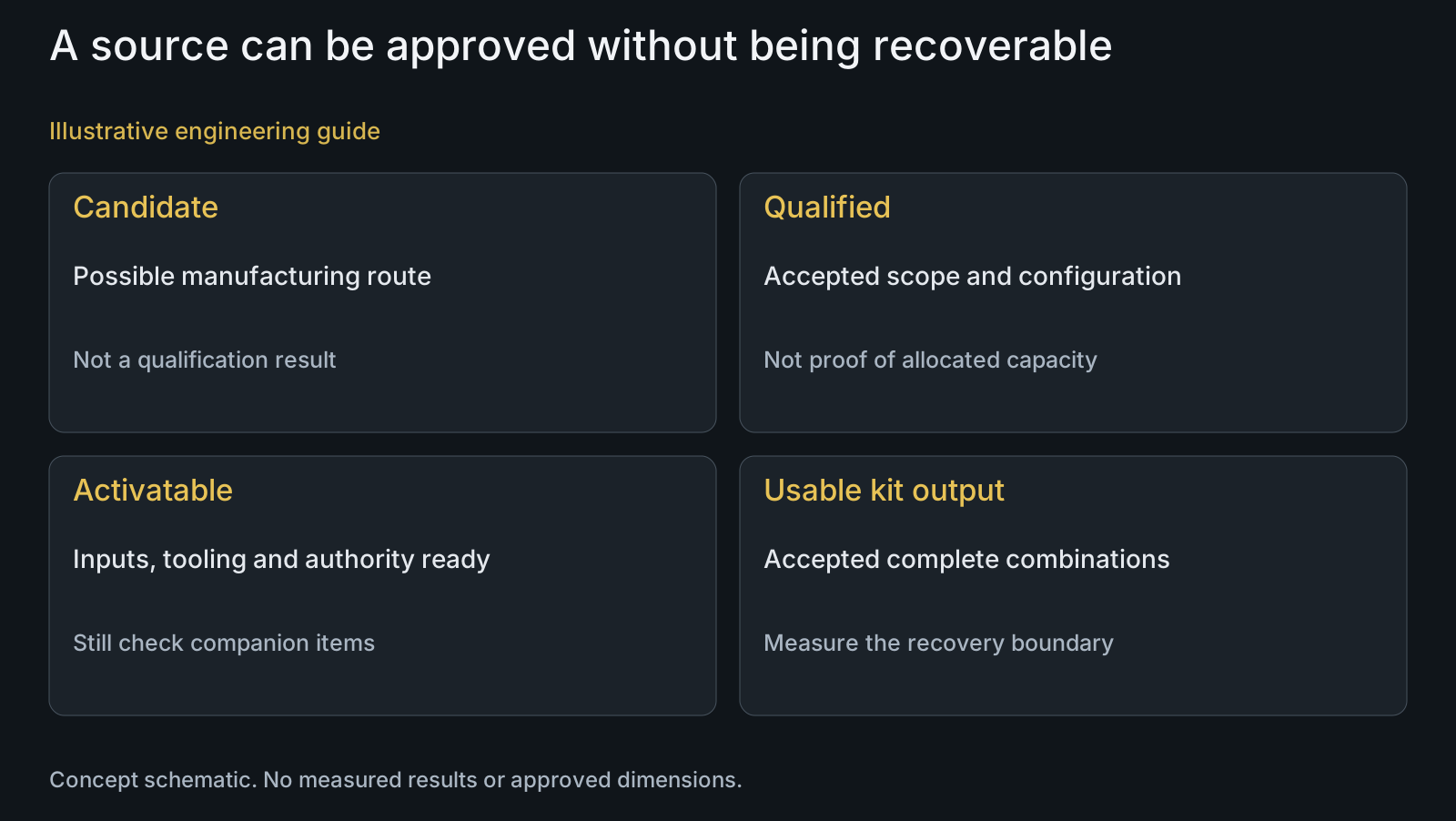
Distinguish candidate, qualified and available sources
A candidate has offered a possible route. A qualified source has the relevant approval for a defined part, site, revision and delivered condition. An available source can also perform the agreed work with accessible tooling, inputs and capacity at the relevant time. Keep these claims separate in the comparison.
Ask which activities remain before first usable delivery. A material source may need input verification; a finished-part alternative may need tooling transfer or an unresolved finishing route. An approved source may still have no agreed production allocation. Describe these dependencies explicitly instead of using a single backup-ready checkbox.
For a titanium input, use the specified grade, product form, condition and record requirements from the titanium stock discussion. The framework's TC4 suggestion is not permission to substitute an alloy or proof that every pivot program needs a universal dual-stock policy.
| Proposed arrangement | Potential contribution | Remaining limitation | Evidence needed for reliance |
|---|---|---|---|
| Candidate backup supplier | Possible alternative route | Qualification and activation unfinished | Accepted scope and remaining work |
| Qualified part source | Approved specified component | Capacity or kit companions unavailable | Accessible quantity at recovery point |
| Split component sourcing | Supply from multiple providers | Unapproved mixing or kit imbalance | Permitted combinations and BOM balance |
| Coordinated alternatives | One interface for defined routes | Hidden shared bottleneck or unclear authority | Activation responsibility and dependencies |
| Defined usable buffer | Bridge a bounded replenishment gap | Wrong revision or release restrictions | Accepted stock, ownership and access |
| Extra non-limiting item | More units of that component | May add no complete recoverable kits | Compare against the actual limiting item |
Calculate the limiting quantity at the accepted kit boundary
For independently interchangeable items, divide each usable item quantity by the number required in one BOM kit, round down to whole kits and take the smallest result. This is a simple quantity bound, not a prediction of yield or a promise to ship. Use only quantities accepted for the required configuration and available by the chosen recovery point.
Exclude unresolved or rejected items, inaccessible reserves and units allocated to other orders. If source mixing is restricted, first separate the quantities into permitted combinations; pooling incompatible sets can overstate recovery. Count a complete assembly's required washers and sleeves, not just its most expensive bolt.
A large non-limiting stock addition may produce no extra kits. The next action should address the limiting item's accepted availability, or the buyer's delivery plan, rather than buy whichever component has the fastest quotation. Material and manufacturing requirements still control what may enter the calculation.
Make the activation sequence explicit
Separate work that can run in parallel from work waiting on a predecessor. Quote review, tooling access and evidence planning may overlap where their inputs are known. Finishing cannot represent a finished component that has not been manufactured, and acceptance cannot rely on a report whose subject is still undefined.
Ask the responsible parties to state the next controlling dependency and its current status. Do not add every estimated activity duration as though all were sequential, or use the longest activity alone when a chain of prerequisites still remains. Any recovery date must account for the actual route and assumptions.
Use the manufacturing overview and surface-treatment scope to clarify offered operations. PremFixer coordinates confirmed in-house manufacturing with relevant qualified partners, but that model is not evidence of reserved partner capacity, accessible emergency tooling or a guaranteed activation time.
Work through an assumed limiting-washer scenario
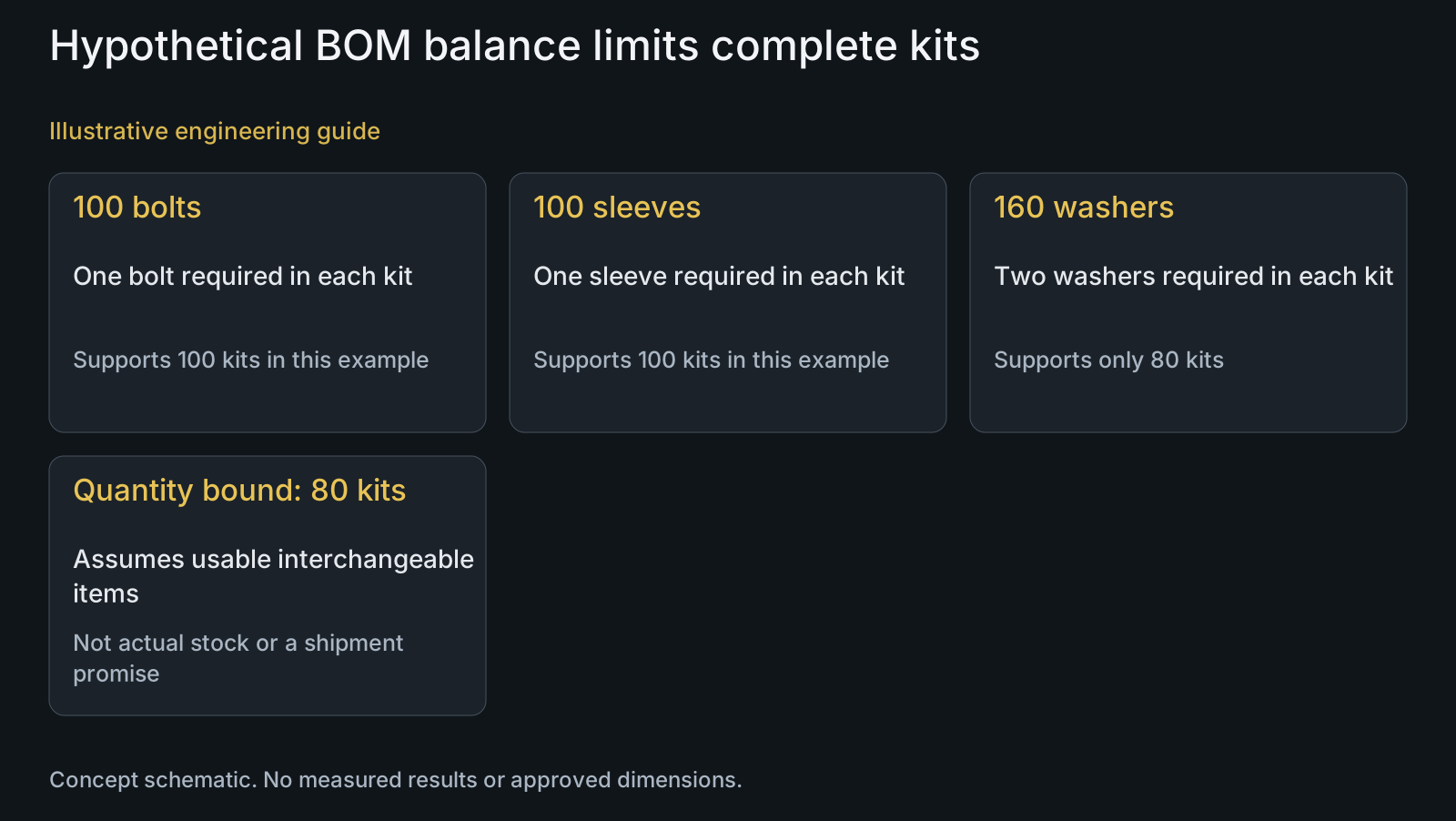
Illustrative engineering example: assume one accepted kit needs one bolt, one sleeve and two washers. At the chosen review point the plan assumes 100 usable bolts, 100 usable sleeves and 160 usable washers, with cross-source mixing permitted. These are hypothetical planning counts, not PremFixer stock or measured production results.
The quantity bound is 80 complete kits because 160 washers support only 80 sets. Adding another 50 accepted bolts alone does not change that bound. If 40 additional accepted washers become accessible at the same point, the arithmetic bound becomes 100 kits, but receiving, packing and any other actual constraints still need review.
If the buyer instead requires matched source-specific sets, this pooled calculation is not valid. Recalculate by permitted combination. The example shows why the sourcing decision needs BOM quantities and mixing permissions; it does not demonstrate an actual recovery, allocation or delivered result.
Compare the commercial commitment behind each fallback
Identify who pays for maintaining the alternative, owns any reserve, authorises activation and accepts the allocation consequences. An updated forecast is not automatically an order for emergency stock, and a spare-source qualification is not automatically a capacity-reservation contract.
Compare one coordinated supplier with staged alternatives, active split sourcing and defined buffers against the same recovery objective. Additional orders can bring revision and allocation work; concentrated coordination can leave a critical dependency. Record the expected output and remaining limitation for each option, without inventing failure probabilities or universal savings.
Use the supplier-evaluation questions for the offered scope and the customer decision knowledge center for adjacent purchasing decisions. Agree when the fallback assessment will be updated if the BOM, allocation or provider route changes. The objective is a usable arrangement, not a claim that one sourcing model is always best.
Questions buyers need to confirm
Is a single pivot supplier automatically too risky?
No. Compare the required recovery output and actually offered alternatives against the defined disruption. One accountable supplier can coordinate several scoped routes; several vendors can still leave a limiting dependency. Supplier count alone cannot establish recoverable kit supply.
Does source qualification establish immediate availability?
No. Qualification concerns the accepted scope; activation also needs accessible tooling, inputs, capacity and authority. Ask what remains before the first usable delivery and how companion items become available at the same recovery point.
How should we estimate complete kits from component stock?
For permitted interchangeable items, divide each accepted usable quantity by its BOM requirement, round down and take the smallest result. Exclude unavailable and unresolved quantities. If matched sets or source-mixing restrictions apply, calculate only permitted combinations instead of pooling everything.
Will extra bolts protect assembly when washers are short?
Not by themselves. A kit requiring washers remains limited by accepted washer availability. Identify the limiting item using the actual BOM and recovery point, then review that item's sourcing or the delivery plan rather than assume every stock increase adds complete kits.
Can one supplier coordinate a multi-source recovery plan?
Yes, as a specifically agreed arrangement. Identify coordinated operations, approved alternatives, activation authority and quantity commitments. Do not infer reserved stock, independent providers or emergency capacity from a one-stop service description.
What inputs make a sourcing-resilience RFQ useful?
Provide the released drawings and BOM, permitted source combinations, usable stock by revision, demand and required recovery point. Identify the disruption, proposed alternate scope, remaining approvals and stock/capacity responsibilities. These fields let the supplier discuss actual fallback output rather than quote a generic backup list.
Technical references and scope
NIST manufacturing supply-chain risk guidance. General manufacturing dependency mapping and alternative-site activation context; not a prescribed pivot sourcing ratio or supplier recovery commitment.
Explore related component, material and sourcing decisions in the customer decision knowledge center. For a drawing review, use the Drawing/BOM RFQ path.
Review the kit output of your proposed fallback
Submit the drawing or STEP model, released BOM, quantities per kit, usable stock and permitted source combinations through the Drawing/BOM RFQ path. State the disruption, required recovery point and proposed stock/capacity responsibilities. PremFixer can discuss the scoped manufacturing arrangement and limiting dependencies without treating a supplier list as guaranteed continuity.
Discuss the drawing and BOM