
An OEM should specify Cpk for a named pivot-hardware characteristic and production question, not as a rating for an entire factory. Define the drawing limits, delivered condition, measurement method, represented route and data structure before agreeing the target. Also say whether the decision uses the reported estimate or a specified confidence-bound criterion, and what response is required when evidence is insufficient or below target. Generic values cannot decide those details for every bearing seat, thread or spacer. A numerical result from a few prototypes does not establish ongoing production capability, and changing the calculation cannot improve the physical process by itself.
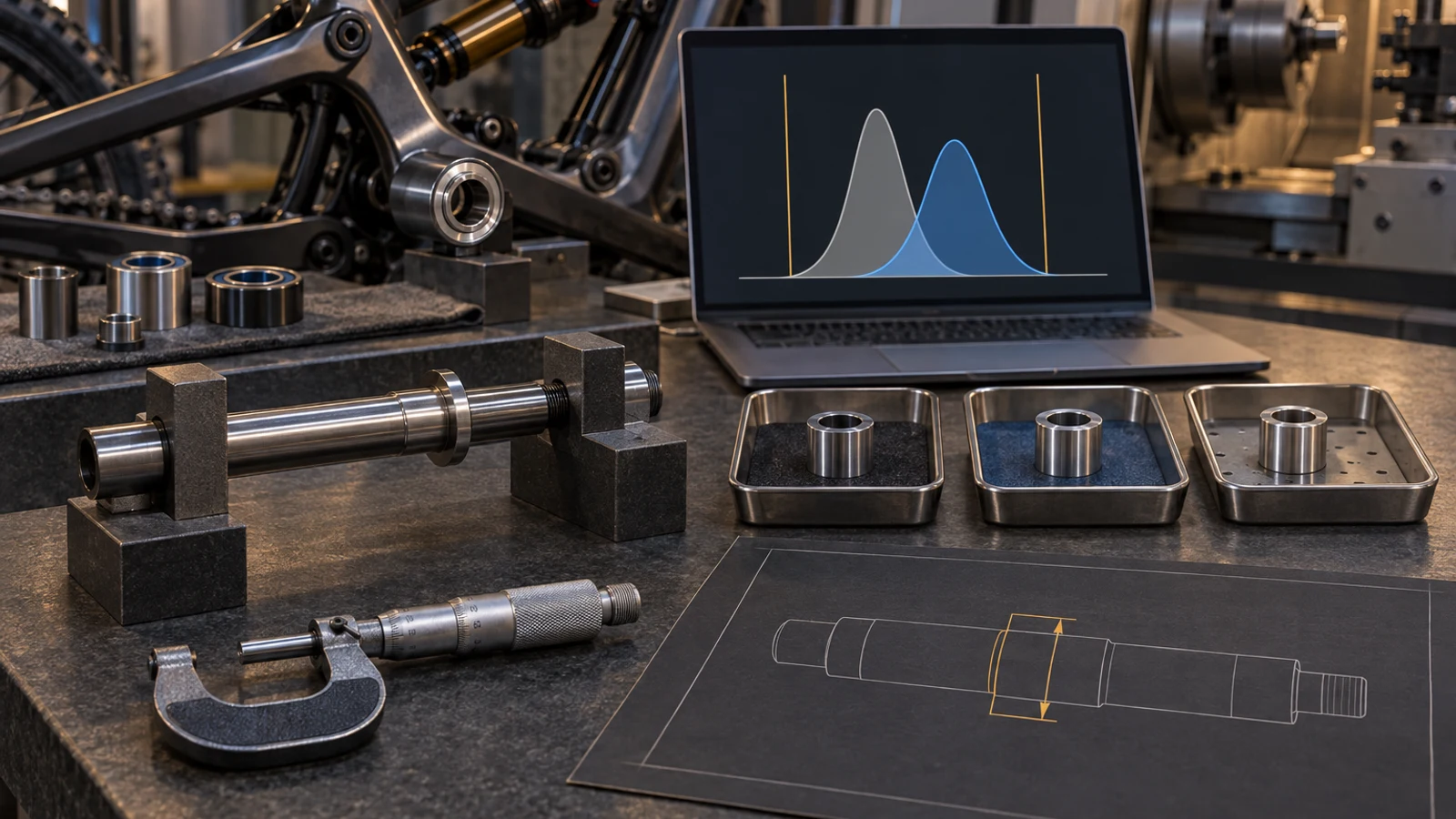
Hero: concept illustration of example hardware and its application. It is not a factory photograph, tested component or approved production geometry.
Write the requirement around a characteristic and purpose
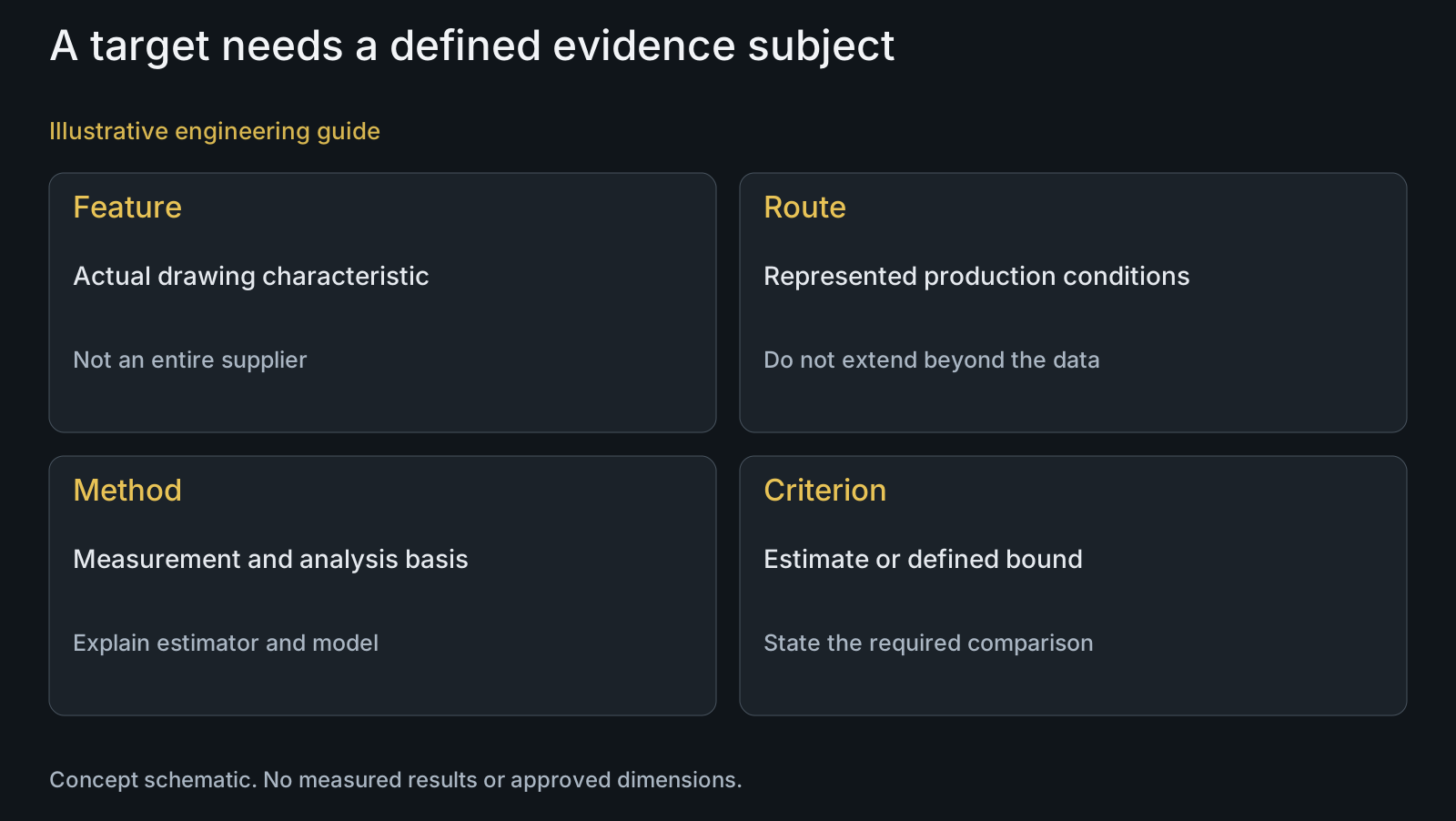
Identify the feature and the decision the study should support: proposed production readiness, continuing evidence for a delivered seat, or investigation after a changed route. Name the drawing revision and relevant specification limits. A unilateral requirement should not acquire an invented second limit merely to fit a preferred calculation.
The target's technical basis belongs with the responsible customer quality and design teams. This guide does not claim that a particular threshold is standard for every safety-related pivot feature or that PremFixer has achieved it. Distinguish the requested criterion from available evidence and actual acceptance.
Define which production conditions the evidence represents
Describe the material condition, route, setup and relevant treatment state, along with the collection period and sequence. Prototype work and a proposed production route may differ. A hand-selected sample cannot independently establish behavior across tool changes, restarts or other conditions never observed.
Preserve meaningful subgroup identity and explain the spread estimator used. The Cpk and Ppk interpretation guide covers their statistical differences. This specification task asks which analysis the buyer actually requires, rather than merely requesting whichever number a supplier already has.
| Requirement field | Choice that matters | Risk if implicit | Review question |
|---|---|---|---|
| Characteristic | Named seat or other feature | A factory-wide rating is assumed | Which limits and revision apply? |
| Supplied state | Before or after relevant processing | Study represents another condition | Does evidence match the delivered interface? |
| Production scope | Route, setups and represented window | Prototype scope becomes ongoing proof | Which relevant conditions were observed? |
| Spread and model | Defined estimator and distribution basis | Different analyses compared as equal | Is the method suitable and explained? |
| Decision criterion | Estimate or specified confidence bound | Headline result hides evidence uncertainty | What exactly must meet the target? |
| Reaction | Evidence gap versus supported shortfall | Unsuitable data treated as a physical verdict | Which action closes which question? |
| Change treatment | Reassessment of affected conditions | Old result covers an unobserved route | What remains represented after change? |
Agree the analysis and evidence criterion explicitly
NIST's capability chapter frames analysis against a stable process and stated distribution assumptions. Confirm suitability rather than assume a bilateral normal calculation is appropriate for every geometric or bounded characteristic. The measurement method must also be suitable for the actual feature; a calibration label alone cannot describe its repeatability in that setup.
Minitab's official options documentation distinguishes reported capability estimates, confidence intervals and one-sided bounds. If the project requires a lower confidence bound above an agreed criterion, state the confidence basis and method. Do not compare that requirement with a report containing only a favorable point estimate as if they were identical.
A process's dimensional target, a required index and an analysis setting are different inputs. Keep the actual drawing limits unchanged unless the design owner authorizes a change for functional reasons. Widening them simply to improve the reported index changes the question being asked.
Keep evidence gaps separate from demonstrated shortfall
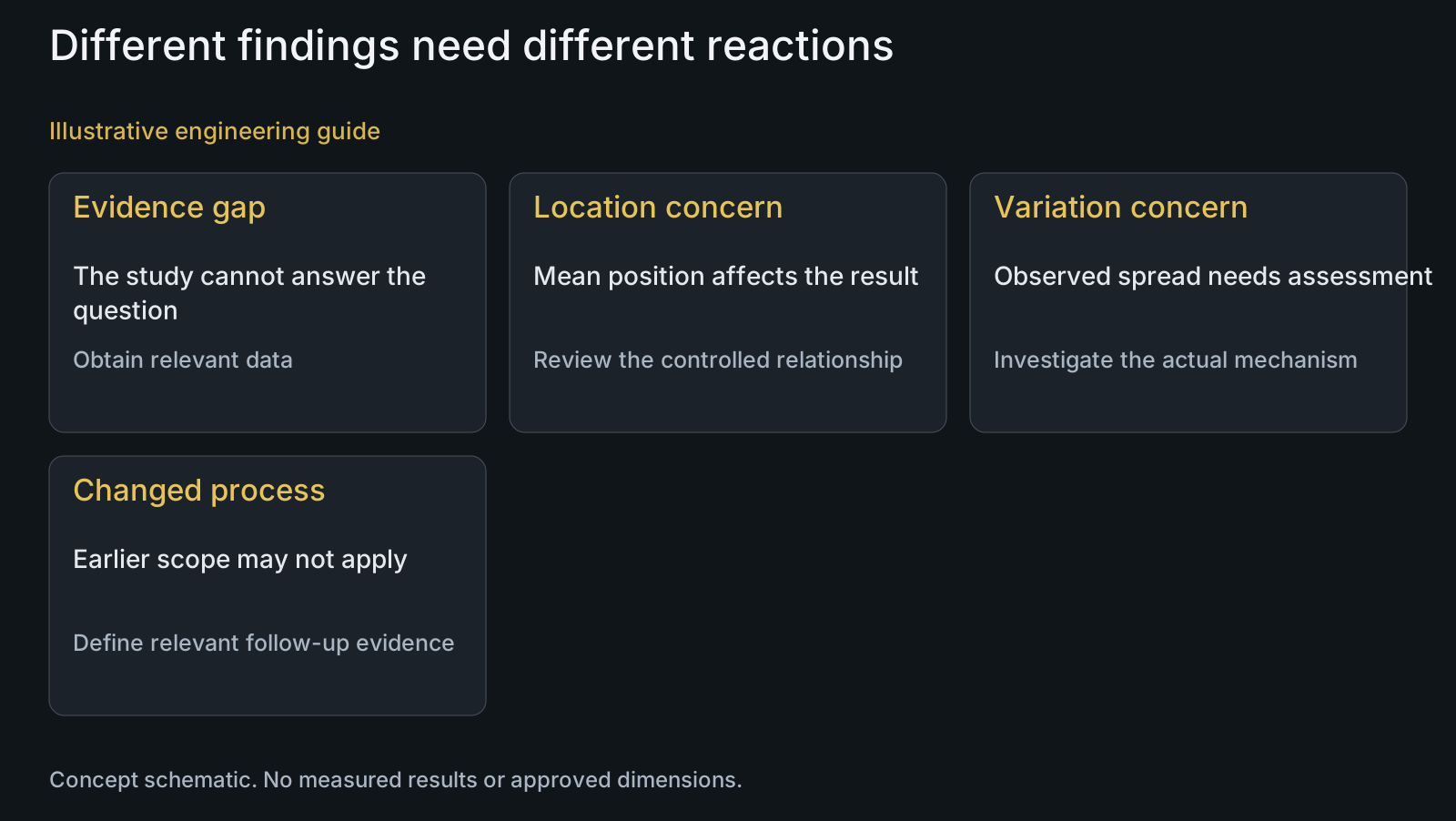
Insufficient or unsuitable data can prevent a supported conclusion even when all supplied readings are within limits. Conversely, a below-target study can reveal a capability concern without proving that every delivered piece is nonconforming. These situations need distinct responses.
Agree what additional measurement or production evidence would close the gap and what temporary acceptance coverage applies, if any. Do not delete inconvenient readings, regroup them arbitrarily or shorten the observation window merely to reach the target. Explain justified exclusions and preserve their effect on the represented scope.
Define a reaction that addresses the actual issue
A location issue, excess variation, unstable behavior or unsuitable measurement calls for different investigation. A larger target cannot correct any of them. Identify the concern and review the relevant setup, tool, material, finishing or measurement conditions without declaring a root cause from the index alone.
The quality-agreement guide connects the study to lot acceptance and disposition. Discuss the offered route through CNC turning, materials and surface-treatment. Temporary inspection or a customer disposition does not become proof of improved capability.
Example: a prototype estimate cannot answer a restart question
Illustrative engineering example: assume a supplier reports a capability estimate for a pivot seat from one prototype setup. The OEM's intended requirement concerns the production route across relevant restarts and a specified lower confidence-bound decision. No readings, target, Cpk value or successful outcome is assumed.
The reviewer identifies the mismatch in represented conditions and evidence criterion. They request a suitable agreed data plan rather than declare the prototype report either a production pass or proof that all parts fail. If the process changes, the follow-up study must represent that changed condition instead of reusing the old result.
Related interface and procurement questions remain available through full-suspension solutions and the customer decision knowledge center.
Questions buyers need to confirm
Is Cpk 1.33 required for every pivot dimension?
No universal requirement is established here. Choose the criterion for the named characteristic, actual risk and intended study with the responsible customer team. The number alone does not specify measurement, production scope or acceptance meaning.
Can prototype measurements establish production capability?
Not by themselves. Compare prototype and intended production conditions, data structure and evidence purpose. An unobserved restart or different finishing condition cannot be covered merely by calling the report a production study.
Should the requirement use a point estimate or confidence bound?
Specify the project's intended criterion. A reported estimate and a defined lower-bound comparison are different evidence requirements. Agree the statistical method and confidence basis before treating two reports as equivalent.
What if all measured parts conform but the study is inconclusive?
Separate observed sample conformity from a supported capability conclusion. Determine which data, stability or measurement questions remain open and apply the agreed lot-acceptance basis rather than inventing a process pass.
Can deleting extreme readings satisfy the target?
It can misrepresent the study. Preserve the sequence and explain any technically justified exclusion and its resulting scope. Removing inconvenient observations is not an improvement to manufacturing or evidence of future conformity.
What should happen below the agreed target?
Follow the defined reaction for the actual issue: measurement uncertainty, location, variation or changing conditions. Agree additional evidence and any temporary acceptance controls separately. A below-target index alone does not establish root cause or condemn every delivered unit.
Technical references and scope
NIST: What is Process Capability?. Stable-process context, normal-model assumptions and sampling uncertainty; no universal numerical target, sample-count prescription or supplier result transferred.
Minitab: Normal capability analysis options. Original distinction among analysis options, estimates, confidence intervals and one-sided bounds; no default confidence level or example target imposed on pivot buyers.
Explore related component, material and sourcing decisions in the customer decision knowledge center. For a drawing review, use the Drawing/BOM RFQ path.
Specify the capability question before requesting a number
Provide the drawing characteristic and limits, final condition, proposed production scope, measurement basis and requested estimate or confidence-bound criterion through the Drawing/BOM RFQ path. Ask PremFixer to discuss the represented data and manufacturing conditions, with targets and reaction rules agreed by your quality team.
Discuss the drawing and BOM