
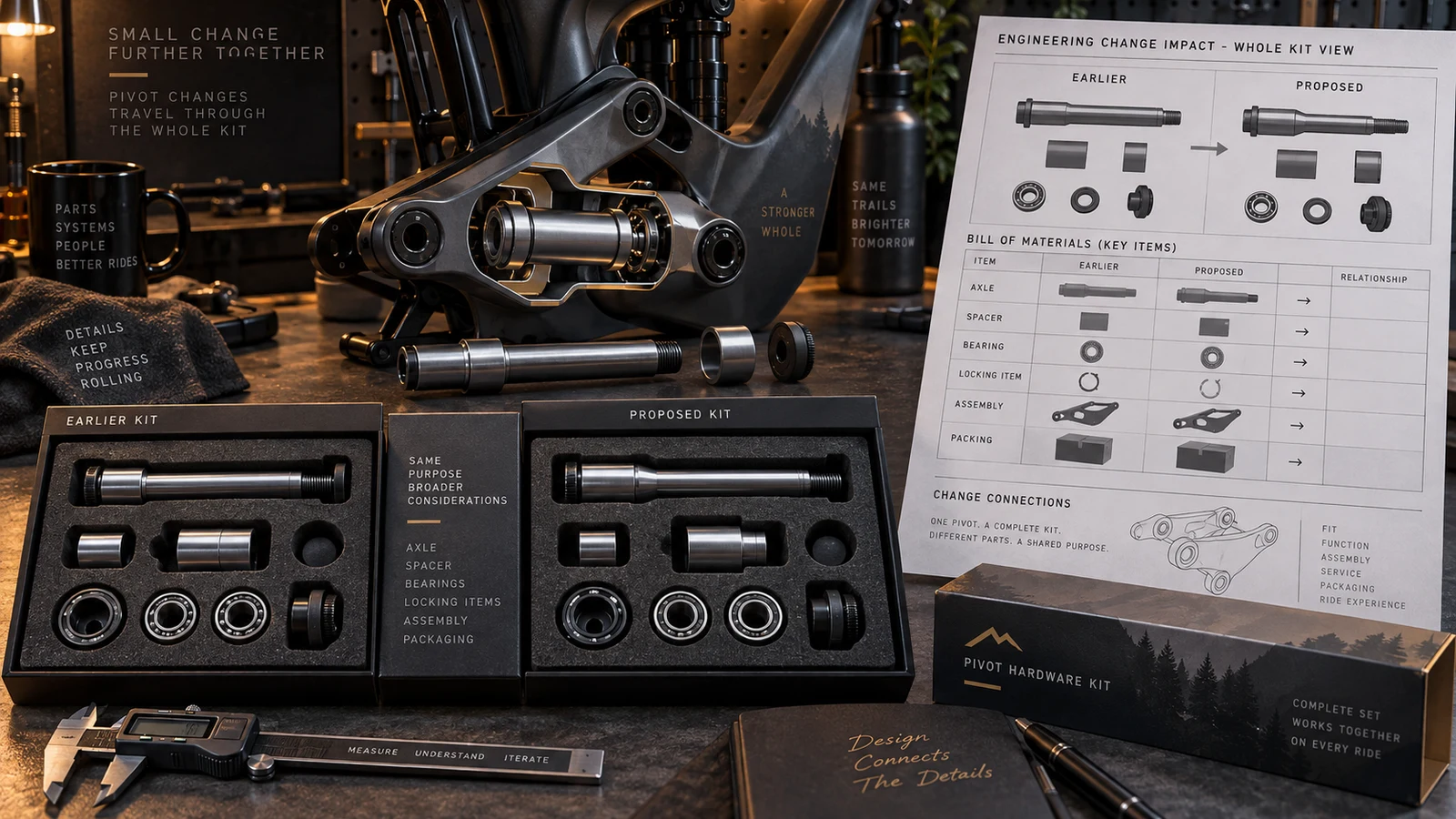
An engineering change notice for a pivot kit must carry the revised requirement beyond the edited axle file. The OEM is deciding whether manufacturing, inspection, assembly and purchasing will select one coherent component combination. Trace the change through receivers, spacers, locking items, parent kits and the instructions that use them. Then distinguish objects that physically change from unchanged objects whose applicability still needs review. Not every item requires a new revision or repeated test, but no affected relationship should disappear because its drawing stayed the same. Define the resulting kit and implementation boundary explicitly; a document upload is not evidence that the change reached every dependent definition.
Hero: concept illustration of example hardware and its application. It is not a factory photograph, tested component or approved production geometry.
Find the dependencies before assigning new revisions
Start with the changed requirement and its original and proposed definitions. Identify the functional mates and every kit or assembly that uses the component. Add the relevant inspection, assembly, packing and purchasing definitions that refer to those identities.
PTC's change-impact documentation describes collecting linked affected objects, including upstream and downstream relationships. That software-specific example supports the importance of relationship scope. It does not mean PremFixer owns that system or that automated collection finds every physical consequence in a bicycle project.
The revision-continuity guide addresses compatibility, cut-in and inventory disposition. This article focuses on dependency closure: establishing that the exact resulting kit and the operational definitions used to make and select it agree.
Separate affected objects from objects that actually change
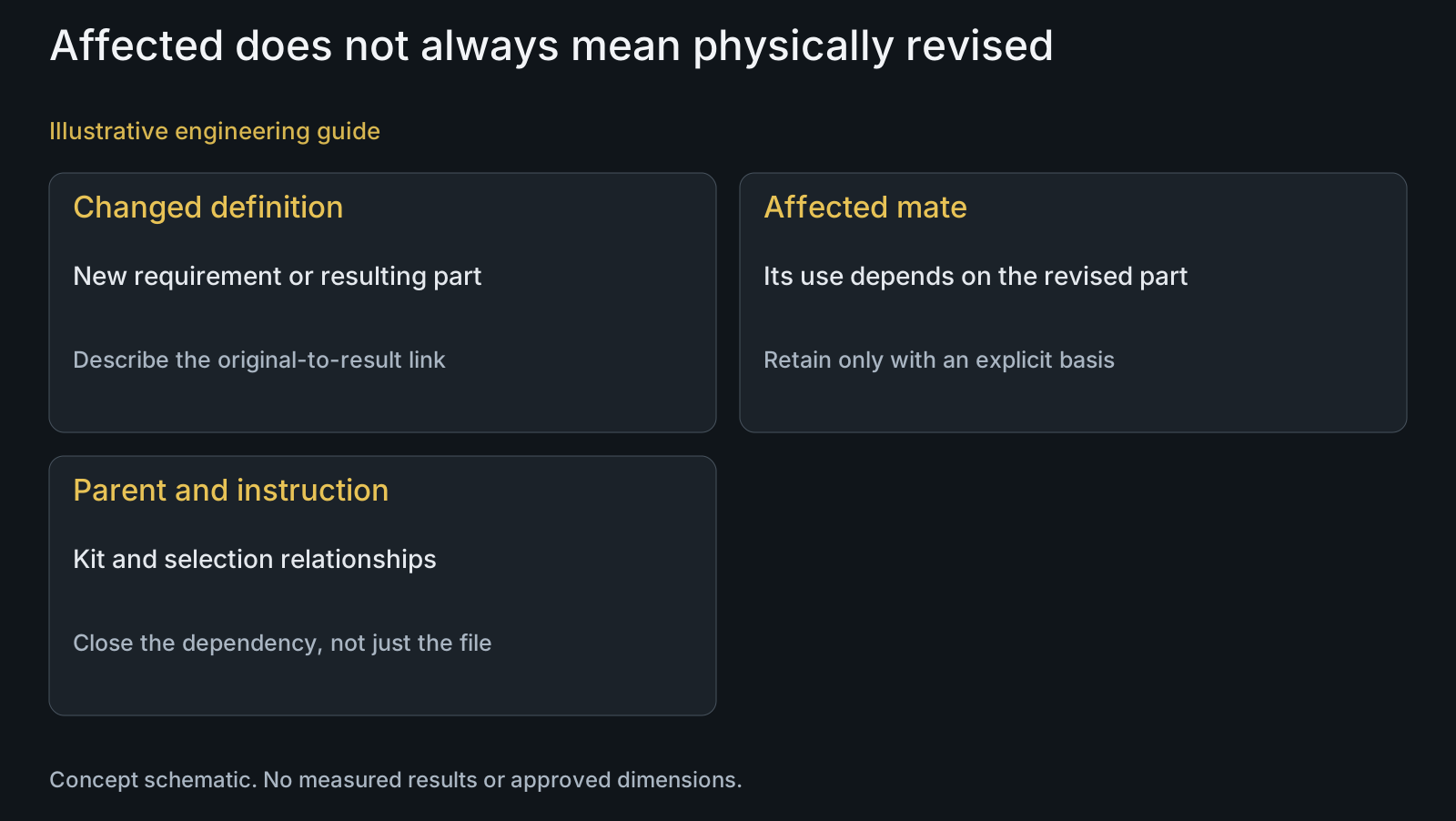
A spacer can be affected by an axle shoulder change without requiring a different physical definition. Its applicability still needs a decision. Conversely, a new assembly instruction may be required even when the hardware geometry is retained. Do not measure the impact scope by the number of edited CAD files.
PTC's change-summary explanation distinguishes affected objects and resulting release content. For a drawing-led kit review, use an explicit original-to-result relationship: revised, replaced, removed or retained with a basis. No particular software workflow is imposed.
Explain unchanged outcomes as well as changed ones. Retaining a receiver means its interface has a reason to remain applicable; it should not be shorthand for nobody reviewed it. A retained item is not automatically reusable in every other platform or mixed-version kit.
| Relationship | Possible outcome | Risk if unresolved | Closure basis |
|---|---|---|---|
| Changed axle requirement | Revised or replacement member | New file selected with old mates | Approved final part and interfaces |
| Unchanged spacer or receiver | Retained or no longer applicable | Not reviewed because drawing is unchanged | Explicit mate applicability decision |
| Parent kit BOM | Changed contents or retained combination | Extra or missing constituent | Resulting positions, quantities and identities |
| Inspection definition | Affected checks updated | Obsolete check hides new requirement | Final supplied state and feature scope |
| Assembly and packing selection | Resolved kit chosen consistently | Newest drawing but oldest pick list | Same authorized combination |
| Open orders and existing stock | Defined implementation and disposition | Mixed use assigned by file date | Order/lot boundary and authorized action |
Carry geometry and process consequences into the right definitions
For a dimensional change, identify the assembled relationship it controls. A shoulder or thread-reach change can affect contact, clearance and useful receiver overlap. The stack-up review helps describe those relationships rather than treating an individual dimension as the whole decision.
If material condition or finish changes, review the final supplied state and relevant assembly assumptions. A geometry-only model cannot express every treatment, masking or preparation requirement. Keep those inputs in the controlling definition rather than let an unchanged surface color imply unchanged behavior.
Update inspection for affected requirements without retaining an obsolete check or deleting a necessary one. Review proposed manufacture through manufacturing. A changed route can need readiness work, but route review is not permission to modify customer requirements silently.
Reconcile the resulting kit, not only the individual part files
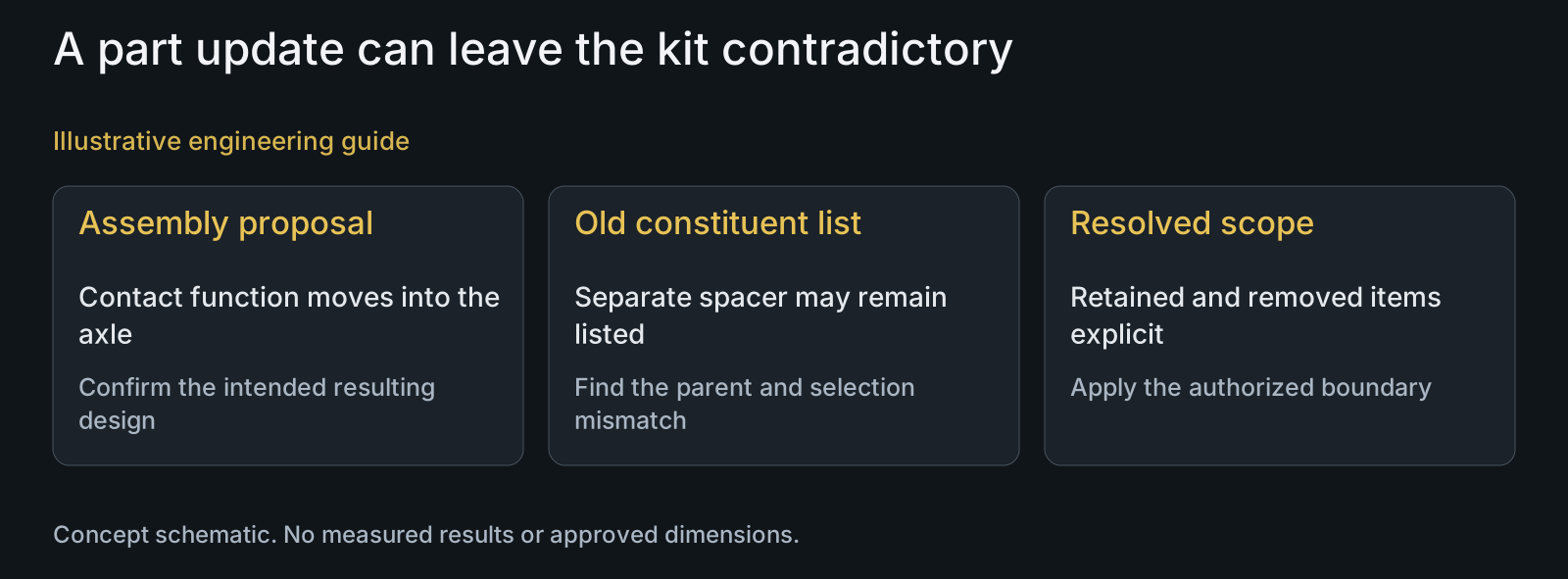
Write the complete resulting BOM with quantities, positions and applicable member identities. Check additions, removals and substitutions against the actual assembly definition. If a loose spacer function becomes integrated, ordering the old spacer as well may be a kit-definition error even when every delivered component conforms to its own drawing.
Match assembly and packing selection to that BOM. A revised drawing link with an earlier picking list can create a contradictory delivery definition. An independent packing check needs the authorized constituent list, not an operator's inference that the newest-looking part belongs everywhere.
For changed and retained items, state whether the result is a complete kit or a partial replacement scope. Keep the package identity definition aligned. A complete-kit change does not automatically authorize mixing selected old and new components in service.
Connect implementation to live order and stock states
Identify the orders, work in progress, finished parts and service groups that use the affected definitions. State where the resolved kit begins to apply and the authorized treatment of each existing state. Calendar timing alone may be insufficient if different orders or lots overlap.
A new released definition and a stock disposition are separate decisions. Retained inventory may remain applicable to its established use, or need another authorized action. Do not relabel a physical component into compliance or assume the supplier must scrap every earlier item without agreement.
Resolve cost, quantity and timing consequences with purchasing alongside the technical outcome. This article does not promise free rework, automatic stock exchange or synchronization with a customer's ERP. The relevant order lines must explicitly select the intended definition before manufacture or packing proceeds.
Review example: the new part leaves an old spacer on the list
Illustrative engineering example: assume a proposed axle revision incorporates a contact feature previously supplied as a separate spacer. The axle file is updated, but the earlier spacer remains on the kit purchasing and packing lists. No actual inventory, acceptance result or savings are assumed.
The reviewer traces the axle's parent kits and identifies the discrepancy between the proposed assembly and its constituent selection. They determine whether the spacer is removed for the resolved configuration and which earlier kits still retain it. They do not infer that deletion is acceptable from the new shape alone.
The change is reconciled across the resulting assembly, BOM, inspection and selection instructions before its defined implementation boundary. The lesson is dependency closure, not an invented successful ECN or a rule that all integrated parts should replace separate mates.
Questions buyers need to confirm
Is a new axle CAD file enough to implement an ECN?
No. Review its mates, parent kits and operational definitions. The resulting BOM, inspection, assembly and supply selection must agree with the accepted change. A file update does not establish that those dependencies were resolved.
Must every affected item get a new physical revision?
Not necessarily. Some items can remain unchanged after an applicability review. Distinguish the affected set from the changed set and record the resulting relationship. Unchanged should not mean that a dependent interface was ignored.
What if the part drawing and packing list disagree?
Resolve which authorized kit definition applies before using the contradictory selection. Check constituent identities, positions and quantities against the resulting assembly. Packing cannot correct an unresolved design relationship by choosing the newest-looking part.
Does a complete-kit ECN approve partial service substitution?
Not automatically. Establish the permitted component combinations and service scope separately. A revised complete assembly can be acceptable for its defined use without authorizing selected new parts in every earlier kit.
Should every old test be repeated after the change?
No blanket rule applies. Identify the affected questions, changed supplied state and retained evidence basis. Define relevant inspection or evaluation rather than repeat all work automatically or waive it because only one file changed.
What makes an ECN-related manufacturing request useful?
Provide original and proposed drawings or STEP, marked changed fields, affected mates and kits, resulting BOM and relevant process or finish requirements. Include the intended order boundary and stock actions already authorized, with open decisions clearly identified.
Technical references and scope
PTC Windchill change-impact analysis. Software-specific linked affected-object collection, including upstream and downstream relationships. Not a claim of owned software or automatic complete physical impact analysis.
PTC Windchill change-summary table. Distinguishes affected objects, resulting release content and affected-part disposition in the documented system; not a universal ECN mandate.
Explore related component, material and sourcing decisions in the customer decision knowledge center. For a drawing review, use the Drawing/BOM RFQ path.
Carry the proposed change into the complete supply definition
Send original and proposed drawings, STEP, affected mating parts, kit BOMs, finish and inspection requirements, and intended order scope through the Drawing/BOM RFQ path. PremFixer can review manufacturing consequences and resulting constituent definitions while your team authorizes the change and implementation.
Discuss the drawing and BOM