

An ESG request for custom pivot hardware should identify what the buyer needs to decide and what the requested evidence represents. A product footprint, worksite assessment and company policy cannot substitute for one another. Name the kit or component, relevant sites and partners, reporting period and intended use before asking for a report. Then distinguish measured data, estimates, supplier declarations and independent assessment. This lets procurement identify useful coverage and unresolved gaps without inventing a sustainability verdict. No PremFixer carbon report, social-audit result or responsible-minerals declaration is established here; specific deliverables and their availability need a scoped discussion.
Hero: concept illustration of example hardware and its application. It is not a factory photograph, tested component or approved production geometry.
Turn a broad ESG request into specific questions
Start with the customer's decision rather than an empty request for an ESG certificate. The buyer may need product emissions inputs, worksite labour information, business-conduct responses or a material-origin declaration. Those are distinct questions with different reviewers and evidence requirements.
For each question, name the subject and intended use. Information for a supplier-screening questionnaire may not support a published product claim. A customer-defined reporting form also needs an explanation of its fields, especially where a yes-or-no answer would conceal partial coverage.
Do not infer a legal obligation from the letters ESG alone. If a requirement comes from a contract, customer policy or applicable regulation, identify that basis separately. Technical manufacturing suitability and the requested sustainability assessment still need their own decisions.
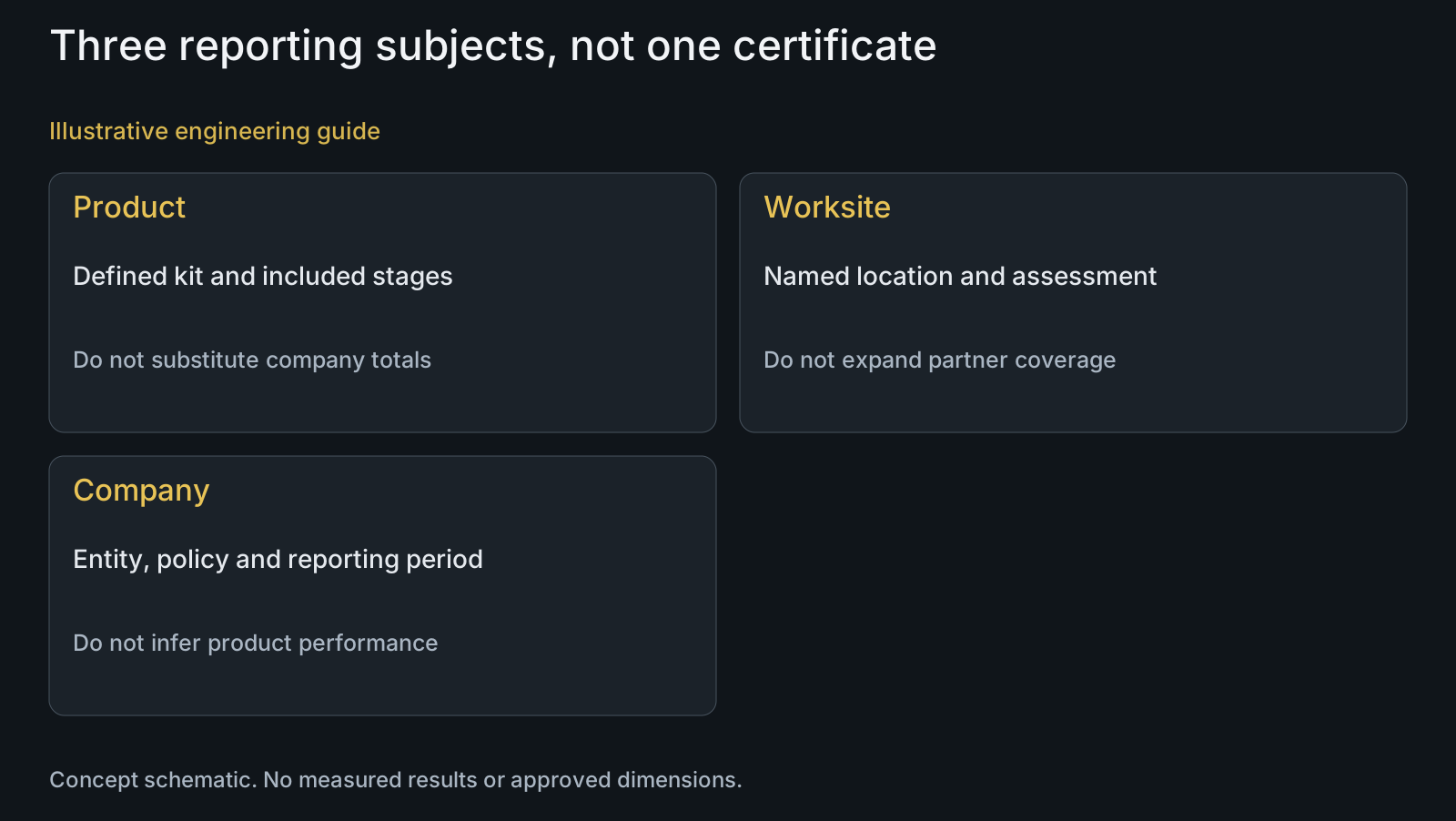
Keep product, worksite and company boundaries separate
The GHG Protocol Product Standard overview distinguishes individual-product accounting from corporate value-chain accounting. A company-level emissions figure is therefore not automatically the footprint of a pivot kit. State the represented product and included stages before seeking inputs.
For product comparisons, the pivot carbon-footprint guide develops equivalent output and accounting boundaries. This article addresses a different purchasing task: matching each ESG request to the appropriate evidence subject, not calculating or ranking emissions.
A site-specific assessment identifies a worksite, scope and assessment date. A company statement identifies an organisation and its stated commitments. Neither should silently expand to include every material source, finishing partner or customer product.
| Buyer question | Appropriate subject | Mismatch risk | Review action |
|---|---|---|---|
| Kit emissions inputs | Specified kit and included stages | Company total substituted for product | Identify input data and boundary |
| Worksite conditions | Named site and assessment scope | One site expanded to all partners | Check site, date and coverage |
| Supplier conduct response | Identified entity and requested fields | Policy treated as observed result | Separate commitment and evidence |
| Material origin request | Specified material and supply chain | Generic declaration applied to kit | Check covered sources and scope |
| Packaging information | Identified packaging material | Packaging claim extended to hardware | Keep subjects separate |
| Public sustainability claim | Exact proposed statement | Internal response used without permission | Review support and authorised use |
Map the requested information to the actual supply route
Use the proposed BOM and manufacturing route to identify relevant information sources. Stock supply, in-house machining, partner surface treatment and packaging can involve different entities. Asking the contracting supplier a single question does not establish that every operation was assessed.
The manufacturing overview explains PremFixer's in-house and partner scope. The surface-treatment page helps identify finishing as a separate route consideration. These capability pages are not evidence of a partner's environmental or labour performance.
A response should explain what it covers and what it does not. Where partner information is unavailable or restricted, record that limitation and ask whether a narrower response answers the customer's question. Do not convert an unanswered field into an implied zero impact or satisfactory audit finding.
Distinguish declarations, audits and assurance
A signed declaration records an identified party's statement. A policy describes intended conduct. An audit report records an assessment under a stated scope; assurance addresses the particular information and engagement identified in its report. These forms of evidence do different work.
Sedex's official explanation states that neither SMETA nor Sedex membership is certification and that the methodology does not issue a pass or fail. If a buyer requests SMETA information, evaluate the actual worksite report and requested scope rather than rename membership an ESG certificate.
Keep the evidence date distinct from the period it describes. A newly sent document may concern an earlier site condition or reporting year. The review should establish relevance to the proposed supply without claiming that a report guarantees future conduct or complete absence of risk.
Handle unknowns and sharing permissions explicitly
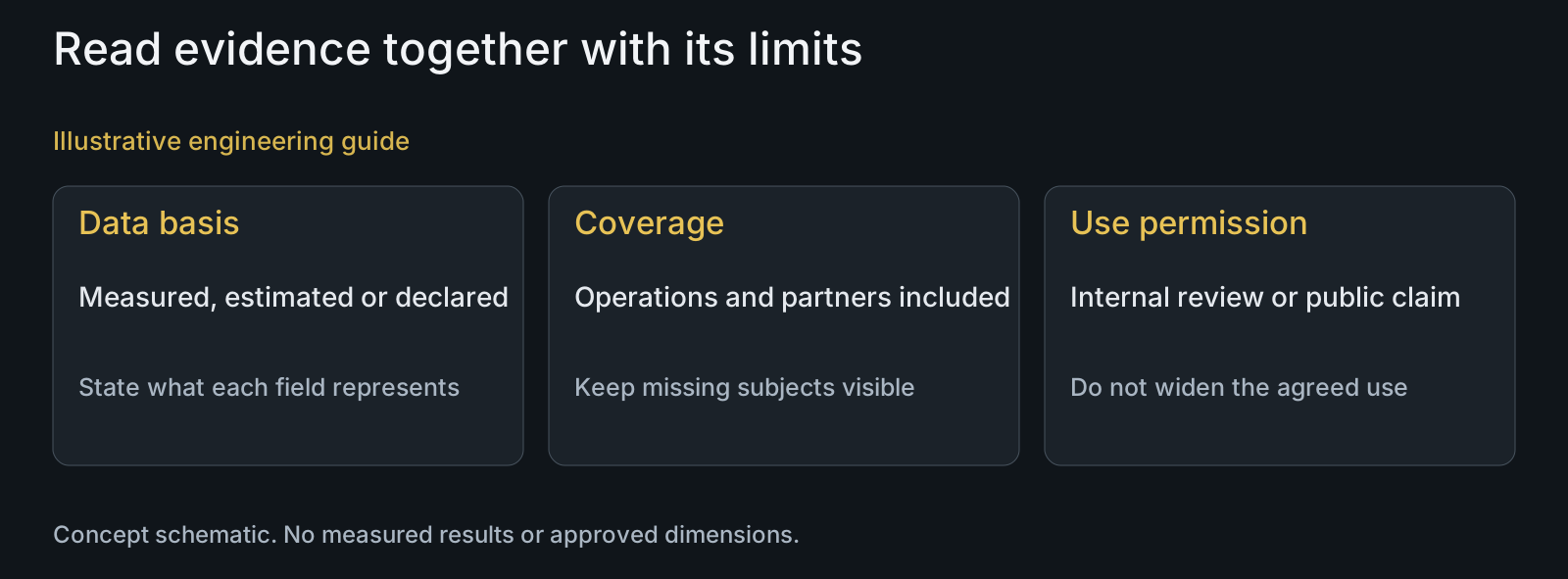
Mark measured, estimated and unavailable information separately. An estimate should state its basis and represented scope; it is not equivalent to a measured input merely because both fit in the same spreadsheet cell. Where uncertainty affects the intended decision, request the missing basis or limit the conclusion.
Agree the permitted recipient and use of sensitive reports. A confidential supplier response for internal screening should not automatically become public website copy or a label on the finished bicycle. Request permission and qualified review for any proposed external claim.
The materials overview supports a discussion of specified stock and component choices. It does not establish recycled-content percentages, verified emissions or responsible-origin evidence for an actual order. Ask for the particular material and reporting documents the customer needs.
Illustrative review: three documents, three different subjects
Illustrative engineering example: assume a buyer requests product carbon inputs for a pivot kit and a supplier-conduct questionnaire. The hypothetical response contains a company annual-emissions summary, a social-audit report for one machining site and a recycled-packaging statement. No actual company records or favourable findings are assumed.
The reviewer separates the requests. The annual summary does not identify the kit's represented manufacturing inputs. The site report may inform relevant conduct questions but does not automatically cover the finishing partner. The packaging statement addresses its own material subject, not the whole kit's environmental performance.
The next request names the missing product inputs, partner coverage and questionnaire fields. The available documents remain useful within their scopes, while unresolved information stays visible. That is a defensible evidence map, not a completed ESG assessment or a verified low-carbon product claim.
Questions buyers need to confirm
Can one ESG certificate answer every buyer question?
No. Specify the product, worksite or company subject and the evidence needed for each request. Carbon inputs, labour assessments and conduct statements are not interchangeable. Identify the customer's reporting purpose before deciding whether a supplied document is relevant.
Can a company emissions report be used as a pivot kit footprint?
Not automatically. A company report and a product result have different accounting subjects. Send the kit BOM, reference output and included-stage boundary, then identify the product inputs that are actually supported. Keep company information within its represented scope.
Does a SMETA report certify the supplier?
No. Sedex identifies SMETA as an audit methodology, not certification. Review the named worksite, report scope and date against the buyer's request. Do not treat membership or the existence of a report as a universal favourable finding.
Should outsourced finishing appear in the information request?
Yes, when it falls inside the requested reporting boundary. Identify the proposed operation and partner information needed. A machining-site response does not establish finishing-site coverage. State unavailable partner data rather than presume the contracting supplier's documents include it.
How should an unavailable ESG field be answered?
Keep it unavailable with a clear scope explanation. If an estimate is acceptable, identify its basis and limits rather than label it measured. The buyer should decide whether more evidence or a narrower use is appropriate; an unanswered question is not a positive result.
What should accompany an ESG-related RFQ?
Send the drawings and BOM, reporting form, named product or site subjects, reporting period and intended use. Specify requested data, declarations, audits or assurance separately. Add sharing restrictions and partner coverage so availability and gaps can be reviewed before a deliverable is agreed.
Technical references and scope
GHG Protocol: Product Standard overview. Public overview and FAQ distinguish product and corporate value-chain accounting subjects; no emissions inventory, calculation or certified result is claimed.
Sedex: What we do and SMETA scope. Official public description states that SMETA and Sedex membership are not certification and do not issue a pass/fail; no actual supplier audit status is inferred.
Explore related component, material and sourcing decisions in the customer decision knowledge center. For a drawing review, use the Drawing/BOM RFQ path.
Scope the supplier-data request around your hardware program
Send the drawings or STEP files, BOM and customer ESG questionnaire through the Drawing/BOM RFQ path. Identify the reporting subjects, period, relevant partners and intended use. The review will separate manufacturing inputs that can be discussed from requested evidence or specialist assessment that needs its own agreed scope.
Discuss the drawing and BOM